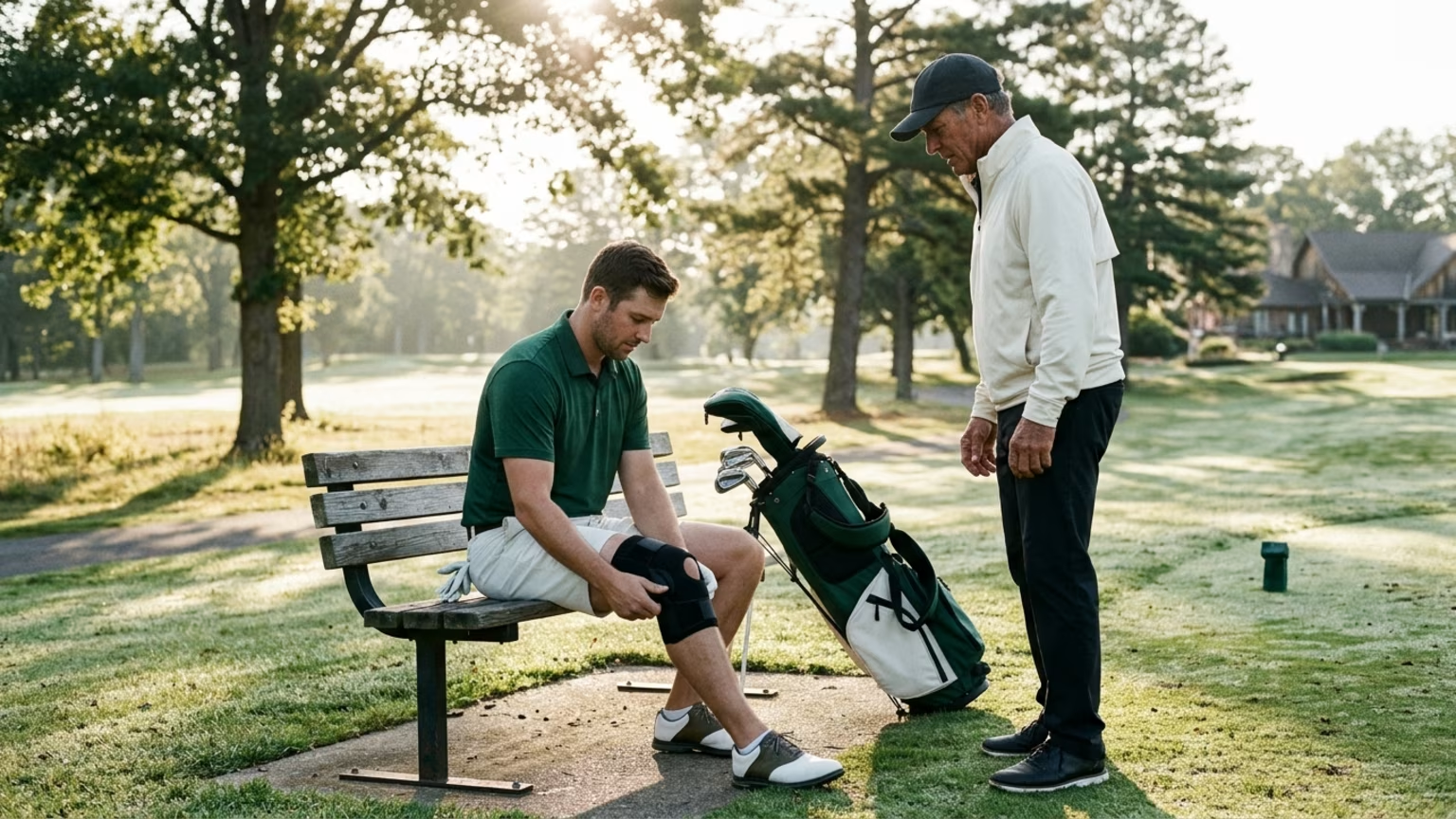

Review your golf routine for lower-body, upper-body and trunk strength, plus walking and balance, without relying on an age-based formula.




Whole-body strength is your ability to produce and control force through your legs, hips, upper body and trunk. For golf, it means looking beyond the muscles that move the club and reviewing the body that carries you through the round.
The useful question is not which single exercise every golfer should do. It is whether your current routine addresses the different physical demands of playing.
A swing matters. So do walking the course and maintaining balance. A practical review gives each demand a place without treating one activity as a substitute for everything else.
Think of this as a completeness check rather than a new workout plan. The aim is to spot what your routine includes and what deserves a closer look.
Across a standard 18 holes, your conditioning has more than one job. There is the swing itself. There is also the activity between shots.
For a tee shot, the strength question concerns the whole movement rather than only the arms holding the club. Between shots, the question shifts toward getting around the course. Reviewing golf fitness means making room for both settings.
The lower-body question covers the legs and hips in relation to walking and swing demands. The upper-body question asks whether your routine includes strengthening beyond repeated swings. The trunk question concerns strength and control rather than rotation alone.
This is the value of viewing swing strength as a connected task. It gives you a wider lens than judging your conditioning by how your arms feel after practice.
On the course, keep the observations simple. Does walking feel more demanding than making a swing? Does the effort of playing feel different late in the round? Record the experience without immediately naming a weak muscle or choosing an exercise to fix it.
A secondary account of a 2023 study reports that 25 healthy golfers with a mean age of 68 completed an 18-hole round and two walking tests. The round lasted longer and involved lower average intensity than the walking sessions.
That comparison gives walking golf a place in the activity picture. For a routine review, walking capacity and strength still belong under separate questions. Completing a round is useful information about your activity, not a complete inventory of your conditioning.
For golfers past 40 or 50, the useful starting point is current ability rather than an age-based exercise formula. A birthday alone does not identify which part of a routine needs attention.
A secondary review of older-golfer research describes a randomized eight-week study of 31 men aged 55 to 79. A combined strength-and-flexibility program improved strength, range of motion and clubhead speed in that group.
These reports involve small groups and short training periods. They do not map natural strength decline through the 40s and 50s or explain its biological causes. They also do not establish an ideal routine, guaranteed speed gains or added playing years.
The practical response is to review what you do now. Ask which physical demands your routine addresses rather than assuming that age explains every change in your game.
This is where treating age as training context becomes useful. It keeps the discussion focused on your present movement and training history instead of a template based only on your age.
The older-golfer findings give strength work a place in that discussion. They are context for asking better questions, not a personal prescription copied from a study.
The most accessible starting habits here are review habits. They require no new equipment and do not ask you to add an exercise before understanding what your current routine contains.
Look at your existing routine one body region at a time. Start with the legs and hips. Identify whether anything in the routine is intended to strengthen that area rather than counting all walking or golf practice as strength work.
Then give the upper body its own review. The question is whether it receives attention beyond swinging a club. You do not need to choose a new movement during this first pass.
Finish with the trunk. Look for work intended to develop strength or control rather than assuming that repeated turning answers the whole question.
A simple written note can use these prompts:
Leave an answer open when you do not know. An unclear answer is a useful discussion point, not proof that your routine is wrong.
Our guide to reviewing strength alongside balance and rotational control offers another way to organize those questions. Keep the first pass narrow: identify coverage rather than redesigning everything at once.
Next, give walking and balance their own place in the review. Do not hide them inside a broad label such as golf fitness.
For walking, ask how your routine accounts for getting around the course. For balance, ask whether the routine gives it any deliberate attention. These questions sit beside the strength review rather than replacing it.
Keep observations separate from explanations. Noting that walking felt demanding is different from concluding that a particular muscle caused the difficulty. The first describes your experience. The second needs an individual assessment.
This also makes the review easier to discuss with a qualified exercise professional. Instead of asking for the best golf exercise, you can ask which demands your current routine leaves out. Personal concerns about pain or injury belong with a qualified healthcare professional.
The finished review does not need to become a long exercise list. Its value is a clearer picture of lower-body strength, upper-body strength and trunk work. Walking and balance complete the discussion of round demands.
A routine may already address all of these areas. Another may leave questions unanswered. Either way, the next conversation can begin with what is actually present rather than a promise that one movement will solve the whole round.
Whole-body strength means accounting for the whole round, a practical foundation for Playing Better for Longer.
Follow Golfergy for practical insights on performance, mobility, recovery and healthy ageing. Stay connected for new articles, research-led guidance and ideas to help you play better for longer.


Understand how strength and mobility serve different roles in your golf swing, with practical ways to assess useful range and movement control after 40.


Learn how lower-body strength relates to ground forces, balance and varied golf shots, plus what older-golfer training studies actually support.

Understand how strength and balance differ across a round of golf, what older-golfer studies show, and two practical habits for reviewing your preparation.
Explore practical resources on performance, recovery, mobility and golf longevity.
Read the Blog