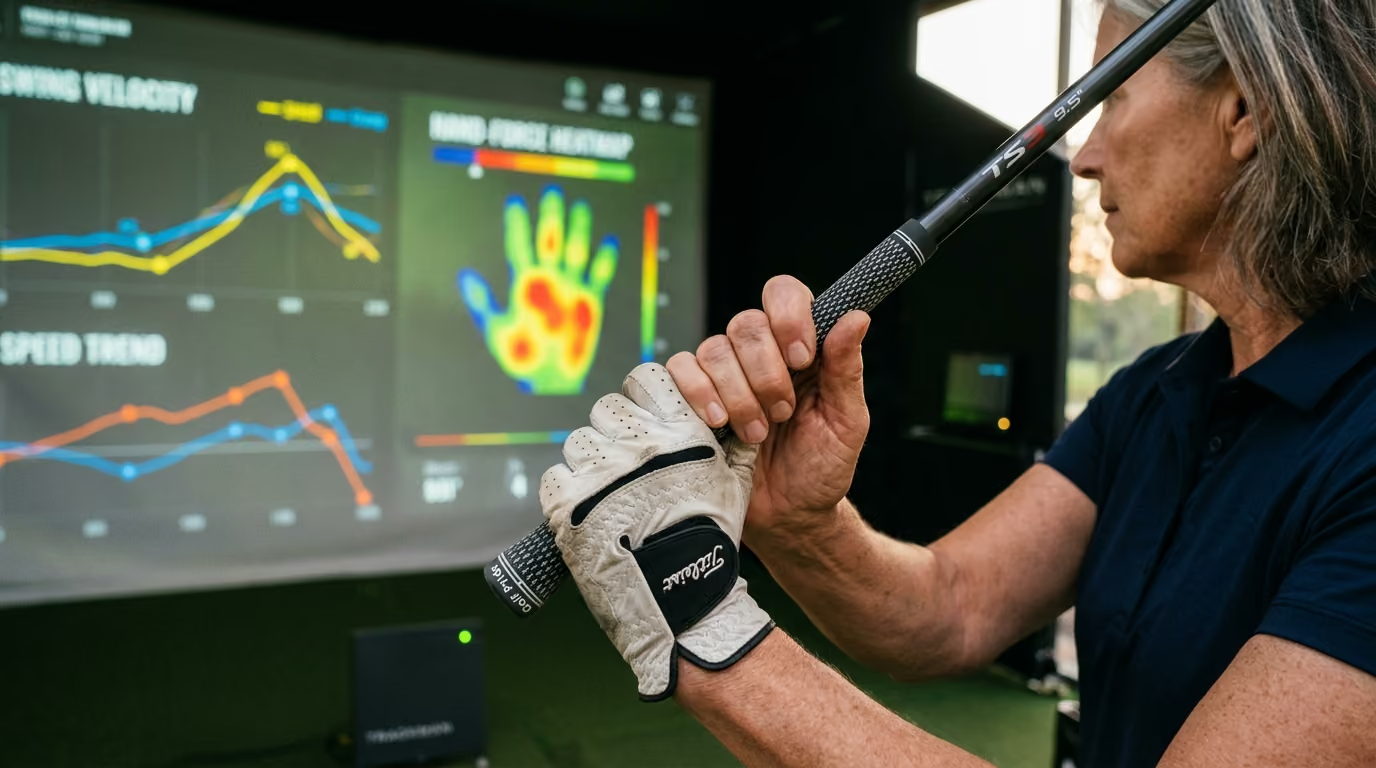
Learn how ankle mobility impacts your golf swing and discover exercises to improve your finish, consistency, and overall performance on the course.




Golfers spend a fortune on custom drivers, premium golf balls, and high-tech swing tracking devices. They practice rotating their hips, turning their shoulders, and keeping their head down. Yet most of these players completely ignore the two small structures that actually touch the ground. Your feet and ankles are the foundation of your entire athletic movement.
If your ankles are stiff, your hips cannot rotate properly. Your knees will take too much stress, and your spine will lose its posture during the swing. This comprehensive guide examines how ankle stiffness ruins your golf swing. It explains how to restore movement to your feet so you can post up and finish your swing with perfect balance.
By studying the biomechanical connection between your feet and your finish, you can unlock a new level of consistency. You do not need to accept back pain or a fading swing as you age. Instead, you can build a stable foundation that keeps you playing this great game for decades to come.
Imagine you are standing on the tee of a long, narrow par four late in your round. Your legs are slightly tired, and you need a solid drive to clear a hazard on the right. You make a full backswing and start your transition toward the target. Suddenly, your lead heel lifts off the ground, your hips thrust forward, and you hit a weak block slice into the trees.
You feel as though you lost your balance right at the moment of impact. Instead of finishing clean and tall on your lead leg, you stumble backward toward your trail foot. Your playing partners notice that you look unstable at the finish. You might blame your swing path, your tempo, or your grip pressure for this poor shot.
The real culprit is much lower down. Your lead ankle locked up halfway through your downswing. Because your ankle could not bend, your entire body had to change its path to keep you from falling over. This on-course frustration happens to thousands of mature golfers every single weekend.
When your ankle joint lacks the mobility to bend forward, your swing posture collapses. You cannot transfer your weight to the lead side, which leaves you hanging back on your trail leg. This physical limitation leads to fat shots, thin shots, and a massive loss of clubhead speed. To fix this pattern, you must first understand the basic mechanics of how your foot interacts with the turf.
To understand why your feet dictate your finish, you must look at the movement called ankle dorsiflexion. Dorsiflexion is the simple anatomical action of pulling your toes up toward your shin, or moving your shin forward over your foot. In the golf swing, this movement happens as your weight shifts toward the target during the downswing. Your lead knee must travel forward and slightly outward over your shoelaces.
If your lead ankle is stiff, your shin cannot tilt forward. This physical block prevents your knee from moving into the correct position. To compensate, your brain will force your lead heel to lift early. It may also force your hips to slide toward the target, or push your pelvis closer to the golf ball.
The lead side post is the action of straightening and stabilizing your lead leg just before impact. This movement acts like a brake on a car. When you run forward and suddenly stop, your upper body flies forward. In golf, when you plant your lead foot and post up, you stop your lower body lateral motion.
This sudden braking action converts linear speed into rotation. It whips your golf club through the hitting zone at maximum velocity. Research by Bourgain and colleagues at Science Arts and Metiers shows that the lead foot must handle massive vertical forces to make this happen. If your lead ankle cannot bend and stabilize, you cannot generate these vertical forces. Your swing will lose its primary source of speed and consistency.
The connection between your ankles and your golf swing is not just a theory. Extensive research from the Titleist Performance Institute reveals a direct link between ankle stiffness and major swing faults. Golfers who cannot perform a deep overhead squat are often diagnosed with poor ankle mobility. The data shows these golfers are 2.3 times more likely to exhibit early hip extension during their swing.
Furthermore, they are two times more likely to lose their posture entirely before impact. When you lose posture, your spine straightens up, and your arms lose the room they need to swing. This leads to early release, flip releases, and inconsistent contact. The root cause of this posture loss is often not a weak back, but stiff ankles.
Ankle issues also affect your lateral stability on the teebox. TPI research shows that failing a single-leg balance test on your lead side makes you three times more likely to slide during the downswing. A slide means your hips sway too far toward the target instead of rotating. This slide ruins your angle of attack and leads to thin, weak shots.
Biomechanics studies in the Journal of Strength and Conditioning Research show that lower body work is a strong predictor of clubhead velocity. The correlation value sits at a high R=0.63. Your ankles are the very first link in this kinetic chain. If they cannot transmit force from the ground, your hips and torso cannot do their jobs.
If you are in the middle of a round and feel your lead ankle locking up, you need an immediate solution. You cannot perform deep mobility drills on the tee box. However, you can make a simple setup adjustment to relieve the pressure on your lead joint. At address, flare your lead foot outward toward the target by about twenty to thirty degrees.
Flaring your foot changes the angle of your ankle joint relative to your target line. This position reduces the amount of pure dorsiflexion your ankle needs during the downswing. It allows your lead knee to track more easily over your foot without hitting a physical wall. You will find it much easier to shift your weight and post up through impact.
Focus entirely on turning your lead hip toward the target while keeping your lead foot flared. This simple change can immediately stop you from sliding or lifting your lead heel too early. Your balance will improve, and you will hit cleaner shots during your round.
Keep in mind that this adjustment is only a temporary band-aid. Flaring your foot too much can slightly reduce your horizontal lateral leverage, which can affect your power. Use this quick fix to get through your round safely, but plan to address the root cause once you get home. True golf longevity requires a more permanent training routine.
To build lasting ankle mobility, you must first test your current range of motion. You can do this at home using the Weight Bearing Lunge Test. Stand facing a wall with your toes exactly five inches away from the baseboard. Keep your heel firmly on the ground, then bend your knee forward to try and touch the wall.
If your knee cannot touch the wall without your heel lifting, your ankles are stiff. You must start a daily routine to restore this movement. Your first exercise is the Half-Kneeling Ankle Mobilization. Kneel on one knee, and place your lead foot flat on the floor in front of you.
Hold a golf club vertically next to your pinky toe. Push your lead knee forward, making sure it passes to the outside of the golf club. Keep your lead heel glued to the floor at all times. Hold this deep stretch for five seconds, then return to the start. Repeat this movement ten times on each side.
Next, perform the Eccentric Calf and Soleus Raise to build both length and strength. Stand on the edge of a step with your heels hanging off the back. Raise up onto your toes with both feet. Lift your trail foot off the step, and slowly lower your lead heel down below the step level over four seconds.
Perform three sets of eight repetitions on each leg. This slow, controlled lowering movement helps remodel stiff tendon tissue. Focus entirely on keeping your ankle aligned without letting it wobble outward. Consistent practice of this routine will transform how your feet interact with the ground during your swing.
Many golfers make critical mistakes when they try to improve their ankle mobility. The most common error is mistaking hip tightness for ankle tightness. This is often called the Hip versus Ankle Rotation Myth. Golfers assume they slide because their hips are tight, so they spend hours stretching their glutes and hip flexors.
However, if your lead ankle cannot balance and bend, your hips cannot rotate anyway. You must test both joints rather than assuming the hips are the sole issue. Another mistake is only stretching your calves with a straight knee. The calf consists of two major muscles, which are the Gastrocnemius and the Soleus.
The Gastrocnemius is stretched when your knee is straight. But the Soleus, which sits deeper in the leg, can only be stretched when your knee is bent. Because the golf swing requires you to bend your knees, a stiff Soleus is often the real problem. You must perform ankle stretches with both a straight knee and a bent knee to address both muscles.
Finally, do not over-flare both feet at address in an attempt to get free rotation. While a slight flare helps, over-flaring reduces your ability to push off the inside of your feet. This lateral push is critical for creating horizontal force. Keep your trail foot relatively square, and only flare your lead foot to a moderate angle.
Your choice of golf shoes has a massive impact on your ankle mobility and swing mechanics. Many modern golf shoes are designed with extremely stiff, supportive soles. While this stiffness provides lateral stability, it can act like a ski boot. It locks your ankle in place and completely blocks your natural dorsiflexion.
When choosing golf shoes, look for models that offer a balance of support and natural flexibility. The shoe should bend easily at the ball of your foot. It should also allow your ankle to move through its natural range of motion without pinching. If you suffer from chronic ankle stiffness, avoid ultra-stiff, traditional leather saddles.
You must also consider your cleat setup. Spiked golf shoes provide high traction, which allows you to push hard against the ground. This traction is excellent for speed, but it requires strong, mobile ankles to handle the resistance. If your ankles are weak, spiked shoes can place excessive strain on your knees and lower back.
Spikeless golf shoes allow for slightly more micro-movement of the foot during the swing. This can reduce the stress on your joints if you have stiff ankles. Experiment with different footwear to see which style allows you to post up comfortably. Your shoes should assist your feet, not lock them in a physical prison.
Improving your ankle mobility is not just about hitting longer drives. It is also a critical part of injury prevention as you age. The human body operates on a joint-by-joint approach. This means your joints alternate between needing mobility and needing stability.
Your foot needs stability, your ankle needs mobility, your knee needs stability, and your hip needs mobility. If your ankle loses its mobility, the nearest stable joint must change its role. In this case, your knee joint is forced to become mobile to compensate for the stiff ankle. Your knee is not designed to twist and bend in multiple directions under high loads.
This compensation is a primary cause of chronic knee pain and meniscus wear in mature golfers. The stress can also travel higher up the kinetic chain, leading to hip pain and lower back spasms. By restoring movement to your ankles, you protect these highly vulnerable joints from unnecessary wear and tear.
This approach is vital for maintaining your physical health and enjoying healthy ageing both on and off the course. A mobile ankle absorbs the force of your swing so your back and knees do not have to. Investing a few minutes each day into your feet will pay massive dividends for your playing longevity.
Your feet absorb your entire body weight with every single step you take on the course. Walking eighteen holes means your feet and ankles impact the ground thousands of times. This constant loading can cause the muscles in the arch of your foot and your calves to become extremely tight. This tightness often persists long after you finish your round.
To maintain your mobility, you must focus on active recovery after every game. Simple techniques like rolling the bottom of your foot on a golf ball can release tight plantar fascia. This release directly improves your ankle dorsiflexion by loosening the connective tissue. Spend two minutes rolling each foot before you go to sleep.
You can also use cold therapy or elevation to reduce any mild swelling in your ankle joints. If you suffer from stiff ankles, a warm bath or a self-massage can help restore blood flow. This care helps keep the joint capsule pliable and ready for your next round.
Good foot care prevents the gradual buildup of scar tissue that restricts your movement over time. A flexible, recovered ankle ensures you can always load your lead side effectively. Do not let post-round stiffness become permanent physical restriction.
Mobility is useless if you do not have the strength and control to use it. You must train your brain to control the muscles of your feet. This is often called foot proprioception, which is your body's ability to sense its position in space. You can improve this by practicing your daily balance exercises.
Try standing on one leg while you brush your teeth in the morning. Focus entirely on keeping your foot quiet and stable on the floor. Do not let your ankle wobble excessively, and do not grip the floor with your toes. Try to distribute your weight evenly across three points: your heel, the base of your big toe, and the base of your pinky toe.
Once this becomes easy, try closing your eyes to increase the challenge. This exercise trains the small stabilizing muscles around your ankle joint. It builds the lateral stability you need to prevent sliding during your downswing. You will find that your lead leg feels incredibly secure when you swing.
This foundation of strength allows you to transfer energy efficiently from the turf. You will no longer feel like you are swinging on ice. Instead, you will feel anchored to the ground, which is the secret to effortless power. Your balance will remain perfect all the way through your finish.
For more resources on physical fitness and swing health, check out our Golf Performance & Recovery page.
Before your next round, remember that your swing posture is built from the ground up, and a mobile lead ankle is the only way to post up and finish in balance.
Follow Golfergy for practical insights on performance, mobility, recovery and healthy ageing. Stay connected for new articles, research-led guidance and ideas to help you play better for longer.


Explore practical resources on performance, recovery, mobility and golf longevity.
Read the Blog