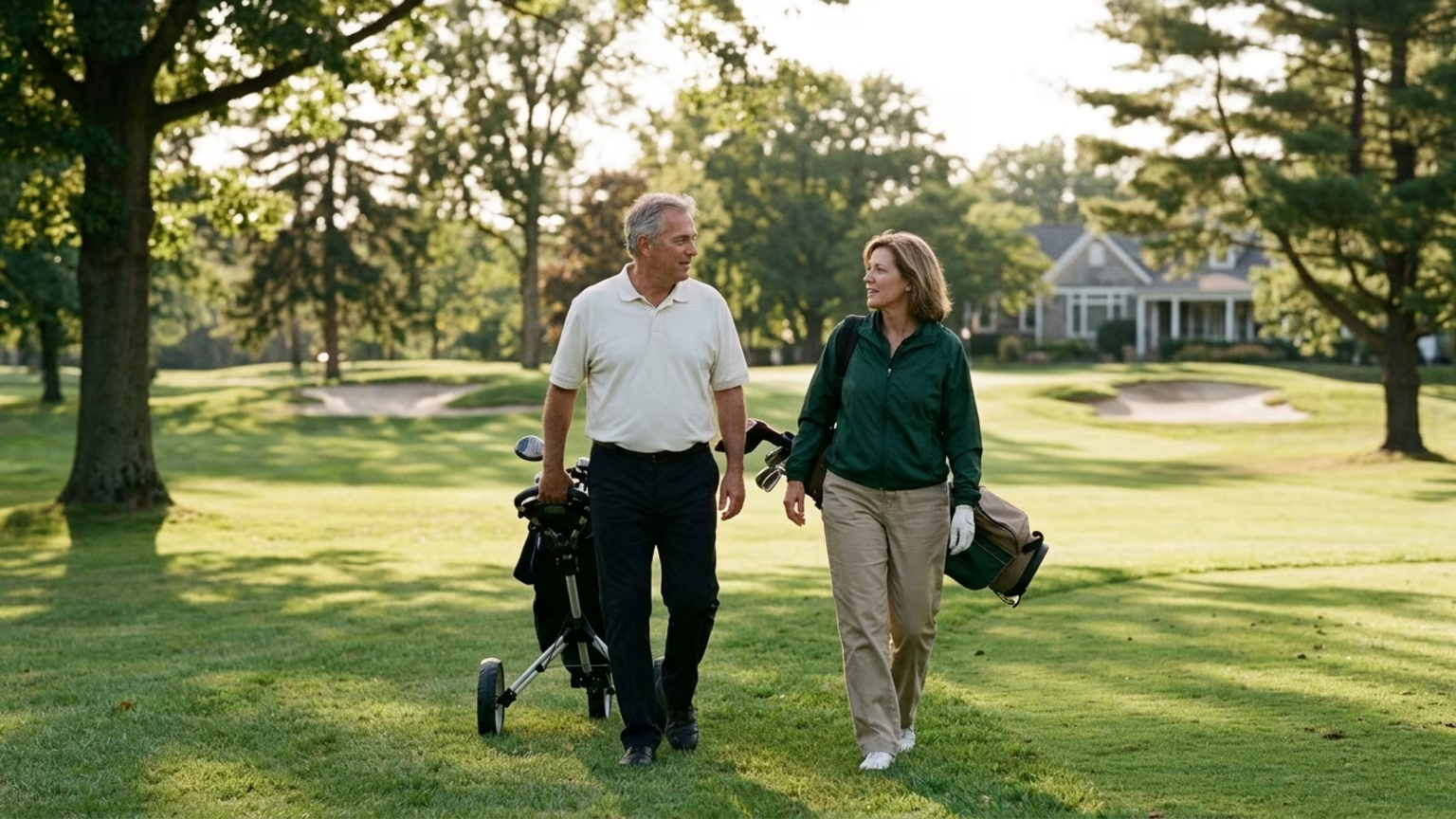
How legs, trunk and upper body share the work of a golf swing, with simple planning habits and a measured look at evidence for older golfers.




Golf strength is your whole body’s capacity to produce and manage the force of a swing. Your legs and hips contribute force. Your trunk helps rotate and control movement. Your shoulders and arms help manage that movement and transmit it to the club.
That makes strength a broader subject than stronger hands or bigger arms. The useful question is not which single muscle matters most. It is whether your physical preparation reflects the different jobs your body performs when you swing.
For the experienced recreational golfer, that is a practical way to think about training without chasing a supposed “golf muscle.”
On a full tee shot, the club is the visible end of a whole-body movement. The legs and hips contribute to producing force. The trunk participates in the turn and its control. The shoulders and arms help manage the club through the swing.
Those are related jobs rather than competing ones. Lower-body strength does not make the upper body irrelevant. Trunk control does not replace the need for the shoulders and arms to handle their share of the movement.
A useful way to translate this into feel is to separate effort from purpose. Feeling your arms work tells you something about your effort. It does not describe everything your body is doing. Likewise, the sensation of a large turn is not a complete measure of control.
Through a standard round, this gives you a broader set of questions than “Did I swing hard enough?” Consider the opening drive, an approach from the fairway and the final full shot of the day. In each case, the physical task includes producing movement and managing it through the club.
This is a way to understand the swing, not a cue to consciously direct every body part during a shot. Trying to monitor your legs, trunk and shoulders at once would also miss the point of keeping each movement focus simple.
Our guide to matching available movement with control develops that distinction further. More movement and better management of movement are different goals.
For golfers passing 40 and 50, the age question deserves a careful answer. The evidence here offers an example of older golfers responding to exercise. It does not provide a biological account of how each strength capacity changes with age.
A secondary golf-media account reports an eight-week study involving 31 male golfers aged 55 to 79. It says 19 completed a strength-and-flexibility program while 12 served as controls. The training group’s average clubhead speed rose from 85.0 to 87.1 mph.
A separate sports-medicine account identifies the research as Thompson and Osness’s 2004 paper on an eight-week multimodal exercise program. These are accounts of the same older study, not separate trials confirming the result.
The secondary accounts do not provide the full methods or a step-by-step prescription. They do not explain the biological causes or pace of strength changes after 40 or 50. They do not establish better accuracy, pain relief, injury prevention or longer playing careers. The findings also cannot guarantee the same response for women or golfers with pain or health conditions.
The useful takeaway is narrower than a promise of extra speed: the reported participants improved during a program that combined strength and flexibility. Their age did not rule out a response to training.
For your own planning, treat age as context rather than a complete assessment. “I am over 50” does not identify whether the priority is lower-body capacity or trunk control. It does not select an upper-body exercise either. Those are individual questions rather than conclusions that follow from a birthday.
The practical starting point is a whole-body view of training. That means giving attention to lower-body strength, trunk rotation and control, and shoulder and upper-body strength. These categories reflect the different physical jobs involved in the swing.
Golfergy’s focus is practical guidance connected to real golf movements rather than quick fixes. Here, that means keeping the starting habits simple without turning a broad principle into a universal workout.
One accessible habit is to look at your existing routine before adding more exercises. Review one category at a time:
This is a planning check rather than a test you must pass. Its purpose is to make the scope of the routine clear. A collection of exercises can look busy while leaving the overall plan difficult to understand.
Keep each review focused on one question. Start with the lower-body category before moving to the trunk. Then look at the upper body. There is no need to turn the review into a list of swing faults.
For more context on the middle category, read about the trunk’s role beyond simply turning.
A second habit is to discuss exercise selection and progression with a qualified professional rather than copying a speed result as a training target. The conversation can stay grounded: which capacity is the movement intended to develop, and how does it fit the rest of the plan?
During a familiar movement, keep attention on that movement alone. You do not need to rehearse the entire golf swing while doing it. A lower-body exercise can have a lower-body purpose without looking like a backswing.
Where pain or health conditions affect exercise choices, those decisions belong with a qualified healthcare professional. A general golf-strength article is education rather than personal treatment advice.
The broader aim is a balanced routine that develops over time, not a search for the single exercise that explains every shot. Our discussion of strength across the whole swing offers another way to connect physical preparation with the game.
Building capacity from your legs through your trunk to your arms keeps strength work connected to the goal of Playing Better for Longer.
Follow Golfergy for practical insights on performance, mobility, recovery and healthy ageing. Stay connected for new articles, research-led guidance and ideas to help you play better for longer.


A practical look at golf strength after 40, with research on older golfers and simple habits for connecting training goals to a coordinated swing.


Understand mobility versus stability in golf, what older-golfer research reports, and two modest habits for comfortable movement control.

Put strength and movement control at the center of golf power training, with a measured look at older-golfer research and exercise choices.
Explore practical resources on performance, recovery, mobility and golf longevity.
Read the Blog