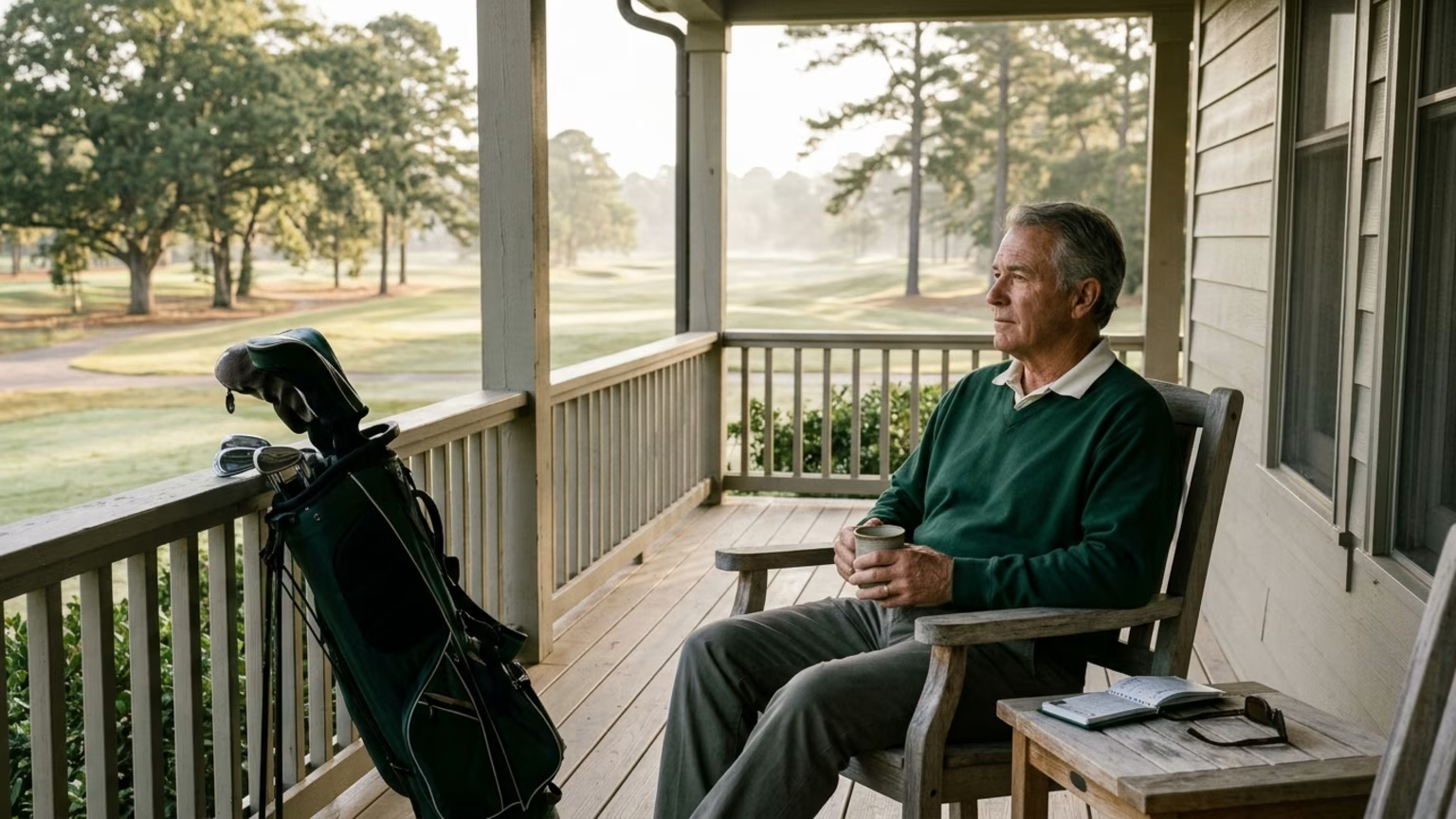
Learn how lower-body strength relates to ground forces, balance and varied golf shots, plus what older-golfer training studies actually support.




Lower-body strength is your legs’ and hips’ ability to produce force. In golf, that ability is part of how you interact with the ground while swinging. It belongs in the same conversation as balance and movement control, not just distance.
The useful distinction is between having physical capacity and knowing how to use it for a particular shot. A stronger lower body is not a command to push harder through your feet. For the mature recreational golfer, the aim is preparation for varied play rather than copying one powerful-looking swing.
A report on a Sports Medicine systematic review describes 24 studies of ground-reaction forces and centre-of-pressure patterns in golf. Of those studies, 9 reported moderate-to-strong relationships between some of these measures and clubhead speed. More skilled golfers also tended to show higher ground-reaction forces and higher clubhead speed.
Ground-reaction force describes the force exchanged between you and the ground. Centre of pressure describes where the combined pressure beneath your feet is centred. These measures help researchers examine what happens underfoot during the swing.
The practical lesson is that the legs and hips belong within a whole movement. Strength is one part of that picture. How the golfer interacts with the ground is another.
The review reported greater force production with a driver than with irons. That matters when thinking about a standard 18 holes: the round is not a series of identical swings.
The on-course aim is a stance that feels controlled while the body turns. That is different from trying to create the same forceful feeling with every club. The findings give no reason to treat a driver swing as the template for every approach shot.
Golfergy’s discussion of how strength fits into ground interaction provides a related way to think about the lower body without reducing the swing to a harder push.
The review also found that centre-of-pressure patterns changed on uphill and downhill lies. The ground beneath the golfer therefore matters alongside the club being used.
On the course, a sloping stance may feel different from a level tee-box stance. The useful goal is managing that particular shot, not recreating an identical underfoot sensation everywhere. This is where lower-body conditioning is better framed around varied play than a single force target.
A standard round includes walking, taking different stances and making swings from changing lies. Those demands give lower-body training a wider purpose than producing a faster drive.
For training discussions, ask how the plan relates to those tasks. A launch-monitor number can be useful, but it does not describe every physical demand between the first tee and the final green.
For golfers past 40 and 50, age can become the default explanation for a less settled stance or a loss of speed. A more useful starting point is the golfer’s current ability and training experience. Those are the factors that should shape an appropriately scaled plan.
There is encouraging evidence that older golfers can respond to training. A secondary summary of a functional-training study reports that 18 male golfers with a mean age of 70.7 years improved driver clubhead speed after eight weeks. Their reported speed rose from 127.3 to 133.6 km/h, while the control group did not improve.
The programme combined flexibility, core stability, balance and resistance exercises. That makes it relevant to a broad approach to golf fitness rather than a legs-only training claim.
A separate summary of strength-and-flexibility research describes golfers aged 55 to 79. It reports improvements in strength, range of motion and clubhead speed after an eight-week programme.
The findings do not establish when natural lower-body strength decline begins or explain its course through the 40s and 50s. The mixed training programme also cannot isolate the contribution of lower-body strength. Its small male sample does not represent every older recreational golfer.
Most studies in the ground-force review were cross-sectional, meaning they compared measurements rather than testing a training change over time. Results varied across golfers and research methods. The review called for clearer measurement methods and more research into whether changing pressure strategies through training improves speed or distance.
The practical takeaway is still useful: later-life improvement was reported, but neither age nor a force measurement supplies an individual exercise prescription.
The evidence supports general training considerations rather than a specific exercise sequence. Two accessible habits offer a sensible starting point without turning research findings into a personalised routine.
The first habit is to think beyond a single “golf power” exercise. The reported older-golfer programme included resistance work alongside balance, flexibility and core stability. Its findings support keeping those elements in the training conversation.
A useful planning question is: “Does this approach address more than force production?” That shifts attention toward the demands of walking and swinging from changing lies. It also keeps lower-body strength connected to the rest of the golfer rather than treating the legs as a separate engine.
Golfergy’s guide to bringing strength and mobility together offers related reading on this broader approach.
The second habit is to base exercise choices on current ability and training experience. The same movement does not have to suit every golfer. Personal decisions about exercise selection belong with a qualified exercise professional or physical therapist.
Keep the focus small when discussing a plan: one movement at a time. Ask what that movement is intended to train and how it fits present ability. There is no need to turn the research into a demanding routine before those questions are answered.
That approach leaves room for steady action without promising a particular speed gain. It also keeps the purpose clear: building a training plan around the golfer who is playing now.
Think of lower-body strength as preparation for the ground beneath your game, with Playing Better for Longer as the goal.
Follow Golfergy for practical insights on performance, mobility, recovery and healthy ageing. Stay connected for new articles, research-led guidance and ideas to help you play better for longer.


Understand how strength and balance differ across a round of golf, what older-golfer studies show, and two practical habits for reviewing your preparation.


A clinical review reports benefits from trunk and leg strengthening and outlines a gradual golf return. Here is the evidence and its limits for golfers over 40.

Understand how legs and hips contribute to your golf swing, what ground-force research shows, and how to assess lower-body control without copying a stance.
Explore practical resources on performance, recovery, mobility and golf longevity.
Read the Blog