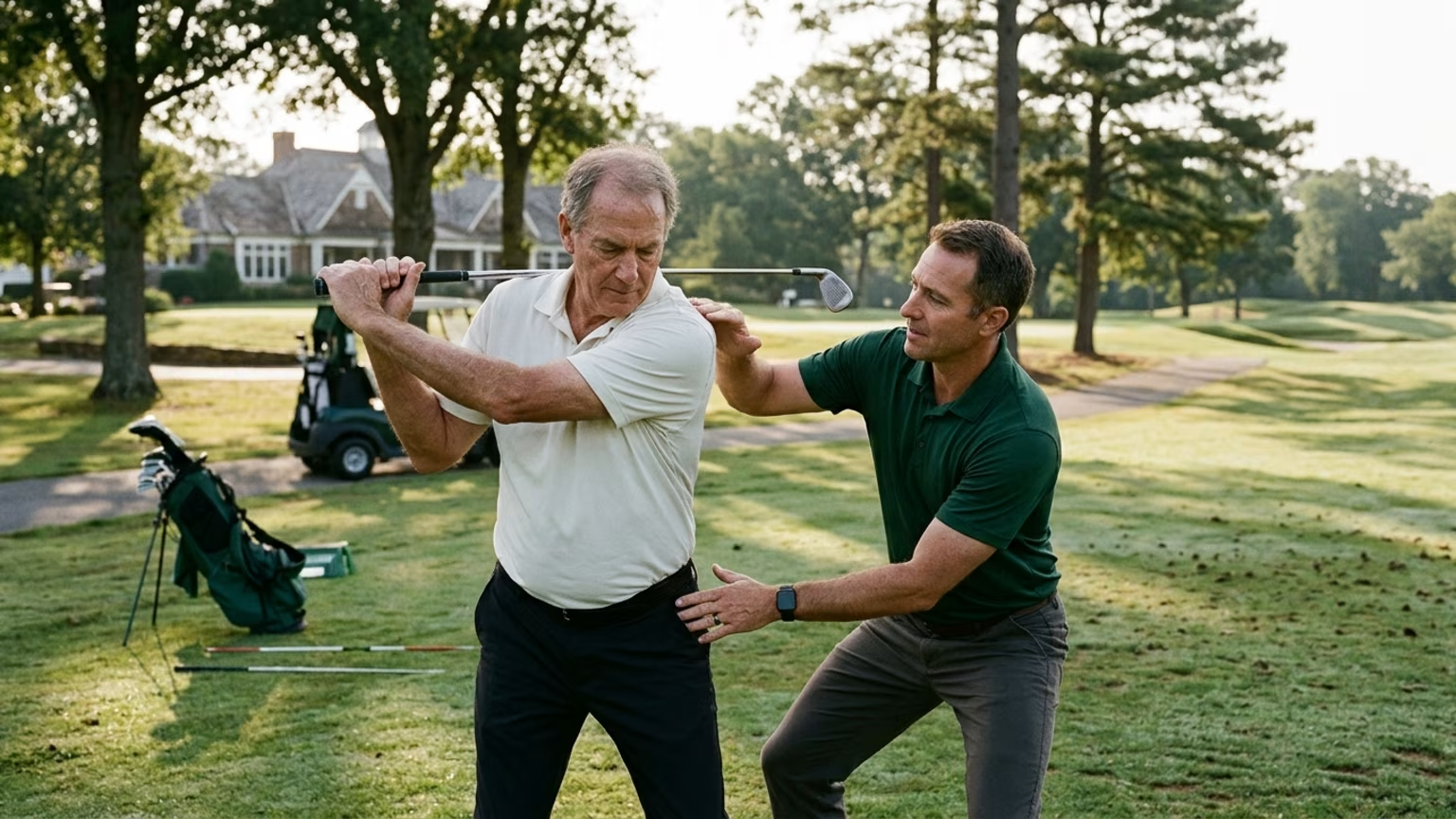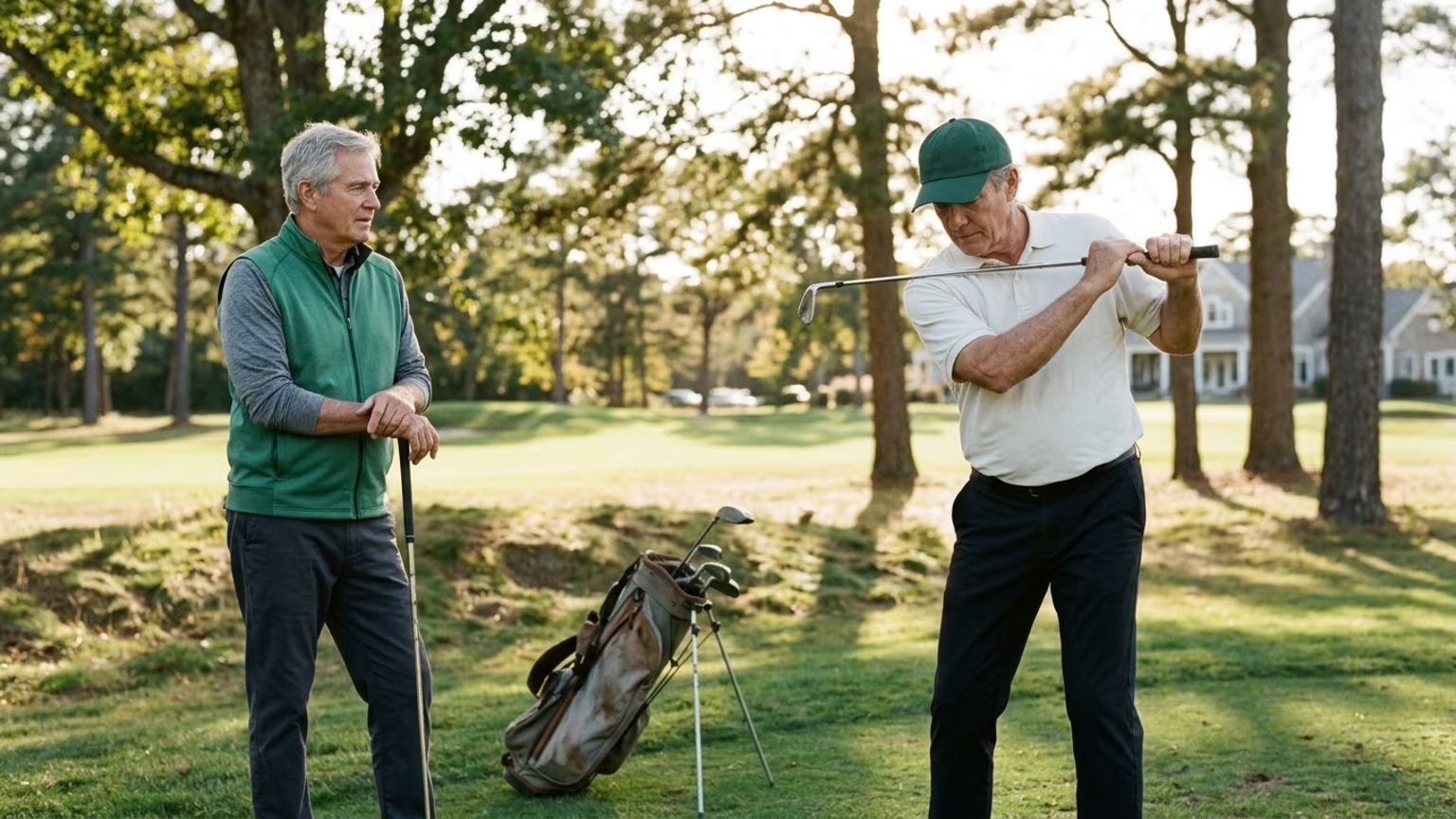

Learn how hip mobility fits your golf turn, why back pain needs a wider view, and two practical habits for a balanced approach after 40.




Hip mobility is your ability to move at the hip, including the rotation that contributes to a golf turn. It is one part of how your pelvis and trunk move through the swing. The useful question is not simply whether your hips feel tight, but how their movement fits into a comfortable turn.
A review of golf biomechanics described in a golf-physiotherapy summary includes pelvis, trunk and joint movement among the features of the swing. It also notes that varied research methods make a single ideal movement pattern difficult to prescribe.
That makes hip mobility worth understanding without turning it into a pass-or-fail test. A bigger range is not the same thing as a proven better swing. Golfergy's guide to movement range and control puts that distinction in a wider golf context.
Across 18 holes, think about hip mobility as part of the turn you bring to different shots. On a tee shot, attention may go to the length of the backswing. On an approach, it may go to how freely the swing moves through the ball. These are useful moments to notice comfort rather than grade your hip motion.
Keep the hip movement separate from the shot result in your thinking. A poor strike does not identify a stiff hip. A shorter-feeling turn does not tell you which body part needs work. The observation is simply that a movement felt different.
Useful questions during a normal round include:
Those questions help place the hip in context with technique, strength and comfort. They do not turn a round of golf into a diagnostic test. For another view of that whole-body context, read about sharing the turn across your hips and trunk.
A systematic review of nine studies found that evidence linking golf-swing biomechanics to low-back pain was limited and conflicting. The authors found no conclusive evidence that low-back pain was associated with “poor” golf-swing technique. They also noted potential study bias and a lack of prospective research.
That does not prove technique never matters. It means a tight-feeling hip or an awkward swing is not enough to explain back pain. Persistent or worsening pain calls for an individual assessment by a qualified clinician rather than a self-diagnosis based on hip mobility.
For golfers moving through their 40s and 50s, the useful focus is the person rather than the birthday. Age belongs in the conversation about physical capacity. It does not identify which part of a particular golfer's turn needs attention.
Sports Medicine Weekly summarizes an eight-week strength-and-flexibility trial in men aged 55 to 79. The combined program improved strength, range of motion and clubhead speed.
This trial does not map natural changes in hip motion through the 40s and 50s or explain their causes. It also cannot separate the effect of flexibility work from strength training. Its value here is narrower: older golfers improved several physical and golf measures through a combined approach.
So the age-related lesson is not to assume that more hip stretching is the answer. Keep strength and flexibility in the same discussion. Think about what has changed in your own turning comfort rather than comparing your motion with a younger player's swing.
Golfergy's guide to combining strength and mobility as you age follows that broader topic.
Make a simple check-in part of how you reflect on golf. Focus on how comfortable the hip turn felt during your usual play. Keep that single observation separate from your score or the distance of the shot.
The aim is to describe the experience in plain language. “My turn felt comfortable” is useful. “My hips caused that miss” is a conclusion the observation does not support.
If you discuss the issue with a coach or clinician, start with what you noticed. That keeps the conversation about your actual golf rather than a label such as “tight hips.” Hip movement can then be considered alongside the swing pattern, strength and comfort.
For exercise planning, use the combined approach from the older-golfer trial as the starting topic for discussion with a qualified professional. The practical habit is to ask about strength alongside flexibility rather than repeatedly adding another hip stretch. That is a broader question than how to gain more rotation.
Hip-focused warm-ups are also worth viewing in their proper context. A golf-physiotherapy summary describes a study of 22 male amateur golfers that tested foam rolling plus dynamic stretching focused on the lead hip. The study reported increased lead-hip internal-rotation range, meaning inward rotation at that hip. Strength and carry also improved.
Other golf-performance measures did not show significant differences between conditions. This was a small and specific study, not a universal warm-up prescription. It does not establish that every golfer needs more hip motion or that the same approach will improve every part of the game.
The useful takeaway is to judge a training idea by the outcome it actually supports. A change in hip range is one result. Better carry is another. Neither should be treated as proof that back pain has been explained or prevented.
There is no need to turn these findings into a complicated routine. Start with a clearer description of your turn and a broader conversation about physical preparation. Those are practical habits without pretending that a single mobility measure tells the whole story.
Hip mobility is one part of a comfortable golf turn, with Playing Better for Longer as the goal.
Follow Golfergy for practical insights on performance, mobility, recovery and healthy ageing. Stay connected for new articles, research-led guidance and ideas to help you play better for longer.


Ben Griffin returned with a 64 and his first 18-hole walk since August. A grounded look at the lessons and limits for golfers over 40.

Learn how hips, trunk and shoulders share a golf turn, with practical habits focused on comfortable rotation rather than a bigger backswing.
Build a manageable golf mobility habit with a moving warm-up, separate home sessions and broader conditioning during quieter parts of the season.
Explore practical resources on performance, recovery, mobility and golf longevity.
Read the Blog