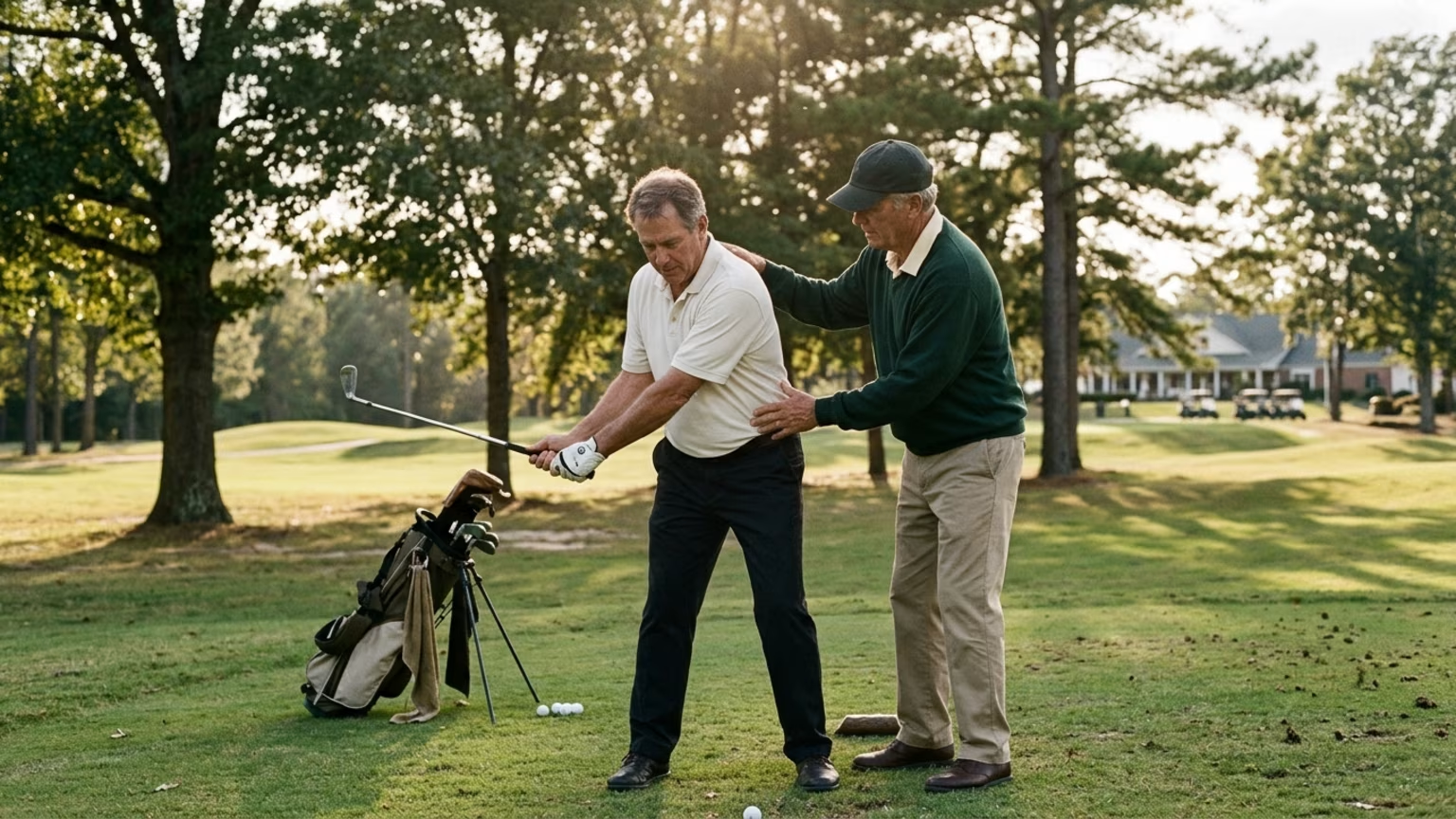

Learn how hips, trunk and shoulders share a golf turn, with practical habits focused on comfortable rotation rather than a bigger backswing.




Shared rotation is the way your hips and pelvis, trunk and shoulders contribute to a golf turn. It means thinking about the swing as a connected movement rather than a shoulder position you must reach.
For an experienced golfer, that shifts the question from “How much farther can I turn?” to “How does the rest of my body take part?” A longer backswing is not the target of this approach. A comfortable and repeatable turn is.
At Golfergy, that is a practical way to think about mobility. The aim is to work with your present movement rather than copy someone else's shape.
Across an 18-hole round, shared rotation is a way to think about each swing rather than a pose to reach. On the opening tee, the useful question is whether you are thinking about your whole turn or only where your shoulders finish.
A report describing a study of 15 injury-free professional golfers found that the relationship between hip and torso-pelvis rotation changed across swing phases. It also differed between the lead and trail sides. In plain English, the relationship was not fixed throughout the swing.
Apply that idea to the backswing by thinking of the hips and pelvis, trunk and shoulders as contributors rather than separate positions on a checklist. As the club changes direction and moves through the ball, do not treat the shape at the top as the rule for the entire motion.
That does not mean all body regions must turn equally or move together as one block. Shared is not the same as identical. The research finding is about changing relationships, so the useful lesson is to leave room for different contributions at different points in the swing.
The feel to focus on is a turn that feels shared rather than an effort to send the shoulders farther. This is the thinking behind sharing the turn across body regions, not asking one region to define the whole movement.
On the back nine, keep the same reference point. A useful turn is not judged by whether it makes an impressive still photograph. Think instead about whether the movement feels comfortable and repeatable from shot to shot.
For golfers in their 40s and 50s, the practical starting point is the movement available today. The research discussed here does not establish an age-by-age pattern of natural rotation loss or explain the tissue changes behind it. A birthday alone is not a basis for prescribing a different swing.
The wider evidence also sets limits on claims about technique and pain. A systematic review summarized in clinical commentary assessed nine studies of swing biomechanics and lower-back pain. It found very limited and conflicting evidence with substantial risk of bias and no prospective studies. The review found no conclusive evidence linking lower-back pain to “poor” swing technique.
The professional-golfer study has its own boundary. Its findings are not a template for older recreational players. Its torso-pelvis model also did not measure each lumbar vertebra separately, so it was not a complete map of movement within the lower spine.
In 2024, a published case report described in clinical commentary outlined an individualized program for a 78-year-old golfer with intermittent lower-back pain and declining driving distance. That was one person's case, not evidence that the same program would work for other older golfers.
For Golfergy, the sensible response is working with the movement you have today rather than treating age or appearance as a verdict on your swing. Comfortable and repeatable rotation is the editorial goal here, not a proven medical prescription.
Keep the focus on one small part of the movement at a time. The starting point is attention rather than an attempt to rebuild the whole swing at once.
Think about your hips taking part in the turn. Leave the size of that movement out of the question for now. The aim is to notice a contribution rather than chase more range.
That keeps the habit tied to the research finding that body regions have changing relationships through the swing. It also gives you one clear focus rather than several competing body cues.
Use a comfortable and repeatable turn as your reference rather than the longest backswing you can produce. If your attention drifts toward matching a model player, return it to how your own turn feels.
This is the practical value of making coordination the priority. Your goal is not to collect separate positions for the hips, torso and shoulders. It is to think about them as parts of the same movement.
Neither habit needs a target angle or a separation score. Keep the question small: am I attending to a connected turn or chasing a pose? Persistent or worsening pain is a reason to speak with an appropriate health professional.
Playing Better for Longer means making your golf turn a comfortable shared movement, not a contest to turn farther.
Follow Golfergy for practical insights on performance, mobility, recovery and healthy ageing. Stay connected for new articles, research-led guidance and ideas to help you play better for longer.


Build a manageable golf mobility habit with a moving warm-up, separate home sessions and broader conditioning during quieter parts of the season.


Learn how hips and back share your golf turn, how to notice movement differences, and when an individual assessment may help.
A practical golf warm-up progression from walking to controlled movement and fuller practice swings, with clear limits on injury-prevention claims.
Explore practical resources on performance, recovery, mobility and golf longevity.
Read the Blog