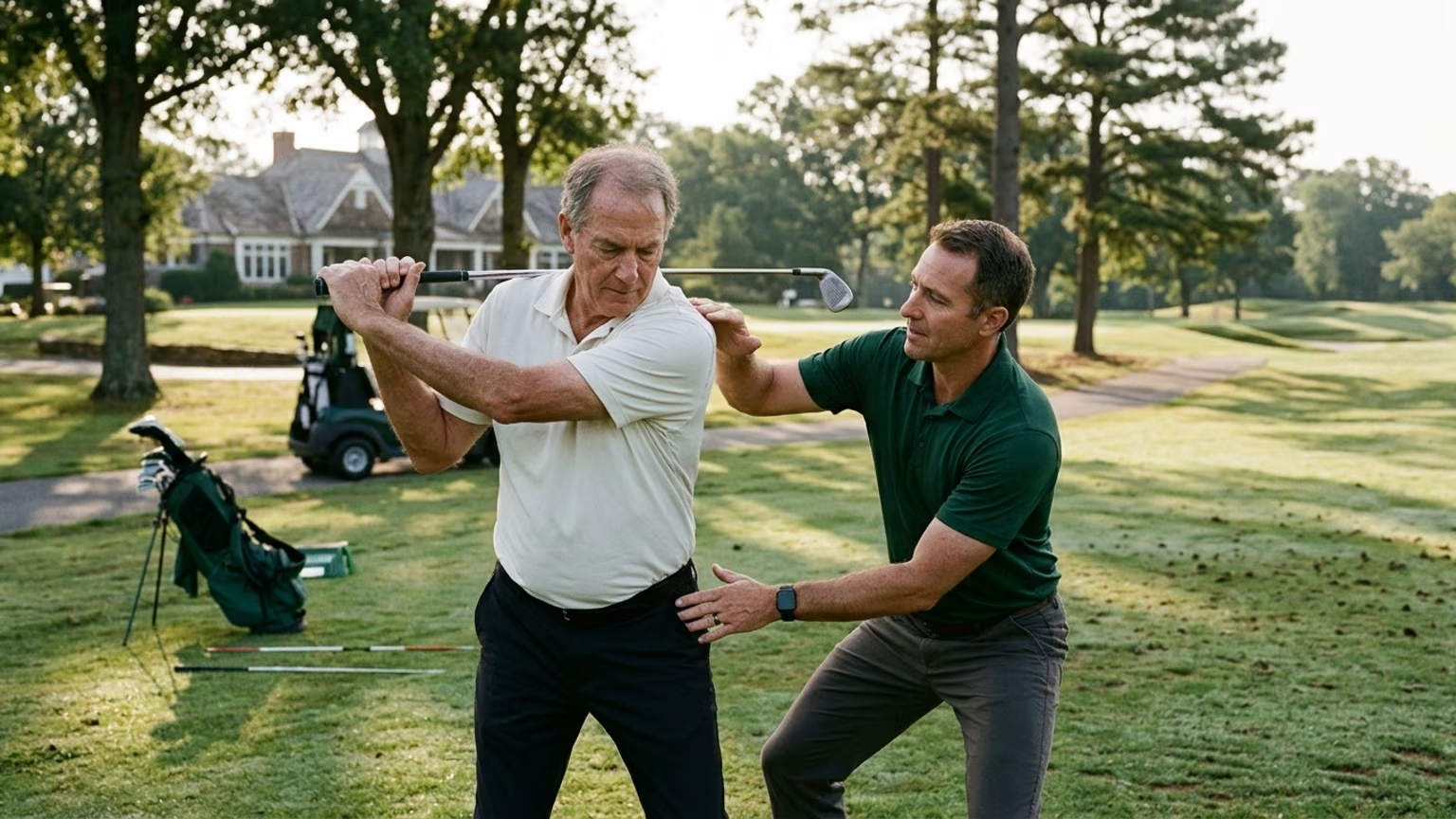

Separate golf mobility from strength and warm-ups, keep practice manageable, and recognise when a restriction needs professional assessment.




Golf mobility is your ability to move through the positions your swing calls for with comfort and control. It is not a contest to make the longest backswing or copy a tour player's shape. The useful goal is movement that serves your game.
Golf physiotherapy guidance separates three related jobs:
Those jobs support each other without being interchangeable. A few stretches do not replace strength work. A pre-round warm-up also has a different purpose from working on a movement limitation between rounds.
Golfergy's approach is practical: understand the purpose before adding more exercises. Our guide to bringing strength and mobility together develops that distinction further.
During a full round, mobility shows up in the positions available to you. Can you move into your backswing comfortably? Can you move through the shot without forcing the turn? Can you finish with control rather than chasing a shape?
These questions translate the physical concept into golf. Your joints provide movement, while strength helps you control the positions you reach. Golf physiotherapy guidance supports working toward comfortable swing positions rather than treating greater flexibility as the whole goal.
On the opening tee, preparation is the immediate task. Between rounds, a specific restriction may deserve focused practice. Those are different situations, so they do not need the same response.
The same distinction applies on the back nine. A turn that feels restricted is information rather than a command to stretch harder. The feeling alone does not tell you whether more range is the missing ingredient.
Think of mobility as useful access to a position. The question is not how far the body can be pushed. It is whether the movement available fits the swing you are trying to make.
For golfers passing 40 and 50, a change in how the swing feels can raise a familiar question: do I need more mobility? The answer should come from the movement issue rather than a birthday.
The research summarized here does not establish how or why mobility declines at those ages. Its practical support is for individual assessment rather than an age-based stretching rule.
Golf-focused assessment guidance treats mobility and strength as distinct qualities. It supports identifying the restriction before choosing the work. Adequate range may point toward strength or coordination work rather than another stretch.
For the mature recreational golfer, that is a useful shift in focus. Instead of assuming that every change needs more flexibility, ask what physical quality needs attention. Our guide to looking at movement before choosing exercises follows that same practical theme.
A golf physiotherapist's research summary reports findings from a 2024 systematic review and meta-analysis of 20 studies. Pooled flexibility measures were not significantly associated with driver clubhead speed. Strength and explosive-power measures showed stronger relationships.
The same summary notes that many flexibility tests were poor or not specific to golf. That limits what the finding says about golf-relevant mobility. It is not proof that mobility has no value.
The physiotherapist's practical perspective is to match mobility work to the restriction being addressed. Any new range should also be paired with strength and control. More available movement is not the same thing as being able to use it well.
That gives mobility a clear place without making it responsible for everything. It may help you access a comfortable swing position. It does not need to promise extra speed to be worthwhile.
The same physiotherapist favours a small number of useful movements over a long list with no clear purpose. Two habits capture that approach without turning mobility into another demanding project.
The starting point is a particular restriction rather than a collection of stretches copied from elsewhere. The guidance supports choosing one or two relevant movements and practising them consistently. It does not establish a universal routine for every golfer.
For each movement, keep the purpose clear: work on the selected restriction through comfortable and controlled motion. Focus on that movement alone rather than trying to correct several parts of the swing at once.
There is no need to chase the deepest position available. The aim is useful movement that can be controlled. Where the choice of movement is unclear, a qualified physiotherapist can help assess what needs attention.
Before play, the task changes from developing a specific quality to preparing to swing. The golf physiotherapy sources recommend active preparation with swings that build toward normal speed. They advise against starting with maximal effort.
The research summary reports that a 2019 review of 23 golf warm-up studies found dynamic warm-ups and those containing resistance exercise tended to improve performance measures. Static stretching alone performed less well as a pre-performance strategy.
That review also found mixed and inconclusive evidence linking warm-ups with lower injury rates. A warm-up is preparation for play, not an injury-prevention guarantee.
The practical distinction is straightforward: use comfortable movement before the round and build into the swing. Keep targeted mobility practice separate in purpose. Our article on preparing your body before the first tee covers that preparation theme.
The physiotherapist's mobility guidance advises stopping rather than pushing farther when a drill causes:
These are reasons to seek professional assessment. Golf physiotherapy guidance on pain also recommends getting symptoms checked when they persist or repeatedly return. Pain that worsens or affects the swing deserves assessment rather than an automatic decision to stretch more.
A sustainable approach gives each part of training a job. Warm up to prepare for play. Practise mobility for an identified restriction. Build strength to produce and control force. Keep personal decisions about painful or persistent limitations with qualified care.
Useful joint movement supported by strength and control connects golf mobility to the bigger goal: Playing Better for Longer.
Follow Golfergy for practical insights on performance, mobility, recovery and healthy ageing. Stay connected for new articles, research-led guidance and ideas to help you play better for longer.


Move from walking to controlled movements and easy swings, with clear expectations about warm-ups, injury evidence and longer-term golf fitness.


Early mitochondrial research offers golfers over 40 a measured view of exercise science, resistance and endurance activity, and the limits of mouse findings.

Learn how hip, upper-back and shoulder mobility fit a comfortable golf swing, with gentle movement observations and a focus on control.
Explore practical resources on performance, recovery, mobility and golf longevity.
Read the Blog