

Understand how hips, upper back and trunk contribute to your golf turn, with practical warm-up habits that respect your available mobility.




Available rotation is the turning movement your body can use comfortably today. In golf, that movement involves the hips, pelvis, upper back and trunk working together. A fuller turn is a reasonable goal. Forcing extra movement through your lower back is not the same thing as building it.
USA Sports Medicine identifies hip capacity, trunk control and rotation through the hips and thoracic spine as possible factors in golf-related low-back pain. The thoracic spine is your upper and middle back. These parts belong in the same conversation rather than being treated as separate fixes.
The lower back also moves during the swing. The goal is not to hold it motionless or make it supply every extra bit of rotation. Understanding how the body shares the turn gives you a better starting point than chasing a longer backswing at any cost.
During a standard 18 holes, this becomes a practical question: can you make the turn you are asking for without pushing through discomfort? That question matters more than whether your shoulders reach a position copied from another golfer. Their available movement is not a prescription for yours.
At the first tee, think about the difference between making a comfortable turn and trying to reach farther. If extra backswing length requires an uncomfortable twist, the useful response is not to force the position. It is to reconsider the movement goal for that swing.
Through the middle of the round, use the same distinction. A turn that feels shorter does not automatically need to be stretched longer. Notice the difference between the movement you can repeat comfortably and the position you are trying to achieve. That observation is useful information rather than a diagnosis.
On the back nine, resist treating every change in feel as a technical fault. If stiffness or pain appears, chasing more rotation is not a useful test of determination. The practical guidance discussed below favors noticing symptoms before increasing effort rather than making the fullest possible swing the starting point.
For golfers moving through their 40s and 50s, the useful comparison is today's movement against today's swing demands. It is not today's shoulder turn against a photograph from years ago. Age alone does not tell you which part of the movement system has changed or why.
That distinction matters when a turn begins to feel restricted. A smaller backswing does not identify whether hip movement, upper-back rotation or trunk control deserves attention. Our guide to a turn that feels different with age keeps the focus on available movement rather than a birthday-based target.
The evidence has clear limits. USA Sports Medicine says a 2024 systematic review found limited and conflicting evidence linking swing biomechanics to low-back pain. Its summary does not identify one universally bad swing. A golf-specific review summary also reports no clear association between pooled hip internal-rotation measures and low-back pain, with individual studies varying.
The research does not establish a normal amount or biological explanation for lost rotation after 40 or 50. It also provides no validated ideal turn angle or tested swing-position prescription for older golfers. The warm-up guidance below is published practical advice rather than a proven injury-prevention method.
There is still a constructive message. Sports Medicine Weekly reports that an eight-week strength-and-flexibility program improved strength, range of motion and clubhead speed in a randomized trial of golfers aged 55 to 79. That is a secondary report of a combined program, not proof that greater rotation alone produces those results. Keep strength and movement control in the picture rather than treating flexibility as the whole answer.
Two foundational habits fit the available guidance: prepare before swinging and build from half swings. Neither requires a target turn angle or an attempt to recreate your younger swing.
Sports Medicine Weekly recommends a brief preparation sequence that includes:
The useful habit is to give each movement its own attention. During the hip-rotation portion, focus on the hips rather than trying to assemble a complete swing. During shoulder circles, keep the task about the shoulders. Preparation does not need to become a complicated swing lesson.
Keep the purpose clear: this is a transition into golf movement rather than a contest to find your largest range. The source recommends noticing stiffness or pain before increasing effort. That makes observation part of preparation rather than something saved until after an uncomfortable full swing.
For more context on preparing for the first tee, keep the same principle in mind: preparation should serve the movement you have today. It should not become another reason to force a position.
The same Sports Medicine Weekly guidance progresses to short-iron half swings before full swings. This gives practice a clear starting point without making backswing length the first goal. A half swing is part of preparation rather than a failed attempt at a full one.
Keep the practice question small: does this amount of turn feel comfortable today? Before increasing effort, notice stiffness or pain. Do not use a particular shoulder position as the measure of whether the preparation has worked. The aim is to work with available movement rather than pass a flexibility test.
Specific stance changes and swing-position adjustments belong in an individual conversation with a qualified coach. Bring a clear observation to that conversation, such as when the turn begins to feel uncomfortable. An observation gives the coach something concrete to discuss without turning a feeling into a self-diagnosis.
For persistent or worsening pain, seek clinical evaluation rather than a bigger backswing. USA Sports Medicine also advises evaluation when pain comes with other concerning symptoms. Choosing a personal response to pain calls for qualified care rather than a general mobility article.
Build your turn around today's comfortable movement, with strength and control alongside mobility, for Playing Better for Longer.
Follow Golfergy for practical insights on performance, mobility, recovery and healthy ageing. Stay connected for new articles, research-led guidance and ideas to help you play better for longer.



Understand how your hips and mid-back contribute to a golf turn, with practical habits that put comfort ahead of extra backswing length.


A progressive golf warm-up for players over 40, moving from easy activity to fuller practice swings without treating preparation as a flexibility test.
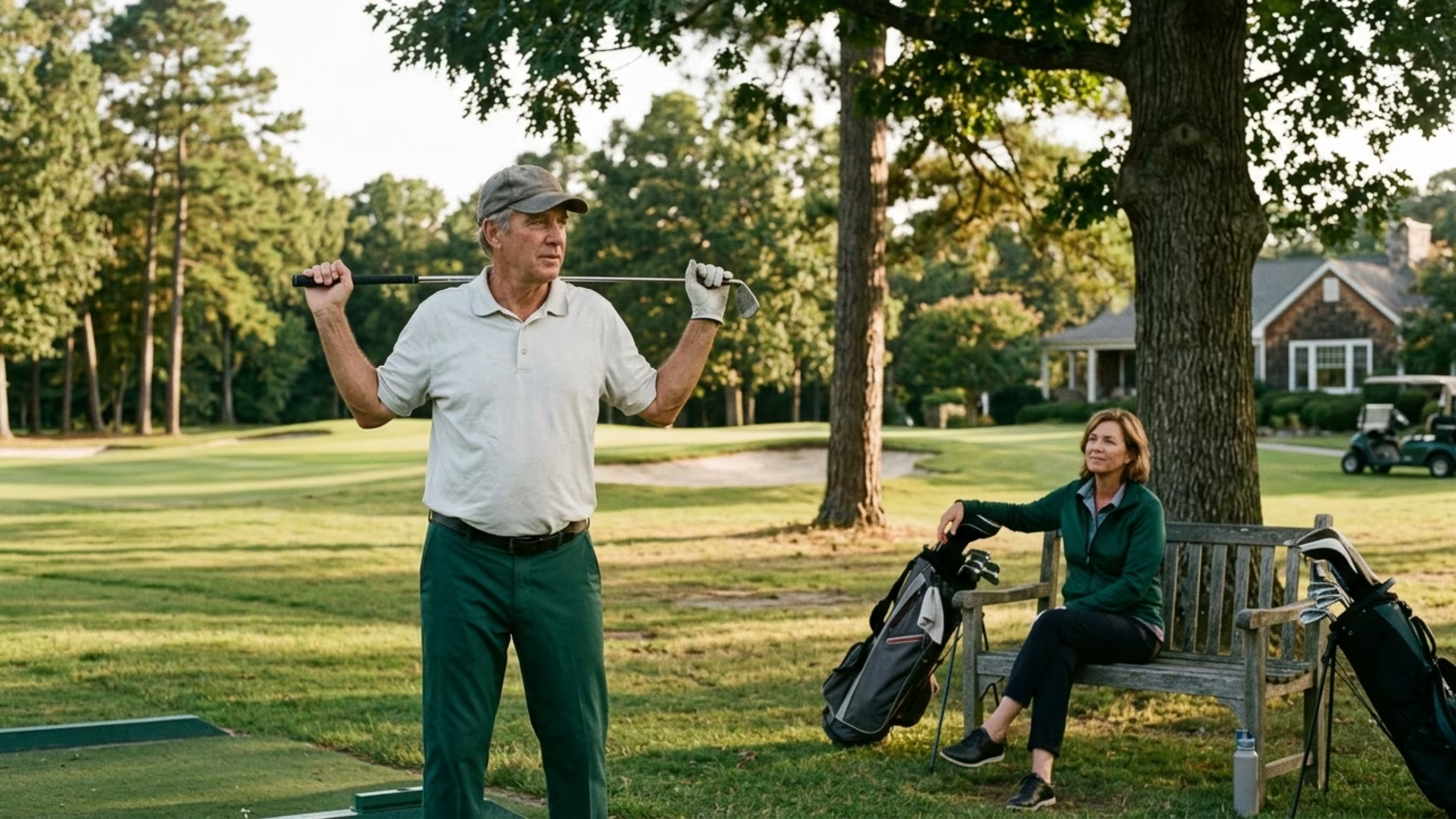
Observe comfortable movement and control to frame better questions about your golf swing, with guidance on when pain needs professional assessment.
Explore practical resources on performance, recovery, mobility and golf longevity.
Read the Blog


