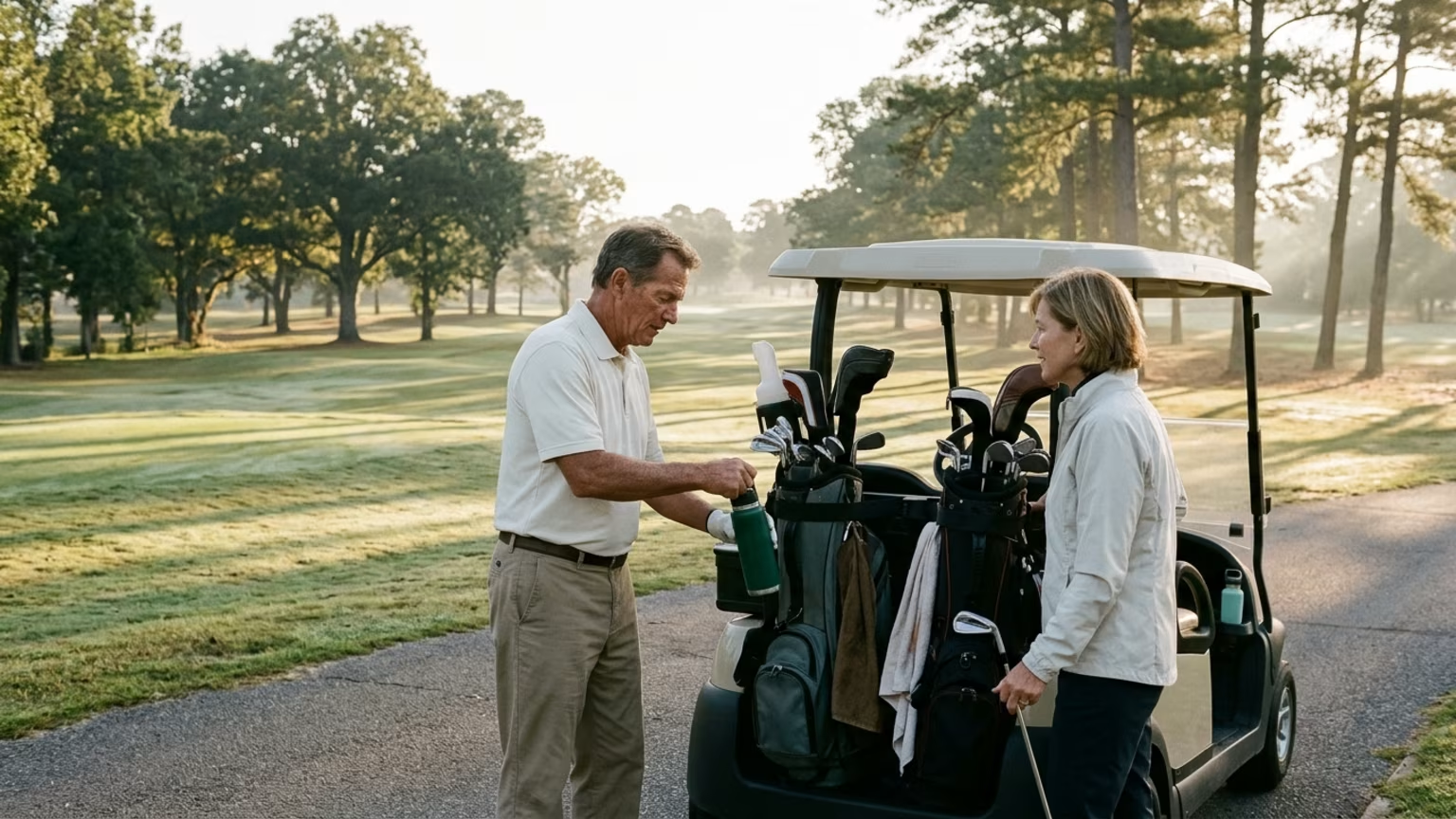

Build a manageable golf mobility habit with a moving warm-up, separate home sessions and broader conditioning during quieter parts of the season.




Evergreen Golf App proposes a five-minute pre-round warm-up and a separate ten-minute home routine for older golfers. Those are published examples, not time requirements for every player. They offer a useful organising idea: prepare before playing and give longer-term work its own place between rounds.
That fits Golfergy's approach to golf longevity: practical habits without quick-fix promises.
Use the opening movements of the warm-up as an informal check-in rather than adding a separate flexibility test. Notice how walking or marching feels. Then pay attention to comfort during the sample's shoulder circles and trunk turns.
The question is whether movement feels comfortable or restricted, not whether you reach a particular angle. This does not measure strength or diagnose the reason for stiffness. Pain or a persistent restriction calls for qualified assessment rather than a harder stretch.
Keep the evidence in perspective, too. AthleteRX describes the evidence linking golf warm-ups to injury prevention as mixed and inconclusive. Links HP reports that dynamic and resistance-based warm-ups tended to improve performance in a review, but notes that many studies were small or involved young or skilled golfers.
The practical goal here is preparation, not a guarantee against injury or a promised performance gain. The published outline also does not establish a breathing cadence or personal pain threshold. Questions about individual breathing, pacing or movement limits belong with a qualified healthcare professional.
Evergreen Golf App's sample progresses through the following movements. Read it as a published outline rather than a personalised exercise prescription. Keep the focus on one movement at a time instead of combining drills into a more demanding circuit.
The sequence begins with brisk walking or marching. This comes before the rotation drills and practice swings.
There is no need to turn this part into swing rehearsal. Its place in the routine is simply the opening movement stage.
Shoulder circles come next. Sports Medicine Weekly also includes controlled shoulder circles in its suggested preparation.
Keep the task focused on the shoulders. Adding a trunk turn at the same time would change the simple sequence being described.
The sample then moves to trunk turns. The focus is turning the torso rather than trying to reproduce a full backswing immediately.
This is a useful distinction for an experienced golfer: a warm-up movement is not an invitation to chase the turn you had years ago. Golfergy's guidance on keeping rotation comfortable without forcing range follows that same practical theme.
Supported leg swings follow the trunk turns. Support is part of the published movement, so this should not become an unsupported balance challenge.
Keep the focus on the leg movement. A larger swing is not the stated objective of this stage.
Next comes a hinge into the golf address position. The task now shifts toward the setup used for golf.
Keep this stage separate from the swing itself. The published order places the address-position hinge before the gradually building practice swings.
The sequence finishes with practice swings that gradually become larger. Sports Medicine Weekly describes a related progression using short-iron half swings before full swings.
The common thread is progression. The first practice swing does not have to resemble the final one.
Evergreen Golf App separates its warm-up from a ten-minute home routine. That distinction matters more than treating either duration as a target to hit exactly.
As a practical planning choice, give home mobility work its own place in the week. Do not assume that every part of it must be squeezed into the minutes before teeing off.
A useful habit cue is an ordinary transition at home. The aim is to make the session easy to remember, not to build an elaborate daily programme. Choose its place around the golf you actually play rather than an ideal week that rarely happens.
The off-season offers room to think beyond stretching. Sports Medicine Weekly recommends golf-specific exercises two or three times weekly to build hip, core and shoulder capacity. That is the article's recommendation, not a proven minimum for every golfer.
Evergreen Golf App also summarises an eight-week programme involving 18 male golfers with an average age of 70.7. It combined flexibility, core stability, balance and resistance exercise. Its reported clubhead-speed improvement therefore cannot be credited to mobility alone.
The planning lesson is modest: broader conditioning deserves space alongside mobility. Build that work gradually with suitable guidance rather than copying a study schedule. Golfergy's discussion of keeping strength work alongside regular golf provides related context.
Turning preparation into a range test. The sample moves toward golf through controlled stages. Trying to make every circle or turn larger changes that purpose.
Skipping the build-up. Moving straight to full practice swings leaves out the gradual progression described by both golf-focused guides. Keep the sequence recognisable rather than rushing toward its final movement.
Making supported work harder. Removing support from the leg swings creates a different task. More demanding does not automatically mean more useful for the routine's purpose.
Combining every session. A warm-up, home mobility work and broader conditioning do not need to become one long pre-round programme. Giving each a separate role keeps the plan clearer.
Planning for an imaginary season. A crowded playing week and a quiet off-season are different scheduling problems. As an editorial rule of thumb, make the plan fit the available space rather than treating a missed session as something to repay before the next round.
At the course, connect preparation to something that already happens: arriving or beginning practice swings. That keeps the warm-up attached to golf rather than making it another separate appointment.
Out on the fairway, the familiar practice-swing moment can carry forward the same idea of gradually building the movement. It does not need to become a new stretching session or a test of maximum rotation.
Golfergy's guide to moving toward the opening drives in stages offers another way to think about that transition. Keep the cue simple: one movement at a time.
A season-long mobility routine needs a clear place, not an elaborate timetable. Use moving preparation before play. Keep home mobility distinct from the warm-up and make room for broader conditioning when the calendar allows.
The worthwhile investment is a repeatable habit built around comfortable movement. It should fit the golf season you have, not demand that you reorganise the season around it.
Follow Golfergy for practical insights on performance, mobility, recovery and healthy ageing. Stay connected for new articles, research-led guidance and ideas to help you play better for longer.



Learn how hips and back share your golf turn, how to notice movement differences, and when an individual assessment may help.


A practical golf warm-up progression from walking to controlled movement and fuller practice swings, with clear limits on injury-prevention claims.

Build a progressive golf warm-up with walking, controlled joint movements and easy practice swings, without treating it as a guarantee against injury.
Explore practical resources on performance, recovery, mobility and golf longevity.
Read the Blog