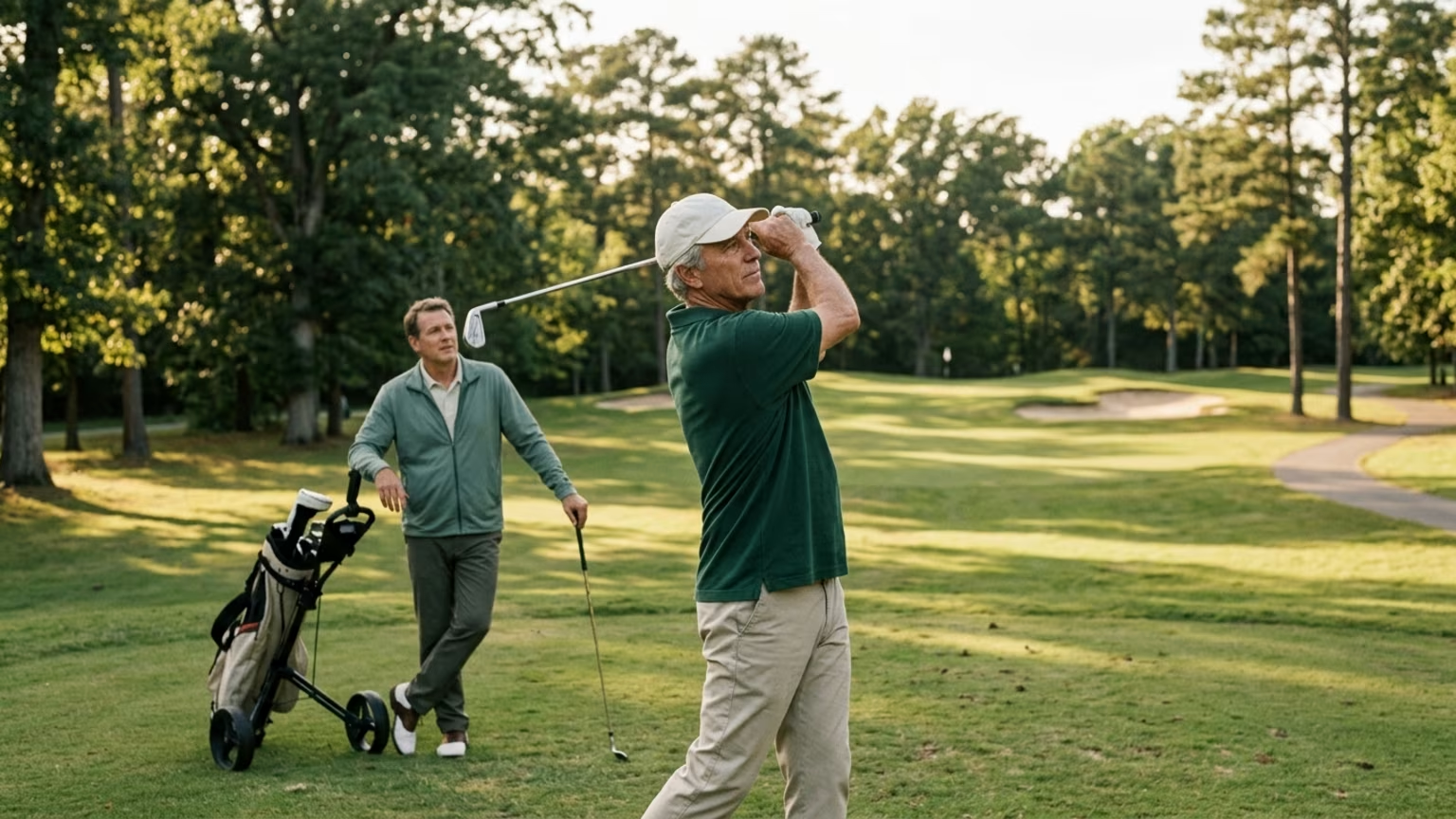

Learn why a healthy golf swing requires more than passive stretching. Understand how combining strength and active control protects your rotation after age 40.




Golf swing mobility is simply your body's ability to reach and control the positions required to hit the ball. Many players confuse mobility with simple flexibility. Flexibility is just the passive stretching of a muscle. You can stretch your hamstrings or shoulders without any real effort. Control is the strength required to maintain your balance and posture while moving. Usable golf mobility requires both traits working together to power your swing safely. When you combine raw flexibility with the strength to manage it, you create true rotational power. This combination acts as the reliable engine for your older swing. Stretching your muscles will not automatically translate into a better turn if you lack the stability to hold those positions dynamically. Understanding this distinction is the absolute first step toward building a swing that lasts.
You can feel the difference between passive flexibility and active control during a standard 18 holes. On the first tee, you might easily turn your shoulders during a relaxed practice swing. Taking that same turn at full speed requires physical strength to hold the position against the force of the club. If you lack this structural control, your body will compensate quickly. You might alter your swing path or stand up prematurely through the shot.
These quick compensations force you to rely heavily on your arms and hands to square the clubface. By the time you reach the back nine, these faulty movements create deep physical fatigue. Your lower back might tighten, and your quality of contact will likely suffer. Preparing your body properly helps, which is why rushing from your car to the first tee harms swing mechanics over the course of the day. A golfer with true mobility can repeat their sequence consistently from the first drive to the final putt. Without proper physical control, your swing breaks down when you need it most.
As golfers pass age 40 and 50, their physical capacity naturally changes. A gradual loss of basic rotation is a common complaint among veteran players. Focusing solely on passive stretching often misses the true cause of this physical decline. Older golfers lose functional strength, dynamic balance and core stability alongside their basic flexibility. Rebuilding a reliable turn requires addressing all these physical areas simultaneously.
Your body functions as an interconnected chain rather than a collection of isolated parts. When you lose core stability, your nervous system often restricts your available range of motion to protect your spine. This means your stiff mid-back might actually be a symptom of a weak abdominal core. Attempting to fix this by only stretching your back muscles will yield poor results on the course. You must build foundational strength and balance to give your body the physical confidence to rotate fully.
Maintaining your physical capabilities becomes a matter of training the entire system. Focusing on balance and resistance work helps you maintain the posture needed for a consistent strike. Golfers who incorporate stability work often find that their usable flexibility improves naturally. Relying entirely on simple flexibility routines ignores the demanding physical realities of the older golf swing.
Improving your physical capacity requires a strategic approach to your training routine. Instead of isolating one tight spot, you can apply a simple framework to evaluate your movement. This approach focuses on building usable strength and practical rotation for the course.
When a specific movement feels restricted, ask whether you lack the actual range of motion or the strength to use it. If you can reach a position slowly but lose it during a swing, the issue might involve control. You might need more core work rather than more stretching to fix the movement flaw. A proper self-assessment helps you target the real problem safely. Understanding your body's limits is a key part of the 5 pillars of golf fitness for senior players.
Build usable capacity through a mixed routine that challenges your stability while you move. You should avoid physical routines that only focus on holding static stretches for long periods of time. A balanced program incorporates dynamic balance drills and light resistance exercises to build true muscular resilience. You can practice rotating your torso while maintaining a stable lower body. Integrating mobility that transfers to your swing means training your muscles to fire correctly during motion. This builds the exact type of active control needed for a full round of golf. Your goal is to train your body to handle the forces generated by swinging a club.
Sometimes a comfortable physical position is simply no longer available to your body. In these cases, you can work with a qualified professional to modify your swing demand instead of forcing more range. Modifying your approach is a smart way to protect your body from unnecessary strain. Adapting your technique relates directly to adapting your mechanics for a lasting playing career. You do not need to force your body into a textbook posture if it causes pain.
It is tempting to blame one stiff joint for all your swing issues or physical pain. Many players assume that poor hip rotation is the sole cause of their discomfort. A golf-performance article from The Performance Shift cautions that pooled evidence does not establish a clear link between hip internal rotation and low-back pain. The evidence linking specific swing mechanics to pain remains limited and conflicting. Focus on overall movement quality rather than isolating one single joint. Mastering the difference between mobility versus flexibility will help you build a more durable swing.
True rotational capacity blends strength with functional range to keep you Playing Better for Longer.
Follow Golfergy for practical insights on performance, mobility, recovery and healthy ageing. Stay connected for new articles, research-led guidance and ideas to help you play better for longer.



Understand how your hips and mid-back contribute to a golf turn, with practical habits that put comfort ahead of extra backswing length.


A progressive golf warm-up for players over 40, moving from easy activity to fuller practice swings without treating preparation as a flexibility test.
Observe comfortable movement and control to frame better questions about your golf swing, with guidance on when pain needs professional assessment.
Explore practical resources on performance, recovery, mobility and golf longevity.
Read the Blog


