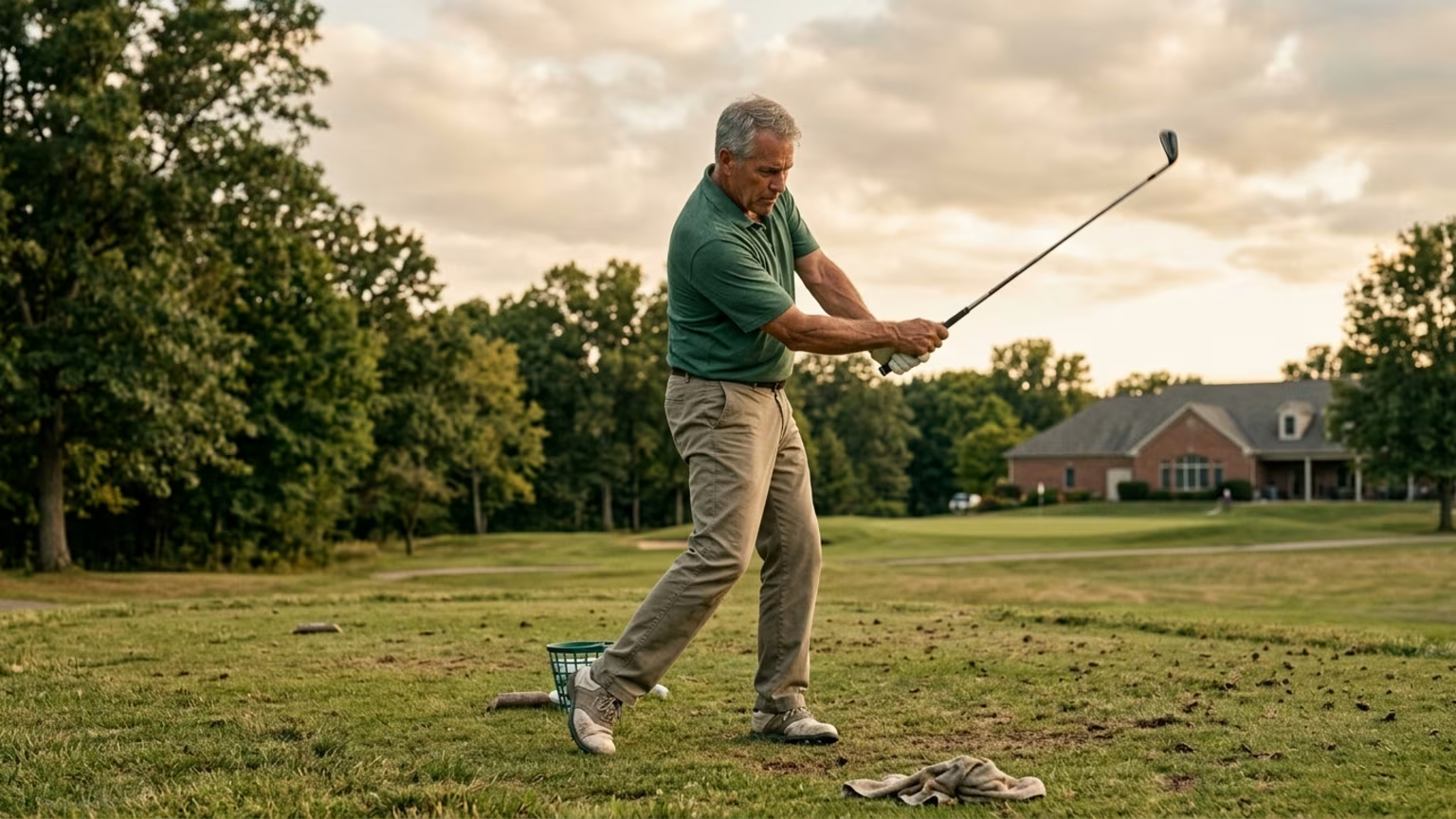

Force transfer in the golf swing starts from the ground up. Learn how leg strength, hip hinges, and trunk control help older golfers play better for longer.




Force transfer in the golf swing is simply your body's ability to push into the turf and send that energy up through your legs, into your trunk, and out to the club. It is the absolute foundation of your power. Many players focus entirely on their arms and shoulders to generate speed, but a strong upper body cannot compensate for a weak lower-body foundation. The hips and legs are the primary engines for creating motion in a healthy golf swing.
This biomechanical concept translates directly to your performance on the golf course. When you step onto the tee of a long par four, your lower body must act as a stable anchor and a powerful catapult. Your legs create force by pushing against the ground during the downswing. Your trunk then acts as a transmission system to move that force into your arms and the club. If your legs lack strength, your upper body has to work much harder to swing the golf club.
Your swing path and clubface control rely heavily on how well your feet interact with the ground. When your legs push down, the ground pushes back, creating vertical and rotational forces. Your core must brace to channel these forces upward. If your core is weak or your legs are tired, the arms try to muscle the club through impact. This upper-body dominance usually leads to a steep downswing, a sliced ball flight, or an inconsistent strike.
Without sufficient lower-body strength, players often sway or lose their balance during the swing. Proper force transfer allows you to sequence your movements efficiently from the ground up. This sequencing prevents the arms from taking over, which often leads to poor contact and early fatigue. A solid foundation helps you maintain control throughout all eighteen holes. Developing power from the turf up requires you to treat your lower body as an active participant rather than a passive platform.
At Golfergy, we often reflect on our early mistakes. As one of our team members notes, "I used to stand on the first tee doing long, static hamstring stretches because I thought it was the right way to warm up. I would actually feel weaker on my first drive. Research later showed me that dynamic movements, like leg swings and torso twists, prime the nervous system much better. Changing my five minute warmup completely transformed my opening tee shots." This dynamic readiness is important for your legs to transfer force properly on the course.
The ability to produce and transfer force changes naturally as golfers pass age forty and fifty. Muscle mass decreases, and the lower body becomes less efficient at generating power. Neuromuscular control also declines, which makes it harder to shift pressure smoothly from the trail leg to the lead leg. This decline often causes older players to rely on their arms, placing extra stress on the lower back.
As these physical changes accumulate, maintaining the golf swing requires a more deliberate approach to physical conditioning. The trunk must continue to transmit and regulate force before it reaches the arms. If the core weakens, that energy leaks out before impact. Building functional strength for the senior golfer becomes highly beneficial to counteract this natural aging process.
The strongest directly relevant expert evidence on this topic comes from a 2021 systematic review published in the Journal of Strength and Conditioning Research. Authors Uthoff, Sommerfield, and Pichardo examined resistance training methods intended to improve golf performance. The review screened 4,557 potentially relevant records and included twenty studies. They concluded that resistance training can positively affect clubhead speed and hitting distance, pointing out that adaptations differ according to the training method and golfer characteristics.
The review compared nonspecific, golf-specific, and combined resistance training approaches. In the review, combined general and golf-specific training was associated with average increases of 4.1 percent in clubhead speed and 5.2 percent in hitting distance. Nonspecific strength training alone was associated with average increases of 1.6 percent and 4.8 percent. The review identified eight-week programs using golf-specific movements performed at high velocity as the most effective pattern among the reviewed interventions. These movements were commonly performed for three to four sets of five to 15 repetitions.
A clinical golf-fitness source frames strength as complementary to flexibility rather than a replacement for it. This clinical source recommends maintaining regular strength training to support control and injury prevention. The guidance suggests at least two weekly strength sessions alongside 150 minutes of weekly cardiovascular activity as a general approach. Clinical experts state that strength is important for tolerating repeated swings and changes of direction. This evidence shows that an active strength routine protects your body much better than passive treatments.
You can start addressing this biomechanical sequence with a few highly accessible foundational movements. First, focus entirely on a simple hip hinge to train your glutes and hamstrings. A basic Romanian deadlift or a supported single-leg hinge teaches your hips to load and extend properly. Second, practice split squats or step-ups to build unilateral leg strength. Golf requires you to shift pressure and stabilize your body on one leg at a time, making split squats a great way to train this balance.
The hip hinge is the most fundamental movement for a powerful golf swing. It teaches you to push your hips back while keeping your spine neutral, mimicking your posture at address. This movement loads the hamstrings and glutes without placing excessive strain on the lower back. Practicing a bodyweight hip hinge daily trains your nervous system to rely on these large muscle groups for power. Mastering this pattern is the first step toward a more reliable swing.
The split squat builds the unilateral strength required to post up on your lead leg during the downswing. Most amateur golfers struggle to transfer their weight cleanly, often hanging back on their trail foot. Performing split squats trains your legs to accept and manage weight independently. This independent strength translates directly to a balanced finish position on the golf course. You do not need heavy weights to see the benefits of this movement.
Begin with a shallow range of motion or use hand support if your balance is limited. Once your hips can produce force comfortably, you can introduce controlled cable rotations to teach your trunk to transmit it. Remember to add speed only after you have established control. The research supports high-velocity training, but mature golfers should earn that progression through stable single-leg work and pain-free movement. Always separate normal muscle fatigue from sharp pain, and seek professional assessment if symptoms worsen.
Anti-rotation exercises are another excellent way to build your trunk stability. Movements like Pallof presses, suitcase carries, and offset holds force your core to resist unwanted motion. The goal is not to freeze the torso during a golf swing, but to improve your ability to control when and how the trunk rotates. You can learn more about assessing your rotational control in our golf fitness framework guide. This sequence of hinges, split squats, and rotational control provides a practical coaching model for older players.
Building strength from the ground up prepares your lower body and trunk to handle the forces of the golf swing so you can keep playing better for longer.
Follow Golfergy for practical insights on performance, mobility, recovery and healthy ageing. Stay connected for new articles, research-led guidance and ideas to help you play better for longer.


Learn how legs, hips, trunk and upper body work together in the golf swing, with simple movement examples and age-aware guidance.


Learn how strength differs from power in the golf swing, what older-golfer studies show, and why controlled training matters more than chasing effort.

Understand how strength relates to swing speed, what older-golfer studies show, and why lifting alone is not a distance shortcut.
Explore practical resources on performance, recovery, mobility and golf longevity.
Read the Blog


