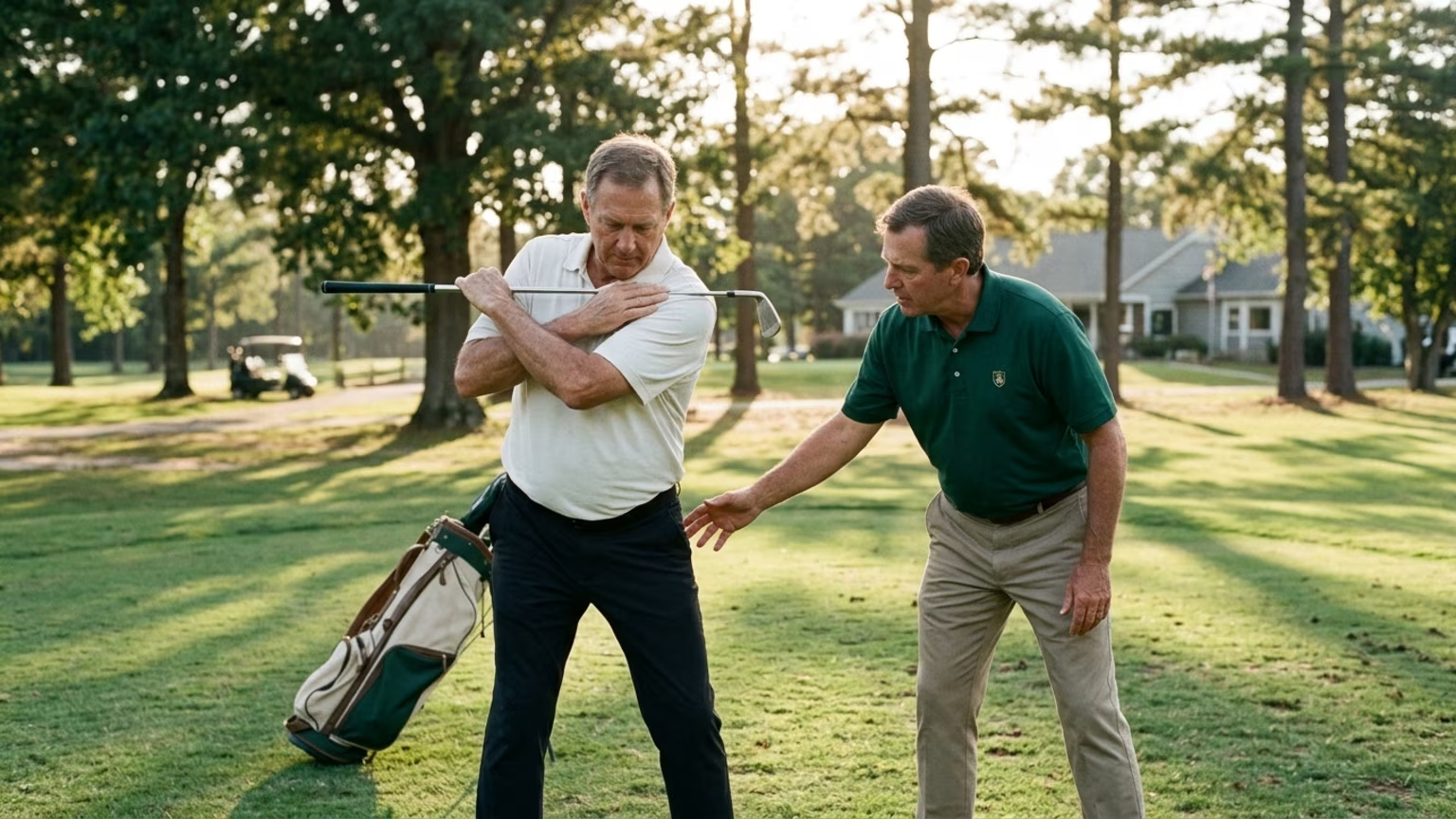

See why a useful golf turn is about available movement and control, with practical questions for golfers over 40 and 50.




Swing rotation is the turning movement available across your hips, trunk and shoulders. A useful golf turn brings that movement into the swing with comfort and control, rather than chasing the longest possible backswing.
A review-oriented golf mobility article describes swing movement as involving several body regions. For a golfer, that makes the turn a whole-body question rather than simply a request to move the shoulders farther.
One measurement often used in this discussion is the X-factor. A sports-physiotherapy explainer defines it as the separation between shoulder and hip rotation near the top of the backswing. X-factor stretch means the increase in that separation as the downswing begins.
That distinction gives “turn more” some needed context. Are you being asked to change your overall turn or create more separation between two parts of your body? Those are different coaching conversations.
On the first tee, a bigger-turn cue can sound straightforward. But the useful question is what movement the cue asks you to produce. Is the focus on your hips, your trunk or the relationship between your shoulders and hips?
Think of the anatomy as connected parts of the same task. Your available hip movement belongs in the discussion alongside your trunk and shoulder movement. The aim is to understand your turn as a whole before deciding which part needs attention.
During a normal round, comfort and effort give you something practical to describe. For example, reaching the top of the backswing might feel comfortable while trying to add more turn feels forced. That is an observation to discuss rather than a reason to label one joint as faulty.
Tee shots and approach shots give this question a place in ordinary play. Instead of judging every swing by how far back the club appeared to travel, pay attention to whether the requested movement felt available. Keep the observation simple: “That turn felt comfortable” or “I felt as though I was forcing the finish of the backswing.”
If the turn feels different later in the round, bring that detail to a coaching conversation. You do not need to decide what caused the change before describing it.
This is the value of thinking about movement across the whole swing. It changes the conversation from “How can I turn farther?” to “What movement am I asking my body to produce?”
For golfers over 40 or 50, a changing turn deserves attention without turning a birthday into a physical diagnosis. The evidence reviewed here does not measure natural mobility loss at those ages or explain its biological causes. It therefore cannot tell you how much rotation you should lose or which body region should change first.
The wider evidence also calls for care. A summary of a 2023 systematic review describes limited and conflicting evidence linking particular golf-swing variables to low-back pain. The golf mobility review notes that differences between studies make it difficult to prescribe one ideal movement pattern for every golfer.
The sports-physiotherapy explainer makes a related point about X-factor. Greater separation is not automatically dangerous, and less separation does not guarantee safety. A comfortable or shorter backswing should not be presented as proven injury prevention.
Keep those limits together rather than turning each swing sensation into a medical theory. Your age can help frame your goals. Your current movement and any symptoms belong in an individual assessment, not a comparison with a universal backswing target.
The research supports two accessible starting habits: question a vague bigger-turn cue and seek an assessment that looks beyond one body segment. Neither requires adopting a rotation number or inventing an exercise routine.
Treat “make a bigger turn” as the start of a conversation. Ask your coach which movement they want to change and what that change is meant to achieve.
Keep the discussion focused on one small element at a time. If the cue concerns your trail hip, ask about that movement before adding a separate shoulder instruction. This keeps the coaching task clear without assuming that every golfer needs more movement everywhere.
Useful questions include:
These questions do not reject swing improvement. They give improvement a clearer purpose than making the backswing look longer.
The same mindset applies to working on control rather than simply adding turn. The goal is a useful coaching decision rather than extra movement for its own sake.
The TPI movement-screening material describes an assessment that looks at movement through different positions. It says this can help coaches identify possible physical limitations and build a realistic improvement plan.
Ask a qualified golf or movement professional to consider your available hip, trunk and shoulder movement together. Bring a clear description of what you notice during a round. “Adding turn feels forced” gives the professional a specific concern to assess without supplying your own diagnosis.
If pain is present, discuss it with a qualified clinician rather than assigning it to backswing length yourself. Decisions about painful movement need individual care.
A useful outcome from assessment is a clearer coaching priority. It might begin with understanding one movement rather than collecting several new swing thoughts. Keep the longer-term aim centred on a comfortable and repeatable turn, not a position copied from someone else's swing.
A turn built around the movement you have keeps the focus on comfort, control and Playing Better for Longer.
Follow Golfergy for practical insights on performance, mobility, recovery and healthy ageing. Stay connected for new articles, research-led guidance and ideas to help you play better for longer.



Keep everyday movement separate from golf preparation, with practical habits for desk and travel days plus a clear look at warm-up evidence.


Understand how hips, trunk and shoulders share a golf turn, with gentle ways to notice restrictions and work within a comfortable range.

Understand how hips and spine share your golf turn, why restrictions may change that pattern, and how to focus on comfortable, controlled movement.
Explore practical resources on performance, recovery, mobility and golf longevity.
Read the Blog