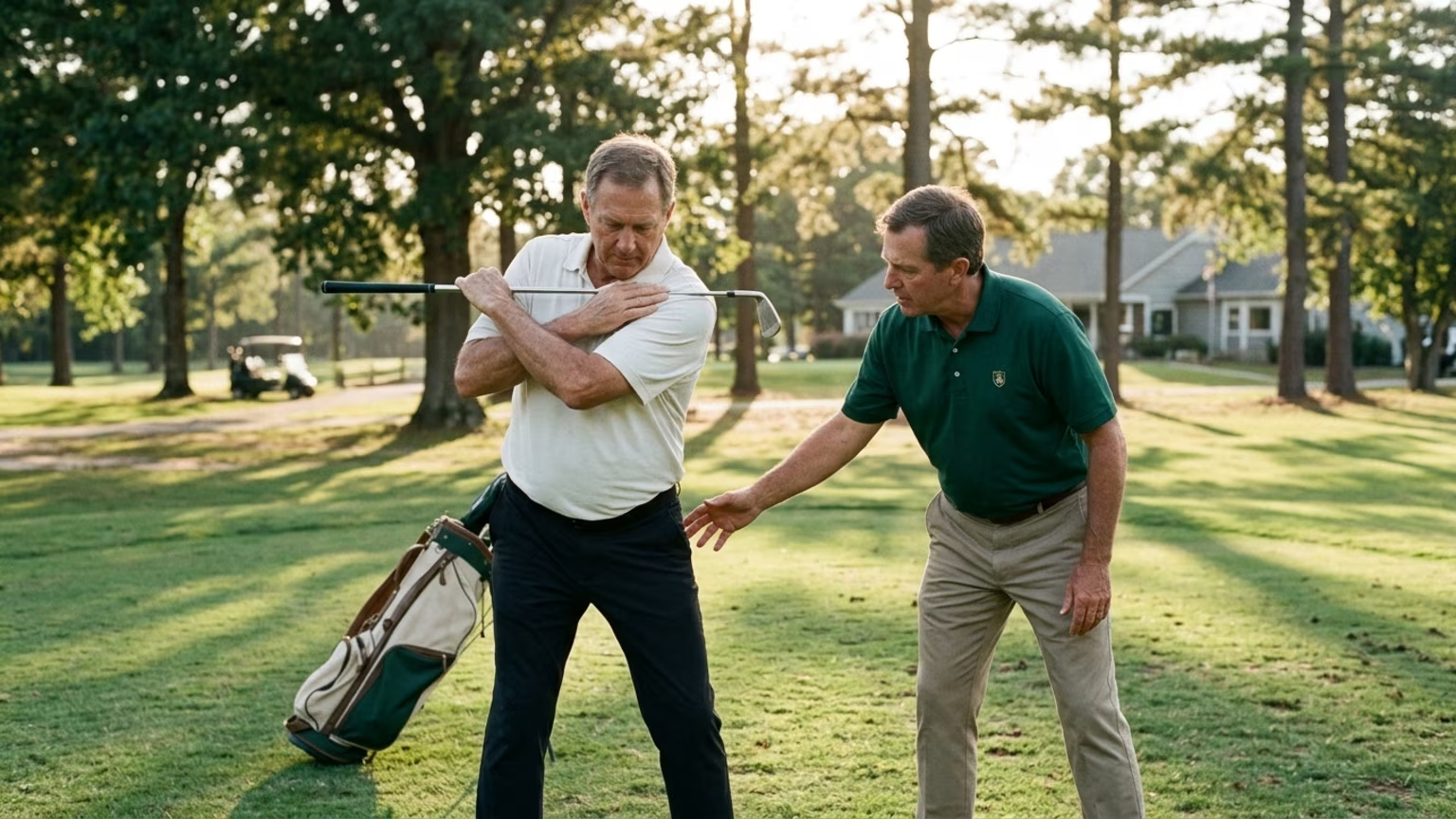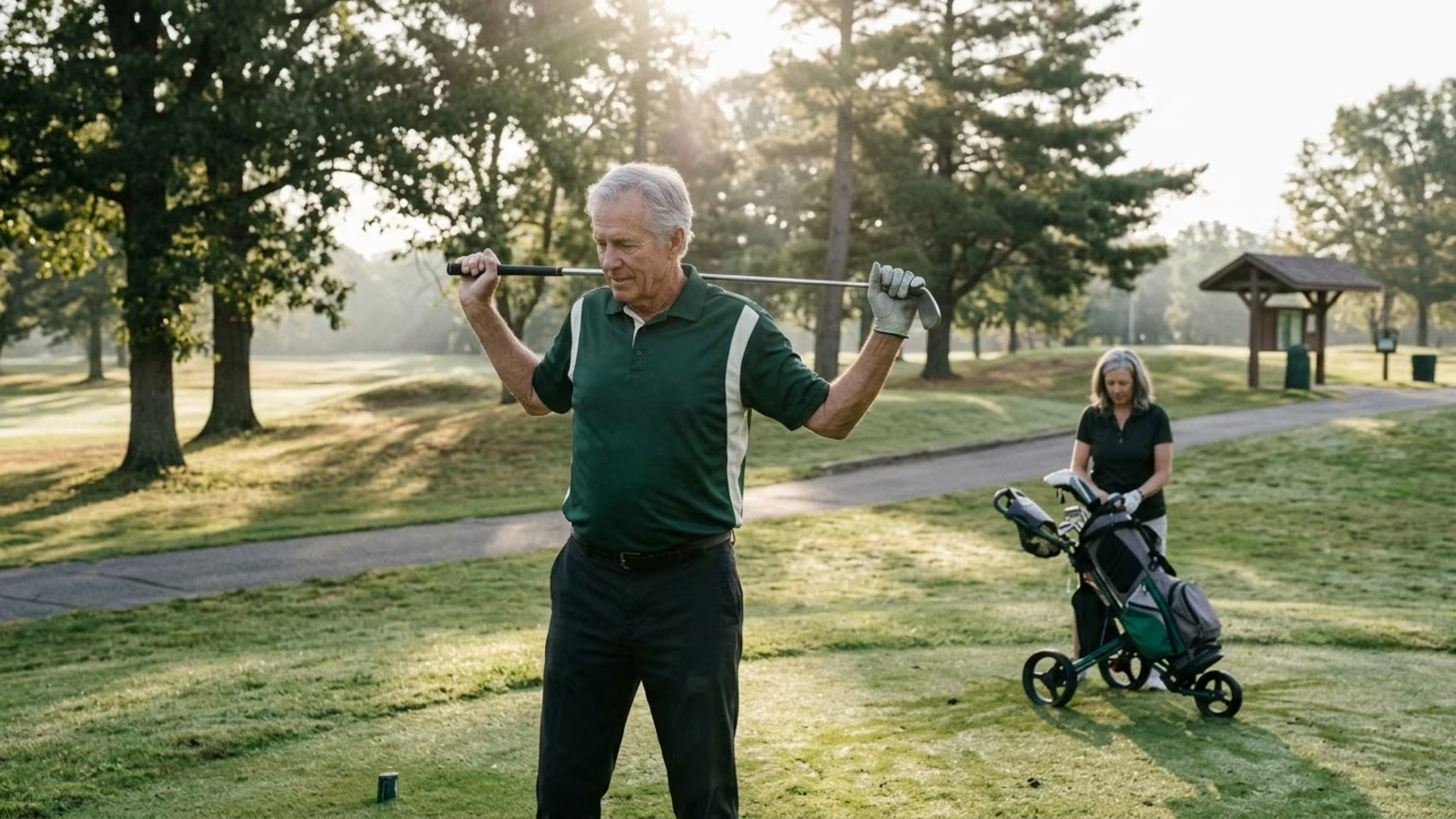

Learn how legs, hips, trunk and upper body work together in the golf swing, with simple movement examples and age-aware guidance.




Whole-body golf strength is your legs, hips, trunk and upper body working together to create and control force in the swing. It is not a search for one special golf muscle. The useful question is how the different parts contribute to the same movement.
A golf-fitness guide describes lower-body, upper-body and core strength as contributors to producing and controlling force. Its exercise examples cover several areas rather than one isolated target. That gives us a practical starting point: think about the body as a connected system.
A golf mechanics explainer uses a ground-up chain to describe that connection. The legs provide a base for movement. The hips and trunk help organize rotation, while the upper body carries that movement toward the club.
For Golfergy, this is a useful way to frame training for the demands of the course. It keeps the conversation focused on playing golf rather than chasing one isolated muscle group.
During a standard round, the chain is a way to think about each full swing. Instead of viewing the shot as something your arms produce alone, think of a base below a turn. Then think about the upper body carrying that movement toward the club.
The anatomy becomes easier to follow when each area has a simple role:
These are roles within the explainer's model, not instructions to move each part separately. Turning a swing into a checklist of body parts misses the point of calling it connected.
What might that feel like on the course? A useful description is a turn that feels supported from below rather than an effort made only with the arms. That is a way to describe coordination, not a standard your swing must match.
The back nine gives this idea a practical setting. If your swing feels less connected late in the round, that feeling alone does not identify a weak muscle. It is a question to bring to an assessment rather than proof that the answer is more core work.
For a golfer past 40 or 50, the goal is not to train an age label. It is to find a useful starting point for the body available today. Passing a birthday does not tell you which of the chain's parts deserves attention.
The connected-swing model explains relationships between body regions. It does not explain the biology of ageing or establish how quickly strength declines after 40 or 50. These guides also do not establish precise force shares, a best routine or proof that these exercises prevent injury.
That leaves a clear practical direction: match the movement to current ability rather than assume everyone your age needs the same version. A qualified exercise professional can help make that choice. Pain or an existing health condition makes the decision a matter for qualified healthcare advice.
At Golfergy, we believe in treating age as context for training rather than an exact formula. The priority is a sustainable habit that fits your golf, not a promise to reverse the clock.
The golf-fitness guide lists squats, lunges, rows and medicine-ball throws among its examples. For a foundational discussion, two of those movement categories are enough: a squat and a rotation.
The following easier versions are editorial suggestions for that discussion.
The squat is one of the provider's examples of lower-body strength work. In the chain model, that makes it a way to discuss the strength of the base rather than the strength of the arms.
A supported squat through a shorter range is the simpler adaptation described here. Keep the discussion focused on one movement: the squat itself. Support and range are the features to adjust with a qualified professional, not a target depth borrowed from another golfer.
The broader point is modest. A familiar lower-body movement can belong in a golf-strength conversation without looking like a swing.
The provider also includes medicine-ball throws as a coordinated movement example. That is not a reason to make throwing the starting point for every golfer.
A controlled rotation without a ball is an easier editorial adaptation. Its single focus is the turn. There is no need to turn it into a combined squat, reach and throw.
This keeps the starting point understandable: one lower-body pattern and one controlled turning pattern. It does not make either a complete whole-body program. The provider's rows are another example of how upper-body work can fit the wider picture.
Whole-body thinking does not mean isolated exercises have no place. It means one exercise should not have to carry the entire job.
If planning feels confusing, start the conversation with a strength approach that fits around golf. Choosing a manageable movement category is a more useful discussion than collecting a long exercise list.
Train the legs and hips to work with the trunk and upper body for one purpose: Playing Better for Longer.
Follow Golfergy for practical insights on performance, mobility, recovery and healthy ageing. Stay connected for new articles, research-led guidance and ideas to help you play better for longer.


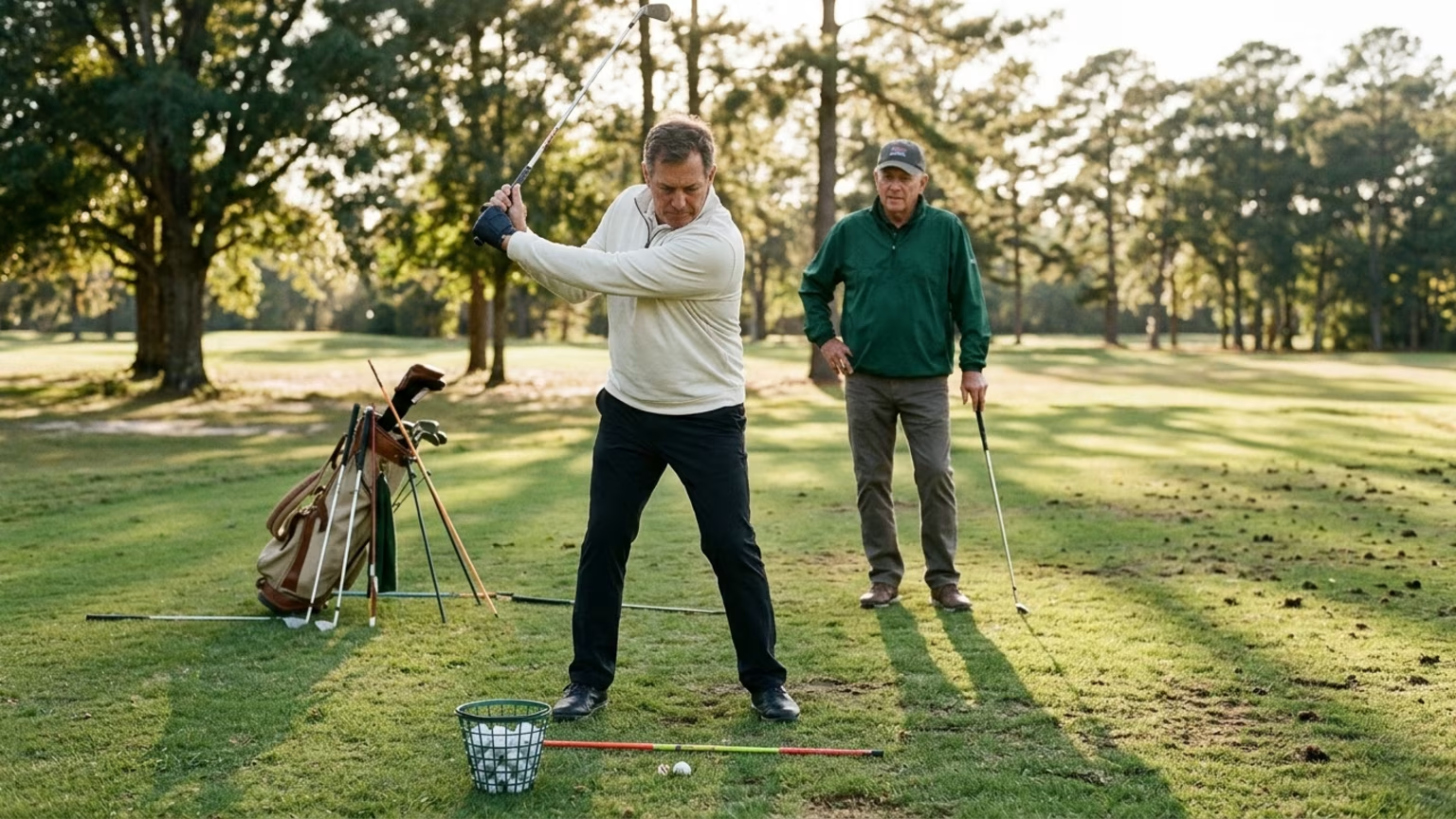
Learn how strength differs from power in the golf swing, what older-golfer studies show, and why controlled training matters more than chasing effort.


Understand how strength relates to swing speed, what older-golfer studies show, and why lifting alone is not a distance shortcut.

An elite golf study linked 16 weeks of strength training with faster clubhead speed. Here is the evidence-bounded takeaway for golfers over 40.
Explore practical resources on performance, recovery, mobility and golf longevity.
Read the Blog