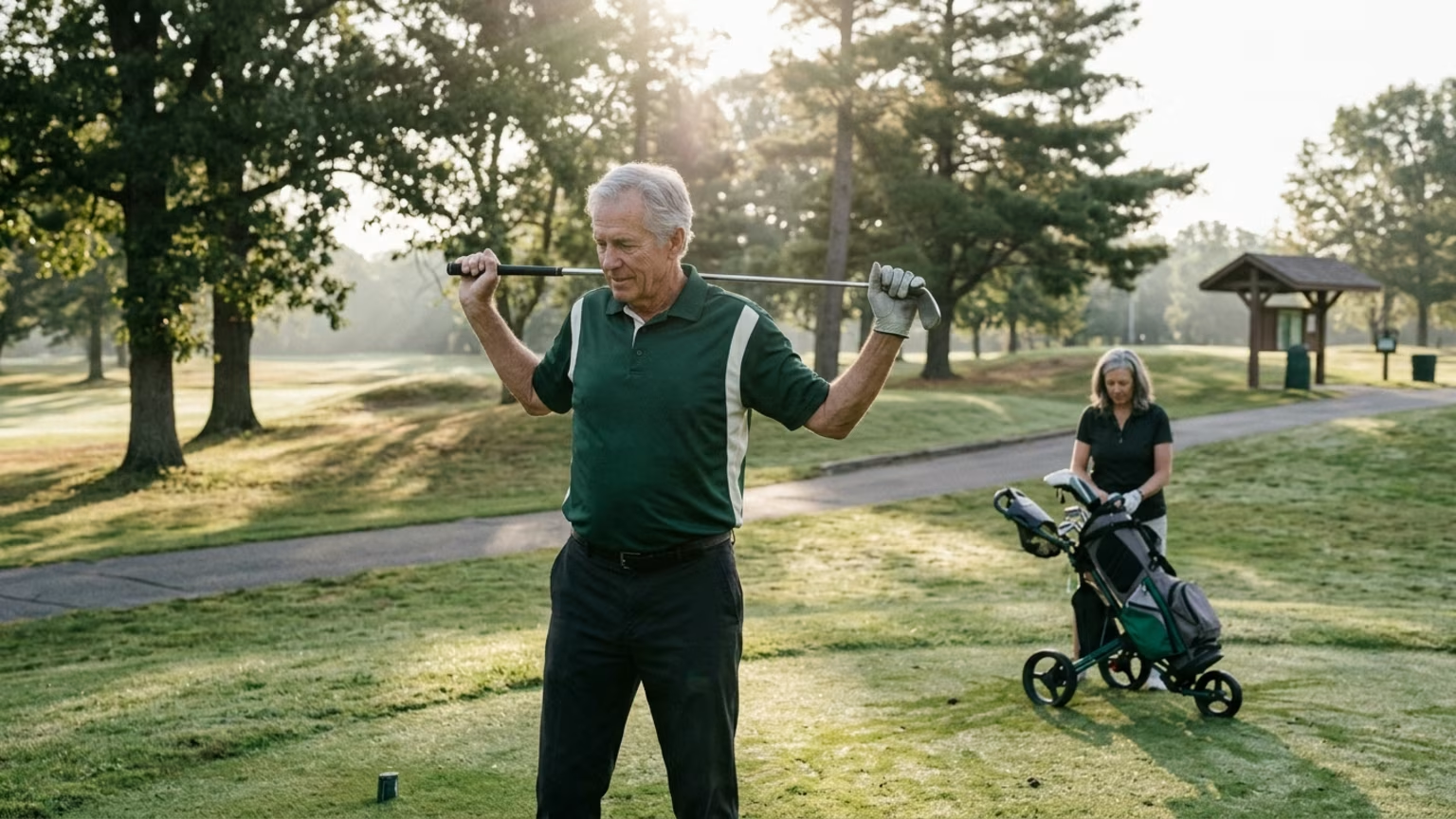
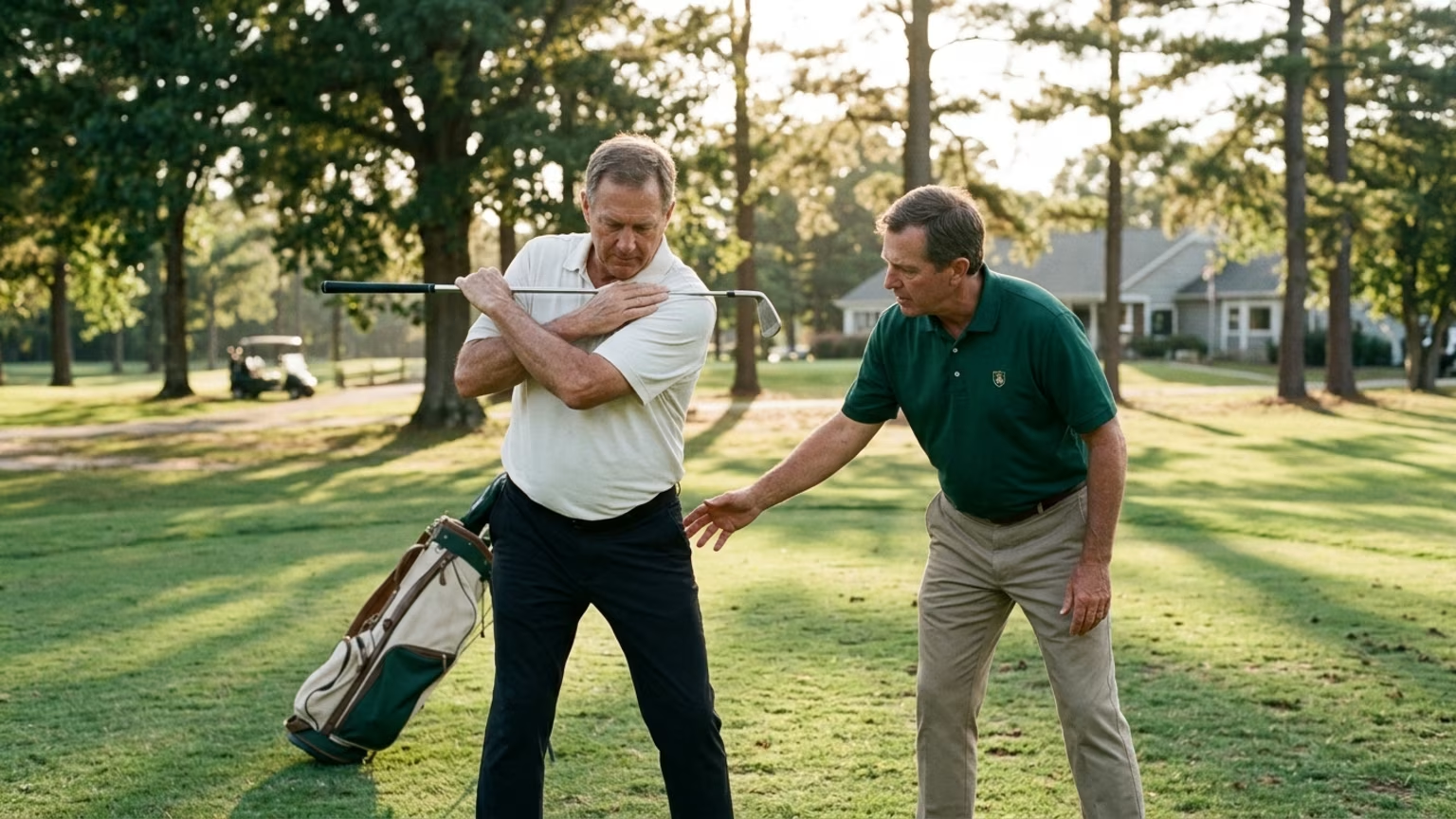
Build a flexible golf fitness week around strength, balance, mobility and aerobic activity, with realistic expectations for golfers over 40.




Golf readiness is your ability to produce movement, control your position and sustain activity throughout a round. Strength, balance, mobility and aerobic fitness describe different parts of that readiness. A well-rounded plan gives each part a place rather than asking stretching or walking to do every job.
The anatomical picture is straightforward. Strength concerns the force your muscles can produce. Mobility concerns the movement available at your joints. Balance concerns control of your body position, while aerobic fitness concerns your capacity for sustained activity.
For experienced golfers, the aim is not to turn the week into a demanding training project. It is to connect manageable activity with the demands of the game. At Golfergy, that means favoring sustainable habits over quick fixes.
An ordinary round gives these fitness terms a practical meaning. Think about the difference between moving the club during a swing and walking between shots. Both belong to golf, but they are not the same physical task.
Use these four questions to connect the framework to your own round:
These are useful descriptions rather than self-diagnostic tests. A restricted-feeling turn does not identify a particular joint problem. A tiring back nine does not reveal its cause on its own.
For the swing, mobility is best viewed as available movement rather than a demand to turn farther. Our guide to sharing rotation across the body takes that discussion beyond a single stretch.
Walking belongs in the picture too. A sports-medicine summary of a golf-health review describes golf as predominantly moderate-intensity activity. It links regular play, particularly walking the course, with cardiovascular and metabolic benefits.
That makes golf a useful contributor to an active week. It does not make a round interchangeable with planned strength or balance work. Public-health guidance treats those forms of activity as separate parts of a broader plan.
Passing 40 or 50 is a useful point to review your fitness habits. It is not a measurement of your strength, balance or available movement. The practical question is what your present capacity allows and which parts of your week receive little attention.
Older-golfer research gives a reason to take structured exercise seriously. A summary of Thompson and Osness (2004) describes a study involving 31 male golfers aged 55-79. After an eight-week strength-and-flexibility program, the training group’s average clubhead speed rose from 85.0 to 87.1 mph.
Another summarized study involved 18 male golfers averaging 70.7 years old. Its eight-week program combined flexibility, core stability, balance and resistance training. The training group’s maximum clubhead speed rose from 127.3 to 133.6 km/h. The control group did not improve.
The evidence has clear boundaries. These small male samples and combined programs do not establish the same response for every golfer or identify which training component produced the changes. They do not explain the natural rate or causes of physical change through the 40s and 50s. Nor do they establish an ideal golf-training week, guaranteed extra distance or injury prevention.
The useful lesson is that older age did not rule out improvement in those groups. A birthday alone should not decide what training is worthwhile. Start with your current abilities rather than assuming that every older golfer needs the same exercises.
Age does affect how the general guidance is framed. For adults 65 and older, the World Health Organization guidance summarized in the research adds a specific focus on varied activity that combines functional balance and strength.
The weekly framework below brings the general recommendations together. Its purpose is to make room for each element without creating an elaborate routine. Keep exercise choices appropriate to your current ability and let the calendar support consistency.
The summary of World Health Organization guidance recommends muscle-strengthening activity on at least two days per week. The practical framework in the research places those sessions on nonconsecutive days. Sessions should cover the major muscle groups using movements appropriate to current ability.
Start the planning process by marking your golf rounds on the calendar. Then find places for the strength sessions. If harder strength work the day before a demanding round makes the schedule less comfortable, place it elsewhere. That is a practical scheduling choice rather than a proven golf-performance rule.
Keep the purpose clear: this is a place for muscle-strengthening work within a balanced week. It does not need to imitate a golf swing to justify its place in the public-health framework.
For more context, read about giving strength work a manageable place in your golf week. The goal is a routine you can maintain rather than a short burst of ambitious training.
The same guidance recommends 150-300 minutes of moderate-intensity aerobic activity per week or 75-150 minutes of vigorous activity. Walking, cycling and other suitable activities can contribute. Walking the course may count toward that total when the effort is meaningful, but simply recording a round does not show that the target has been met.
Spread aerobic activity across the week in a way that fits your playing schedule. Keep golf in the plan without expecting it to supply every type of exercise. This distinction is useful when a busy playing week leaves little time for other activity.
Add brief, regular balance practice and comfortable range-of-motion work alongside that aerobic activity. For adults 65 and older, the guidance calls for varied activity emphasizing functional balance and strength on three or more days per week.
During mobility work, focus on one comfortable movement at a time. The role here is to give movement practice a place beside strength and balance rather than treating a bigger turn as the sole target.
A simple calendar review can keep the framework practical: look for the strength sessions, the aerobic activity and the opportunities for balance and mobility. Our guide to matching fitness with the demands of a full round provides related context.
When pain, health conditions or functional limitations affect exercise choices, use qualified clinical guidance to shape the plan around your situation.
Muscles that produce force, joints with comfortable movement and the capacity to control and sustain activity belong together in Playing Better for Longer.
Follow Golfergy for practical insights on performance, mobility, recovery and healthy ageing. Stay connected for new articles, research-led guidance and ideas to help you play better for longer.



Build a more repeatable golf turn by considering hips, trunk and shoulders together, with practical habits and a clear view of the evidence.


Look beyond a flexibility score to understand golf mobility, strength, balance and coordination, with practical ways to observe your own turn.

Learn how static and dynamic balance differ, how foot pressure moves through the swing, and two simple ways to observe your control.
Explore practical resources on performance, recovery, mobility and golf longevity.
Read the Blog