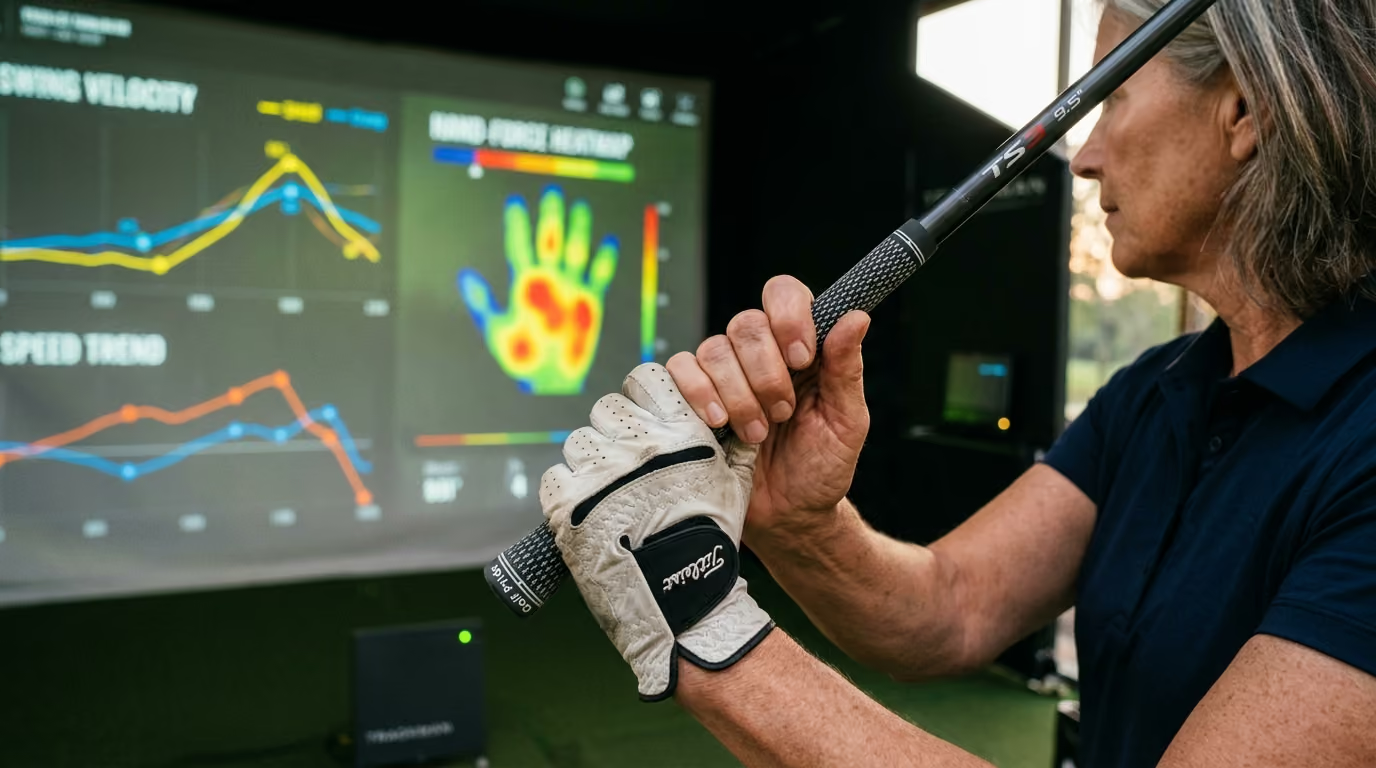
Effortless swing power and longer drives come naturally when you use ground reaction forces to create clubhead speed instead of overworking your upper body.




Most golf instructors tell you to pull the club down with your arms. They tell you to twist your shoulders as hard as possible. This advice is actually backward. Trying to manufacture speed with your upper body is highly inefficient.
As we cross the age of 40, relying on sheer muscular force is a losing strategy. Your muscle mass naturally declines. Your joints lose some of their natural flexibility. If you try to swing harder using only your upper body, your spine absorbs the shock.
The secret to effortless power is not in your shoulders. It is right under your feet. The turf is a massive source of free energy. By learning how to interact with the ground, you can generate more speed with less physical strain.
This guide will show you how to use ground reaction forces to protect your body and hit longer drives. We will break down the science of foot pressure, sequence your movements, and show you how to train your legs. You will learn to use the earth as a springboard for your swing.
Imagine you are standing on the tee box of the par-four fourteenth hole. You have walked several miles, and your legs are starting to feel heavy. Your lower back has a slight dull ache. You need a big drive to clear a fairway bunker, so you decide to swing hard.
You take a long backswing and pull the club down with your arms. Because your lower body is tired, your feet stay quiet. Your weight remains stuck on your back foot. The club slices across the ball, sending a weak fade into the rough.
This common scenario shows what happens when your lower body stops working. When your legs get tired, your brain stops using the ground. You lose your foundation, so your upper body tries to compensate. This compensation ruins your swing path, kills your clubhead speed, and puts your joints in danger.
Understanding how to use the ground is vital for improving your golf recovery. When you build a swing based on ground forces, your larger leg muscles do the work. Your spine and shoulders simply act as transmitters of that power. This shift keeps you fresh and pain-free through the eighteenth hole.
To understand how this works, we must look at basic physics. Sir Isaac Newton proved that for every action, there is an equal and opposite reaction. When you push your feet down into the grass, the grass pushes back against you. This return force is called ground reaction force.
In biomechanics, researchers divide these forces into three directions. There are lateral forces, rotational forces, and vertical forces. Each force plays a distinct role in moving your club. They must happen in a precise sequence to create speed.
If you only focus on turning your shoulders, you miss out on these forces. Think of a sprinter starting a race. They do not just stand up and run. They push hard against the starting blocks to propel themselves forward.
Using these forces helps you maintain rotational flexibility as you age. By letting the ground turn your hips, you do not have to force your joints past their comfort zone. You let physics do the heavy lifting.
Your swing uses three different types of ground force. They must peak at different times during the downswing. Biomechanists call this pattern the kinetic sequence. When you get the order right, the club accelerates naturally.
Horizontal force is the side-to-side push. It is the force that shifts your pressure from your trail foot to your lead foot. This is the first force to peak during your downswing.
This push must happen early. It peaks when your lead arm is parallel to the ground during the transition. If you do not push laterally, you cannot transfer your energy forward. You will end up hanging back on your trail leg.
To do this correctly, focus entirely on shifting your lead hip toward the target. Do not spin your shoulders yet. Just slide your weight onto your front foot. This shift creates the foundation for the next forces.
Rotational force is created by a shearing motion. Your feet push the ground in opposite directions. Your trail foot pushes forward, while your lead foot pushes backward.
This dual action turns your pelvis. It acts like a brake on your lateral shift, turning that forward energy into fast rotation. This force peaks as your lead arm is moving from parallel to the ground down toward the ball.
Without rotational torque, your hips will slide too far forward. This slide is called lateral sway. Pushing your front foot backward stops the slide and snaps your hips open.
Vertical force is the downward push that creates upward lift. You push straight down into the turf, and the ground pushes you back up. Golfers often call this posting up or jumping.
This force peaks when your club shaft is parallel to the ground. This is well before you actually hit the ball. This sudden upward push pulls your lead side up and slings the club through impact.
Elite long hitters generate vertical forces that exceed 200 percent of their body weight. You do not need to hit that number to play good golf. However, you do need some vertical lift to generate speed. Research from Swing Catalyst shows that vertical force is the primary driver of clubhead speed.
You might think that drivers require the most vertical force because they go the farthest. Biomechanical research shows the opposite is true. Golfers actually generate more vertical force with their irons.
Studies show that skilled players produce vertical forces of about 1.1 times their body weight on their front foot with an iron. With a driver, that number drops to around 0.84 times their body weight. This difference comes down to swing planes and angles of attack.
An iron swing is steeper, requiring a more direct downward push to hit down on the ball. A driver swing is flatter and wider. To hit a driver, you need more horizontal and rotational force to sweep the ball off the tee.
Understanding this distinction helps you avoid injury. If you try to jump as hard with a driver as you do with a seven-iron, you might lose your balance. Focus on a wide, stable rotation with your driver, and use a sharper downward push with your irons.
Before you try to fix your swing, you need to know how you currently use the ground. Most amateur golfers fall into one of three categories. Identifying your type will help you choose the right drills.
Gliders rely almost entirely on horizontal force. They slide their hips far toward the target during the downswing.
While this movement transfers weight, it often leads to a slide that goes too far. If you slide past the ball, you cannot rotate your hips. This limits your speed and causes blocks or hooks.
Spinners use rotational force but lack lateral shift and vertical lift. They spin their hips immediately from the top of the backswing.
Because they do not shift their weight forward, they tend to stay on their trail foot. This movement causes an over-the-top swing path. It also places a high amount of twisting stress on the lower back.
Launchers use vertical force but often use it at the wrong time. They push upward too early in the downswing, before their weight has shifted forward.
This early push causes the hips to move toward the ball, which straightens the spine. You lose your posture and have to flip your wrists to make contact. To use vertical force, you must first shift and rotate.
If you feel your power slipping during a round, you need an immediate adjustment. You cannot think about complex biomechanics while standing over the ball. You need simple, physical cues.
Before you take your shot, try a practice swing with a small step. Start with your feet close together. As you take your backswing, lift your lead foot slightly.
Just before your backswing ends, step your lead foot back down. Press your weight firmly into the grass. Once your foot is planted, swing the club through.
This drill exaggerates the transition. It forces you to get your weight onto your lead side before you swing down. It stops you from hanging back on your trail leg.
If you struggle with rotation, simplify your thoughts. Focus entirely on turning your trail hip backward during the backswing. Feel your weight load into the inside of your trail heel.
Holding this weight in your heel prevents you from swaying outward. It sets up a strong diagonal line of force. When you start down, you can push off that heel to rotate your hips.
Keep your thoughts focused on one joint at a time. Trying to control your feet, knees, and hips all at once will paralyze your swing. Focus on your trail hip, and let the rest of your body follow.
These small adjustments can prevent the joint strain that causes chronic golf injuries. Keeping your movement simple reduces muscle tension. This tension is often the real cause of post-round soreness.
On-course feels are helpful, but they only work if your body has the physical capacity to move. You need to train your muscles and joints to handle these forces. A simple, regular routine will build the strength you need for golf.
For older golfers, the goal is not to lift heavy weights. The goal is to build stability, coordination, and explosive power. You can do these exercises at home with minimal equipment. Check our golf physical resources for more training ideas.
This exercise trains the transition from lateral shift to vertical lift. Stand in your golf posture with your hands on your hips.
Shift your weight slowly onto your lead foot. Once your weight is there, straighten your lead leg. Focus entirely on turning your trail hip forward as you straighten.
Do not let your lead knee buckle outward. Keep your lead foot flat on the ground. Repeat this motion ten times to build muscle memory for the downswing. This is a great way to start your strength training for golf longevity.
This drill teaches the timing of the downward push. Hold a light medicine ball with both hands. Stand with your feet in your normal golf stance.
Raise the ball up over your trail shoulder, simulating a backswing. From this top position, shift your weight to your lead foot.
Slam the ball down into the ground right next to your lead foot. To do this with power, you must push down hard with your legs. This movement mimics the vertical force peak that happens before impact.
Snap downs build the deceleration strength needed to protect your joints. Stand tall with your feet shoulder-width apart. Raise up onto your toes and reach your arms overhead.
In one quick movement, snap your arms down and drop into a shallow squat. Land softly on flat feet. Keep your knees aligned over your toes.
Hold this landing position for two seconds. This exercise teaches your body how to absorb force quickly. This ability is crucial for preventing knee and lower back pain.
If you have knee issues, standard jumping movements can be painful. The caveman throw is a safer alternative. Hold a light medicine ball between your knees in a shallow squat.
Push through your heels and stand up quickly. Throw the ball straight up and forward over your head.
Focus entirely on extending your hips. Do not jump off the ground. This extension trains your glutes to generate vertical force without putting high impact on your knees.
When golfers try to use the ground, they often make a few critical mistakes. These errors actually reduce your power and increase your risk of injury.
This is the most common mistake among amateur players. Golfers try to hit the ball high by staying on their back foot. They do not shift their weight forward during the transition.
When you hang back, your low point shifts behind the ball. You will either hit the ground first or thin the ball. This movement also prevents you from using vertical force. You cannot push up if you have not shifted your weight forward.
Some players hear about vertical force and try to jump immediately. They push upward before they finish their lateral shift.
This early jump pushes your hips toward the ball. Your spine straightens, and you lose your posture. Biomechanists call this early extension. It leaves no room for your arms, forcing you to flip your wrists to hit the ball.
Your lateral and vertical forces should not happen at the same time. If you push up and forward together, you will slide past the ball. Your balance will suffer, and you will lose rotational torque.
The lateral shift must happen first to establish a pivot point. Once your lead foot is planted, you push down to go up. Keep these movements sequential, not simultaneous.
To generate vertical force, your lead leg must act as a solid post. If your lead knee buckles outward or stays bent, your platform collapses.
A collapsing knee absorbs the energy instead of reflecting it up to the club. It also puts dangerous lateral stress on your knee joint. Keep your lead foot stable and let your leg straighten naturally as you turn.
Your connection to the ground is only as good as your footwear. If your shoes slip, you cannot generate horizontal or rotational force. You will waste energy trying to stay balanced.
Many modern golfers prefer spikeless shoes because they are comfortable. However, research shows that spiked shoes offer significant performance benefits. A study conducted at Pinehurst Resort compared spiked and spikeless designs.
The study found that wearing spiked shoes improved ball speed and smash factor. High handicappers gained an average of six yards of carry distance. Low handicappers gained about 2.6 yards.
Spikes provide a more consistent platform for high-torque swings. Spikeless shoes had more slips and inconsistent strikes. If you want to get the most out of your ground forces, wear shoes with high-quality spikes.
Check your shoes regularly. If the spikes are worn flat, you are losing power. Replacing your spikes is a simple way to restore your connection to the turf. Read more about gear and performance in our golf blog.
Using ground reaction forces is the best way to maintain your speed as you age. It takes the pressure off your joints and puts it into the turf. By training your lower body to interact with the ground, you can play pain-free golf for years.
Focus on one movement at a time. Start with your lateral shift, then build your rotation, and finally add your vertical push. Consistent, daily habits will yield the best results on the scorecard.
Your power does not come from your arms, so stop pulling and start pushing against the turf.
Follow Golfergy for practical insights on performance, mobility, recovery and healthy ageing. Stay connected for new articles, research-led guidance and ideas to help you play better for longer.


Explore practical resources on performance, recovery, mobility and golf longevity.
Read the Blog