
Eight weeks of targeted resistance training can boost senior golfers' driving distance by nearly eleven percent while protecting vulnerable joints from painful sports injuries.




Do you find yourself searching the internet for ways to stop losing driving distance after age 60? Many senior players search for remedies for lower back pain after playing eighteen holes. It is common to feel your swing getting shorter and your body getting stiffer each season. You do not have to accept this physical decline as a normal part of getting older. Strength training can build a protective layer of muscle to support your joints and keep you on the tee box for decades.
The saddest thing I have seen in golf is watching lifelong playing partners slowly drop out of our weekend group. It usually starts with a nagging shoulder or knee issue they ignore until it requires surgery. That pattern is exactly why I became obsessed with golf longevity. We do not have to stop playing as we age, provided we do the right maintenance work between rounds.
We will look at how targeted resistance training helps you maintain your mobility, protect your spine, and hit the ball further than you have in years. By building physical armor, you can preserve your swing speed and protect your body from the repetitive stress of the golf swing.
As we age, our bodies undergo specific physical changes that directly affect the golf swing. The most common change is the gradual loss of muscle mass, a condition known as sarcopenia. Research shows that sarcopenia affects between 5 percent and 13 percent of adults over the age of 60. This loss of muscle tissue makes it harder to support your joints during a high-speed swing.
An even bigger challenge for golfers is dynapenia, which is the loss of muscle strength and power. Dynapenia often occurs much faster than the loss of actual muscle mass. As you lose muscle power, your ability to generate speed decreases. This physical change is the primary driver of lost clubhead speed on the tee box.
Many players assume that losing twenty yards off the tee is just a natural biological limit. However, sports science shows that much of this loss comes from sedentary habits rather than aging itself. If you do not actively train your fast-twitch muscle fibers, your body slowly stops using them. These fast-twitch fibers are responsible for explosive movements, like the downswing.
Fortunately, these muscle fibers can be recovered with the right type of training. An 8-week resistance training study showed that senior golfers can increase their driving distance by up to 10.9 percent. Rebuilding these muscle fibers does not just add distance to your drives. It also creates a stronger physical cushion around your joints to absorb the force of the swing.
To build effective armor for your golf game, you must understand how your body moves. Sports scientists use a concept called the mobility-stability framework to explain this. This framework views the human body as a stack of joints. Each joint has a specific job to do during the golf swing.
Some joints are designed to move in multiple directions, which is called mobility. Other joints are designed to remain steady and resist movement, which is called stability. In a healthy body, these joints alternate. Your ankles need mobility, while your knees need stability. Your hips need mobility, while your lower back, or lumbar spine, needs stability.
+-----------------------------------+
| THE MOBILITY-STABILITY |
| FRAMEWORK |
+-----------------------------------+
| Shoulder ........ MOBILITY |
| Scapula ......... STABILITY |
| Thoracic Spine .. MOBILITY |
| Lumbar Spine .... STABILITY |
| Hips ............ MOBILITY |
| Knees ........... STABILITY |
| Ankles .......... MOBILITY |
+-----------------------------------+
When you play golf, your swing demands a lot of movement. If your hips are tight and cannot turn, your body still needs to find that rotation somewhere. It will force your lower back to twist to make up for the tight hips. Because your lower back is designed for stability rather than rotation, this extra twisting leads to tissue damage and severe pain.
This is why we focus heavily on injury prevention by training specific joints for their correct roles. We must train the hips and the thoracic spine to rotate freely. At the same time, we must train the core and the lower back to remain strong and stable. This joint-by-joint approach prevents your body from compensating in ways that cause injury.
Many golfers believe that swing power comes entirely from the arms and shoulders. In reality, the power in a golf swing starts at your feet. Biomechanists call this ground reaction force, which is the force you exert against the turf. When you push down into the ground during your swing, the ground pushes back up through your body.
This upward force travels through your legs, into your hips, across your core, and finally into the clubhead. Senior golfers often lose the ability to push against the ground efficiently. As leg strength declines, players begin to rely on their upper body to pull the club through. This swing style reduces clubhead speed and places immense strain on the neck, shoulders, and lower back.
Compound leg movements, such as squats and deadlifts, are the best way to rebuild this lower-body engine. These exercises train your legs to apply force into the floor. This directly improves your ability to create speed without overworking your upper body. It also provides a solid foundation that prevents you from losing your balance during the swing.
The benefits of rebuilding this ground-based power are well-documented. A 10-week strength and flexibility program for golfers aged 55 to 79 showed great success. The players increased their average clubhead speed from 85.0 to 87.1 miles per hour. By focusing on strength, these golfers improved their swing efficiency and reduced their physical fatigue on the back nine.
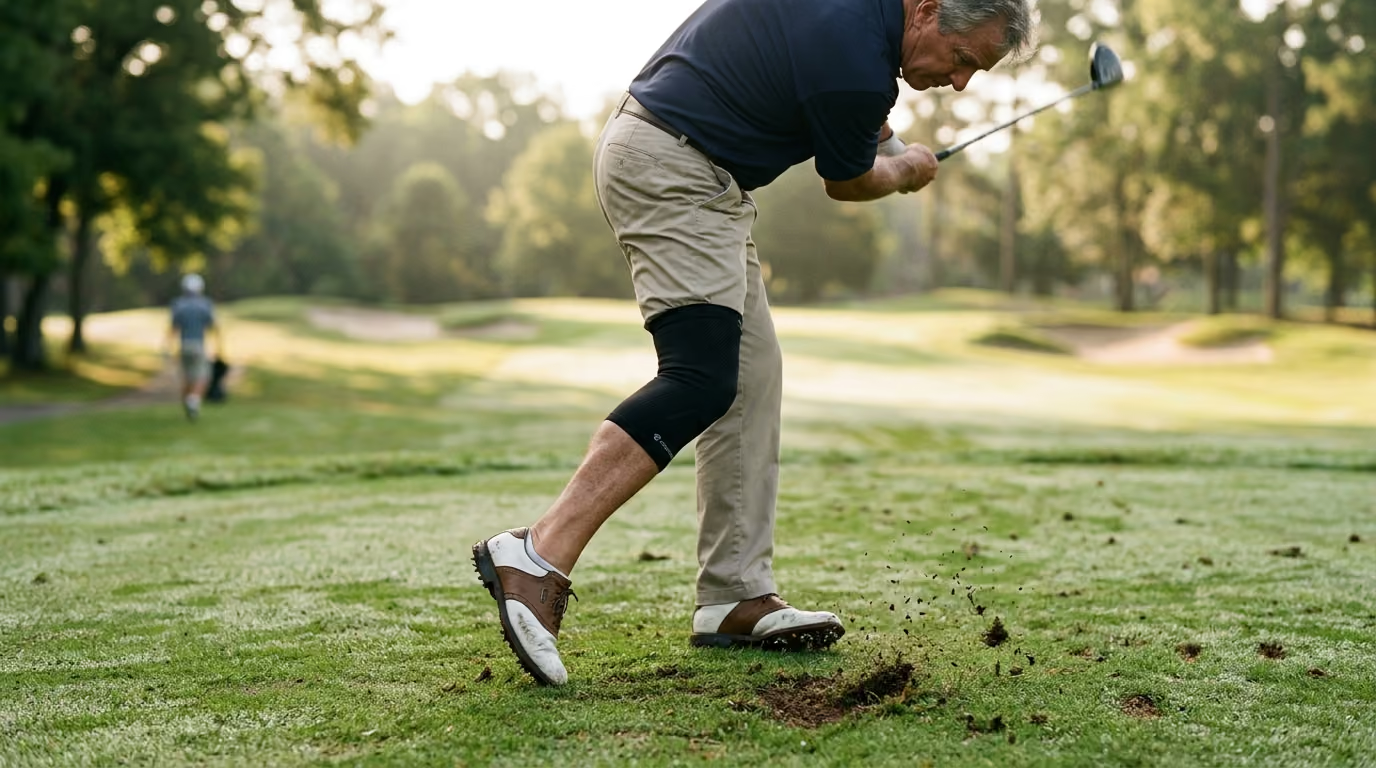
When we watch a golf swing, we tend to focus on the backswing and the impact. We look at how fast the club moves forward. However, the most dangerous part of the swing for your body is actually the follow-through. Once you hit the ball, your body must slow down a club traveling at high speed.
This slowing-down process is called deceleration. To stop the club, your muscles must contract while they are lengthening. This type of muscle action is called eccentric loading. If your muscles are not strong enough to handle this eccentric force, your joints and ligaments must absorb the shock.
Most golf-related injuries occur during this deceleration phase because players ignore eccentric training in the gym. If you only practice lifting weights quickly and dropping them fast, you miss the benefit of eccentric loading. Slow, controlled lowering of weights is what prepares your muscles for the follow-through of your swing.
Eccentric training is highly beneficial for mature golfers. It stimulates collagen production, which is necessary for repairing and strengthening worn-out tendons. This type of training helps prevent common overuse issues like golfer's elbow and shoulder tendinitis. Incorporating slow lowering phases into your exercises is a key part of physical recovery and long-term joint health.
Before you begin any strength routine, you should assess your current physical capabilities. The Titleist Performance Institute developed a 16-point physical screen that is used by top golf trainers. This screen helps identify specific physical limitations that cause swing faults and injuries. You can perform three key parts of this screen at home to check your mobility and stability.
The first test is the Overhead Deep Squat. To perform this, stand with your feet shoulder-width apart. Hold a golf club overhead with both hands, keeping your elbows bent at ninety degrees, then press the club straight up. Keep the club directly over your head and squat down as deep as you can. If your heels lift, or if the club falls forward, you may have tight hips, calves, or a stiff upper back.
The second test is the Toe Touch. Stand with your feet together and your knees completely straight. Bend forward from your hips and try to touch your toes with your fingertips. If you cannot touch your toes without bending your knees, you have limited mobility in your hamstrings or lower back. This stiffness makes it difficult to maintain a good golf posture throughout your swing.
The third test is the 90/90 Test, which measures shoulder external rotation. Stand tall and raise your lead arm out to the side at shoulder height. Bend your elbow to ninety degrees so your fingers point forward. Keeping your upper arm still, rotate your hand upward and backward as far as possible. Your forearm should tilt back past vertical, which is necessary for a safe backswing.
+--------------------------------------------------------+
| TPI HOME SELF-ASSESSMENT |
+--------------------------------------------------------+
| 1. OVERHEAD DEEP SQUAT |
| - Goal: Squat deep with club held straight overhead. |
| - Tests: Hip, ankle, and upper back mobility. |
| |
| 2. TOE TOUCH |
| - Goal: Touch toes with straight knees. |
| - Tests: Hamstring and lower back flexibility. |
| |
| 3. 90/90 SHOULDER TEST |
| - Goal: Rotate forearm backward past vertical. |
| - Tests: Shoulder mobility for backswing depth. |
+--------------------------------------------------------+
To understand how these physical concepts play out on the golf course, let us look at a common scenario. Imagine you are standing on the fifteenth tee. You have played well so far, but you are starting to feel a dull ache in your lower back. Your legs feel heavy, and your shoulders feel tight.
On this tee shot, you swing hard to carry a water hazard. Because your glutes and legs are tired, you cannot push against the ground to rotate your hips. Instead, your hips slide toward the target, a movement known as swaying. To get the club around, your lower back twists violently, and your shoulders lift up early.
The result is a weak slice into the right rough. Even worse, you feel a sharp pinch in your lower spine as you finish your swing. This is the moment where physical limitations turn into a poor shot and a potential injury. Your body was too tired to maintain its posture, so your stable joints had to bend.
If you had a stronger physical foundation, your legs would still be pushing efficiently. Your core would remain stable, protecting your spine from that painful twisting. Building this stamina in the gym ensures that your swing on the eighteenth hole looks and feels just like your swing on the first tee.
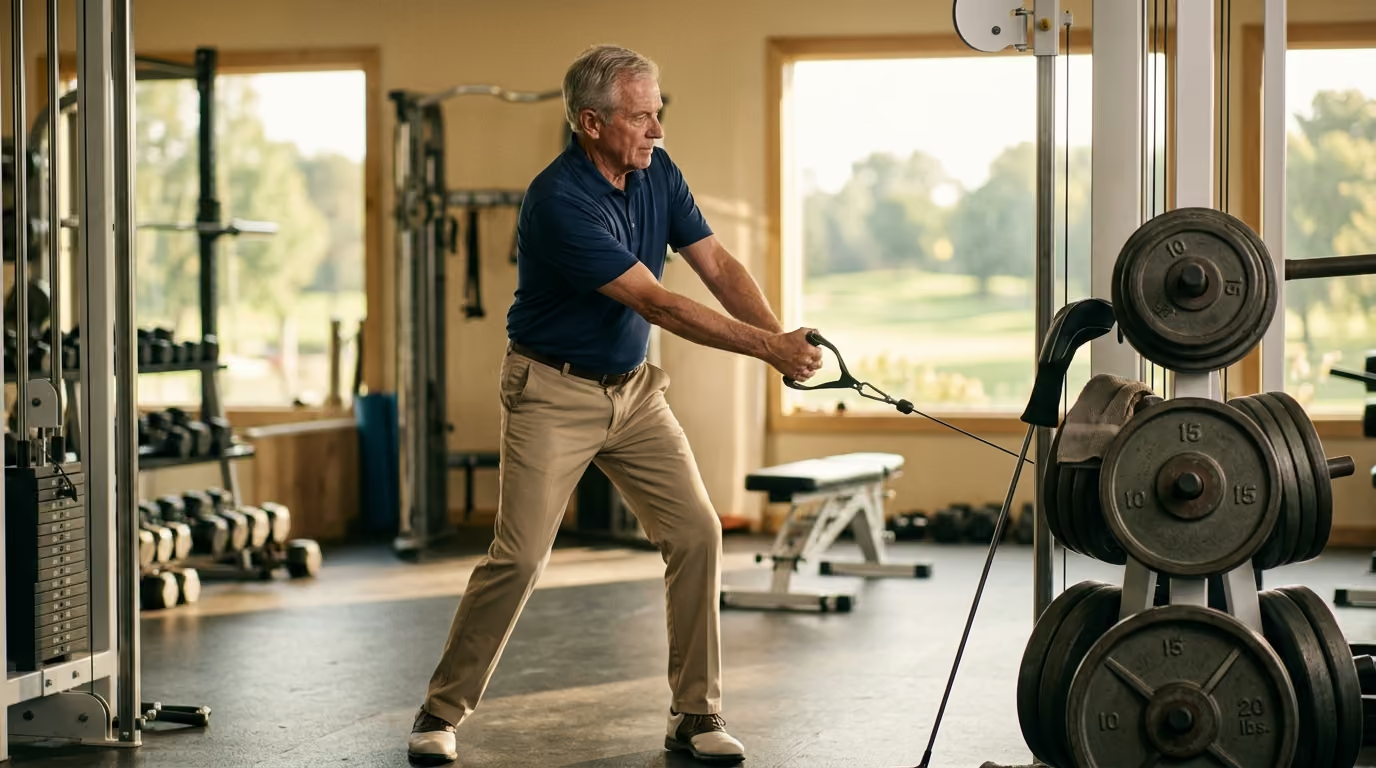
To build your physical armor, you need a structured exercise routine. This program focuses on compound movements that directly improve the physical skills needed for golf. You should perform this routine two to three times per week, leaving at least one day of rest between sessions. Focus on doing each movement slowly and with perfect form.
This exercise stabilizes the lead hip and builds strength in your glutes. Lie flat on your back on a comfortable mat with your knees bent and feet flat on the floor. Keep your arms flat at your sides to help you balance. Lift your hips toward the ceiling until your body forms a straight line from your shoulders to your knees.
Once you are in this raised position, focus entirely on turning your trail hip slightly to engage the glute muscle. Lift your left foot off the floor, bringing your knee toward your chest in a marching motion. Keep your hips steady and do not let them sag toward the ground. Lower your left foot, then repeat the march with your right foot. Perform 3 sets of 10 repetitions on each leg.
[Knee March]
o---o
/ \
o----o o <-- [Keep Hips High]
/ \
/ \
o==================o <-- [Shoulders on Floor]
This movement improves your thoracic spine mobility, which allows for a fuller shoulder turn. Get down on your hands and knees on your exercise mat. Place your hands directly under your shoulders and your knees directly under your hips. Place your right hand behind your head, keeping your elbow pointed out to the side.
Focus entirely on turning your chest toward the ceiling as you rotate your right elbow upward. Keep your lower back and hips as still as possible during this movement. Hold the top position for one second, then slowly rotate back down. Do 2 sets of 10 repetitions on each side to loosen up your upper back.
These three exercises build a strong core to protect your spine during the high-velocity swing. The first is the Bird-dog. Start on your hands and knees, then slowly extend your right arm forward and your left leg backward. Focus entirely on keeping your lower back perfectly flat and hold for ten seconds. Repeat on the opposite side.
The second exercise is the Side Plank. Lie on your side and prop your upper body up on your elbow. Lift your hips until your body forms a straight line, keeping your knees on the floor if you need an easier option. Focus entirely on keeping your side muscles tight and hold for twenty seconds on each side.
The third exercise is the Modified Curl-up. Lie on your back with one leg straight and one knee bent. Place your hands flat under your lower back to support your natural spinal curve. Slowly lift your head and shoulders just an inch off the floor, holding for eight seconds. Perform 3 sets of 8 repetitions to build core endurance.
These movements are excellent for improving your physical posture on the course. You can learn more about these methods in our guide to healthy ageing.
When senior golfers start a strength training program, they often make a few common errors. The first major mistake is training to total muscular failure. Many players think they must lift weights until their muscles completely give out. This approach causes extreme fatigue and increases your risk of injury.
Instead, you should monitor your effort using the Rate of Perceived Exertion scale. This scale runs from 1 to 10, where 1 is sitting on a couch and 10 is maximum effort. For golf longevity, keep your training intensity between an RPE of 4 and 7. This level builds strength and power without putting your joints at risk.
Another common mistake is ignoring the eccentric phase of your lifts. Many golfers lift a weight quickly and then let it drop back down with gravity. This habit deprives your muscles of the deceleration training they need for the golf swing. Always take two to three seconds to lower the weight during every exercise.
Finally, do not fall for the myth that lifting weights will make you stiff or muscle-bound. Lifting weights through a full range of motion actually improves your functional flexibility. It helps you maintain a wider, more consistent swing arc. Strength and flexibility work together to make your swing more efficient.
Your physical fitness is only one part of the longevity equation. The gear you use on the course also plays a major role in protecting your joints from injury. If you have joint stiffness, small changes to your equipment can make a big difference.
Consider upgrading to midsize or oversized grips on your clubs. Larger grips reduce the tension in your hands, wrists, and forearms during the swing. This is helpful if you suffer from arthritis in your fingers. It allows you to hold the club securely without squeezing too tightly.
You should also look at the shafts in your irons and woods. Lightweight graphite shafts absorb much more impact shock than traditional steel shafts. This reduction in vibration helps protect your elbows and shoulders from repetitive strain injuries. It also makes it easier to maintain your swing speed as you get older.
Your choice of footwear can also help protect your body. Spikeless golf shoes often feature more cushioning and a wider sole than spiked shoes. This extra cushioning absorbs impact when you walk the course, which saves your knees and hips. It also provides a stable platform for your feet during the swing.
If you want to play pain-free golf for the rest of your life, you must take action today. Building physical armor is a gradual process that requires consistency, not extreme effort.
Build your armor in the gym so you can swing with freedom on the course.
To help you get started this week, here is a practical checklist of your next steps:
Follow Golfergy for practical insights on performance, mobility, recovery and healthy ageing. Stay connected for new articles, research-led guidance and ideas to help you play better for longer.


Explore practical resources on performance, recovery, mobility and golf longevity.
Read the Blog