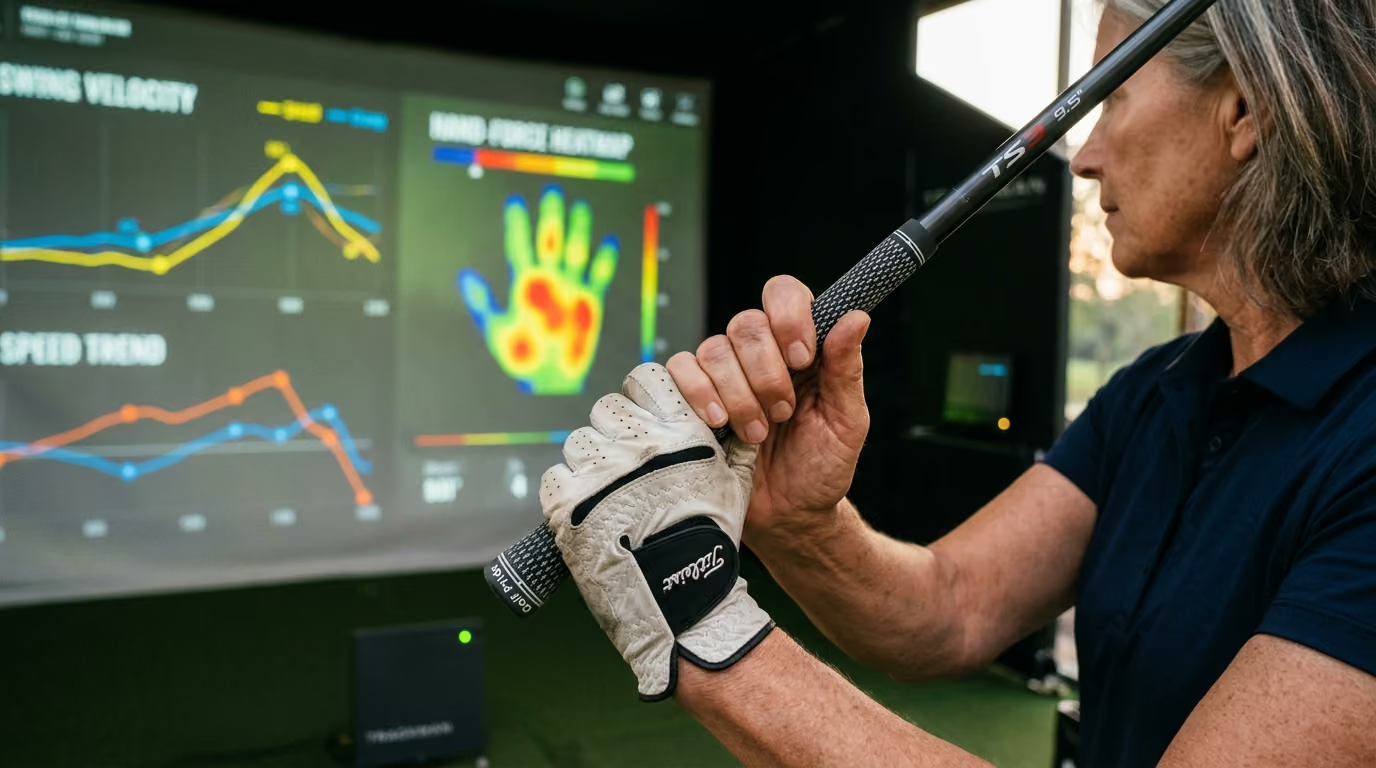
Most players blame their equipment for lost distance, but yoga provides the joint mobility and hip dissociation needed for true power.




If you have ever searched for how to stop losing yardage after age forty, you are not alone. Many players search for physical solutions to a declining swing. They buy lighter shafts or adjust their stance. Yet, the real limitation is rarely the club in your hands. The limitation is the physical tension in your joints.
You stand on the fourteenth tee box of a long par four. Your lower back feels like a block of cold pine. You have played thirteen holes of decent golf, but fatigue is settling into your joints. You take your backswing, intending to make a full turn. Your lead hip refuses to clear, and your shoulders stop halfway.
Because your hips are locked, your hands try to make up for the lost power. You flip the clubhead at impact, sending a weak slice into the right rough. This is not a swing flaw that can be fixed with a new driver. It is a physical block that requires a systematic approach to movement.
By addressing these physical limitations off the course, you can restore your natural swing path. A structured approach to movement helps you maintain your posture through impact. It also protects your body from the wear and tear of repetitive swing motions. Let us examine how targeted physical training can help you play pain-free golf for decades.
To understand how yoga improves your swing, you must first understand the kinematic sequence. The kinematic sequence is the precise order of movement in your swing. According to the Titleist Performance Institute, this sequence begins at the ground. It travels through your feet, up your legs, into your hips, through your torso, and finally into the clubhead.
If any joint in this chain is stiff, the sequence breaks. A break in the sequence means you must use your muscles to force the clubhead speed. This forcing leads to inconsistent ball striking and chronic muscle fatigue.
[Ground Force] ➔ [Feet & Legs] ➔ [Hips & Pelvis] ➔ [Torso & Shoulders] ➔ [Arms & Club]
One key metric in swing speed is the X-Factor stretch. This stretch is the rotational difference between your hips and your shoulders at the top of your backswing. A larger gap between these two angles creates more potential energy. Research led by Sorbie at Abertay University shows that a six-week yoga program can improve this rotational difference.
Just thirty minutes of practice per week can produce a two to three-degree improvement in this stretch. This small shift can increase your hand speed by two meters per second. The result is a noticeable increase in clubhead speed without any extra effort.
Another critical concept is hip-to-shoulder dissociation. This is the ability to move your upper body independently of your lower body. If your hips and shoulders move as a single block, your swing will lack power. You will also struggle to find a consistent plane. Yoga teaches your nervous system to isolate these areas, allowing for a smoother transition at the top of the swing.
Finally, you must use the ground to generate power. Yoga emphasizes ground force through standing balance poses. When you learn to press your feet firmly into the mat, you train the stabilizing muscles in your ankles and knees. This improved stability allows you to push off the turf more forcefully during your downswing.
Yoga is not a single type of exercise. It is a broad discipline with different styles that serve different physical needs. For a golfer, three specific styles provide the best benefits: Hatha, Yin, and Vinyasa.
Hatha yoga is slower-paced and focuses on precise alignment. In a Hatha class, you hold poses for several breaths while paying close attention to your posture. This style is excellent for building the technical form needed for a consistent setup.
Hatha poses teach you where your joints are in space. This awareness is called proprioception. When you know exactly how your spine is aligned on a yoga mat, you can recreate that perfect posture at address. It helps you avoid the rounded shoulders and arched lower back that ruin so many setups.
Yin yoga targets the fascia and connective tissues of the body. Unlike active styles, Yin uses passive, supported poses held for three to seven minutes. This slow approach is necessary because fascia does not yield to quick stretches.
This style is highly beneficial for the desk-bound golfer with chronically tight hips. Sitting at a desk for hours thickens the connective tissue around your hip joint. This tightness prevents you from clearing your hips on the downswing. Yin yoga helps release this deep tissue, restoring your natural range of motion.
Vinyasa yoga coordinates your breath with continuous movement. In a Vinyasa class, you flow from one pose to the next on an inhale or an exhale. This fluid motion mirrors the tempo and rhythm of a proper golf swing.
Vinyasa builds functional strength and cardiovascular stamina. It teaches your body to move dynamically while keeping your core stable. Practicing this style can prevent the late-round fatigue that often causes poor tee shots on the back nine. To build a well-rounded routine, look into the variety of golf mobility programs that integrate these three styles.
To protect your body and improve your performance, you must target the areas that experience the most stress during a golf swing. These areas are the thoracic spine, the hips, and the pelvic core.
The thoracic spine is your mid-back. It is designed to rotate, unlike your lumbar spine, which is designed for stability. If your mid-back is tight, your body will force rotation from your lower back. This compensation is a primary cause of lower back pain in older players.
To test your mid-back rotation, sit in a chair with your knees together. Try to turn your shoulders ninety degrees without moving your hips. If you cannot do this, your mid-back is tight. Poses like Cat-Cow and Seated Spinal Twists are designed to restore this rotation. They allow you to turn your shoulders fully without putting your lower back at risk.
Your hips must rotate both internally and externally during the swing. On the backswing, your trail hip must rotate internally. On the downswing, your lead hip must rotate internally to let you clear.
If your hips are tight, your body will sway or slide instead of turning. This lateral movement ruins your low-point control, leading to fat and thin shots. Poses like Pigeon Pose and Low Lunges target the glutes and hip flexors. They help you build the hip mobility needed for a powerful, rotary swing.
A powerful swing requires a stable foundation. Your pelvis must remain level and stable while your upper body turns against it. If your pelvis tilts or sways during the swing, you lose power and risk injury.
The Bird-Dog pose is an excellent exercise for building this pelvic stability. It teaches your deep core muscles to stabilize your spine while your limbs are moving. This skill is critical for maintaining your posture throughout the entire swing. For more on how to build this foundation, check out our guide on injury prevention strategies.
When you are on the course, you do not have time for a full yoga session. However, you can use quick physical cues to release tension before a shot. This is especially useful when you are waiting on a tee box or walking between shots.
If you feel your shoulders rising toward your ears, try a standing chest opener. Hold your driver behind your back with both hands. Gently pull your shoulders back and down while keeping your ribs soft. Hold this position for three deep breaths, focusing entirely on the feeling of space in your collarbones.
Another quick option is the standing pelvic tilt. Stand with your feet shoulder-width apart and your hands on your hips. Soften your knees slightly. Gently arch your lower back, then tuck your tailbone under. Repeat this small movement five times to release tension in your lumbar spine.
These small movements can keep your joints loose and your mind calm during a round. They prevent the gradual buildup of physical tension that leads to poor shots under pressure. To find more practical tips like these, explore our golf performance resources section.
To see lasting improvements in your flexibility, you need a consistent routine. This framework is designed for the mature golfer. It fits easily into a busy schedule and targets the root causes of swing stiffness.
Do not perform static stretches before you play. Holding a stretch for a long time can temporarily reduce muscle power. Instead, use a dynamic flow to wake up your nervous system and increase blood flow. Spend five to ten minutes on these movements before heading to the first tee.
After eighteen holes, your muscles will be tight from the repetitive swing motion. This is the perfect time for passive stretching. This routine uses Yin-style holds to release deep muscle tension and promote recovery. Complete these poses on the evening after your round.
[Post-Round Recovery] ➔ [Low Lunge (2 mins)] ➔ [Pigeon Pose (3 mins)] ➔ [Seated Twist (2 mins)]
For deeper insights into how post-round routines can speed up your body's healing, read our articles on muscle recovery.
Perform this routine once or twice a week on days when you do not play. It combines Hatha alignment with active balance work to build swing stability.
Hand/Knee Position Active Extension (Flat Back)
o o o o
/||\ /||\
/ \ / \ / \ / \
Integrating these exercises into your schedule will build lasting physical improvements. It helps you maintain your posture and power, even when playing multiple rounds a week. To see how these movements fit into a complete golf fitness program, read about building golf strength on our site.
When golfers begin a yoga practice, they often bring their competitive nature to the mat. This approach can lead to injuries and poor results. Knowing these common mistakes will help you practice safely.
Many players view yoga as simple stretching. They think that the more flexible they are, the better they will play. However, flexibility without control is dangerous for a golfer.
If you increase your range of motion without building the strength to control it, your joint stability will suffer. Your body needs both mobility and stability to swing safely. Make sure your routine balances passive stretching with active strength poses like Bird-Dog and Warrior positions.
Golfers are obsessed with getting a bigger turn. When they practice twists, they often force their lower back to rotate. This is a significant mistake.
The lumbar spine is only designed to rotate about five degrees. Your thoracic spine and your hips should do the turning. When practicing twisting poses, focus on turning from your ribs. Keep your belly button facing forward to protect your lower back from injury.
[Lumbar Spine] ➔ Designed for STABILITY (5° of rotation)
[Thoracic Spine] ➔ Designed for MOBILITY (35° of rotation)
In yoga, the physical poses are only half of the practice. The breath is just as important. Many golfers hold their breath when they enter a difficult pose.
Holding your breath triggers a fight-or-flight response in your nervous system. This reaction causes your muscles to tighten, which defeats the purpose of the stretch. It also prevents you from learning the mental calm needed on the course. Focus on keeping your inhales and exhales even, especially during challenging poses.
Your physical condition should dictate the equipment you use. If you have physical limitations, you can adjust your gear to make the game easier on your body.
Your golf shoes can also impact your body. Highly structured shoes with stiff soles can limit your foot movement. If your feet cannot move naturally, your ankles and knees must work harder. Try using a more flexible, spikeless shoe to allow your feet to interact naturally with the ground.
You can also make a simple change to your setup on the tee box. If your lead hip is tight, flare your lead foot outward by fifteen to twenty degrees at address. This slight adjustment pre-rotates your hip, making it easier to clear during your downswing. It reduces the twisting force on your lead knee, protecting the joint from wear.
To get started with your new routine this week, use this simple checklist:
Remember, consistency is far more important than intensity. Doing five minutes of movement every day will yield better results than a single two-hour session once a week. Be patient with your body, and let your range of motion improve naturally over time.
To maintain a powerful swing and a pain-free body, you must prioritize the health of your joints over the speed of your swing.
Follow Golfergy for practical insights on performance, mobility, recovery and healthy ageing. Stay connected for new articles, research-led guidance and ideas to help you play better for longer.


Explore practical resources on performance, recovery, mobility and golf longevity.
Read the Blog