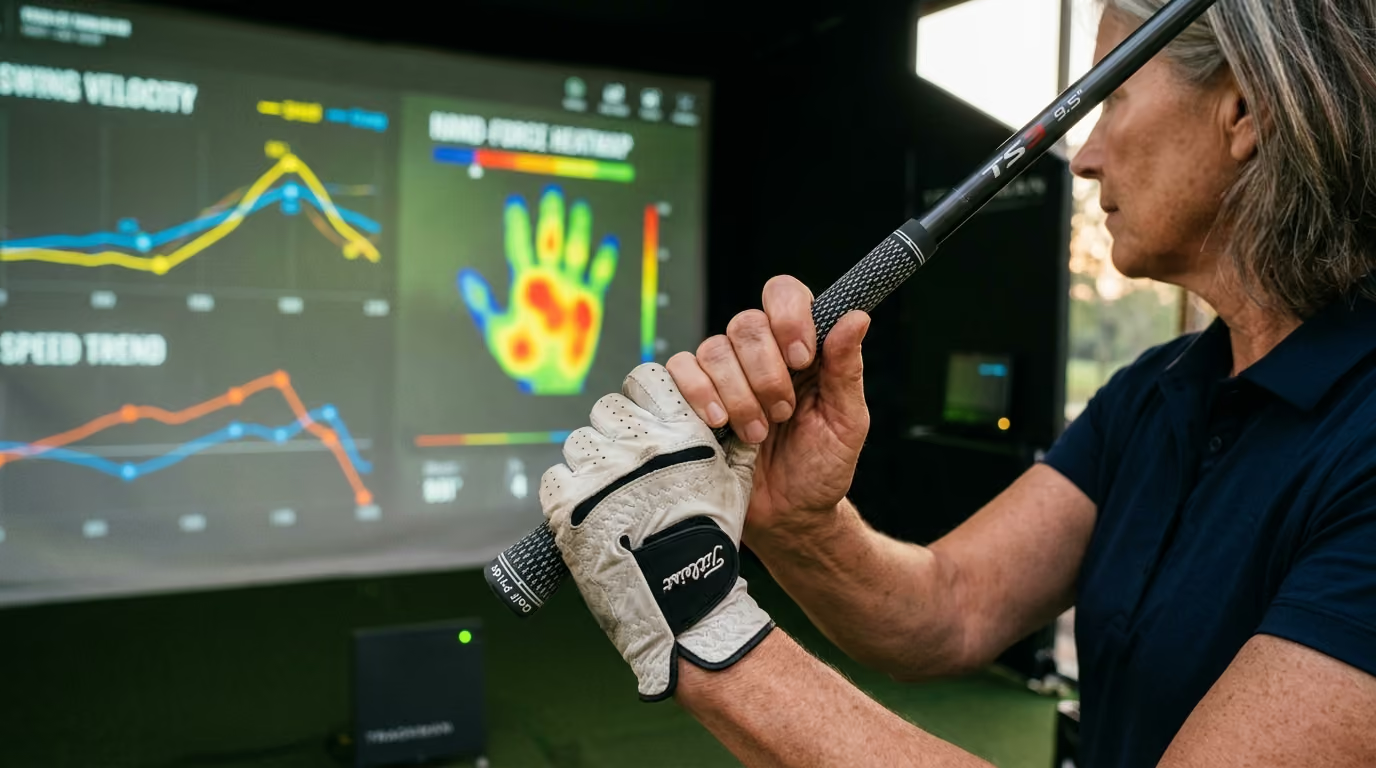
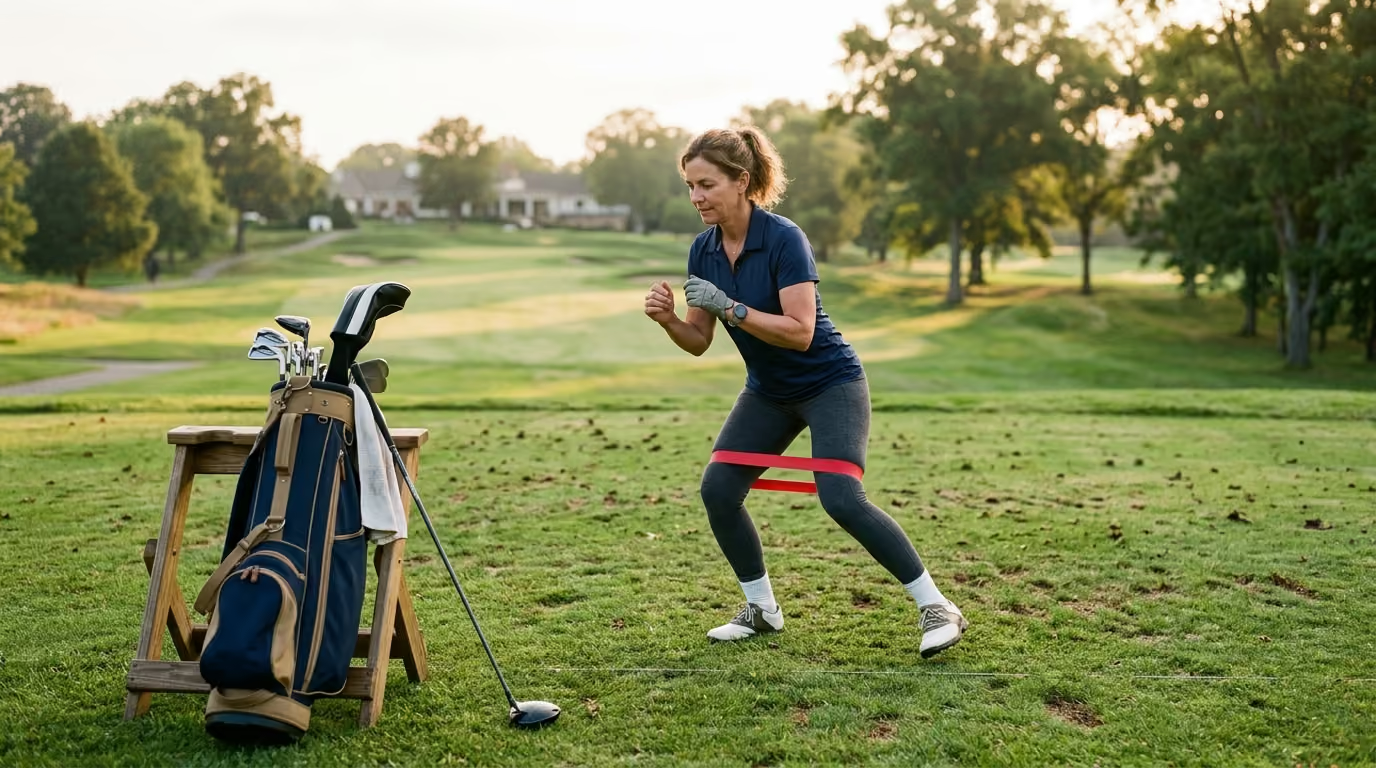
Strength training helps senior golfers maintain club head speed, build bone density, and protect joint health for years of pain-free play on the course.




How to stop losing club head speed after fifty is a common search for experienced golfers. Another frequent search is how to prevent lower back pain during golf. If you have searched for these topics, you want a clear path to keep your body strong. You want to protect your physical health while playing the sport you love.
Imagine you are standing on the fifteenth tee of a long par four. The wind is blowing directly against you. Your lower back feels stiff from walking the first fourteen holes. You try to turn your shoulders, but your hips feel locked in place.
You swing as hard as you can, but the ball slice-fades into the rough. You feel tired, weak, and frustrated. Your legs do not have the power they had ten years ago. This is not a swing fault that can be fixed with a quick tip.
It is a physical change in your muscles and bones. This guide will show you how to build lasting physical capacity for golf.
As we grow older, our bodies change in quiet ways. Two major changes affect senior golfers. These changes are sarcopenia and osteopenia.
Sarcopenia is the loss of muscle mass that comes with age. This process starts early, often in your thirties. Without training, you can lose up to thirty percent of your strength by age seventy. This loss makes it hard to generate swing speed and maintain balance.
Osteopenia is the loss of bone mineral density. Bone density drops after age fifty. This is a major concern for both men and women. Postmenopausal women can lose up to twenty percent of their bone density in the seven years after menopause.
UCLA Health has studied these aging processes closely. Their research shows that resistance training can stop this loss of muscle and bone. Lifting weights helps you keep your muscles active. It also keeps your bones strong and healthy.
If you want to play golf for many years, you must protect your body. This is why focusing on healthy ageing is the key to playing for decades. You cannot stop time, but you can change how your body ages.
Your muscles have two main types of fibers. These are slow-twitch and fast-twitch fibers. Fast-twitch fibers give you speed and explosive power. Slow-twitch fibers help you with endurance and long walks.
Aging targets your fast-twitch fibers first. This is why you lose swing speed before you lose the ability to walk eighteen holes. Your body stops reacting quickly to the demands of a fast swing. Your downswing loses its snap and power.
To keep your fast-twitch fibers, you must lift weights. Walking is good for your heart, but it does not save these fast-acting muscle cells. You need heavy resistance to trigger them.
Bones are living tissue. They react to the physical stress you put on them. When you lift weights, your muscles pull on your bones. This pull tells your body to build more bone tissue.
If you only do light activities, your bones do not get this message. They slowly become thin and brittle. This increases your risk of fractures if you fall.
Research shows how specific weights help. Exercises like squats and deadlifts apply force to your spine and hips. This force makes your skeleton stronger. It protects your back during a powerful golf swing.
Joints need movement to stay healthy. Cartilage does not have its own blood supply. It gets nutrients from the fluid inside your joints. This fluid moves when you use your joints through a full range of motion.
Strength training keeps your joints lubricated. It strengthens the muscles around your joints. This reduces the load on your cartilage.
If you have arthritis, lifting weights can actually reduce your pain. Stronger muscles keep your joints aligned. This prevents the bones from rubbing together.
The golf swing is a violent movement. It requires rapid rotation and lateral force. As you age, your joints lose their range of motion. This loss changes how you must swing the club.
Many golfers try to copy young professionals. This is a mistake. Young pros use the modern swing style. This style keeps the hips quiet while the shoulders turn.
The modern swing creates a lot of torque. This torque puts massive stress on your lower back. Your lumbar spine is not built to rotate. It is built to remain stable.
For seniors, this modern style often leads to pain. It causes disk injuries and muscle strains. You need a swing style that matches your physical capacity. Working on injury prevention can reduce your risk of back pain.
The classic swing is much safer for older players. In this swing, you do not lock your hips. Instead, you let your hips turn freely.
To do this, focus entirely on turning your trail hip during your backswing. Let your trail heel lift slightly off the ground. This movement reduces the twisting force on your lower back.
You should also flare your lead foot outward at setup. Turn it out about a quarter of a turn. This reduces the need for deep hip rotation. It protects your lead hip and knee.
Research on recreational golfers shows that these small changes work. A golf-specific strength program can reduce injuries by sixty percent. Combining strength with a classic swing is the best way to protect your body.
Your spine has different zones. Your mid-back is the thoracic spine. It is built to twist. Your lower back is the lumbar spine. It is built to resist twisting.
When your mid-back is tight, your lower back tries to twist. This is where pain begins. You must keep your mid-back loose.
At the same time, you must keep your lower back stable. This balance allows you to turn safely. It keeps your posture steady during the swing.
The golf swing moves side to side. You push off your trail foot and slide your weight forward. This requires strong hip stabilizers.
The gluteus medius is a key hip muscle. It sits on the side of your hip. It keeps your pelvis level when you stand on one leg.
If this muscle is weak, your hips will sway. This sway ruins your swing path. It also puts stress on your lower back.
To stay strong, you do not need complex gym machines. You need to focus on basic human movements. The Titleist Performance Institute focuses on functional movement patterns. These patterns train your brain and muscles to work together.
There are seven primary patterns. These are squatting, lunging, bending, pushing, pulling, twisting, and gait. Training these patterns will keep you moving well on and off the course. Focus on one pattern at a time.
Building functional strength allows you to maintain swing speed. Let us look at each pattern and how it helps your golf game. This approach is much better than isolating single muscles. It builds real-world strength.
Squatting is the foundation of lower body power. When you squat, you bend at your hips and knees. This movement strengthens your thighs and glutes. These muscles help you push against the ground to create swing speed.
Lunging trains single-leg strength. Golf is played on one leg at a time during the swing. You shift your weight from your trail foot to your lead foot. Lunges improve your balance and prevent slipping.
To do a proper squat, keep your chest up. Push your knees outward as you lower down. This protects your knees from injury.
For the lunge, take a long step forward. Lower your back knee toward the floor. Keep your front knee behind your toes.
Bending, or hip hinging, is crucial for your golf posture. To hinge, you push your hips back while keeping your spine straight. This is different from bending at your waist.
The hip hinge targets your glutes and hamstrings. These muscles are your power generators. A solid hinge allows you to maintain your spine angle during your swing.
If you lose your hinge, your spine will round. This causes you to stand up during the downswing. This swing fault is called early extension. It leads to thin or fat shots.
To practice the hinge, stand near a wall. Push your hips back until they touch the wall. Keep your back completely flat.
Pushing movements strengthen your chest and shoulders. Pulling movements strengthen your upper back. These movements keep your shoulders balanced.
Balanced shoulders allow for a wide swing arc. They also protect your rotator cuff. Many senior golfers suffer from shoulder pain because their chest is tight and their back is weak.
Focus on pulling more than you push. This keeps your shoulders pulled back. It prevents the rounded posture that many seniors develop.
For a pull exercise, try a row. Pull a resistance band toward your chest. Squeeze your shoulder blades together.
Twisting is how you turn your shoulders against your hips. This movement must happen in your upper back. You must keep your lower back stable while you twist.
Gait is your walking pattern. Walking eighteen holes is a major endurance test. It requires strong ankles, feet, and calves.
If your gait is weak, you will tire out on the back nine. This fatigue ruins your swing mechanics.
By training these seven patterns, you prepare your body for golf. It keeps your body moving as a single unit. This is how you maintain your yardage as you age.
Many golfers think core training is about doing crunches. They want flat stomach muscles. This is a misunderstanding of how the core works in golf.
Your core is a cylinder of muscles. It includes your abdominals, your lower back, and your hips. Its primary job in golf is to protect your spine.
The core does this by resisting movement, not by creating it. It acts as a stabilizer. There are three pillars of core stability.
These pillars are anti-flexion, anti-extension, and anti-rotation. Each pillar has a specific job in your swing.
Anti-flexion is the ability to resist rounding your spine forward. When you stand over the ball, gravity pulls your chest down. Your back muscles must work to keep your spine straight.
If your anti-flexion strength is weak, your posture collapses. Your shoulders round forward. This limits how far you can turn.
Exercises like the dead bug train this ability. They teach your abdominal muscles to hold your spine steady. This keeps your posture consistent on every shot.
To do the dead bug, lie on your back. Keep your lower back flat against the floor. Alternate reaching opposite arms and legs.
Anti-extension is the ability to resist arching your lower back. Many seniors arch their back too much at the top of the backswing. This is called a reverse spine angle.
This position puts massive pressure on your lumbar vertebrae. It is a common cause of lower back pain.
Planks are an excellent way to train anti-extension. When you plank, your core works to keep your hips from sagging. This muscle memory transfers directly to your swing.
Hold a plank for thirty seconds. Keep your body in a straight line from head to heels. Squeeze your glutes to help protect your back.
Anti-rotation is the ability to resist twisting in your lower back. Your lumbar spine can only rotate about five to twelve degrees safely. Your thoracic spine should do all the twisting.
Your core must stop your lower back from rotating too far. This resistance protects your spinal disks.
The Pallof press is the best exercise for this pillar. You hold a cable or band at your chest and press it straight out. The band tries to twist your body, but you resist it. This builds the exact stability you need during your downswing.
Stand sideways to a band anchor. Hold the band at your chest. Press it straight out and hold for two seconds.
Some physical therapists used to tell seniors to avoid heavy weights. They thought heavy lifting was too dangerous for older joints. They recommended light weights and high repetitions.
Modern research has proved this wrong. Light weights do not build bone density. They do not stop osteopenia.
To make your bones stronger, you need heavy loads. This is called high-intensity resistance training. It means lifting weights that feel heavy to you.
This type of training triggers your body to lay down new bone minerals. It is highly safe when you use proper form.
Researchers at the University of Missouri studied middle-aged men with low bone density. The men lifted weights for sixty to one hundred and twenty minutes per week.
They performed basic exercises. They did deadlifts, squats, and overhead presses.
After six months, the results were clear. The men had a significant increase in bone mineral density. Their bones were thicker and stronger.
This study proved that heavy lifting can reverse bone loss. It is not just for young athletes. It is a necessary tool for older adults.
We must look at age limits. Research shows that weight training helps at any age. However, some studies suggest that bone density gains are harder to achieve after age seventy.
If you have advanced muscle loss, your bone building slows down. But this does not mean you should stop lifting.
Even if your bones do not get thicker, your muscles will get stronger. Strong muscles protect your joints. They improve your balance.
This balance prevents falls on the course. A fall is the greatest risk to bone health for seniors. Improving your mobility and strength will unlock a wider, safer swing turn.
If you are new to lifting, start slow. Learn the correct form before adding weight. You can use a trainer to guide you.
Never lift to the point of joint pain. Muscle soreness is normal, but joint pain is a warning sign.
Always rest forty-eight hours between heavy workouts. This allows your muscles and bones to repair.
You do not need to spend hours in the gym to see results. A simple, consistent routine is much better. You should train two to three times per week.
This routine focuses on the movements we have discussed. It targets your hips, your mid-back, and your core.
Always start with a gentle warm-up. This gets blood flowing to your muscles.
Here are the key exercises for your routine. Perform them with focus and control.
This exercise improves your thoracic mobility. It helps you get a deeper turn without hurting your back.
Lie on your left side with your knees bent at ninety degrees. Place your hands together in front of you.
Slowly lift your right hand and reach it up and over to your right side. Focus entirely on turning your chest toward the ceiling. Keep your knees glued together on the floor.
Hold the stretch for two seconds, then return to the start. Do ten repetitions on each side.
This exercise strengthens your hip abductors. These muscles control your lateral stability during your swing.
Place a small resistance band around your ankles. Stand with your feet hip-width apart and bend your knees slightly.
Take ten steps to your right, then ten steps to your left. Keep your feet pointing straight forward.
Do not let your knees cave inward. You will feel a burn in the sides of your hips. This burn means your stabilizing muscles are working.
This movement builds balance and hamstring strength. It teaches you to stabilize your body on one leg.
Stand on your left foot with your knee slightly bent. Hold a light weight in your right hand.
Slowly hinge forward at your hip, reaching your right hand toward the floor. Extend your right leg straight behind you.
Focus entirely on keeping your hips level with the ground. Squeeze your left glute to stand back up. Perform eight repetitions on each leg.
The Titleist Performance Institute highly recommends this exercise. It is a complete movement pattern. It requires your brain to coordinate your muscles.
Lie on your back holding a light weight in your right hand. Press the weight toward the ceiling.
Bend your right knee and place your right foot flat on the floor. Use your left hand to prop yourself up onto your elbow.
Push up onto your hand, sweep your left leg under you, and kneel. Stand up while keeping the weight pointed straight up.
Reverse the steps to lie back down. This movement builds overall coordination and joint stability. Do three repetitions on each side.
Glute bridges activate your butt muscles. Lie on your back with your knees bent and feet flat. Squeeze your glutes and lift your hips until your body is straight. Hold for two seconds, then lower down.
Bird dogs build deep core strength. Start on your hands and knees.
Reach your right arm forward and your left leg backward. Keep your back flat like a table.
Hold for three seconds, then switch sides. This teaches your core to support your spine.
When senior golfers start a strength program, they often make mistakes. These mistakes can lead to injury. They can also stop you from getting results.
Understanding these pitfalls will help you stay safe. You can avoid common setbacks.
Let us look at three common mistakes.
The biggest mistake is avoiding weights out of fear. Many seniors think lifting will cause a hernia or joint damage.
Research shows that strength training is highly safe. It is safe even for frail elderly adults.
The key is starting light and learning the movement. Your body will adapt quickly.
Avoiding weights actually increases your risk of injury on the golf course. Weak muscles cannot support your joints during a fast swing.
Many seniors spend all their gym time on treadmills or stationary bikes. They believe cardio is the best way to stay healthy.
Cardio is good for your heart. However, it does not build muscle mass. It does not stop bone loss.
To maintain your golf performance, strength is more important than cardio. You need muscle power to swing the club.
Make sure you lift weights at least twice a week. Do not let walking replace your strength work.
Do not try to match the swing of young players on television. They have different bodies. They have highly flexible spines and open hips.
If you try to restrict your hip turn, you will hurt your back. Use the classic swing style instead.
Focus on your own mobility limits. Train to improve your movement, but swing within your physical limits. This is how you stay on the course.
Your physical strength is only one part of the equation. Your equipment must match your body. The wrong gear can strain your muscles and joints.
As you build strength, review your golf equipment. Small changes can reduce stress on your body.
This reduction helps you recover faster after your rounds. Allowing time for recovery keeps your joints healthy.
Heavy steel shafts require a lot of force to swing. This force can hurt your elbows and shoulders.
Switching to graphite shafts is a smart move. Graphite is lighter than steel. It also absorbs more vibration.
This absorption protects your joints from shock. Choose a regular or senior flex shaft to make speed easier to generate.
If you have arthritis in your hands, standard grips can be painful. You have to squeeze too hard to hold the club.
Midsize or jumbo grips are a great solution. They require less hand pressure.
This reduction in pressure relaxes your forearms. It reduces tension in your shoulders. It allows for a smoother release of the club.
Your swing starts from the ground up. You need stable footwear to transfer power.
Spikeless shoes are comfortable, but they can slip on wet grass. This slipping can twist your knee.
Choose shoes with good traction. This traction keeps your lead foot stable during the downswing. It protects your joints from unexpected twisting.
To get started this week, focus on simple steps. Do not try to change everything at once. Use this checklist to begin your journey.
By taking these steps, you will protect your body. You will keep your swing powerful. You will enjoy the game for many years to come.
The secret to playing golf into your eighties is protecting your spine through functional core stability and classic swing mechanics.
Follow Golfergy for practical insights on performance, mobility, recovery and healthy ageing. Stay connected for new articles, research-led guidance and ideas to help you play better for longer.


Explore practical resources on performance, recovery, mobility and golf longevity.
Read the Blog