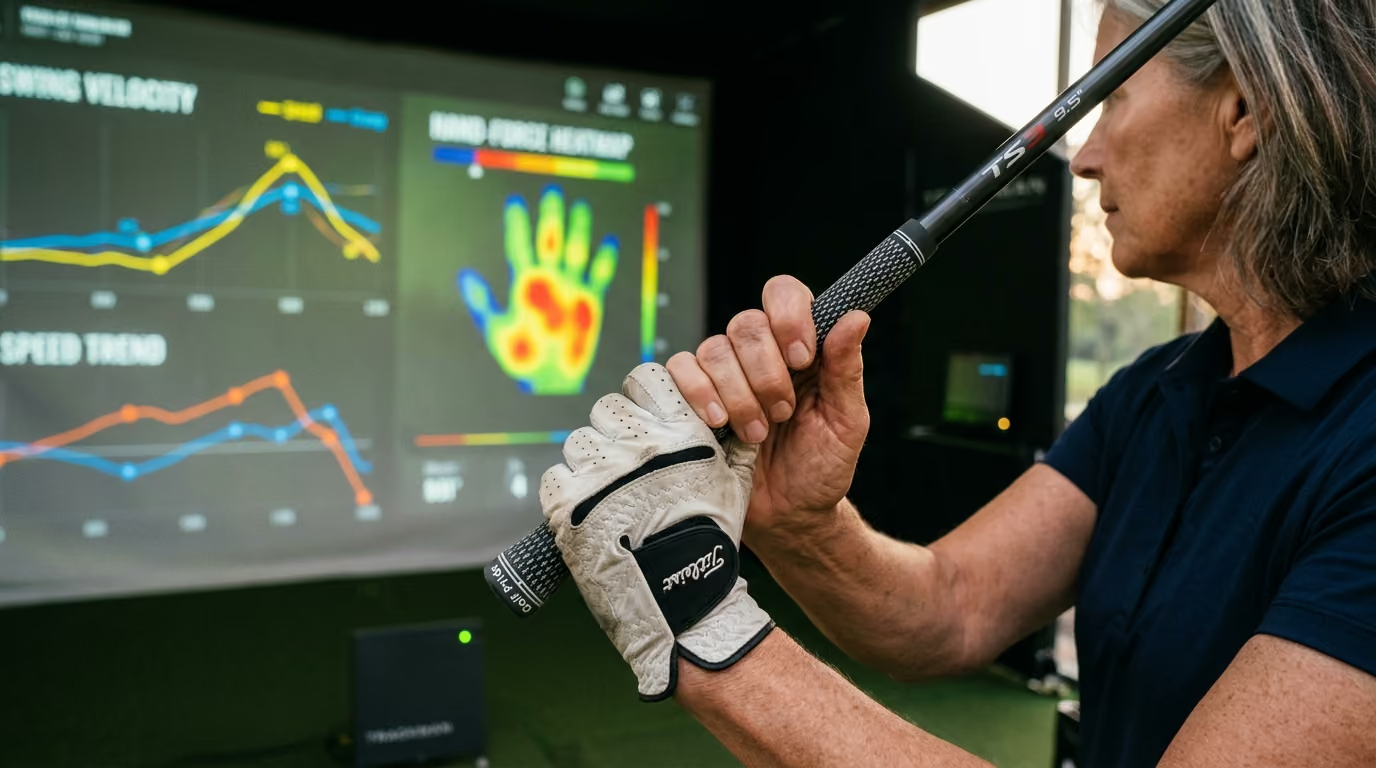
Complete recovery from medial epicondylitis requires targeted strengthening movements, proper swing mechanics, and specific equipment adjustments that protect vulnerable inner elbow tendons.




Many active players believe that golfer’s elbow is a minor muscle strain that will disappear with a few days of rest. This is a common misunderstanding. Golfer’s elbow is not an acute, inflammatory condition that heals through passive rest alone. It is a chronic, degenerative tendon problem that requires active movement and structural care to resolve.
To manage this condition successfully, you must understand exactly what is happening inside your arm. You need to know how your swing mechanics stress these tissues, how to adjust your gear, and how to perform a step-by-step physical recovery program. This comprehensive guide provides a detailed roadmap to help you overcome inner elbow pain and protect your arms for many years to come.
Golfer’s elbow is the common name for medial epicondylitis. This term refers to irritation at the bony bump on the inside of your elbow. This bony area is called the medial epicondyle. It serves as the main anchor point for the muscles that control your wrist and fingers.
The group of muscles that attach here is known as the flexor-pronator group. These muscles allow you to flex your wrist forward and rotate your forearm inward. The specific muscles include the pronator teres, the flexor carpi radialis, the palmaris longus, and the flexor carpi ulnaris. When these muscles contract, they pull on the tendons attached to the inner elbow bone.
According to research from StatPearls, golfer’s elbow is not a true inflammatory disease. Instead of swelling caused by immune cells, the tissue shows signs of microtears and cellular degeneration. Over time, repetitive stress causes the tendon fibers to break down faster than the body can repair them.
Pathologists call this tissue change angiofibroblastic hyperplasia. This term means the tendon tissue becomes disorganized, weak, and filled with tiny, inefficient blood vessels. It is a wear and tear issue rather than a simple bruise or sprain. Because tendons have a naturally limited blood supply, this degeneration can take a long time to heal.
Data from the Cleveland Clinic indicates that this issue is highly prevalent among recreational athletes. While it affects about 1% of the general population, the rate climbs to over 8% in people who perform repetitive arm movements. In recreational golfers, it accounts for up to 18% of all recorded physical injuries.
For players over the age of 40, the risk of developing this condition increases. As we age, our tendons naturally lose their elasticity and become more brittle. According to the Mayo Clinic, factors like a higher body mass index and smoking can further decrease blood flow to these critical tissues. This makes older golfers especially vulnerable to sudden increases in practice volume or poor swing mechanics.
To understand how this injury starts, imagine a typical on-course scenario. You are standing on a damp fairway with a mid-iron in hand. You take a powerful swing, but you strike the ground two inches behind the golf ball. The club face digs deep into the heavy turf and stops instantly.
This sudden, violent stop transmits a massive shock wave up the steel shaft. Your hands are gripping the club tightly, so your inner elbow tendons must absorb the entire force. You feel a sharp, hot sensation on the inside of your elbow. This single fat shot can cause immediate microtears in an already weakened tendon.
Your lead arm and your trail arm experience this swing stress in completely different ways. For a right-handed golfer, the lead arm is the left arm, and the trail arm is the right arm. Each arm requires a different focus to prevent injury.
During the downswing, your lead arm undergoes rapid supination, which means your forearm rotates outward. At the same time, your lead wrist must flex quickly to pull the club through impact. If your forearm muscles are weak, this rapid rotation and flexion overloads the lead tendon. The constant pulling force at the impact zone creates repetitive microtrauma.
The trail arm is usually injured by a swing error known as casting. Many players try to generate speed by throwing the club with their hands from the very top of the backswing. This premature release of the wrist hinge is called casting, and it forces the trailing wrist into sudden, violent extension.
This movement subjects the trailing inner elbow to extreme valgus stress, which is a sideways bending force. To protect your trailing arm, focus entirely on turning your trail hip during the downswing. This small movement helps you hold the wrist hinge longer and prevents the sudden, painful snap at the top of the swing.
Repeatedly hitting fat shots or practicing on hard synthetic mats also places extreme stress on these tendons. Synthetic mats do not give way like natural turf, so every swing that strikes the mat transmits a high-energy vibration directly to your joints. Over time, these minor vibrations accumulate and cause the tendon fibers to fray. Working on your impact position is one of the most effective injury prevention strategies you can use.
If you are in the middle of a round and begin to feel a dull ache on the inside of your elbow, you need an immediate solution. You cannot perform a full physical therapy routine on the tee box. You must make a quick, practical adjustment to reduce the mechanical strain on your arm right away.
The fastest way to lower the stress on your inner elbow is to reduce your grip pressure. Most golfers hold the club far too tightly, especially when they are nervous or trying to hit a long shot. Squeezing the grip forces your forearm muscles to contract at maximum capacity before your swing even begins.
This constant muscle tension leaves no room for the tendons to absorb the shock of impact safely. It places a continuous, heavy load on the medial epicondyle throughout your entire swing.
To fix this, use the classic bird analogy for grip pressure. Imagine you are holding a small, delicate bird in your hands. You must hold the bird firmly enough so it cannot escape, but you must not squeeze so hard that you crush it. On a scale of one to ten, where ten is a death grip and one is letting the club slip away, aim for a pressure of two or three.
Before every swing, take a deep breath and focus entirely on relaxing your hands. Wiggle your fingers on the grip to release any lingering tension. Let your hands feel soft and light as you address the ball.
This simple reduction in grip force immediately lowers the activation of your flexor-pronator muscles. It allows your forearm muscles to act as natural shock absorbers during the swing. This simple change can help you finish your round without causing further damage to the tendon tissue.
To achieve lasting relief, you must build tendon resilience using a structured, progressive loading framework. Tendons do not respond well to total rest, because rest does not make tissues stronger. Instead, you must guide the tendon through four distinct phases of physical rehabilitation.
The goal of the first phase is to quiet down an irritated tendon and restore pain-free motion. During this phase, you should avoid any activities that cause sharp pain. However, you should not keep your arm completely still.
Keep your wrist moving through its full, pain-free range of motion without using any weights. Gently bend your wrist up and down, and rotate your hand from palm-up to palm-down. This gentle movement keeps the joint lubricated and brings fresh blood flow to the surrounding tissues. You should remain in this phase until you can move your hand and wrist freely without any sharp discomfort.
Once your elbow is pain-free at rest, you can begin isometric strengthening. Isometric exercises involve holding a muscle contraction without moving the joint. This type of training is highly effective because it builds muscle strength and reduces pain without irritating the tendon attachment.
To perform a wrist flexion hold, sit comfortably in a chair. Rest your forearm flat on your thigh with your palm facing upward. Your wrist and hand should extend just past your knee.
Hold a very light dumbbell, such as a two-pound or three-pound weight. If you do not have a dumbbell, you can use a full water bottle. Use your opposite, healthy hand to lift your wrist into a slightly flexed position.
Once your wrist is raised, remove your healthy hand and hold the weight completely still. Focus entirely on holding your wrist in this position for 30 seconds. Do not let your hand sag or shake.
After 30 seconds, use your healthy hand to take the weight away and rest your arm. Complete 3 to 5 repetitions of this hold once per day. If you feel any sharp pain, reduce the weight immediately. Use golf mobility exercises alongside this routine to keep your other joints moving well.
Eccentric training involves strengthening a muscle while it is lengthening. This specific type of loading stimulates the body to produce healthy, organized collagen fibers. It helps rebuild the structural integrity of a damaged tendon.
To perform eccentric wrist flexion, start in the same position with your forearm on your thigh and your palm facing up. Use your healthy hand to lift the dumbbell upward.
Once the weight is at the top of the movement, let go with your healthy hand. Now, slowly lower the weight using only your injured arm.
Take a full 5 to 10 seconds to let your wrist drop back down to the starting position. Use your healthy hand to lift the weight back up, and repeat the slow lowering process.
Perform 3 sets of 10 repetitions, three times per week. This slow, controlled lowering is the key to remodeling the tendon tissue.
Once you can perform eccentric exercises without pain, you are ready for heavy slow resistance. This phase uses heavier weights moved slowly through both the lifting and lowering phases.
Perform 3 sets of 15 repetitions, three times per week. Take three seconds to lift the weight, and three seconds to lower it.
You must also target other golf-specific forearm movements. This includes pronation, supination, and radial deviation.
To perform pronation and supination drills, hold a light golf club by the very bottom of the grip. Hold your elbow at a 90-degree angle next to your side.
Slowly rotate your forearm so the club points to the left, then rotate it so the club points to the right. Focus entirely on turning your forearm muscle to control the movement of the club.
To practice radial deviation, hold the club by the grip and let it hang down. Slowly raise the head of the club up using only your wrist, then lower it back down. This complete program builds the forearm strength needed to handle the forces of a full golf swing. You can find more physical conditioning ideas in our golf performance resources.
When faced with inner elbow pain, many golfers make critical mistakes that delay their recovery. Avoiding these common pitfalls will help you return to the course much faster.
The first common mistake is stretching an angry tendon too early in the recovery process. When golfers feel tightness in their forearm, their immediate instinct is to pull their fingers back to stretch the wrist flexors.
Stretching a highly irritated tendon creates compression at the attachment site on the bone. This compression can cause further microtears and increase your pain.
You should never stretch a tendon when it is in an acute, highly painful state. Only introduce gentle stretching after you can perform pain-free isometric holds.
In golf, players often confuse a strong grip style with tight grip pressure. A strong grip is a term that describes how your hands are rotated on the club handle.
A strong grip means your hands are rotated away from the target, showing three or four knuckles of your lead hand. This style of grip is a normal technical preference and is not inherently dangerous.
The real danger is high grip pressure, which means squeezing the club handle with excessive force. You can use a strong grip style while maintaining very soft grip pressure. Keep your hands relaxed, regardless of how you position them on the club.
Many golfers try to cure their elbow pain using only passive treatments like ice, rest, and anti-inflammatory medications. While these tools can help reduce temporary discomfort, they do not address the root cause of the problem.
Resting for several weeks may make your arm feel better temporarily. However, without active loading, the tendon will heal with weak, disorganized scar tissue.
As soon as you return to the course and swing a club, the weakened tendon will fail again. You must use active rehabilitation, such as forearm strength training, to build resilient tissue that can handle the game.
The gear you choose to play with has a massive impact on how much shock travels into your elbow. Making small adjustments to your equipment is a highly effective way to protect your joints.
The material of your golf shafts plays a major role in vibration dampening. Steel shafts are highly rigid and transmit a large percentage of impact force directly to your hands and arms.
Graphite shafts are much more flexible and excel at absorbing high-frequency vibrations. Research shows that switching from steel to graphite shafts reduces peak impact force at the elbow by 20 to 35%.
For recreational players over the age of 40, this reduction in joint stress is highly beneficial. Modern graphite shafts are incredibly stable and can match the performance of steel without hurting your joints.
The physical size of your golf grips directly determines how hard you must squeeze the club. If your grips are too small, your fingers will dig deeply into the palms of your hands.
Using undersized grips requires 20 to 30% higher grip force to keep the club from twisting during your swing. This constant extra squeeze overloads your flexor-pronator tendons.
If you have larger hands, you should consider switching to midsize or jumbo grips. To check your hand size, measure from your wrist crease to the tip of your middle finger.
If this measurement is 18 centimeters or longer, standard grips are likely too small for you. Larger grips allow you to hold the club securely with much less muscular effort. This simple change is one of the easiest ways to improve your long-term golf performance while protecting your arms.
Before you begin any treatment program, you must ensure that your inner elbow pain is actually golfer's elbow. A common lookalike condition is Cubital Tunnel Syndrome, which is an entirely different medical issue.
Cubital Tunnel Syndrome involves the compression or irritation of the ulnar nerve. This nerve passes through a narrow space on the inside of your elbow, close to the medial epicondyle. Because of this close proximity, the two conditions can easily be confused.
You can easily tell these two conditions apart by looking closely at your specific symptoms:
If you experience any numbness or tingling in your fingers, you should avoid aggressive elbow exercises. These symptoms indicate nerve irritation, which requires specialized medical care. Always consult a healthcare professional to get an accurate diagnosis.
The most critical lesson to remember before your next round is that tendon health is built through gradual, consistent movement rather than total rest or sudden, intense strain.
You can often continue to play golf if you modify your routine and avoid making your pain worse. Focus entirely on making smooth, controlled swings and avoiding heavy turf contact. Reduce your playing frequency, and use graphite shafts with larger grips to minimize the vibration hitting your joints. If you feel any sharp pain during or after a swing, stop immediately and return to your rehabilitation exercises.
Tendon tissue does not have a rich blood supply, so it does not heal well with rest alone. When you rest, the tendon may stop hurting temporarily, but it also becomes weaker and less flexible. As soon as you return to the high-force movements of a golf swing, the weakened tendon suffers new microtears. To prevent this cycle, you must actively strengthen the tendon using progressive loading.
Place your hand on the club in your normal gripping position. Look closely at your ring finger and middle finger on your lead hand. If the tips of these fingers are pressing hard into the pad of your thumb, your grip is likely too small. There should be a very slight gap, or the fingers should just gently touch the palm without digging in.
A compression sleeve can help manage your symptoms, but it will not heal the underlying tendon damage. Sleeves work by keeping the area warm and increasing local blood circulation, which can temporarily reduce pain. They can also improve your awareness of your joint position. However, they are not a substitute for a structured strengthening program.
Follow Golfergy for practical insights on performance, mobility, recovery and healthy ageing. Stay connected for new articles, research-led guidance and ideas to help you play better for longer.


Explore practical resources on performance, recovery, mobility and golf longevity.
Read the Blog