Yoga and Pilates improve rotational flexibility and core strength to help golfers increase their swing depth and prevent joint stiffness.




Many mature golfers believe that losing clubhead speed is a natural part of growing older. They notice their backswing getting shorter and their joints feeling stiffer after a round. To fix this, they often try to swing harder or buy expensive new drivers. These solutions rarely work because they do not address the real issue. The real issue is functional flexibility, which is the ability to move your joints through a full range of motion with total control.
This guide provides an in-depth comparison of yoga and Pilates for the mature golfer. We will look at how these two physical disciplines target the specific joint demands of the golf swing. You will learn the science of joint movement and how to balance the structural stress of your swing. We also provide a complete taxonomy of movements that you can use to build a healthy body. This information is designed to help you play better golf and protect your physical health for years to come.
Imagine you are standing on the fourteenth tee box of a long, challenging golf course. The afternoon wind has started to blow, and you need a solid drive to carry a fairway bunker. You have played thirteen holes, and your muscles are beginning to feel tight. You step up to the ball, take your stance, and begin your backswing. Your body stops turning halfway through the movement because your trail hip feels like a locked hinge.
Because your hips cannot rotate, your shoulder turn is cut short. Your brain senses this lack of depth and tries to make up for the loss of power. To generate speed, your hands and arms pull the club down rapidly from the top of the swing. This sudden pull causes your body to slide toward the target instead of turning. The club faces open at impact, and the ball slices into the deep grass on the right.
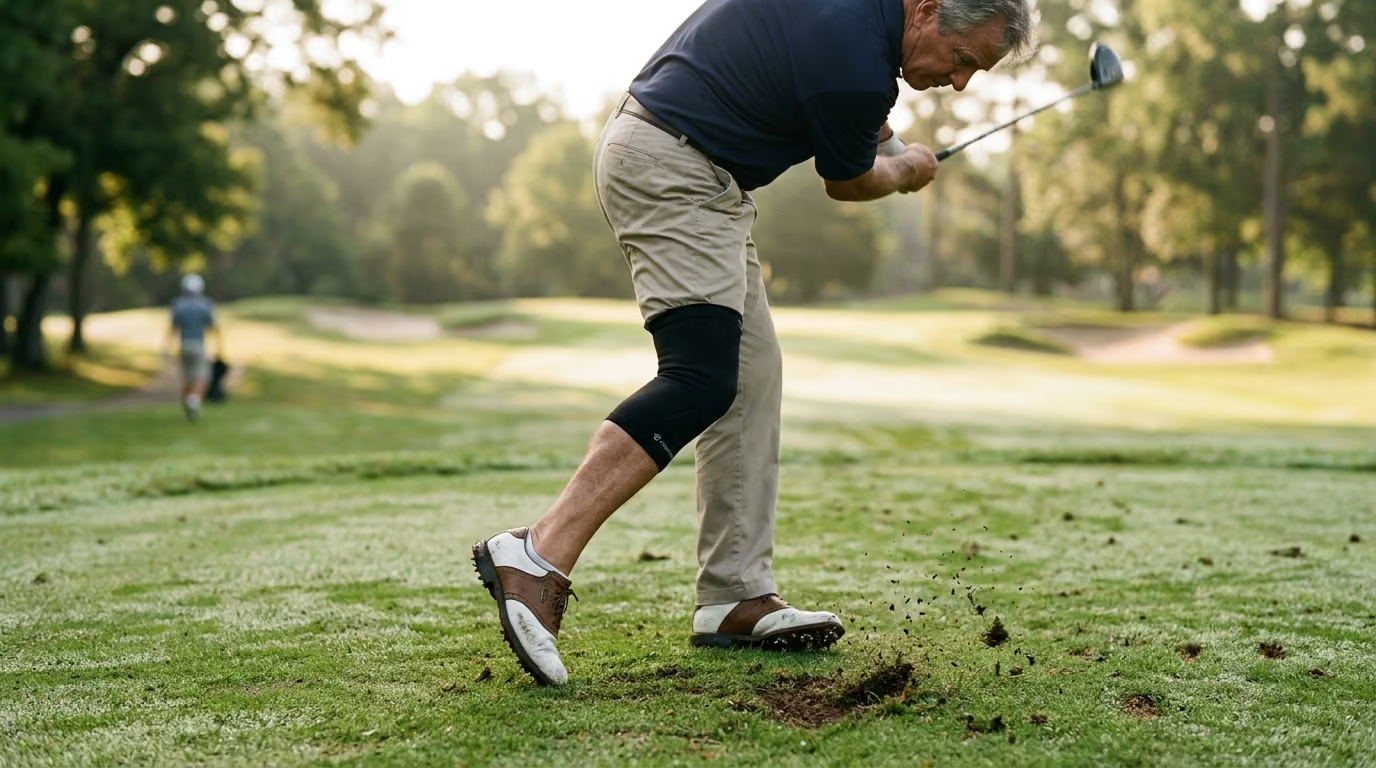
As you watch the ball curve away, you feel a sharp pinch in your lower back. Your left knee also feels sore from absorbing the awkward forces of the swing. This experience is common for golfers who lack mobility in their major joints. The swing flaw you just made was not caused by a bad lesson. It was caused by a physical block in your body.
When your joints are stiff, your swing will always be compromised. You cannot force a tight body into a correct swing plane without causing pain. Your body will always choose the path of least resistance to protect itself. If you do not have the range of motion to turn, your body will tilt, slide, and lift to get the club back. Over time, these compensations ruin your consistency and damage your joints.
To understand why your body gets stiff, you must look at how your nervous system controls movement. Your joints are surrounded by sensory receptors that constantly talk to your brain. These receptors report on the angle, tension, and speed of every joint movement. If your brain feels that a joint is moving into a zone where it lacks strength, it hits the brakes.
This braking system is known as protective tension. Your brain contracts the surrounding muscles to stop the joint from moving further. This is why many golfers feel tight even after stretching for hours. The tightness is not a physical problem with the length of the muscle. It is a safety system run by your nervous system.
Yoga helps to turn off this safety system through eccentric lengthening. This type of training strengthens your muscles while they are in a long, stretched position. When you hold a yoga pose, you teach your brain that your body is strong at its outer limits. Once your brain feels safe in these deep positions, it releases the protective tension. This allows your joints to move more freely without locking up during your swing.
Pilates works on the opposite side of the same movement equation. It builds deep abdominal strength to stabilize your spine and pelvis. When your core muscles are strong, they act as an anchor for your limbs. Your brain will only allow your hips and shoulders to rotate fast if your spine is perfectly stable. By building this core anchor, Pilates gives your brain the confidence to release tension in your hips and shoulders.
When you feel your joints locking up on the course, you cannot lie down on the grass to stretch. You need a fast, standing movement that wakes up your nervous system. This quick movement will help release tension in your back and hips between shots. You can do this stretch while waiting for your playing partners on the tee box.
Stand with your feet spaced shoulder-width apart and keep your knees slightly bent. Hold your driver across your chest, grasping each shoulder with the opposite hand. Tilt your pelvis backward slightly to flatten your lower back. Focus entirely on turning your ribcage to the right while keeping your hips pointing forward.
Hold this turned position for three slow, deep breaths through your nose. With each exhale, try to turn your chest one inch further without moving your hips. Slowly return to the center, then repeat the movement to the left. This simple exercise coaxes your thoracic spine to release its protective grip. It takes less than one minute and helps restore your turn before your next shot.
The joint-by-joint framework was created by athletic trainers Mike Boyle and Gray Cook. This theory explains that the human body is a stack of joints. Each joint has a primary job to do during movement. These jobs alternate between needing mobility and needing stability as you move up the body.
If one joint fails to do its job, the joint above or below it must compensate. This compensation is the primary cause of chronic pain and injury in amateur golfers. Let us look at how these joint requirements alternate from the ground up:
When you play golf, your hips must rotate deeply on both the backswing and the follow-through. If your hips are stiff, they cannot perform this mobility role. Because your body still needs to turn to hit the ball, it looks for movement elsewhere. It forces your lower back to twist to complete the swing.
The lower back is designed for stability and only has about fifteen degrees of total rotation. Forcing it to twist like a hip causes muscle strains, joint wear, and disc herniations. This is why injury prevention efforts must focus on opening the hips and upper back. By restoring mobility to those areas, you protect your lower back from dangerous twisting forces.
Yoga and Pilates are often grouped together, but they approach movement from different angles. Yoga is an ancient practice that focuses on functional flexibility and mental focus. It uses static poses and breathing patterns to release tension in tight tissues. This makes yoga excellent for opening the tight hips and stiff shoulders that restrict your swing.
Yoga poses often require you to hold your body weight in stretched positions. This builds strength in your connective tissues and teaches your joints to feel safe at their end ranges. The deep breathing used in yoga also calms your nervous system. This mental calm helps you stay relaxed when you face a difficult shot on the course.
Pilates is a system of exercises designed to build rotational stability and core strength. It targets what Joseph Pilates called the powerhouse, which includes your abdominals, lower back, and hips. Pilates exercises use controlled, precise movements to teach your body how to isolate specific muscles. This is helpful for golfers who need to separate their upper body rotation from their lower body.
Pilates emphasizes spinal alignment and pelvic control during movement. You learn to move your legs and arms while keeping your spine perfectly still. This skill is critical for maintaining your posture throughout the golf swing. While yoga stretches your body to create a wider swing, Pilates gives you the strength to control that movement.
To build a functional body for golf, you must use poses that target key swing muscles. These poses focus on the areas of the body that get tight during a long round. Perform these movements slowly and focus on your breathing.
Start on your hands and knees with your wrists directly under your shoulders. As you inhale, let your belly drop toward the floor and lift your head and tailbone. As you exhale, round your spine toward the ceiling, tuck your chin, and pull your belly button in. Focus on moving one vertebra at a time from your pelvis to your neck. This movement warms up your spine and lubricates your back joints with synovial fluid.
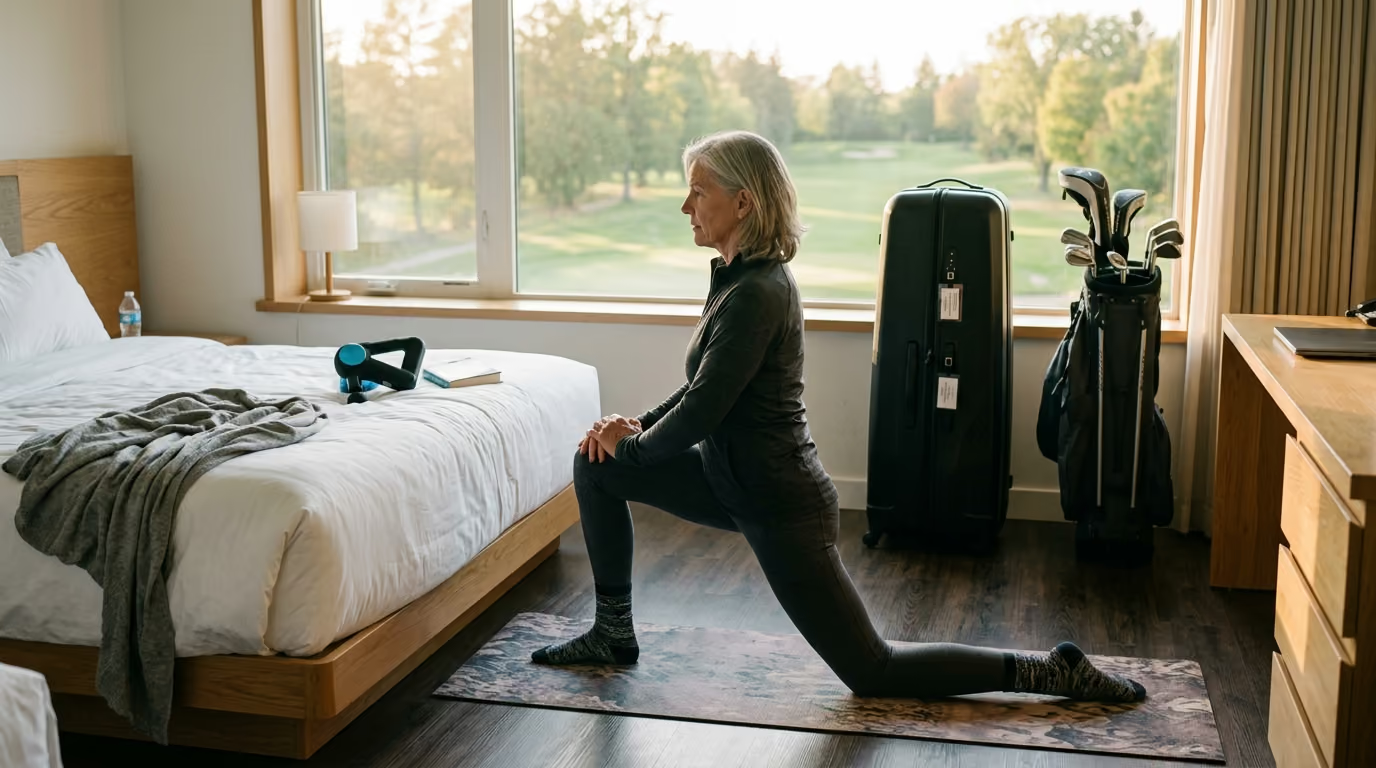
Step your right foot forward into a deep lunge and bend your front knee. Place your left hand on the floor inside your right foot. Lift your right arm toward the sky, turning your chest open to the right. Focus entirely on turning your chest away from your front thigh. This pose stretches your trail hip flexors and improves rotation in your upper back.
Stand with your feet wide apart and turn your right foot out ninety degrees. Reach your right hand down toward your shin while lifting your left hand toward the sky. Keep both legs straight and focus on opening your chest to the side. This pose stretches your inner thighs and hamstrings while building strength in your obliques.
Stand with your feet wide and bend your front knee until it is over your ankle. Keep your back leg straight and press the outer edge of your back foot into the floor. Extend your arms out to the sides at shoulder height and look over your front hand. This pose opens your hip joints and builds endurance in your thighs and glutes.
Start on your hands and knees, then slide your right knee forward behind your right wrist. Extend your left leg straight back behind you, lowering your hips toward the floor. If your hips are tight, support your right hip with a folded blanket. This deep stretch targets your glutes and outer hip rotators, which are key for a full backswing.
Pilates exercises build the deep strength needed to hold your spine steady during a fast swing. These movements teach your body to rotate your upper back while keeping your pelvis quiet.
Sit tall on the floor with your legs extended wider than your shoulders. Extend your arms out to the sides at shoulder height. Inhale to grow taller, then exhale as you rotate your chest to the right. Reach your left hand past your right pinky toe while keeping your left hip pressed into the floor. This exercise improves upper back rotation while stretching your hamstrings.
Sit on the floor with your legs pressed together and your feet flexed. Extend your arms out to the sides and pull your abdominal muscles in deep. Inhale to lengthen your spine, then exhale to twist your chest to the right. Focus entirely on turning from your ribcage while keeping your hips perfectly still. This movement teaches you how to separate your upper body from your lower body.
Lie on your side with your body in a straight line and support your head with your arm. Lift your top leg to hip height and pull your belly button toward your spine. Draw small, controlled circles in the air with your top foot. Keep your hips stacked and focus on keeping your pelvis completely still. This exercise builds strength in your glutes, which helps stabilize your lower body during the swing.
Lie on your back with your knees bent at a ninety-degree angle in a tabletop position. Lift your head and shoulders off the floor and extend your arms straight by your sides. Pump your arms up and down quickly while breathing in for five counts and out for five counts. Keep your lower back pressed into the floor and your core tight. This classic exercise builds deep abdominal endurance.
Lie on your back with your knees in tabletop position and place your hands behind your head. Lift your head and shoulders, then twist your right elbow toward your left knee while extending your right leg. Hold for one second, then switch sides slowly. This targets your oblique muscles, which are the main muscles used to rotate your torso during the swing.
The golf swing is an asymmetrical movement that you repeat hundreds of times. If you are a right-handed golfer, you always swing the club to the left. This repetitive motion creates massive imbalances between the left and right sides of your body. Over time, these imbalances can lead to muscle tightness and chronic pain.
Research shows that amateur golfers are five times more likely to injure their lead side. The lead side is the left side of the body for a right-handed player. This side absorbs massive forces during the impact and follow-through phases of the swing. The lead hip must rotate internally at high speed, and the lead shoulder must stabilize the club.
To prevent these injuries, you must use a compensatory routine in your training. This means you need to spend extra time stretching and strengthening your trail side. If you are right-handed, your trail side is your right side. In your Pilates practice, focus on trail-side rotation to balance the rotational pattern of your swing.
When practicing yoga, pay extra attention to lead-side shoulder stability and trail-side hip rotation. This balance helps keep your pelvis aligned and reduces wear on your joints. Balancing both sides of your body is key for long-term health and a consistent swing. You can find more tips on balancing your body on our blog.
Many golfers make mistakes when trying to improve their flexibility. These errors can lead to injuries or actually make your swing less efficient.
A common misconception is that more flexibility is always better. Some golfers have joints that are naturally very loose, which is called hypermobility. If you are hypermobile, deep static stretching can destabilize your joints. Your nervous system will respond by creating protective tension to keep your joints from separating. Hypermobile golfers should focus on building end-range stability with Pilates rather than stretching with yoga.
Golfers often confuse lower back movement with upper back movement. When trying to turn further in their backswing, they twist from their lower back. This is a dangerous mistake because the lumbar spine is not designed to rotate. Pilates teaches you to rotate from your ribcage while keeping your pelvis absolutely still. Protecting your lower back requires learning how to isolate these two areas of your body.
Many golfers join high-intensity power yoga or fast-paced Pilates classes. These classes often focus on sweat and speed rather than precise form. Moving too quickly through these poses can cause acute injuries to your shoulders and lower back. Look for slow-paced classes that focus on alignment and breath control. This slow approach is safer and translates better to the controlled movements of golf.
Your golf gear has a direct effect on how your body moves during your swing. If your equipment is not set up correctly, it can force your joints to compensate.
If your club shafts are too stiff, you will have to swing harder to get the ball airborne. This extra effort forces your muscles to tense up, which limits your natural mobility. Using lighter, more flexible shafts allows you to swing with less effort. This helps your muscles stay relaxed, which protects your joints from strain.
Your golf shoes also play a major role in how your body moves. Heavy, rigid shoes can lock up your ankles and prevent proper weight transfer. Mobile ankles are required to shift your weight and turn your hips. Look for shoes that are lightweight and allow your feet to bend naturally as you swing.
Finally, check the size of your grips on your clubs. Grips that are too small cause you to squeeze the club too tightly. This tension travels up your forearms into your neck and shoulders, blocking a free turn. Using larger grips can help relax your hands and free up your shoulder movement. For more gear advice, visit our resources page.
To see lasting changes in your mobility, you must establish a consistent habit. A daily fifteen-minute routine is more effective than one long session per week. This routine combines yoga and Pilates to prepare your body for the physical demands of golf.
Perform this routine three times a week on non-consecutive days. Start with the yoga movements to open your joints, then finish with Pilates to build stability.
Consistency is the key to changing your connective tissues. Over several months, this simple routine will build a body that feels loose and powerful on the course. Your recovery times between rounds will also improve.
Older golfers must approach flexibility training with care to protect their bones and joints. If you have osteoporosis or joint wear, some traditional movements can be risky.
You should avoid folding forward deeply from your waist. This movement puts dangerous pressure on the front of your vertebrae. You should also avoid twisting your spine to the point of pain or strain. Instead, use modified versions of these exercises to keep your body safe.
Chair yoga is an excellent alternative to traditional mat work. You can perform the Seated Spine Twist while sitting in a sturdy chair. This supports your lower body and pelvis, allowing you to focus on turning your upper back safely.
When doing lunges, you can use a wall or a chair for balance. This support reduces the risk of falling and allows you to focus on the stretch. Always move slowly and never force your body into a position that causes sharp pain.
Focus on building stability in your core so your hips and upper back can turn freely.
You should avoid holding long, static stretches immediately before you tee off. Static stretching can temporarily reduce the power and speed of your muscles. Instead, use dynamic movements like the Cat-Cow stretch or simple torso twists. These movements warm up your joints and wake up your nervous system without draining your power. Save the long, deep static stretches for after your round to help with recovery.
Most golfers notice a change in how their joints feel within two to three weeks of consistent practice. According to research from Abertay University, just thirty minutes of yoga per week can increase your turn by two to three degrees in a short period. Lasting changes in your connective tissues take about twelve weeks of regular training. Consistency is more important than intensity when trying to increase your range of motion.
You can practice both disciplines on the same day, but it is best to separate their focuses. Perform yoga poses first to release tight muscles and open up your joint ranges. Follow this with Pilates exercises to build strength and stability in those new ranges of motion. This combination teaches your brain how to control the new flexibility you have unlocked.
If any exercise causes pain in your lower back, stop doing it immediately. Pain is a signal from your brain that a joint is under dangerous stress. This pain usually happens because you are forcing your lower back to twist instead of your upper back or hips. Modify the movement by reducing the range of turn, or use a chair to support your body. Always prioritize comfort and safety over trying to make a pose look perfect.
Follow Golfergy for practical insights on performance, mobility, recovery and healthy ageing. Stay connected for new articles, research-led guidance and ideas to help you play better for longer.


Explore practical resources on performance, recovery, mobility and golf longevity.
Read the Blog