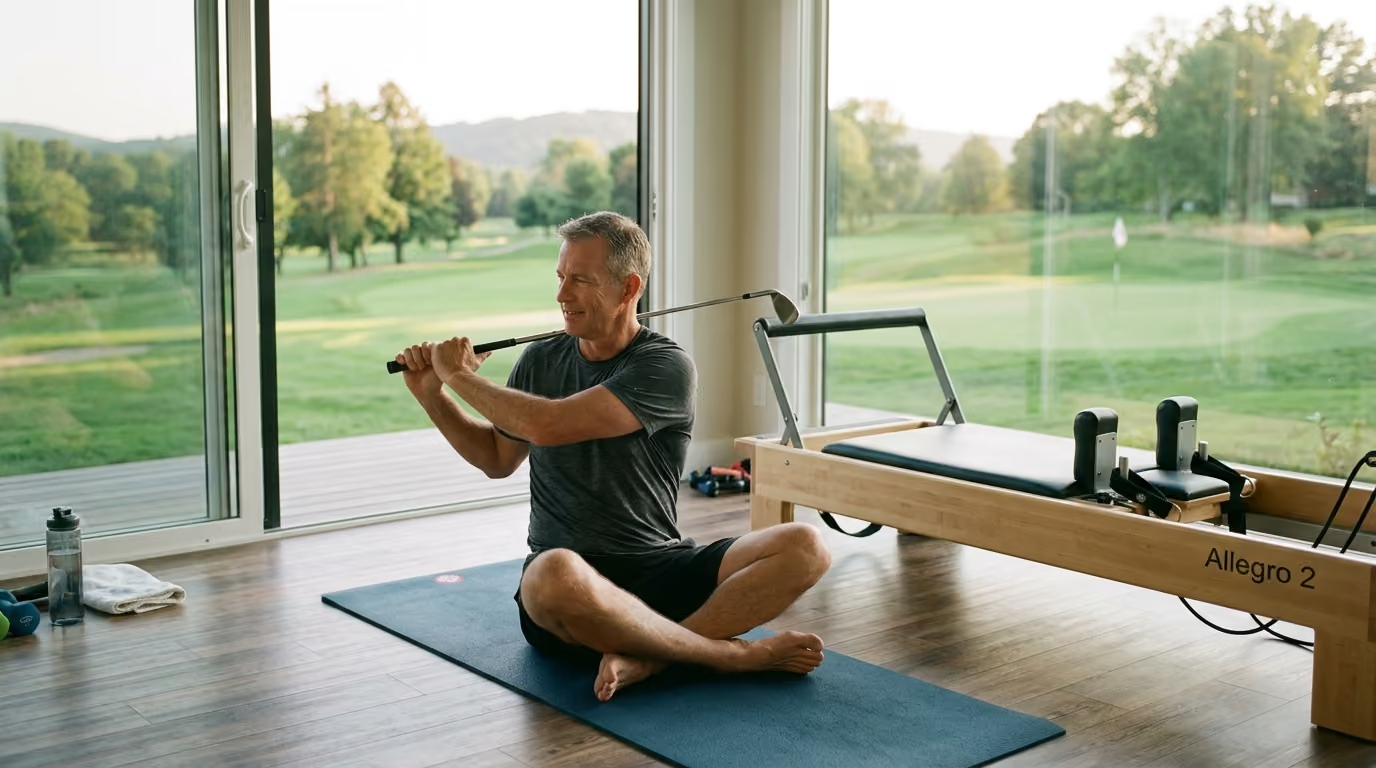

A pain-free golf swing with greater rotational power comes from choosing the right functional flexibility routine between yoga and Pilates.




Many recreational golfers over the age of 40 search online for ways to increase their shoulder turn. They want to know how to stop their backswing from shortening as they age. They often look for deep stretches to cure the lower back stiffness that sets in after playing 18 holes.
The usual advice is to stretch more. You might try to bend further, twist harder, or hold positions longer. Yet simple static flexibility is rarely the real solution for a better swing.
The real solution is functional flexibility. This means having the strength to control your joints through a full range of motion. It means knowing how to turn your shoulders while keeping your lower body stable.
Both yoga and Pilates offer excellent pathways to build this movement capacity. This guide will compare these two practices. It will help you choose the right approach to protect your joints, improve your swing, and play pain-free golf for many years.
Imagine standing on the 14th tee box. Your group is down by one stroke in a friendly match. You want to hit a long drive over a deep fairway bunker.
You try to make a massive backswing like you did twenty years ago. You focus entirely on turning your trail hip and chest as far back as possible.
Because your hips and upper back are stiff, your body compensates. Your trail hip slides outward instead of rotating. Your lead knee collapses inward toward the ball.
You feel a sharp, pinching sensation in your lower back. Your head sways far off the ball. You lose your posture, throw your hands at the club, and hit a weak slice into the trees.
This scenario happens because you forced a range of motion that your body does not actually own. When a joint cannot turn, your brain borrows movement from somewhere else. Usually, it borrows that movement from your lower back. This leads to poor ball striking and muscle fatigue on the back nine.
To prevent this, you can use injury prevention strategies for golf to keep your joints moving safely. The goal is to build controlled mobility so you never have to force a position during your swing.
To understand how to improve your movement, you must look at how the swing actually works. The golf swing is a rapid, coordinated sequence of rotations.
This sequence starts at your feet and moves up through your legs. It travels through your pelvis and torso. Finally, it moves into your shoulders, arms, hands, and the clubhead.
According to a comprehensive systematic review of golf swing mechanics, elite players follow a strict proximal-to-distal sequence during the downswing. The pelvis reverses direction first. Next, the upper torso rotates. This is followed by the shoulders, arms, hands, and finally the club.
This sequence depends on a concept known as the X-factor. The X-factor is the relative angle of separation between your pelvic rotation and your upper torso rotation.
During the transition from the backswing to the downswing, this separation increases. This moment is called the X-factor stretch. It happens because the pelvis begins turning toward the target while the upper torso is still completing its backswing.
However, more separation is not always better. The X-factor is not a single muscle that you should stretch as hard as you can. It is a complex measurement of how your body segments coordinate.
Trying to force a massive X-factor stretch without control can damage your spine. Research on golf-related lower back pain shows that excessive trunk rotation and abnormal muscle recruitment are major risk factors for injury. You do not need the maximum possible twist. You need a stable, coordinated separation that you can repeat without pain.
This is why we focus on mobility with ownership. You need enough range of motion to make a functional swing. You also need the strength, balance, and coordination to control that range of motion at high speeds.
To move safely, you must understand the difference between your thoracic spine and your lumbar spine. Your thoracic spine is your middle and upper back. Your lumbar spine is your lower back.
These two sections of your spine are built for completely different movements. Your thoracic spine is designed for rotation. Each joint in your upper back has the anatomical structure to twist.
Your lumbar spine is built for stability. The vertebrae in your lower back lock together to prevent rotation. They only allow a few degrees of twist.
When your upper back is stiff, your body still wants to turn. It forces your lower back to twist instead. This creates high levels of torsion and shear force on your lumbar discs. Over time, this compensation causes pain and injury.
Your hips play a critical role in protecting your spine. Your hips are ball-and-socket joints designed for large amounts of rotation.
Your lead hip and trail hip do different work during the swing. Your trail hip must rotate internally as you load into your backswing. Your lead hip must rotate internally as you turn through impact and finish your follow-through.
If your lead hip cannot rotate, your pelvis stops turning too early. This forces your lower back to bend and twist laterally at high speed.
Research shows that golfers with restricted lead-hip rotation have higher rates of lower back pain. They also demonstrate greater lumbopelvic movement during the swing. Improving your hip mobility is one of the best ways to protect your lower back.
Using a dedicated golf mobility program can help you target these specific areas. It will help you build motion in your upper back and hips while keeping your lower back stable.
Yoga is an ancient practice that focus on postures, breathing, balance, and body awareness. For golfers over 40, it is an excellent tool to explore your range of motion. It can also help you manage physical asymmetries and speed up recovery.
However, not all yoga classes are the same. You must choose a style that fits your physical needs and playing volume.
Hatha yoga is a broad, traditional style of practice. It focuses on physical postures held for moderate periods.
This style is an excellent starting point for mature golfers. It allows you to build general hip and shoulder mobility at a steady pace.
It also gives you time to feel how your body balances. You can identify which side of your body feels tighter or weaker.
The slower pace makes it easy to modify poses. You can use blocks or straps to support your joints. This reduces the risk of straining your muscles.
Iyengar yoga is highly precise. It focuses on exact anatomical alignment and uses props like blocks, bolsters, and ropes.
This style is ideal for golfers who want to improve their address posture. It teaches you how to position your pelvis, spine, and shoulders with great accuracy.
A study summary on Iyengar yoga reported improvements in golf swing range, clubhead speed, and balance. It also showed a reduction in physical asymmetries.
The focus on long, supported holds helps you build quiet strength. It teaches your brain how to control your body at the end of your range of motion.
Vinyasa yoga connects postures together in a continuous, flowing sequence. The movements are synchronized with your breath.
This style is highly dynamic. It challenges your balance as you transition from one position to the next.
This flow can help you coordinate your body movements. It teaches you to breathe smoothly while your muscles are working.
However, fast transitions can sometimes cause problems. If you move too quickly, you might rely on momentum instead of control. You must make sure you maintain good form as you transition.
Yin yoga is a very slow, passive practice. You hold seated or lying positions for several minutes at a time.
The goal is to apply gentle pressure to your connective tissues. You do not force a deep stretch. Instead, you find a mild edge and stay still.
Yin yoga is perfect for post-round recovery. It helps calm your nervous system after a stressful match.
It is also useful during a high-volume playing season. It keeps your tissues supple without draining your physical energy.
Do not use Yin yoga right before you play. Long, passive holds can temporarily reduce your muscle power. Use it on your rest days instead.
Pilates was developed to improve core strength, posture, and muscle control. It focuses heavily on the concept of centering. This means building a strong trunk to support your limbs.
The practice uses six core principles. These are centering, concentration, control, breath, precision, and flow. These principles fit the physical demands of the golf swing perfectly.
A systematic review of Pilates research found strong evidence that it improves flexibility and dynamic balance. It also found moderate evidence for improvements in muscular endurance. This makes Pilates an excellent choice for golfers who want to maintain their posture on the back nine.
These exercises are performed lying on your back. You practice tilting your pelvis forward and backward. You also learn to find a neutral pelvis while moving your legs.
This teaches you excellent pelvic awareness. You learn how to move your hips without arching or flattening your lower back.
This skill is necessary for a consistent address posture. It helps you avoid early extension during your downswing.
These movements include exercises like the "open book" stretch. You lie on your side and rotate your chest open while keeping your knees stacked.
This exercise forces your upper back to rotate. It keeps your pelvis and lower back locked in place.
This is the exact type of movement you need for a safe backswing. It teaches your body to separate your chest rotation from your pelvic position.
This category includes side kicks, leg lifts, and hip circles. You perform these movements while lying on your side with your spine straight.
These exercises build strength in your gluteus medius. This muscle is critical for lateral stability.
Strong side hips keep your pelvis level during your swing. They prevent your hips from swaying or sliding during your pivot.
The bird-dog exercise is a classic example of this category. You start on your hands and knees. You then reach one arm forward and the opposite leg backward.
This movement teaches your body to diagonalize force. It mimics how your body transfers energy across your torso during the swing.
It also builds excellent endurance in your deep back muscles. This helps you maintain your posture during a long round.
Many fitness programs make bold claims about what they can do for your golf game. It is important to look at what the actual scientific research says. The evidence base for golf-specific yoga and Pilates is small but encouraging.
A six-week feasibility study examined how a yoga program affected golf swing mechanics. The study looked at ten male golfers who did two 15-minute yoga sessions per week.
The researchers used laboratory motion capture to test the golfers before and after the study. They found significant changes in the golfers' pelvic rotation and overall X-factor.
The average rotation range improved by two to three degrees. However, the study did not find significant changes in hand velocity or the speed of the club.
This study shows that even a small amount of yoga can change how your body rotates. It can help you make a fuller turn. Yet you should not expect yoga alone to instantly make you hit the ball much further.
An eight-week study looked at the effects of Pilates on 40 amateur golfers. The golfers were split into two groups. One group did Pilates core exercises. The other group did general strength training.
The Pilates group showed significant improvements in core stability, flexibility, and dynamic balance. They also showed increases in carry distance, ball speed, and clubhead speed.
Most of the final measures were similar between the two training groups. This means Pilates is highly effective, but it is not magic. It works just as well as structured strength training for improving your physical capacity.
Another study looked at Pilates for golf rehabilitation. This research showed that Pilates helped golfers improve their sit-and-reach scores. It also improved their balance and reduced postural asymmetries in their upper back.
These studies show that both systems are valuable. Yoga is highly effective for improving your rotational range. Pilates is excellent for building the core endurance and balance needed to control that range.
To choose the right practice, you must compare how they address specific golf needs. You can use both systems to build a better body for golf.
Yoga uses deep, sustained postures and flowing sequences to open your chest and shoulders. It is excellent for exploring your maximum twisting range.
Pilates focuses on rotating your rib cage while keeping your pelvis organized. It teaches you to control your upper back turn without losing your center.
If your upper back feels locked, yoga can help you find new movement. If you can turn but feel shaky, Pilates will teach you how to stabilize that turn.
Yoga poses like the low lunge and figure-four stretch are great for opening your hip joints. They help you release tight hip flexors and improve your rotation.
Pilates focuses on strengthening your hip muscles through targeted movements. It teaches you to move your leg in the socket without moving your pelvis.
Combining these two approaches is highly effective. You can use yoga to unlock your hips, then use Pilates to stabilize your pelvis.
Yoga postures like the plank and warrior poses build isometric strength. They teach your muscles to hold a position against gravity.
Pilates is designed specifically for trunk endurance. Exercises like the dead-bug and bird-dog challenge your core while your limbs are moving.
This dynamic core strength is critical for golf. It keeps your spine safe as you swing a heavy club at high speeds. This is a great way to build strength for a sustainable swing.
Standing yoga poses challenge your balance on one foot. They teach your brain to coordinate your body weight over your ankle.
Pilates uses precise, unilateral movements to build balance. It focuses on keeping your hips level as you transfer weight.
Both methods will help you navigate sloped fairways and deep bunkers. They teach your feet to stay anchored to the turf.
Yoga offers excellent recovery options like Yin and restorative classes. These practices help quiet your nervous system and ease muscle tension after a hard round.
Pilates can be used for recovery, but the exercises are usually more active. A gentle mat session can help restore your postural alignment.
For the best recovery, use a slow yoga session on the evening after your game. This will help you recover faster so you can play again sooner.
To get the most out of these practices, you need a structured plan. Here are three simple routines you can use. They are designed to fit into a busy golf schedule.
The goal of this routine is to warm up your joints. Do not hold deep stretches before you play. Focus on active, gentle movements instead.
Use this routine on the evening after your round to relax your muscles. Focus on slow, deep breathing throughout this session.
Perform these short sessions during the week to build strength and posture. Space them out so you have a rest day in between.
To see how these routines fit into a complete health plan, you can review our golf performance and longevity resources for older players. This will help you balance your training with your time on the course.
Many golfers make simple mistakes when trying to improve their flexibility. These mistakes can lead to injury and poor performance.
The first mistake is believing that more rotation always means more distance. If you force your body into a deep twist, you will lose your balance and posture. You do not need a tour-pro turn. You need a stable, controlled turn that fits your anatomy.
If your hips or upper back are tight, your body will try to twist from your lower back. This is a major cause of golf-related spinal injuries. Keep your lower back quiet and focus your rotation in your hips and upper back.
A golfer might have great flexibility when lying on a table. Yet if they cannot control that range when standing, it will not help their swing. You must turn passive flexibility into active, usable mobility.
A good stretch should feel like mild tension. It should never feel like sharp, pinching, or radiating pain. If you feel pain in your joints, back off immediately.
Golf is an asymmetrical sport. You only swing the club in one direction. However, training only one side can cause severe muscle imbalances. Always train both sides of your body during your yoga and Pilates sessions to maintain physical balance.
Some golfers try to keep their spine completely rigid. While a stable spine is important, the swing requires some natural bending and tilting. Do not brace your torso so hard that you cannot move naturally.
Many golfers think Pilates is only for abdominal strength. Yet a good Pilates program also targets your hips, upper back, and shoulder blades. Make sure your routine covers your entire body.
You might think yoga is just holding still stretches. However, styles like Vinyasa involve dynamic, flowing movements. Choose a style that matches your daily energy levels and physical needs.
A mobility program cannot fix the strain of hitting 500 balls a day. If you are playing and practicing a lot, you must reduce the intensity of your workouts. Balance your training with your recovery.
Your gear can also affect your joints. For example, wearing heavy, stiff golf shoes with long metal spikes can lock your feet to the ground. This prevents your ankles and knees from rotating naturally, which forces your hips and lower back to absorb more twist.
Using softer, spikeless shoes can allow your feet to move naturally. Also, make sure your club grips are not too small. Small grips can cause you to hold the club too tightly, which creates tension in your shoulders and prevents a smooth shoulder turn.
Every golfer has a unique body. Here are four common patterns and how to address them.
This golfer has tight hips and a stiff upper back. They do not have any pain, but their swing is short and weak.
They should focus on Hatha or Iyengar yoga. These styles will help them explore new ranges of motion safely. They should also do basic Pilates movements to learn pelvic control.
Their goal is to build a fuller backswing. They should focus entirely on turning their trail hip and chest back without losing their posture.
This golfer is naturally flexible. They can make a massive turn, but they struggle with balance and inconsistent ball contact. They often sway during their backswing.
This golfer does not need more stretching. They should focus on Pilates to build trunk endurance and hip stability. They should also do standing yoga poses to improve their single-leg balance.
Their goal is to control their range of motion. They should focus on keeping their lead foot anchored and their pelvis stable during their pivot.
This golfer has a history of lower back soreness after playing. Their lead hip is highly restricted in internal rotation.
This golfer should start with a medical check to make sure their spine is safe. Then, they should do gentle Pilates movements on their back to build core endurance. They should avoid deep, loaded twists.
They should use gentle yoga to improve their lead hip rotation. Their goal is to let their hips rotate through impact so their lower back does not have to twist.
This golfer is over 60. They want to maintain their clubhead speed and walk the course without knee or back pain.
According to a meta-analysis on older adults, both yoga and Pilates improve balance, flexibility, and muscle strength. This golfer should combine both practices. They should do supported standing yoga for balance, and gentle mat Pilates for core strength.
Their goal is overall physical function. They should focus on smooth transitions and keeping their joints moving easily.
To learn more about healthy aging, you can read our guide on recovering between rounds. This will help you keep your body fresh throughout the season.
Before starting a yoga or Pilates routine, you should assess how your body moves. You can perform these five simple checks at home.
A study of competitive male golfers reported average thoracic rotation values of 36.6 degrees on the left and 38.8 degrees on the right. This shows that even high-level players have some natural asymmetry. You do not need perfect symmetry. You simply need enough balanced movement to swing without pain.
If you are new to these concepts, read our about page to understand our approach to golf fitness. We focus on practical, research-led insights to help you play better for longer.
Yoga and Pilates are not competing systems. They are highly complementary.
Yoga is excellent for exploring and maintaining comfortable hip, shoulder, and upper back mobility. It also supports mental focus, breathing, and physical recovery.
Pilates is ideal for building the trunk endurance, pelvic control, and dynamic balance needed to use that mobility safely. It teaches your body to stabilize your spine while your hips and shoulders rotate.
For the best results, use both practices. Use yoga to open your tight joints, and use Pilates to strengthen your core.
This balanced approach will help you build a strong, flexible, and repeatable swing. It will protect your joints from wear and tear. Most importantly, it will allow you to play the game you love for many decades to come.
If you have questions about how to build a routine, you can visit our contact page to connect with our team. We are always happy to help golfers improve their movement.
Your golf swing does not require the maximum possible flexibility, but rather a stable and controlled separation between your hips and upper back that you can easily repeat without putting stress on your lower back.
Follow Golfergy for practical insights on performance, mobility, recovery and healthy ageing. Stay connected for new articles, research-led guidance and ideas to help you play better for longer.


Explore practical resources on performance, recovery, mobility and golf longevity.
Read the Blog