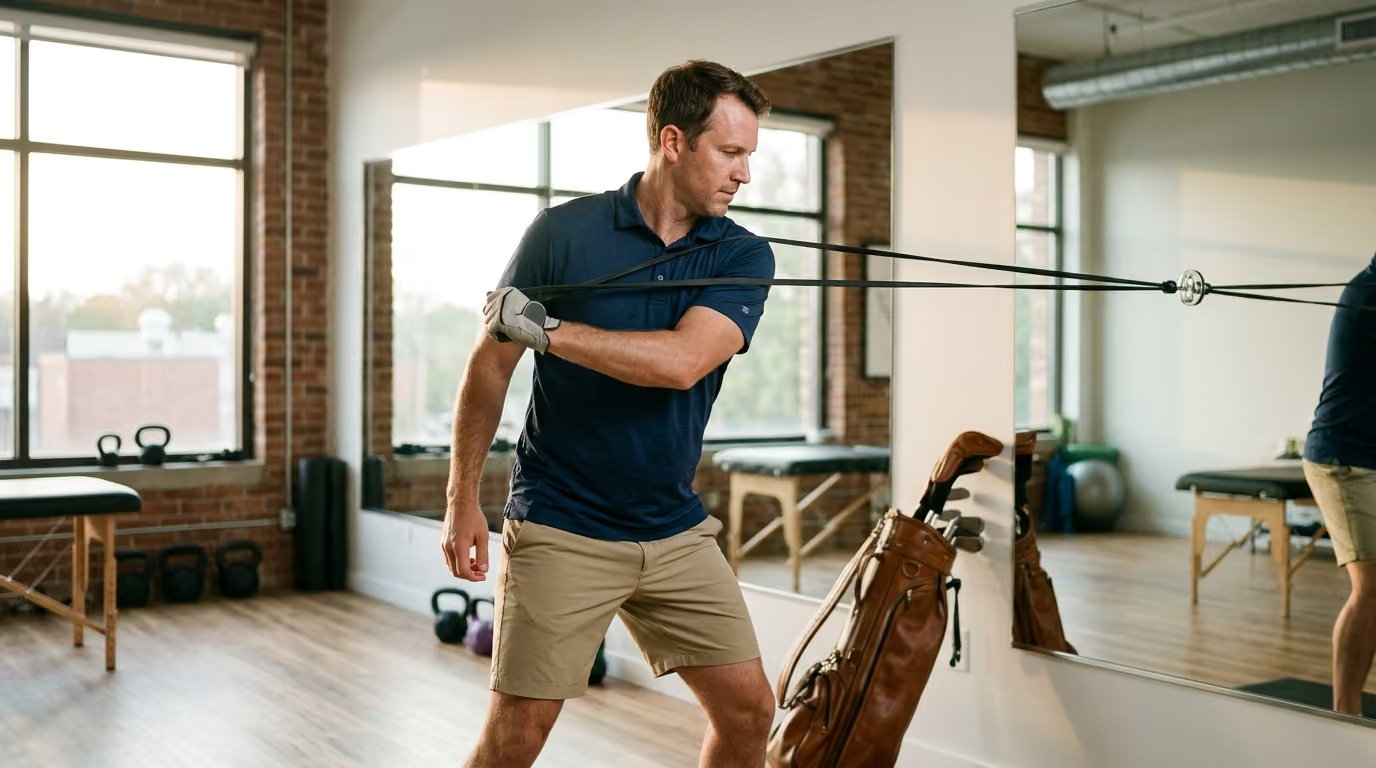
Functional core stability protects a golfer from lower back pain by keeping the spine secure during high-speed rotational swings.




Most golfers believe that a strong core means doing hundreds of sit-ups every morning. They assume that a flat, visible set of abdominal muscles will automatically shield their lower back from the violence of a driver swing. This is a common mistake.
In fact, training your trunk by repeatedly bending it forward can actually make your back more vulnerable on the course.
A golf swing does not ask your spine to bend forward like a sit-up does. Instead, it demands that your trunk remains stable while your hips and shoulders rotate at high speeds.
This guide is an in-depth resource designed to help you build the exact type of stability your golf game requires. We will look at the actual forces your spine experiences during a round. We will also outline a complete, research-backed training framework to keep you playing pain-free for decades.
Let us look at a common scenario on the course. You are standing on the tee box of the par-four 14th hole. You have played well so far, but you are starting to feel a familiar tightness in your lower back.
When you swing your driver, your trail hip does not seem to turn fully. Your lower back starts to pinch at the top of your backswing. To make up for this lack of turn, you start pulling the club down with your arms.
This arm-heavy swing causes a slice that lands deep in the right rough. By the time you walk up to your ball, your lower back is stiff and aching. You spend the remaining holes simply trying to survive the walk to the clubhouse.
A few years ago, I noticed my swing falling apart around the 14th hole. My lower back would tighten up, and I started compensating with my arms. I spent months thinking it was a swing flaw.
It was not until I started a simple evening hip mobility routine that I realized my glutes were just turning off from fatigue. Fixing that one physical limitation brought my back nine scores down drastically.
This breakdown is not a technical swing error that you can fix with a new tip from a magazine. It is a physical limitation caused by poor trunk endurance and bad hip movement.
When your deep stabilizing muscles get tired, your body looks for other ways to support your spine. It often uses your lower back muscles as an emergency brake, which leads to stiffness and pain. To extend your playing years, you must learn to recognize this late-round fatigue before it causes an injury.
To understand how to protect your back, we must look at how the spine behaves under load. The core is not just one muscle on the front of your stomach. It is a complete system that includes your abdominal wall, back muscles, diaphragm, pelvic floor, and hips.
According to research by Dr. Stuart McGill, lumbar stability is achieved when these muscles work together to keep the spine in a neutral position. They co-contract to create a natural corset around your midsection. This system acts as a transmission, transferring the power generated by your legs through your trunk and into your arms and club.
During a swing, your lower back is subjected to massive physical forces. Research measuring lumbar loads during a golf swing shows that the lower back experiences compressive forces greater than six times your body weight during the downswing. The swing also creates shear forces, which act like a sliding motion between your spinal discs.
These forces are not dangerous by themselves if your muscles can control them. However, they become a problem when your spine becomes the primary source of rotation. Your lumbar spine is only designed to rotate about two degrees per segment. Most of your rotation must come from your hips and your thoracic spine, which is your upper back.
Some trainers advocate for abdominal hollowing, which means sucking your belly button in toward your spine. However, research shows that hollowing does not protect your spine well from sudden movements.
A better approach is abdominal bracing. This means binding your midsection by tensing all your core muscles at once, as if you were about to be punched in the stomach. Bracing creates a wider area of support and keeps your spine in a safer position.
This co-contraction allows the deep muscles of the lower back, like the multifidus, to work with the obliques and rectus abdominis. Together, they act like the guy wires supporting a tall sailboat mast. If one wire is too tight or too loose, the mast becomes unstable.
Bracing keeps all the wires under equal tension, which protects the delicate spinal discs from shifting under load. This is a primary pillar of golf longevity and performance as you age.
Sit-ups are excellent for training your rectus abdominis, which is the superficial muscle on the front of your stomach. They can build local muscle endurance if you need to bend your torso forward repeatedly.
However, golf does not require you to bend forward under load. It requires you to resist unwanted movement while your limbs move at high speeds. If you only train with sit-ups, you are teaching your body to move through your lower back rather than your hips.
A study of young elite golfers tracked their muscle activity over a six-month period. The researchers found that the golfers who developed low back pain actually showed higher activation of their dominant front abs and lat muscles during the swing.
This suggests that simply making your front abdominal muscles work harder is not the secret to a pain-free back. In fact, overworking these muscles can create a rigid trunk that prevents your hips from turning naturally.
Instead of focusing on how your abs look, you need to focus on how they function. We can organize this functional training into a clear hierarchy. It starts with simple body awareness and breathing, then moves to resisting movement, transferring loads, and finally controlling rapid rotation.
By following this path, you build a trunk that supports your swing instead of blocking it. True stability is about controlling motion under force, fatigue, and speed. It is not about having a flat stomach or being able to hold a plank for five minutes.
Furthermore, repetitive spinal flexion under compression can damage the outer fibers of your spinal discs over time. When you perform a sit-up, you squeeze the front of your discs, pushing the soft inner gel backward.
In a golf swing, you are already exposing these discs to high rotational speeds. Adding hundreds of repetitive flexion movements in the gym simply increases the cumulative wear and tear on these sensitive structures.
To build a golf-specific core, we must focus on three primary types of resistance. These are anti-extension, anti-lateral-flexion, and anti-rotation.
Anti-extension is the ability to prevent your lower back from arching excessively. During the backswing and follow-through, many golfers flare their rib cage and arch their lower back. This position puts high pressure on the facet joints of your spine.
Anti-lateral-flexion is the ability to resist unwanted side-bending. The golf swing requires a specific amount of side-bend, but it must be controlled. If your trunk collapses toward one side during the downswing, your spine experiences heavy shear forces.
Anti-rotation is the ability to resist twisting forces. This sounds counter-intuitive because the golf swing is a rotational movement.
However, you must be able to resist rotation in your lower back to allow your hips and upper back to rotate fully. If your lower back twists too much, it becomes the default stabilizer, which often leads to injury.
Improving your joint mobility in your hips and upper back allows your core to do its job. When your hips can turn freely, your lower back does not have to twist to make up for the lack of movement. This team effort is what keeps your swing powerful and your spine safe.
Consider the role of the lead hip during the downswing. As you transition, your lead hip must rotate internally to clear space for your hands. If this hip is stiff, your pelvis stops turning early.
Your brain still wants to complete the swing, so it forces your lower back to twist to find that extra range of motion. By training your core to resist this unwanted twist, you force your hips to do the work they were designed to do.
This long-term routine progresses through six distinct phases. Do not rush through these steps. Spend at least three weeks on each phase to build a deep foundation of control.
The goal of this phase is to find a comfortable neutral spine and learn to breathe under tension. Lay on your back with your knees bent and feet flat on the floor. Place one hand on your chest and one hand on your stomach.
Breathe in deeply through your nose, making sure your stomach rises while your chest stays relatively still. As you exhale, gently tense your abdominal wall without pulling your belly button down. Practice taking five deep breaths while maintaining this light tension.
This drill teaches you to brace your trunk without holding your breath, which is vital on the course. It trains your diaphragm to act as both a breathing muscle and a spinal stabilizer simultaneously. Repeat this sequence for three rounds daily.
This phase teaches your trunk to resist the pull of your moving arms and legs. The classic dead bug exercise is perfect for this goal. Lay on your back with your arms pointing toward the ceiling and your knees bent at ninety degrees above your hips.
Slowly lower your right arm behind your head while extending your left leg toward the floor. Only go as far as you can without letting your lower back arch off the floor. Return to the starting position and repeat with the opposite arm and leg.
Perform three sets of eight repetitions on each side, focusing entirely on keeping your lower back flat. If your back begins to arch, reduce the range of motion by not lowering your leg as close to the floor.
This phase builds strength along the sides of your body to prevent your spine from collapsing sideways. The suitcase carry is a highly practical movement for this goal. Hold a relatively heavy kettlebell or dumbbell in your right hand.
Stand tall and make sure your shoulders are perfectly level. Walk forward slowly for thirty paces, keeping your torso upright without leaning toward the weight. Switch the weight to your left hand and walk back.
Perform three rounds on each side to build endurance in your lateral abdominal wall. Focus on taking small, controlled steps rather than rushing your stride.
This phase teaches you to resist twisting forces, which is your primary defense against swing-related back pain. The Pallof press is the gold standard for this phase. Stand sideways to a cable machine or a resistance band anchored at chest height.
Hold the handle with both hands and pull it to the center of your chest. Stand with your feet shoulder-width apart and your knees slightly bent. Press the cable straight out in front of you, making sure your body does not twist toward the anchor.
Hold the extended position for two seconds, then return the handle to your chest. Perform three sets of ten repetitions on each side. Keep your shoulders down and avoid shrugging as you press.
Once you can resist movement, you must learn to rotate with control through your hips and upper back. Use a cable machine set to a high position. Stand with your feet wider than shoulder-width apart, holding the handle in both hands.
Pull the cable diagonally down and across your body, mimicking a wood-chopping motion. Focus entirely on turning your trail hip as you pull, keeping your lower back relatively stable. Slowly return to the starting position under control.
Perform three sets of eight repetitions on each side. This drill teaches the hips and shoulders to rotate around a stable spine, which is the key to a safe swing.
The final phase prepares your body to absorb the high-speed forces of a full swing. Hold a light medicine ball in both hands. Stand facing a solid wall about three feet away.
Rotate your hips back, then throw the ball underhand against the wall. As the ball bounces back, catch it and immediately brace your body to stop the momentum. Do not let your trunk twist wildly as you catch the ball.
Perform three sets of six throws on each side to build deceleration power. This phase is critical for injury prevention during the high-speed finish of your swing.
If you feel your lower back tightening up during a round, you cannot stop to do floor exercises. Instead, you can use a simple standing drill on the tee box to reset your posture.
Stand with your feet shoulder-width apart and place your hands on your hips. Gently tilt your pelvis forward and backward until you find the middle position where your back feels relaxed. Once you find this neutral spot, take a deep breath in through your nose.
As you breathe out, perform a light brace around your midsection, about twenty percent of your maximum effort. While holding this light brace, take two normal breaths.
This quick drill reminds your deep stabilizers to turn back on before your next shot. It helps prevent your lower back muscles from overworking to support your spine.
You can also perform this reset while walking between shots. Let your arms swing naturally beside you while keeping a light, comfortable tension in your stomach.
Avoid walking with a slumped posture or carrying your golf bag over only one shoulder. These small adjustments keep your spinal posture aligned and reduce the cumulative stress of walking several miles over uneven terrain.
Many golfers make their back pain worse by using the wrong techniques in the gym. Avoiding these mistakes will save you weeks of recovery time and help you build a more resilient body.
Some golfers brace their core as hard as possible for every exercise. They hold their breath and turn their face red trying to create maximum stiffness. This is counter-productive.
Research shows that over-bracing actually increases the compression forces on your spinal discs. It also reduces the natural coordination of your muscles. You should only brace as much as the task requires.
A light chip shot requires very little stiffness, while a hard driver swing requires a stronger brace. Always make sure you can breathe comfortably while maintaining your brace.
Many training programs focus entirely on the front abdominal muscles, like the rectus abdominis. This approach ignores the muscles on the sides and back of your body. Your trunk works as a complete cylinder.
If you only strengthen the front, you create an imbalance that can pull your pelvis out of alignment. Make sure your routine includes exercises for your lateral walls, like side planks, and your back muscles, like bird dogs.
This balanced approach is the key to building real strength that transfers to the golf course. It protects you from developing a rigid, forward-leaning posture over time.
The belief that you must push through pain is dangerous for mature golfers. If an exercise causes a pinching sensation or radiating pain, stop immediately. Pain is a warning sign that your spine is overloaded or out of position.
Forcing your way through a painful movement will only cause deeper inflammation. Instead, scale the exercise back to a level that you can perform without discomfort. If the pain persists, seek a medical evaluation rather than trying to strengthen through it.
Your equipment can have a surprising impact on how your core functions during a round. Making small adjustments to your gear can reduce the stress on your spine and help you maintain better alignment.
The shoes you wear affect how you transfer force from the ground. Spiked shoes offer excellent traction, which allows you to generate more rotational power.
However, if your hips are tight, that extra traction can force your lower back to twist more. Spikeless shoes allow for a small amount of foot rotation during the swing.
This small slip can actually relieve pressure on your lower back. If you suffer from frequent back stiffness, try switching to a flexible, spikeless shoe to see if it improves your comfort.
If your grips are too small, you will tend to squeeze the club too tightly. This hand tension can travel up your arms and cause your shoulders and trunk to stiffen up.
Using midsize or jumbo grips can help you maintain a lighter grip pressure. This relaxed upper body allows for a smoother turn and better muscle coordination.
Additionally, carrying a heavy stand bag for eighteen holes can fatigue your back before you even swing. Using a push cart or a riding cart preserves your energy and keeps your stabilizing muscles fresh for the back nine.
Reducing these small physical stresses adds up to a much more comfortable round and helps optimize your recovery between play days.
Not every golfer needs the same training program. Your age, skill level, and injury history should dictate how you approach core stability.
As we age, we naturally lose some joint mobility and muscle mass. For golfers over forty, the primary goal of core training should be endurance and balance rather than maximum power.
Focus on holding positions longer rather than adding heavy weights. Exercises like suitcase carries and standing Pallof presses are excellent because they do not require you to get down on the floor.
These standing movements also improve your balance, which is crucial for a consistent swing finish. Consistent, low-intensity training is the best way to support healthy ageing on and off the course.
Recreational golfers often have inconsistent swings that place unpredictable loads on the spine. If your swing path changes with every shot, your trunk has to work harder to protect your back.
For these players, the priority should be movement repeatability. Keep your exercises simple and focus on maintaining a stable posture throughout the movement.
Do not worry about high-speed rotation drills until you can perform basic holds with perfect form. Building a stable base will help you stay healthy as you work with a teaching professional to improve your swing technique.
Elite players swing the club at much higher speeds, which creates massive physical forces. These golfers need a highly resilient trunk to absorb these rotational loads over multiple days of competition.
If you play in tournaments, your program should include high-velocity deceleration drills and medicine ball throws. You must also monitor your training volume carefully.
A sudden spike in practice swings can overwhelm your stabilizing muscles and lead to injury. Combine your core work with regular assessments of your hip and thoracic mobility to ensure your body can handle the speed you generate.
To help you get started, we have created three distinct weekly workout templates. Choose the template that matches your current physical condition and experience level.
This program is designed for golfers who are currently recovering from mild back stiffness or have not performed core training before. Focus entirely on control and breathing.
This program is perfect for active recreational golfers who want to protect their back and build a more consistent swing foundation.
This program is for experienced golfers who are pain-free and want to train their core to handle high-speed rotational forces.
How do you know if your core training is actually working? You do not need expensive lab tests to track your improvement. Instead, you can look for several practical indicators during your weekly rounds.
First, pay attention to how your lower back feels on the back nine. If you can walk off the 18th green with the same comfort you had on the 1st tee, your trunk endurance has improved.
Second, monitor your swing balance. If you can hold your follow-through position until the ball lands without losing your balance, your dynamic stability is functioning well.
Finally, keep track of your practice volume. If you can hit a full bucket of balls on the range without feeling stiff the next morning, your body is recovering efficiently. These real-world improvements are much more valuable than the number of sit-ups you can perform.
If you want to track more specific metrics, check out our golf-specific templates and training tools to guide your routine. Consistent practice of these movements will help you enjoy the game you love for many years to come.
Trunk stability is the foundation of a powerful swing and a healthy back, but it is built by resisting motion rather than forcing it.
Follow Golfergy for practical insights on performance, mobility, recovery and healthy ageing. Stay connected for new articles, research-led guidance and ideas to help you play better for longer.


Explore practical resources on performance, recovery, mobility and golf longevity.
Read the Blog