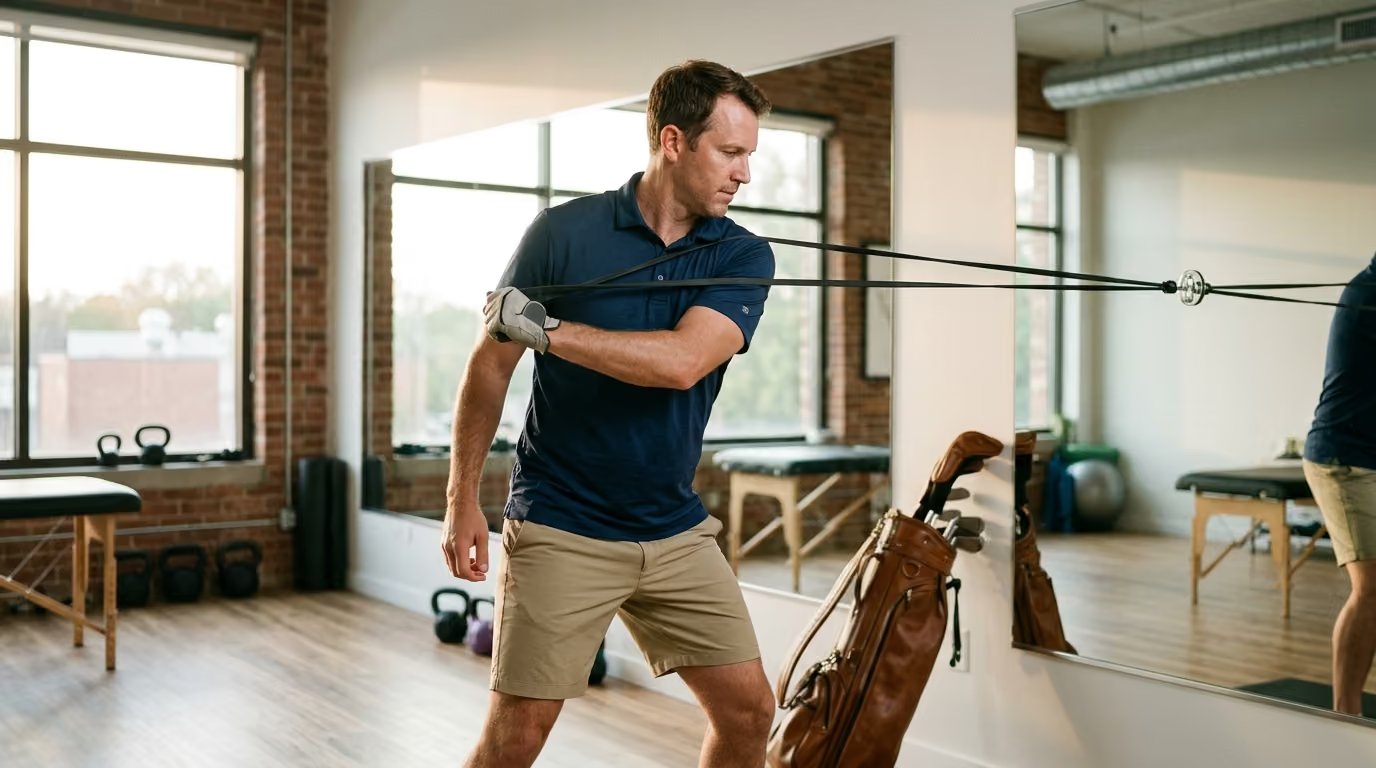
Golfers who struggle with joint fatigue on the back nine need strong hands and wrists to absorb heavy impact forces and maintain consistent mechanics.




You stand on the fourteenth tee box of a long, chilly autumn round. Your score is decent, but you feel a familiar dull ache creeping into your lead wrist. On the last hole, you hit a shot slightly fat from a heavy lie. The sudden shock of the club hitting the turf sent a sharp jolt straight up your arm. Now, you find yourself gripping the club much harder to prevent it from twisting in your hands. This extra tension is already changing your swing path and causing your forearms to feel tight.
Many mature golfers struggle with this exact scenario on the back nine. We often look at the wrong parts of the body when our swing starts to break down. A few years ago, I noticed my swing falling apart around the 14th hole. My lower back would tighten up, and I started compensating with my arms. I spent months thinking it was a swing flaw. It was not until I started a simple evening hip mobility routine that I realized my glutes were just turning off from fatigue. Fixing that one physical limitation brought my back nine scores down drastically.
The hands and wrists are the final mechanical link between your body and the club. If this link is weak or painful, your entire swing suffers. Your body will naturally try to protect a sore joint by changing how you move. This protective reaction often leads to swing flaws, poor contact, and extra strain on your elbows and shoulders. Understanding how your hands and wrists function is the first step toward playing pain-free golf for many years.
Your wrists are remarkably complex structures that must handle high speeds and heavy forces. They do not just bend in one direction. Instead, they move through three distinct paths during a normal golf swing.
The first path is flexion and extension. This is the movement of bending your palm toward your forearm or bending the back of your hand toward your forearm. The second path is radial and ulnar deviation. This is the side to side motion of the wrist toward your thumb or toward your little finger. The third path is pronation and supination, which is the rotation of your forearm that turns your palm up or down.
During a standard right-handed swing, your lead wrist is your left wrist. Your trail wrist is your right wrist. Your lead wrist undergoes a major change during the transition from the backswing to the downswing. It starts in a radial-deviated position, where the wrist is tilted toward the thumb. As you swing down toward impact, it moves rapidly into ulnar deviation, which tilts the wrist toward the little finger.
This rapid change makes the ulnar side of your lead wrist highly vulnerable to injury. Research shows that the lead wrist is the site of the vast majority of golf wrist issues. In fact, a study of European Tour professionals found that sixty-seven percent of all wrist problems occurred in the lead wrist. The same study revealed that thirty-five percent of all reported wrist issues were located specifically on the ulnar side.
The ulnar side of the wrist contains a small cartilage structure called the triangular fibrocartilage complex. This structure acts as a shock absorber between your arm bones and your wrist bones. When you swing a club, this small pad of cartilage must bear immense rotational force. If your lead wrist moves too quickly or hits the ground hard, this cartilage can easily become irritated.
The trail wrist faces different challenges. It tends to move more into extension and forearm rotation to help control the clubface. While it is injured less frequently than the lead wrist, it still bears significant load. Both wrists must work together to maintain a stable connection to the club without locking up. If you want to continue playing without pain, maintaining your physical performance as you age requires keeping these small joints moving smoothly.
It is common to hear golfers talk about grip strength as the solution to all swing problems. However, maximum grip strength and active grip pressure are not the same thing.
Grip strength is the maximum force you can produce when you squeeze an object. Doctors often measure this with a device called a dynamometer to check your overall physical health. In older adults, grip strength is a reliable indicator of muscle mass, joint health, and general physical function. Having good baseline grip strength is helpful for club control.
Grip pressure is the actual force you apply to the handle of the club during your swing. You do not want to use maximum grip strength when you play. Squeezing the club as hard as you can actually limits your performance. High grip pressure creates stiffness that travels up your arms into your shoulders and neck. This tension slows down your hand speed and prevents a natural release of the club.
When you use excessive grip pressure, you increase the muscular demand on your forearms. Research shows that a firmer grip reduces how much your wrist can bend during the swing. It also forces your muscles to work much harder for a longer period. This extra work leads to early fatigue, which can cause you to lose control of the clubface on the back nine.
The goal for a healthy swing is force control. This is the ability to apply the minimum amount of grip pressure needed to control the club. You need enough control to keep the club from twisting, but enough relaxation to let your wrists move freely. Good force control allows you to handle uneven lies, heavy sand, and thick rough without overstressing your joints.
Grip endurance is also critical. It does not matter if your grip feels great on the first hole if it fails by the twelfth. If your forearm muscles tire out, they can no longer absorb the shock of impact. This forces the delicate bones and ligaments in your wrists to take the brunt of the force. Building forearm endurance helps protect these joints from repetitive wear.
As we age, the joints in our hands and wrists naturally undergo structural changes. Understanding these changes helps us adapt our game without giving up the sport we love.
The most common joint issue for mature golfers is osteoarthritis. This is a degenerative joint condition where the protective cartilage on the ends of your bones gradually wears down. In the hand, osteoarthritis typically targets the base of the thumb. It also commonly affects the small joints closest to your fingertips and the middle joints of your fingers.
Osteoarthritis symptoms usually include pain during or after activity, stiffness in the morning, and a loss of normal joint movement. You might also notice mild swelling, a grinding sensation called crepitus, or a general feeling of weakness in your fingers. A study from the University of Western Ontario showed that people with hand arthritis experience significant limitations in wrist movement. On average, they lose over seventeen percent of their normal wrist flexion and nearly thirteen percent of their extension.
Rheumatoid arthritis is a different condition. It is an autoimmune issue where your immune system mistakenly attacks the lining of your joints. This condition usually causes symmetrical pain, meaning it affects the same joints on both hands. It often causes warm, red, swollen knuckles, prolonged morning stiffness, and general fatigue.
The distinction between these two types of arthritis is important because they require different care. If you have osteoarthritis in the base of your thumb, you might struggle with the pinching motion required to hold a golf club. The natural reaction is to squeeze harder with your other fingers to compensate. This extra squeezing places a heavy load on a joint that is already irritated.
Treating the thumb as a primary load-bearing link is vital for mature golfers. The base of your thumb must support the weight of the club during the transition and downswing. If this joint is weak or painful, your brain will limit your swing speed to protect the hand. Modifying your grip and your equipment can help protect this joint from excessive wear.
The golf swing requires a rapid transfer of energy from your body, through the club, and into the ball. When everything goes right, this energy transfer is smooth. When you strike the turf too early, that energy has to go somewhere else.
Golf wrist injuries frequently happen right at the moment of impact. If your club hits hard ground, deep rough, or a hidden root, the club stops suddenly. The energy of your swing is instantly redirected back up the shaft and into your hands. This sudden change in load places extreme stress on the ligaments and tendons in your wrists.
One specific bone at risk during bad impacts is the hamate. This is a small, hook-shaped bone located on the little-finger side of your palm. The end of your golf club rests directly against this bony hook. If you hit a fat shot on hard ground, the club handle can compress directly against this bone. This blunt force can cause a hook-of-hamate fracture, which is a common but frequently missed golf injury.
Another common impact injury involves the triangular fibrocartilage complex, or TFCC. This structure can tear if your wrist is twisted or compressed suddenly at impact. This injury causes deep, localized pain on the little-finger side of the wrist. It is often accompanied by a clicking sound when you turn your hand or open a door.
Tendon issues are also highly common among high-volume players. The extensor carpi ulnaris tendon runs along the back and side of your wrist. It helps stabilize your wrist during the swing. Repetitive ground contact can irritate this tendon, leading to swelling and pain when you bend your wrist backward.
You should never ignore pain that only happens when you hit a fat shot. That sudden pain is not just a sign of a poor swing. It is a warning that your tissues are being loaded past their safe limits. Over time, these minor impacts can cause cumulative damage that requires a long layoff from the game.
You do not have to accept hand and wrist pain as an inevitable part of aging. Making smart changes to your equipment can significantly reduce the physical stress of the game.
Start by looking at your grips. Most standard golf clubs come with narrow, firm grips. Squeezing a narrow handle requires a high amount of finger force. If you have arthritis, this tight pinch can quickly provoke joint pain. Replacing your worn grips is one of the easiest steps you can take to make the game more comfortable.
Using a larger grip can make a major difference. A thicker grip allows you to hold the club securely without having to close your fingers tightly. This reduction in finger force helps protect the small joints in your hands. However, you must be careful not to use a grip that is too large. If the grip is too thick, you might struggle to release the club, which can cause you to push your shots to the right.
The material of your grips also matters. Softer, shock-absorbing materials can damp the vibrations that travel up the shaft after a shot. Some grip designs are specifically engineered for players with arthritis. Testing different sizes and textures on a single club is a great way to find what works best for your hands.
Your club shafts play a massive role in shock absorption. Heavy steel shafts are very rigid and transmit a large amount of vibration to your hands. Switching to lightweight graphite shafts can help protect your joints. Modern graphite shafts are highly stable and can absorb a significant portion of the shock from ground impact.
You can also adjust your clubhead selection and ball choice. Using perimeter-weighted clubheads can help reduce twisting on off-center hits. Playing with a low-compression golf ball also reduces the force required to compress the ball, which lowers the impact shock. Using longer tees is another simple way to minimize your contact with hard turf.
If you start to feel discomfort during a round, you do not have to walk off the course immediately. There are several active adjustments you can make to manage your symptoms and protect your joints on the remaining holes.
First, focus entirely on turning your trail hip during the backswing. When your hips stop turning, your body will naturally try to create club speed by overusing your hands and wrists. This leads to a steep swing path and a higher chance of hitting fat shots. A full hip turn helps create a shallower angle of attack, which reduces the severity of ground impact.
Next, pay close attention to your grip pressure on the practice swings. Try a simple exercise before you address the ball. Squeeze the club as hard as you can, which is a level ten pressure. Then, let go completely. Now, grip the club just tightly enough to keep it from slipping out of your hands, which should feel like a level three or four. Maintain this lighter pressure throughout your swing to keep your forearm muscles relaxed.
You can also change your strategy on the turf. If you have a difficult lie in the rough, do not try to muscle a long iron through the grass. Instead, use a hybrid club with a flatter sole that glides easily over the ground. If you are playing from a hard fairway, consider playing a sweep shot that nips the ball off the turf without taking a deep divot.
Finally, use a glove on both hands. Many golfers only wear a glove on their lead hand. Wearing two gloves improves your overall traction on the grip. This extra traction allows you to maintain control of the club with much less physical squeezing pressure. It is a simple, inexpensive way to reduce joint strain during a round.
Building long-term joint resilience requires a consistent physical routine. You cannot rely solely on quick fixes if you want to play pain-free for decades. A dedicated home routine should focus on both joint mobility and balanced strength.
Before you begin any exercises, it is helpful to assess your current joint mobility. Gently move your wrists through their full range of motion. If you notice a major difference between your hands, or if you feel sharp pain, you should adjust the exercises accordingly. Working on improving your general joint mobility will make these specific wrist movements much easier to perform.
Start your routine with gentle mobility movements. Begin by sitting with your forearm supported on a table, with your hand hanging over the edge. Slowly bend your wrist downward as far as comfortable, then raise it upward toward the ceiling. Repeat this movement ten times in a slow, controlled manner. Do not force the movement through sharp pain.
Next, focus on forearm rotation. Hold a light object, like a kitchen spatula or a short golf club, by the handle. Keep your elbow tucked against your side at a ninety-degree angle. Slowly rotate your forearm so your palm faces up, hold for two seconds, then rotate so your palm faces down. This movement helps build control in the muscles that manage clubface rotation.
Wrist Mobility Flow:
[Forearm Supported on Table]
│
├──► 1. Flexion/Extension (10 slow reps)
│
├──► 2. Forearm Rotation (Palm up to palm down, 10 reps)
│
└──► 3. Thumb Opposition (Touch thumb to each fingertip)
To build joint capacity without irritating your cartilage, use isometric exercises. Hold a soft ball or a rolled-up towel in your hand. Squeeze the ball gently at about half of your maximum effort. Hold this squeeze for ten seconds, then relax completely. Perform five repetitions on each hand to build endurance in your gripping muscles.
You also need to balance your forearm strength by working the muscles on the back of your hand. Put a thick rubber band around your fingers and thumb. Slowly open your hand against the resistance of the band, spreading your fingers as wide as possible. Hold for two seconds, then close your hand slowly. This exercise prevents the muscle imbalances that often come from constant gripping.
Forearm Strength Exercises:
├──► 1. Isometric Squeeze (Soft ball, 5 reps x 10-second hold)
└──► 2. Finger Extension (Rubber band, 10 slow reps)
After your exercises, practicing proper post-round recovery techniques is helpful for reducing joint stiffness. Applying ice to a sore joint can help soothe irritation after a long practice session. If your joints feel stiff but not inflamed, applying gentle warmth before your routine can help prepare your muscles for movement. Consistency is much more important than intensity when working on these small joints.
To build the structural support needed for a stable swing, you can also include targeted forearm strength training in your weekly routine. Using light weights for controlled wrist curls can help build the tendons that stabilize your joints at impact. Always start with very light loads to make sure your joints can handle the stress without flaring up.
Many well-meaning golfers make simple mistakes when trying to manage their hand and wrist issues. These errors can turn a minor strain into a chronic injury that keeps you off the course.
The first mistake is trying to build maximum grip strength to cure joint pain. If you have an active joint flare-up from arthritis, squeezing a heavy metal hand gripper will only make the inflammation worse. Your joints need a balance of mobility and gentle endurance, not maximum crushing force. Squeezing through pain can damage the very cartilage you are trying to protect.
The second mistake is wearing a rigid wrist brace continuously. A supportive brace can be very helpful during a painful flare-up or immediately after an injury. However, leaving it on all the time can cause your surrounding forearm muscles to weaken. If you do not use your muscles, they will waste away, leaving your wrist joints with even less natural support. Use braces selectively and pair them with movement.
The third mistake is assuming all ulnar-sided pain is simple tendonitis. The ulnar side of your wrist contains many small, delicate structures like the TFCC and the hook of the hamate bone. If you treat a cartilage tear or a bone fracture as a simple muscle pull, you might continue to load it destructively. If your pain does not improve after a few weeks of rest, you need a professional assessment.
Common Mistakes to Avoid:
├──► 1. Using heavy hand grippers during a joint flare-up
├──► 2. Wearing a rigid brace 24/7 (leads to muscle wasting)
└──► 3. Ignoring ulnar-sided pain (assuming it is just a minor strain)
└──► 4. Stopping all movement (which increases joint stiffness)
The fourth mistake is treating arthritis as a reason to stop moving your hands entirely. When your joints hurt, it is natural to want to protect them by keeping them still. However, joints need movement to stay healthy. Gentle motion helps circulate the fluid that lubricates your cartilage. If you stop moving, your fingers and wrists will become increasingly stiff and weak.
Understanding these common errors is a core part of effective golf injury prevention strategies for mature players. By avoiding these pitfalls, you can protect your joints while still keeping your body active. Always prioritize gentle, pain-free movement over absolute rest or aggressive strength training.
It can be difficult to tell the difference between normal post-round soreness and a structural injury that needs medical attention. Having a simple system to check your symptoms can help you make smart decisions.
Start by looking at the location and timing of your pain. If your wrists just feel slightly tired or stiff after eighteen holes, this is usually normal fatigue. If you have localized pain on the ulnar side that hurts when you turn a doorknob, this is a warning sign. Pain that persists into the next morning, or is accompanied by visible swelling, should not be ignored.
Symptom Triage Guide:
├──► Normal Fatigue: Mild stiffness, clears up within 24 hours
└──► Medical Evaluation Needed:
├──► Localized pain on the ulnar or radial side
├──► Clicking, popping, or a feeling of joint instability
├──► Numbness, tingling, or shooting pain in fingers
└──► Swelling that lasts more than 48 hours
Pay close attention to any clicking, popping, or feelings of instability in your wrist. If your wrist feels like it might give way when you pick up a coffee cup, you may have a ligament issue. These structural problems will not get better by simply swinging through them. Continuing to play with an unstable joint can lead to rapid wear of your remaining cartilage.
Numbness and tingling are also critical warning signs. If you feel a pins-and-needles sensation in your thumb, index, or middle fingers, your median nerve may be compressed. This is often a sign of carpal tunnel syndrome, which can be aggravated by tight gripping. Tingling in your little finger can indicate irritation of the ulnar nerve at the elbow or wrist.
If you experience sharp, localized pain after a single bad shot, treat it as an acute injury. Apply ice, rest the hand, and avoid testing your grip strength by squeezing hard objects. If the pain does not begin to improve within a week, seek a professional medical evaluation. Catching a small ligament tear or a bone fracture early makes the recovery process much easier.
To understand how these concepts apply to your game, let us look at some common situations that mature golfers experience on the course.
A sixty-two-year-old golfer notice sharp pain at the base of his lead thumb when holding the club. The pain is particularly bad during the transition at the top of the backswing. To keep the club from slipping, he begins squeezing much harder with his fingers. By the twelfth hole, his forearm is incredibly tight, and he starts hitting thin, weak shots.
The solution for this golfer is to reduce the mechanical demand on the thumb joint. He should switch to a midsize or oversize grip with a soft, cushioned texture. He should also wear gloves on both hands to increase traction. In his daily life, he should avoid heavy pinching tasks that strain the same joint. At home, he can practice gentle thumb mobility exercises and use light isometric squeezes with a soft ball to build support.
A fifty-eight-year-old golfer hits a heavy wedge shot from a hard, dry fairway. She feels an instant, sharp pain on the little-finger side of her lead wrist. She tries to play through it, but every impact causes a sharp jolt. The next morning, her wrist is swollen, and she struggles to turn her car steering wheel.
This golfer has likely irritated her TFCC or suffered a minor stress injury to the wrist bones. She should not try to stretch or strengthen the wrist while it is swollen and painful. She should rest the hand, apply ice, and avoid all golf swings until the swelling is gone. Once the pain has settled, she should seek a professional assessment to check for ligament damage before returning to the range.
A sixty-five-year-old golfer decides to play four rounds a week after retiring. He has no history of wrist injury, but he gradually notices a deep ache in the back of his lead wrist. The ache is worst during his practice sessions on the range. He has no swelling, but his wrist feels stiff when he wakes up in the morning.
This is a classic capacity problem where the tissues are being loaded faster than they can recover. The golfer should temporarily reduce his playing volume to two rounds a week to allow his joints to adapt. He should also replace his firm, worn grips with softer options that absorb shock. At home, he should focus on a daily mobility routine to keep his joints moving smoothly and practice balanced forearm stretching.
Summary of Case Interventions:
┌───────────────────────────┬───────────────────────────────────┬───────────────────────────────────┐
│ Case Pattern │ What to Do │ What to Avoid │
├───────────────────────────┼───────────────────────────────────┼───────────────────────────────────┤
│ 1. Thumb-Base Arthritis │ Use oversize grips, two gloves │ Heavy pinching, tight squeezing │
├───────────────────────────┼───────────────────────────────────┼───────────────────────────────────┤
│ 2. Sharp Post-Impact Pain │ Rest, apply ice, seek assessment │ Swinging through the sharp pain │
├───────────────────────────┼───────────────────────────────────┼───────────────────────────────────┤
│ 3. High-Volume Fatigue │ Reduce volume, use softer grips │ Continuing high daily practice │
└───────────────────────────┴───────────────────────────────────┴───────────────────────────────────┘
Your hands and wrists are the final transfer point of your swing power. If you want to protect these joints, you must balance your grip strength with relaxed swing pressure and shock-absorbing equipment.
You should read this guide again if you notice your forearm muscles feeling unusually tight after a round. It is also helpful to review these steps before you head to a club fitting, so you can make informed decisions about your grip sizes and shaft materials. Keeping these joints healthy is the best way to make sure you can play this game for a lifetime.
Follow Golfergy for practical insights on performance, mobility, recovery and healthy ageing. Stay connected for new articles, research-led guidance and ideas to help you play better for longer.


Explore practical resources on performance, recovery, mobility and golf longevity.
Read the Blog