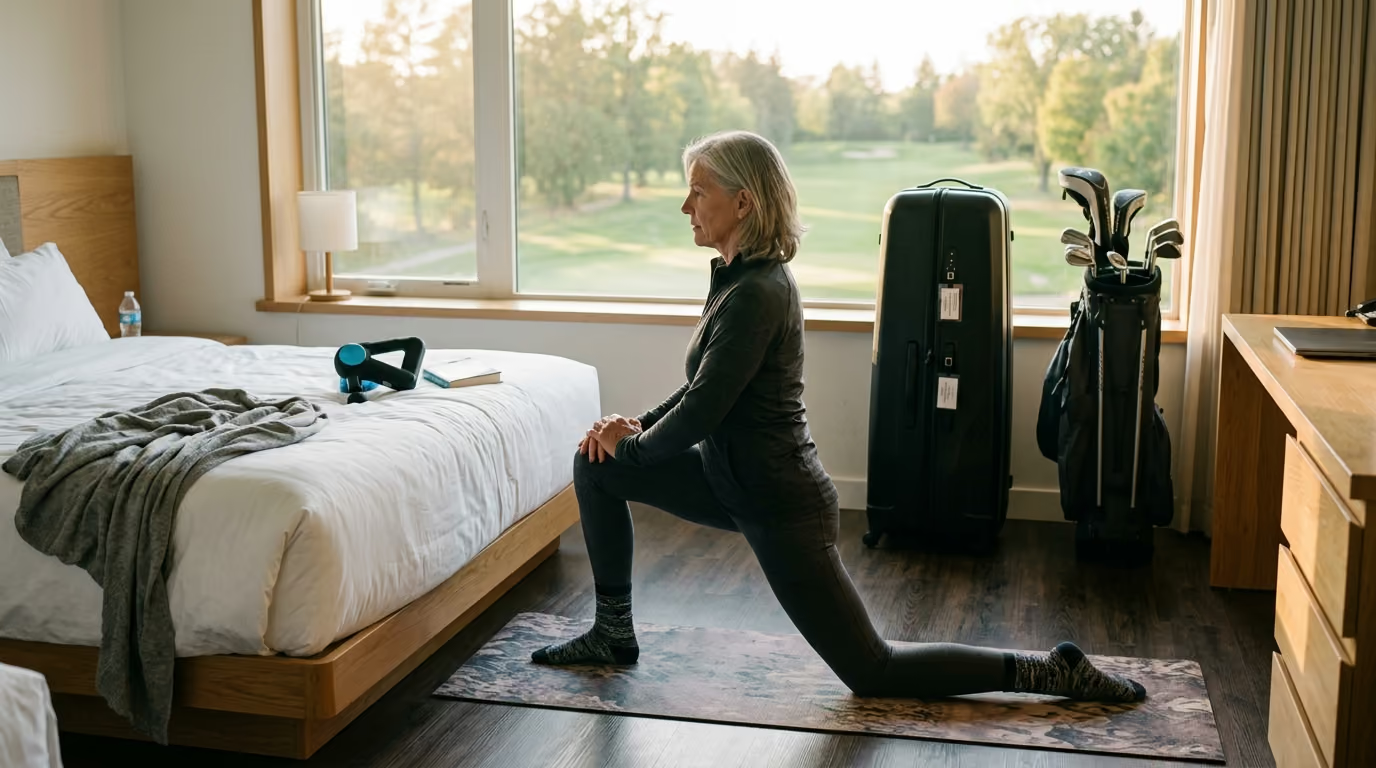

Longer tee shots and complete freedom from lower back pain come from restoring essential thoracic spine mobility in your mature golf swing.




Many golfers face a frustrating problem as they age. They watch their tee shots land shorter and shorter down the fairway. They feel a tight pull in their shoulders during the backswing. The next morning, they struggle to get out of bed because of a dull, aching pain in their lower back.
If you have searched for ways to stop losing yardage or how to ease back pain after eighteen holes, you are not alone. The solution is rarely found in buying a new driver. Instead, the answer lies in the middle of your back. This area is called the thoracic spine.
The saddest thing I have seen in golf is watching lifelong playing partners slowly drop out of our weekend group. It usually starts with a nagging shoulder or knee issue they ignore until it requires surgery. That pattern is exactly why I became obsessed with golf longevity. We do not have to stop playing as we age, provided we do the right maintenance work between rounds.
Restoring movement in this specific region of the spine protects your body and recovers lost distance. This guide will explain how to test your movement, why this area is so important, and how to fix the root cause of your pain.
Consider a common scene on the golf course. You are standing on the fourteenth tee of a long par four. The wind is blowing slightly against you. You want to hit a strong drive to leave a short iron into the green.
As you start your backswing, you feel a sudden restriction in your upper back. Your body physically stops turning halfway through the movement. Because you want a full swing, you compensate. You bend your lead elbow and lift your hips to force the club back.
This compensation ruins your swing plane. You swing down with an over the top motion. The result is a weak fade that lands deep in the right rough. Your lower back feels a sharp pinch as you finish the swing.
By the time you walk to the green, your lower back is tight. You spend the last four holes swinging gently just to get through the round. The next morning, your back is so sore that putting on your shoes is difficult. This is a classic pattern for mature golfers who lack upper back mobility.
When you cannot turn your upper back, your golf swing suffers. Your body attempts to find rotation from other places. These other areas are not designed to twist. This creates poor shots, robs you of power, and leads directly to injury.
To understand why this happens, we must look at how the body moves during a golf swing. Sports scientists use a concept called the Joint by Joint Approach. This framework was developed by physical therapists Gray Cook and Michael Boyle. It explains that the human body is a stack of moving segments.
Each segment has a specific job. These jobs alternate between mobility and stability. The foot needs stability to ground you. The ankle needs mobility to flex. The knee requires stability to stay aligned.
The hip requires high mobility to rotate. The lower back, or lumbar spine, requires stability to protect your spinal cord. The middle back, or thoracic spine, requires high mobility to turn and bend. Finally, the shoulder blades and neck require stability.
When one segment fails to do its job, the adjacent segments must do extra work. If your thoracic spine is stiff and cannot rotate, your body still demands a full turn to swing the club. It looks for this rotation in the nearest joint. That joint is your lumbar spine.
Your lower back is built for stability, not rotation. The vertebrae in your lower back are thick and block excessive twisting. They are anatomically designed for only ten to fifteen degrees of total rotation. Forcing your lower back to twist during a high speed swing causes micro tears in the discs.
This is the classic dynamic of the victim and the culprit. Your lower back is the victim that feels the pain. Your stiff middle back is the culprit that caused the trouble. To resolve the issue, you must focus entirely on turning your trail hip and mobilizing your upper back.
A stiff upper back does more than cause pain. It acts as a speed brake on your golf swing. Biomechanics researchers have studied how physical limits affect your clubhead speed as you age.
Recreational golfers who do not perform regular movement training lose an average of twelve miles per hour in clubhead speed between forty five and sixty five. This is a massive loss of power. Fortunately, this loss is not inevitable. It is caused by joint stiffness rather than aging.
The relationship between swing speed and distance is very clear. For every single mile per hour of clubhead speed you restore, you gain about two and a half yards of carry distance. If you can regain that lost twelve miles per hour, you will add thirty yards of carry to your drives.
This speed is generated through two main physical principles. The first is called the X Factor. The X Factor is the difference in rotation between your chest and your hips at the top of your backswing. When you turn your shoulders fully while keeping your hips stable, you stretch your torso muscles.
This stretch stores elastic energy. During the downswing, your body releases this energy like a snapped rubber band. If your upper back is stiff, you cannot create this separation. Your shoulders and hips turn together, which eliminates your power source.
The second principle is hand path length. Biomechanics researcher Dr. Sasho MacKenzie has shown that the distance your hands travel is a major driver of clubhead speed. A longer hand path gives you more space to build speed before hitting the ball. A mobile thoracic spine allows your shoulders to turn deeper, which naturally lengthens your hand path.
Investing time in injury prevention is the most effective way to keep this hand path long. It allows you to maintain swing speed without putting your joints at risk.
You cannot build permanent mobility in the middle of a round. However, you can use a quick exercise to reduce tension when you feel tight on the course. This simple movement helps wake up your nervous system.
[Target: Upper Back]
Hold mid iron across chest
Feet shoulder-width apart
Turn chest slowly right
Focus on trail hip turning
Hold for 3 deep breaths
Repeat to the left side
To perform this, stand with your feet shoulder width apart. Hold a mid iron across the front of your shoulders. Keep your knees slightly bent. Slowly turn your chest to the right as far as you can without pain.
As you turn, focus entirely on turning your trail hip. Do not let your knees collapse inward. Hold this turned position and take three deep breaths. Exhaling deeply helps your nervous system relax tight muscles.
Slowly return to the center, then turn to the left. Repeat this process three times on each side. Do this drill on the tee box while waiting to hit. It helps restore temporary rotation and keeps your swing from shortening during the back nine.
Before starting a movement program, you should measure your current range of motion. You can perform two simple tests at home. They require no special equipment.
The first test is the Wall Test, which measures thoracic extension. Stand with your back against a flat wall. Your heels, glutes, upper back, and head must touch the wall. Keep your lower back flat by pulling your belly button toward your spine.
Raise your arms straight out in front of you, then lift them toward the wall. Try to touch the back of your hands to the wall without arching your lower back. If your lower back pulls away from the wall, or if your elbows bend, your thoracic spine lacks extension.
The second test is the Mirror Rotation Test. Sit on a hard chair in front of a full length mirror. Sit up straight and squeeze a yoga block or a rolled towel between your knees. Squeezing your knees locks your pelvis in place.
Hold a golf club across your collarbones. Slowly rotate your chest to the right as far as you can. Look in the mirror to see the angle of the club. Repeat the movement to the left.
[Rotation Angle Targets]
Normal Competitive Range: 37° - 39° per side
Sufficient Range: 45° (Club points to corner of room)
Restricted Range: Under 30° (Struggling to turn)
Ideally, you should rotate your chest forty five degrees in both directions. This means the club will point toward the corner of the room. Average competitive players exhibit thoracic extension of fifty degrees and rotation of thirty seven to thirty nine degrees.
If you struggle to reach these angles, your swing is compromised. You can track your progress by repeating these tests every two weeks. For more diagnostic tools, you can view our resources page.
To make permanent changes in your joints, you must be consistent. It takes six to eight weeks of daily practice to remodel stiff tissues. Set aside ten minutes each day for these four exercises.
This exercise restores extension to the individual joints of your mid back. Place a foam roller on the floor. Lie on your back with the roller positioned horizontally under your mid back. Keep your knees bent and your feet flat on the floor.
Support your neck by placing your hands behind your head. Keep your elbows pointed forward. Slowly lower your head and shoulders toward the floor, using the roller as a pivot point. Squeeze your stomach muscles to keep your lower back from arching.
Hold this position for five seconds, then return to the start. Move the roller up about one inch and repeat the movement. Perform this at three different spots along your upper back. Do not place the roller under your lower back.
This drill improves rotation and stretches the chest muscles. Lie on your left side on a yoga mat. Bend your hips and knees to ninety degrees. Your knees should be stacked directly on top of each other.
Place your left hand on top of your right knee to keep it pinned to the floor. Reach your right arm straight out in front of you. Slowly sweep your right arm up and over to the right, opening your chest toward the ceiling.
Follow your moving hand with your eyes. Keep your knees together and firmly pressed to the floor. Hold the stretch for two seconds, then return to the starting position. Perform ten repetitions, then switch to your right side.
This exercise isolates upper back rotation from your pelvis. Get down on your hands and knees on the floor. Place your hands directly under your shoulders and your knees under your hips.
Place your right hand behind your neck. Do not pull on your head. Point your right elbow down toward your left wrist. This is the starting position.
Slowly rotate your chest and point your right elbow up toward the sky. Keep your hips still. Do not let your weight shift backward or to the side. Perform ten controlled repetitions, then switch sides.
This movement connects your thoracic rotation with your hip mobility. Step your left foot forward into a shallow lunge. Place your right knee on a soft pad on the floor. Keep your torso upright.
Place your right hand on the floor inside your left foot. Reach your left arm straight down. Slowly lift your left arm toward the ceiling, turning your chest to the left.
Follow your hand with your eyes and reach as high as you can. Focus entirely on turning your ribcage. Hold for three seconds, then lower your arm. Perform ten repetitions on each side.
Consistently practicing these movements supports healthy ageing and keeps you on the course for years.
Many mature golfers make errors when they try to fix their mobility. These mistakes can prevent progress and even lead to new injuries.
The first mistake is ignoring posture before trying to rotate. Many of us spend hours sitting at a desk or driving a car. This causes our shoulders to round forward. This position is called C-posture.
When your spine is bent forward, the joints lock together. Try sitting in a slumped position and turning your chest. You will find that you cannot turn very far. You must stand up straight and extend your spine before you can rotate.
The second mistake is neck compensation. When your mid back is stiff, your body still wants to make a full backswing. Your brain tries to help by turning your head.
You twist your neck excessively to keep your eyes on the golf ball. This puts immense strain on your cervical spine. It can cause chronic neck soreness and shoulder pain. Your head should turn naturally with your chest, not independent of it.
The third mistake is focusing solely on core strength. Many golfers are told that a stronger core will cure their back pain. They perform planks and sit ups to tighten their stomach muscles.
If you strengthen muscles around a stiff joint, you simply lock that joint in place. You must mobilize the joint first. Once your thoracic spine can move, you can strengthen the surrounding muscles to support that movement.
Finally, do not treat your left and right sides the same way. Golf is an asymmetrical sport. Your backswing requires different movement than your follow through. Assess each side separately and spend extra time on your stiffest side.
While you work to improve your movement, you can adjust your equipment to protect your body. Small changes in your gear can reduce the strain on your spine.
Consider your grip size. If your grips are too small, you will squeeze the club too tightly. This tension travels up your forearms, into your shoulders, and locks your upper back. Using a midsize or jumbo grip can help relax your hands and upper body.
Your footwear also plays a role. If your shoes do not provide stable support, your feet will slip during the swing. This slipping prevents your hips from turning correctly. When your hips cannot turn, your mid back must turn even further to compensate.
[Equipment Adjustments]
Grips: Thicker grips to reduce upper body tension
Shoes: Stable spiked shoes to secure hip rotation
Shafts: Lighter, more flexible shafts to maintain club speed
Using lighter, more flexible shafts can also help. If your clubs are too heavy, you must use maximum physical effort to swing them. This effort tense your muscles and restricts your natural turn. A lighter shaft allows you to maintain speed with a shorter, safer swing.
You can learn more about how equipment choices impact your physical health by reading our blog.
Improving your physical health is a long term process. You do not need to spend hours in the gym to see results. You can start making progress this week.
Use this simple checklist to begin:
By taking these steps, you can protect your joints and play pain free.
Expert Takeaway: Your lower back pain is often a direct result of a stiff middle back, and restoring thoracic mobility is the single most effective way to regain your swing speed and protect your body as you age.
Follow Golfergy for practical insights on performance, mobility, recovery and healthy ageing. Stay connected for new articles, research-led guidance and ideas to help you play better for longer.


Explore practical resources on performance, recovery, mobility and golf longevity.
Read the Blog