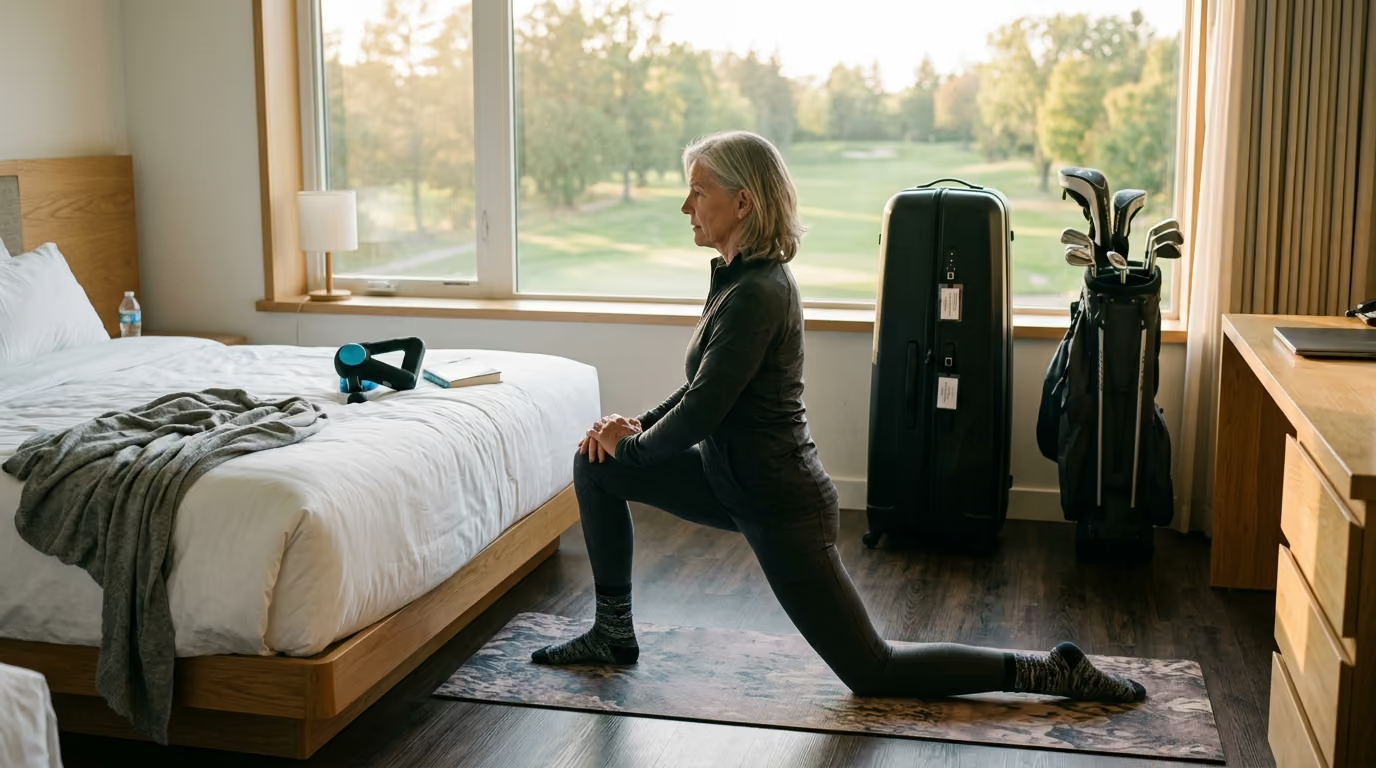
Forty-five to fifty-five degrees of thoracic spine rotation is required to produce a safe golf swing and prevent severe lower back pain.




Many golf tips promise to add thirty yards to your drive with a wider stance. Others tell you to rotate your hips as fast as possible. These tips can be dangerous for mature players. If your middle back is stiff, trying to force a larger swing will only cause injury.
Most amateur golfers over forty suffer from limited spinal mobility. They spend money on new drivers to cure a short backswing. They work on complex swing mechanics to fix a slice. Yet they ignore the physical root cause of their limitations.
This guide focuses on the thoracic spine, which is the middle section of your back. This area acts as the engine room of a safe swing. When this area is locked, your swing breaks down. This guide will show you how to identify stiffness, protect your joints, and keep playing without pain.
We will examine the biology of your spine and look at practical tests you can do at home. We will also outline a daily routine to restore your rotation. By addressing this physical bottleneck, you can protect your body and enjoy the game for years to come.
Let us look at a situation that happens on the course. You are standing on the tee of a long par four on the back nine. You are tired after walking several miles. Your lower back is starting to feel tight. You want to hit a long drive to clear a fairway bunker.
You take a wide stance and begin your backswing. You try to make a deep shoulder turn to generate clubhead speed. Your mind wants your shoulders to turn ninety degrees. However, your middle back stops turning halfway through the swing.
To get the club back further, your body starts to make compromises. You lift your arms up toward the sky. Your lead arm bends. Your head tilts toward the target.
At impact, you do not have the power to compress the ball. Your drive starts to leak to the right. Your swing feels rushed and unstable. As you walk off the tee, you feel a sharp pinch in your lower back. Your neck feels stiff as you look down the fairway.
This is the classic bottleneck of a stiff thoracic spine. Your body is trying to complete a movement that your joints cannot support. Instead of a smooth rotation, you get a series of jerky adjustments. These adjustments ruin your accuracy and place severe stress on your joints.
Over time, this pattern leads to chronic pain. You might blame your age or your swing technique. In reality, your middle back is simply locked. To fix this, you must understand the structure of your spine.
The human body is a stack of alternating joints. Some joints need to be stable, while other joints need to be mobile. This concept is called the Joint-by-Joint Approach. It was created by physical therapists Gray Cook and Mike Boyle.
Your lower back, or lumbar spine, is built for stability. It should not twist very much. The lumbar spine only has about five to fifteen degrees of total rotation. The joints in your lower back are designed to support weight and resist twisting.
Your middle back, or thoracic spine, is built for mobility. It is designed to twist and bend. To swing a golf club safely, you need forty-five to fifty-five degrees of thoracic rotation.
When your middle back is stiff, your body still needs to find rotation. It looks for that rotation in the joints above and below. This means your lower back and your neck start to twist to finish the swing.
Forcing your lower back to rotate is a major cause of disc injuries. Your neck also takes a beating. If your middle back does not turn, your neck must twist excessively to keep your eyes on the ball. This is why improving your mid-back flexibility is so important for injury prevention on the course.
The Titleist Performance Institute uses a term called the X-Factor. This is the difference between your hip rotation and your shoulder turn. A mobile thoracic spine allows you to create this separation. This separation creates a whip effect that gives you clubhead speed.
Another helpful concept is the Three Amigos. This is the neutral alignment of your head, rib cage, and pelvis. Keeping these three parts stacked is vital for a safe swing. When they stay stacked, your spine can rotate without pinching.
True mobility is not just passive flexibility. Flexibility is how far someone can push your body. Mobility is your ability to control your muscles through a full range of motion. You must have active control over your thoracic rotation to swing a club safely.
You can test your own thoracic rotation with a couple of simple movements. You do not need any special medical equipment. These tests will help you understand if your mid-back is truly stiff.
The first test is the Seated Trunk Rotation Test. Sit on a chair with your feet flat on the floor. Keep your knees squeezed together to lock your hips in place. Hold a golf club across your chest, resting it on your shoulders.
Turn your upper body as far as you can to the right. Do not let your knees slide forward. Do not let your hips twist on the chair.
Look down at the angle of the club relative to your thighs. If you cannot reach a forty-degree angle, your thoracic spine is limited. Research shows that zero percent of PGA Tour players fall below this forty-degree mark. Yet many amateur players cannot reach it.
The second test is the Wall Test. Stand with your heels, buttocks, upper back, and head flat against a wall. Hold your arms straight out in front of you. Keep your lower back flat against the wall by pulling your belly button toward your spine.
Raise both arms overhead to touch the back of your hands to the wall. Do not let your lower back arch away from the wall. If your lower back arches, your middle back is tight. Your body is using your lower back to fake the overhead movement.
Sometimes the issue is not a lack of joint mobility. It can be a lack of motor control. This is a concept used in the Selective Functional Movement Assessment.
If you can rotate your mid-back easily while lying on your side, your joints are fine. Your brain simply does not know how to use that rotation when you stand up. In this case, you need stability and coordination training rather than deep stretches.
When your thoracic spine is locked, your body will find a way to swing the club. It will create compensations to complete the movement. These compensations destroy your power and lead to chronic pain.
The first compensation is the arm swing illusion. You want to make a full backswing, but your chest will not turn. To fix this, you pull your lead arm tight across your chest. This lifts the club, but your body has not turned at all.
This move places immense pressure on your lead shoulder. It can lead to shoulder impingement and rotator cuff wear. It also makes it very hard to return the club to the ball consistently.
The second compensation is the reverse pivot pattern. If you cannot rotate your middle back, your upper body may tilt toward your target. This happens as you try to get the club to the top of the swing.
A reverse pivot puts your body in a weak position. It forces you to slide your hips during the downswing to get back to the ball. This slide causes a massive loss of power and puts severe stress on your lower back.
The third compensation is the early extension pattern. This is very common among golfers over fifty. If your middle back cannot extend and rotate, you will run out of room during the downswing.
To make room for the club, your hips will push forward toward the ball. This is early extension. It causes you to stand up at impact, leading to shanks, blocks, and thin shots.
Desk posture is the primary driver of these problems. Sitting at a desk for hours causes Thoracic Kyphosis, which is a rounded upper back. This rounded posture places your middle back in a constant state of flexion.
Anatomically, flexion locks your facet joints. When your joints are locked in flexion, they physically cannot rotate. This posture causes a C-Posture at address, which ruins your swing before it starts.
You must avoid the myth of lumbar rotation. Many golfers are told to twist their hips and lower back harder. This advice is dangerous. Your lower back joints are shaped to block rotation, so forcing them to twist can cause a herniated disc.
To restore your thoracic mobility, you need a daily routine. This routine should focus on small, controlled movements. It must address both joint mobility and breathing.
The first exercise is the Quadruped T-Spine Rotation. Start on your hands and knees on a soft mat. Sit your hips back toward your heels to lock your lower back in place. Place one hand behind your head.
Slowly rotate your elbow up toward the ceiling. Focus entirely on turning your middle back. Do not let your hips shift to the side. Hold the top position for three seconds, then return to the start. Do ten repetitions on each side.
The second exercise is the Side-Lying Rib Distraction. Sometimes your ribs block your spine from rotating. This exercise helps to expand your rib cage.
Lie on your side with your knees bent at ninety degrees. Place a foam roller under your top knee to keep your hips still. Reach your top arm forward, then sweep it over your body in a wide circle.
Focus entirely on breathing into your side ribs as you rotate. Take deep, slow breaths. This breathing helps release the tension in your rib cage. Repeat this circle ten times on each side.
The third exercise is the Foam Roller Extension. Place a foam roller on the floor. Lie on your back with the roller positioned across your middle back.
Support your head with your hands. Keep your buttocks on the floor. Tighten your core muscles to keep your lower back from arching.
Gently lean back over the foam roller. Focus entirely on bending your middle spine. Do not force your neck or lower back to bend. Move the roller up or down an inch and repeat. Do this for two minutes daily.
This routine is excellent for healthy ageing and long-term joint health. Consistency is key for this routine. Performing these movements daily will yield better results than one long session per week. Your nervous system needs regular inputs to accept these new ranges of motion.
You cannot perform deep stretches in the middle of a round. However, you can use quick movements to wake up your spine. These exercises help you maintain your turn on the back nine.
The first quick fix is the Club-Behind-Back Turn. Stand with your feet shoulder-width apart. Place your golf club behind your back, cradled in the crooks of your elbows.
Take your golf posture. Slowly turn your shoulders back as if you are making a backswing. Focus entirely on turning your chest while keeping your lower body quiet.
Hold this position for two deep breaths. Feel the stretch in your mid-back. Now, slowly rotate into your follow-through position. Repeat this five times before you tee off.
The second quick fix is the Standing Chest Opener. Hold your driver with both hands in front of you. Step your left foot forward into a small lunge.
Raise the club overhead. Gently press your chest forward. Feel your middle back extend.
Take a deep breath into your chest. This movement counters the hunched posture from riding in a cart or carrying your bag. Do this on the tee box to keep your spine mobile.
These small actions help maintain circulation. They prevent your muscles from tightening during slow play. Use them whenever you feel your swing getting short or stiff.
Many golfers make mistakes when trying to improve their thoracic mobility. These mistakes can lead to injuries or waste your training time.
The first mistake is arching your lower back during thoracic stretches. Your lower back loves to help. If your mid-back is stiff, your lower back will arch to make you think you are extending.
This arching compresses the joints in your lower back. It prevents your thoracic spine from getting any benefit. To fix this, always engage your abdominal muscles. Keeping your core tight protects your lower back and forces your mid-back to do the work.
The second mistake is forcing passive flexibility over active control. Some golfers use heavy bands or partner stretches to force their shoulders to turn. This is dangerous.
Your brain will protect your joints if you do not have control. If you force a range of motion, your muscles will spasm to protect the joint. Always focus on active movements where your own muscles control the rotation.
The third mistake is ignoring your breathing. Your lungs and rib cage are connected to your thoracic spine. If you hold your breath during stretches, your rib cage stays rigid.
You must breathe deeply to release the muscles between your ribs. Exhale fully as you reach the end of your rotation. This exhale allows your spine to move those last few degrees safely. Use recovery breathing techniques to get the most out of your mobility sessions.
Your equipment can have a major impact on your spinal posture. If your clubs do not fit your body, you will struggle to rotate.
The first item to check is your golf shoes. Shoes with too much heel elevation can tilt your pelvis forward. This tilt arches your lower back and rounds your upper back.
Look for shoes with a lower profile or a neutral drop. This helps you maintain a balanced posture at address. Balanced feet allow your spine to stay in a neutral alignment.
The second item is your grip size. If your grips are too small, you will squeeze the club too hard. Excessive hand tension travels up your arms into your shoulders and upper back.
This tension locks your thoracic spine. Larger grips can help reduce your grip pressure. This relaxation allows your upper body to turn more freely.
The third item is your club shaft flex and weight. If your shafts are too heavy or too stiff, you will try to swing harder. This extra effort causes your muscles to tense up.
Tense muscles cannot rotate efficiently. Switching to a lighter, more flexible shaft can help you swing with ease. This ease allows your thoracic spine to function as the natural engine of your swing. Better equipment selection is a key component of overall golf performance planning.
Building a mobile spine is not a one-time project. It requires consistent care and smart habits. This is especially true for mature golfers who sit during the day.
You must break up long periods of sitting. If you work at a desk, set a timer for every fifty minutes. Stand up and do a quick chest stretch or a gentle twist. This prevents your spine from locking into a flexed position.
You should also combine your mobility work with strength training. A mobile spine needs strong muscles to support it. Focus on exercises that strengthen your upper back, such as rows and band pull-aparts.
These exercises help pull your shoulders back and open up your chest. They make it easier to maintain a good posture throughout your entire round. A strong upper back acts as a solid anchor for your rotating spine.
Remember that progress takes time. Do not expect to gain twenty degrees of rotation overnight. Celebrate small improvements, such as a smoother backswing or less soreness after eighteen holes.
By protecting your spine, you can extend your playing years. You will enjoy the game more when you are not fighting your body. Focus on these steady habits to keep your swing fluid and pain-free.
Explore more resources on Golf Longevity, Performance & Recovery to find customized routines for your game.
Your middle back must rotate freely to protect your lower back and generate lasting clubhead speed.
Follow Golfergy for practical insights on performance, mobility, recovery and healthy ageing. Stay connected for new articles, research-led guidance and ideas to help you play better for longer.


Explore practical resources on performance, recovery, mobility and golf longevity.
Read the Blog