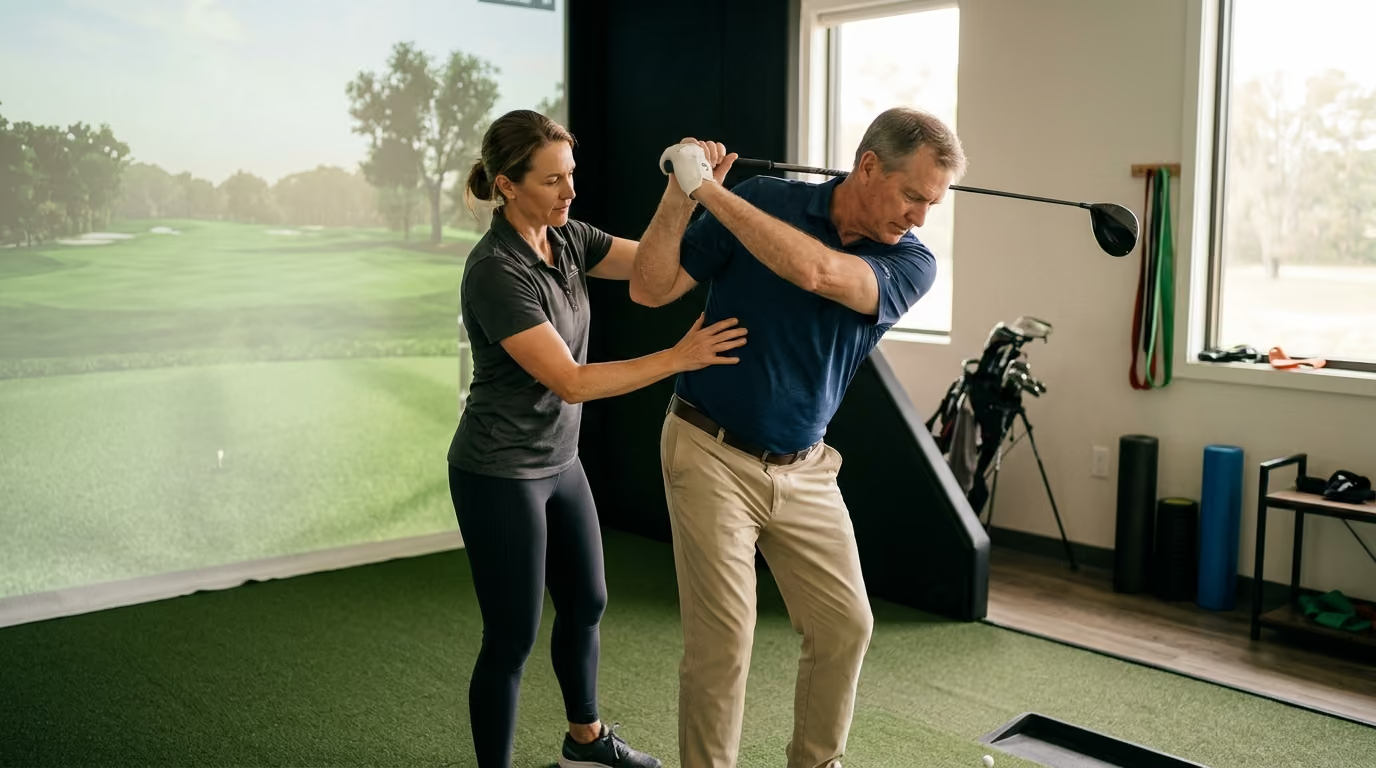

Thousands of golfers struggle with late-round swing collapse because poor thoracic spine mobility limits rotation and causes lower back pain.




Many golfers believe that buying a new adjustable driver is the fastest way to fix a short, weak backswing. They spend thousands of dollars trying to buy a larger shoulder turn. Yet, the real limit to their swing speed is not the club in their hands. It is the stiff mid-back sitting at their office desk.
If the upper body cannot turn, the swing becomes short and steep. Golfers often try to fix this by sliding their hips or pulling their arms across their chest. These moves feel like a turn, but they do not create power. Instead, they lead to high-velocity stress on the joints.
A fluid swing requires a body that can move where it is meant to move. The mid-back, known as the thoracic spine, is designed to be the primary rotating engine of your upper body. When this engine is locked, your swing suffers and your body begins to break down.
Taking care of your thoracic spine is the key to maintaining power as you age. It is a vital part of golf longevity that helps you stay on the course for decades. Let us look at how this part of your body works and how to free it up.
You are standing on the 14th tee box. You have played a decent round, but you notice your drives are starting to leak to the right. Your shots are shorter than they were on the front nine. Your lower back has a dull, nagging ache.
To compensate for the tightness, you try to swing harder with your arms. You pull the club back as far as you can, but your shoulders will not turn. Your lead arm bends, your hips slide away from the target, and you strike the ball thin. You leave the course feeling frustrated and sore.
In our experience, this breakdown is a classic sign of physical fatigue. A few years ago, I noticed my swing falling apart around the 14th hole. My lower back would tighten up, and I started compensating with my arms. I spent months thinking it was a swing flaw.
It was not until I started a simple evening hip mobility routine that I realized my glutes were just turning off from fatigue. Fixing that one physical limitation brought my back nine scores down drastically. When the lower body and mid-back stop rotating, the lower back takes the abuse.
This exact situation happens to thousands of recreational players every weekend. They blame their swing mechanics or their mental game. In reality, their mid-back has simply locked up. The body is protecting itself from pain by limiting its movement.
When your mid-back loses its ability to turn, your swing loses its foundation. You cannot hold your posture throughout the swing. Your body finds other ways to move, which leads to injury.
To understand why the mid-back is so important, we must look at how the body moves. Fitness experts Gray Cook and Mike Boyle created a concept called the Joint-by-Joint Approach. This framework shows that the human body is a stack of alternating segments.
Some segments are designed to be stable, while others are built to be mobile. The foot needs stability to grip the ground. The ankle needs mobility to bend and flex. The knee requires stability to keep from buckling outward or inward.
The hips need high mobility to rotate in all directions. The lumbar spine, which is your lower back, needs stability to protect your spinal cord. Above that, the thoracic spine needs mobility to let your upper body turn. Finally, the scapula, or shoulder blade, needs stability to support the arm.
This alternating pattern is critical for a smooth golf swing. If one segment fails to do its job, the segment above or below it must compensate. This creates a chain reaction of movement errors.
When your thoracic spine becomes stiff from hours of sitting, it loses its mobility. The body still needs to turn to swing the club. Since the mid-back cannot turn, the body forces the stable lumbar spine to do the work.
Your lower back is not built to handle rotational force. Forcing it to twist leads to muscle strains, joint wear, and disc herniations. Working on injury prevention means keeping each joint doing its proper job.
The anatomy of your spine dictates how your body should move. Your spine is divided into different regions, and each region has a distinct shape. The design of the bones determines how much they can bend or twist.
The thoracic spine consists of 12 vertebrae in the middle of your back. These bones connect to your rib cage. The joints between these vertebrae, called facet joints, are angled to allow for rotation.
In a healthy body, the thoracic spine can rotate about 30 to 40 degrees to each side. This rotation is what allows you to turn your shoulders away from the ball. It creates a wide, powerful arc without moving your lower body out of position.
The lumbar spine consists of five large vertebrae in your lower back. These bones are built to support the weight of your upper body. Their facet joints are shaped like interlocking blocks that prevent twisting.
The lumbar spine can only rotate about 1 to 2 degrees per segment. This means your entire lower back only has about 5 to 15 degrees of total rotation. Forcing the lower back to twist beyond this limit causes severe damage.
Research from the Aspetar Sports Medicine Journal shows that the lumbar spine is the most common site of pain in golfers. This pain is rarely caused by a weak back. It is almost always caused by a stiff thoracic spine that forces the lower back to rotate.
When you improve your golf mobility, you protect these delicate structures. You allow the thoracic spine to rotate freely. This relieves the pressure on your lower back and keeps you pain-free.
Postural imbalances at address are the primary cause of mid-back stiffness on the course. Many golfers suffer from Upper Crossed Syndrome because of daily desk work. This imbalance features tight chest muscles and weak upper back muscles.
This muscle imbalance leads directly to a swing fault called C-Posture. In C-Posture, the golfer's shoulders are slumped and the mid-back is excessively rounded. This position physically locks the joints of the thoracic spine.
If you want to test this, slump forward in your chair right now. Try to turn your shoulders to the right. You will find that you can barely move. Now, sit up tall and try to turn again. You will turn twice as far with ease.
Other golfers try to correct their slump by arching their back too much. This is called S-Posture. It is common in former athletes who want to look powerful at address.
S-Posture occurs when a golfer sticks their tailbone out excessively. This creates Lower Crossed Syndrome, which features tight hip flexors and a tight lower back. It also weakens the abdominal muscles and the glutes.
This arched position places the lumbar spine in a vulnerable state before the swing even starts. During the backswing, this posture often leads to a Reverse Spine Angle. This is the single greatest cause of lower back injuries in golf.
Both C-Posture and S-Posture ruin the kinematic sequence of the swing. The kinematic sequence is the order in which your body parts transition from the backswing to the downswing. It should start from the ground and move up through the hips, torso, arms, and club.
If your posture is poor, this sequence breaks down. You lose swing speed because you cannot transfer energy efficiently. Correcting your posture is a critical step in golf performance training.
Before you try to fix your movement, you must know your starting point. The Titleist Performance Institute developed a simple movement screen called the Seated Trunk Rotation Test. This test measures how much your thoracic spine can rotate without help from your hips.
To perform this test, sit tall on a bench or chair. Place your knees and feet together. Squeeze a small ball or foam block between your knees to keep your lower body quiet.
Place a golf club across your collarbones and hold it with crossed arms. Without moving your knees, turn your shoulders as far to the right as possible. Hold the position and measure the angle of the club relative to your hips. Repeat the test to the left side.
A passing score on this test is 45 degrees of rotation in both directions. If you cannot reach this angle, your thoracic spine is restricted. You are likely compensating during your swing.
Data from the Titleist Performance Institute shows that golfers who fail this test have predictable swing faults. They have a 55 percent chance of showing C-Posture or a flat shoulder plane. These faults make it hard to strike the ball cleanly.
Failing the test also means a 50 percent chance of early extension. This is when your hips move toward the ball on the downswing, causing a loss of posture. It also creates a 45 percent chance of swaying during the backswing.
These faults are physical limitations, not mental errors. No amount of practice on the range will fix them if your joints cannot move. You must improve your physical capacity before you can improve your swing mechanics.
If you are playing a round today, you do not have time for a full fitness routine. You need a quick adjustment to help you turn on the course. These simple adjustments can free up your rotation immediately.
First, flare your trail foot outward at address. Turn your foot out by about 15 to 20 degrees instead of pointing it straight ahead. This simple change opens up your trail hip joint.
Opening the hip reduces the amount of rotation needed from your mid-back. It allows you to make a deeper backswing without straining your spine. It is an easy way to protect your lower back when you feel stiff.
Second, change your focus during the backswing. Instead of trying to pull your shoulders back, focus entirely on turning your trail hip. Keep your mind on that single, small movement.
This focus helps your pelvis rotate early in the backswing. When your pelvis rotates, your thoracic spine does not have to twist as far to get the club back. You get a full turn with less effort.
These adjustments are useful on cold mornings or during the back nine. They do not solve the root cause of your stiffness, but they keep you safe. They are great tools to use while you work on your long-term mobility.
To solve mid-back stiffness for good, you need a daily routine. This routine should focus on thoracic extension and rotation. Doing these exercises three to four times a week will change how your swing feels.
[Foam Roller Extension] ──> [Open Book Stretch] ──> [Quadruped Rotation]
This exercise improves your ability to stand tall and avoid C-Posture. It targets the tight segments of your mid-back.
Do not let your lower back arch during this movement. Keep your abdominal muscles slightly engaged to protect your lumbar spine. Focus the bend entirely in your upper back.
This stretch improves your rotational range of motion. It stretches your chest muscles and opens your shoulders.
Perform 10 slow repetitions on each side. Focus on keeping your knees glued to the floor. The rotation should come from your rib cage, not your hips.
This exercise builds active strength in your upper back muscles. It teaches your body to rotate under control.
Perform 10 repetitions on each side. Keep your hips still and level throughout the movement. Focus entirely on turning your trail shoulder toward the sky.
Adding these movements to your week will build lasting physical capacity. It is an excellent form of strength training for your posture. Over time, your swing will feel longer and much smoother.
When golfers try to improve their thoracic mobility, they often make critical errors. These mistakes can lead to injury and slow down your progress.
Many golfers try to stretch through pain. They push their joints past a comfortable limit, thinking that more force equals more flexibility. This aggressive stretching causes your muscles to tighten up to protect the joint. Always move with control and stop if you feel sharp pain.
Another error is moving the hips during thoracic stretches. If your hips slide or twist during your exercises, you are not stretching your mid-back. You are simply rotating your pelvis. Keep your lower body locked to target the thoracic spine.
Some players focus entirely on stretching and ignore their core muscles. A mobile upper back requires a stable base. If your abdominal muscles are weak, your body will lock up your mid-back to create stability. Combine your mobility work with basic core exercises for the best results.
You can learn more about these movement patterns on our golf performance blog. Understanding how your body moves is the first step to playing better.
Your equipment plays a major role in your posture. If your gear does not fit your physical needs, it can force your body into bad positions.
Take a close look at your golf shoes. Many modern shoes have a high heel lift that tilts your pelvis forward. This tilt arch your lower back and leads directly to S-Posture.
Look for shoes with a lower heel-to-toe drop. Flat shoes help you maintain a neutral pelvis at address. This neutral position makes it much easier for your thoracic spine to rotate.
You should also check the size of your grips. If your grips are too thin, you will squeeze the club too hard. This excessive grip tension travels up your forearms and into your shoulders.
Tight shoulders and chest muscles pull your upper body forward into a slump. Upgrading to midsize or oversize grips can reduce this tension. This small change allows your shoulders to relax and turn freely.
Using the right gear supports your body's natural movement. It is a simple way to get more out of your mobility training.
A fluid shoulder turn is not a gift of youth, but a result of proper joint mobility.
Follow Golfergy for practical insights on performance, mobility, recovery and healthy ageing. Stay connected for new articles, research-led guidance and ideas to help you play better for longer.


Explore practical resources on performance, recovery, mobility and golf longevity.
Read the Blog