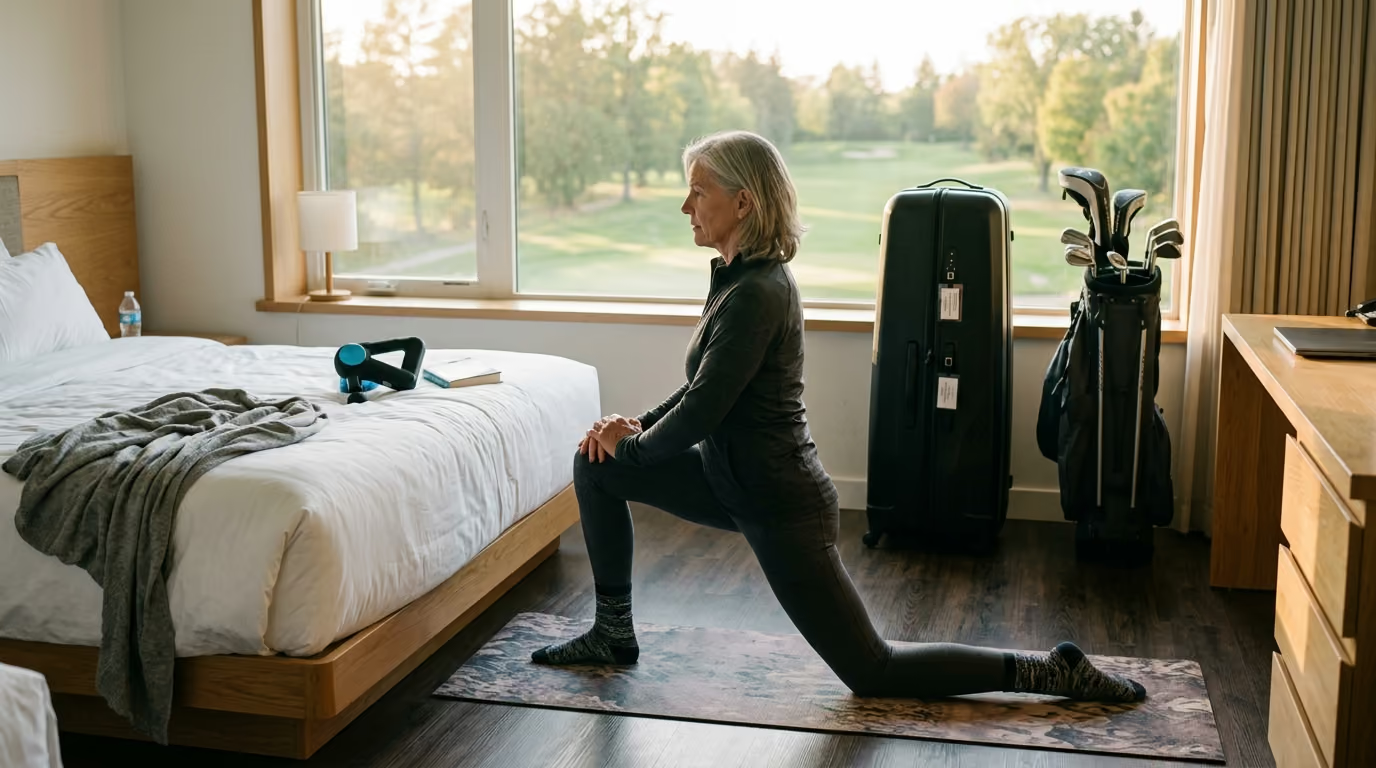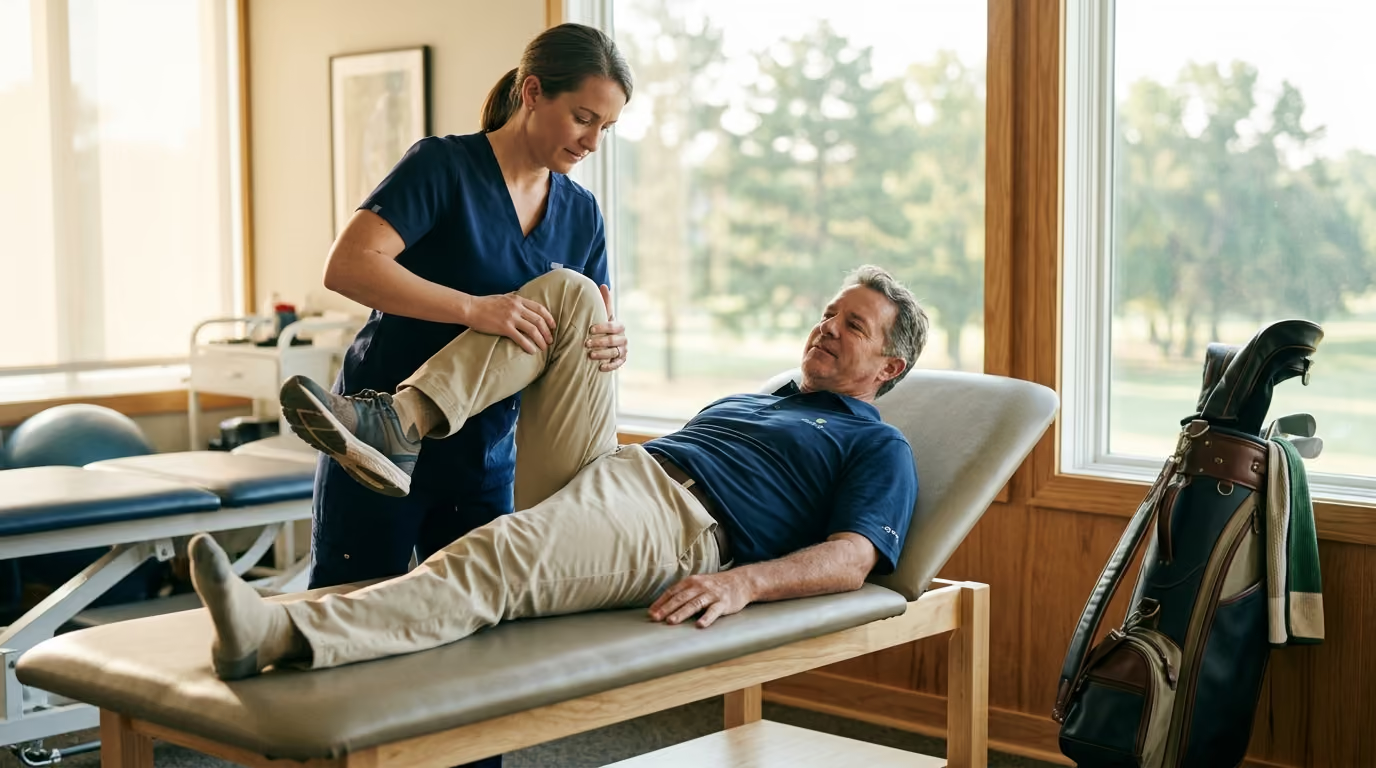
Desk jobs seem harmless, but static office hours actually stiffen the joints and set up weekend athletes for painful muscle tears.




Have you ever searched the internet for how to cure back pain after golf? Many of us face this exact problem. We spend forty hours a week sitting in an office chair. Then we expect our bodies to perform like elite athletes on Saturday morning.
This mismatch between our daily work life and our weekend passion is the root cause of many swing flaws. It leads to chronic discomfort that can ruin your enjoyment of the game. This guide provides a complete, research-backed strategy to protect your body. It will help you maintain your swing mobility when you work a desk job.
By understanding how sitting affects your muscles, you can make simple changes. These small habits will keep you on the fairway for years to come. Let us look at why this physical decline happens and how you can stop it.
The term weekend warrior describes a common lifestyle pattern. It involves a low-activity week followed by high-intensity weekend sports. For golfers, this sudden transition is a recipe for physical trouble. Your body is not prepared for the sudden stress of a dynamic swing.
According to research published in the Journal of Science and Medicine in Sport, between 15.8% and 40.9% of amateur golfers suffer an injury annually. The lifetime injury incidence for amateurs ranges from 25.2% to 67.4%. These numbers show that golf is harder on the body than most people think. The risk is especially high for those who sit all week.
During a typical workday, your muscles remain in a fixed, static position. Your hip flexors are shortened. Your chest muscles tighten. Your back muscles are stretched out and weak.
When Saturday arrives, you suddenly ask these stiff tissues to rotate at high speeds. The average golf swing requires rapid acceleration and sudden deceleration. Without proper conditioning, this force causes micro-tears in your muscle fibers. Over time, these small injuries build up into chronic pain.
Many amateur golfers do not feel hurt during their round. They experience what physical therapists call Monday morning injuries. This happens because the body attempts to repair the damaged tissues after a period of rest. The stiffness sets in when you return to your desk on Monday.
The Mayo Clinic notes that sudden bursts of activity after a sedentary week are a primary cause of acute muscle strains. When you sit still, blood flow to your joints decreases. The synovial fluid that lubricates your joints becomes thick. This makes your movement stiff and inefficient.
When you force a stiff joint to move fast, the surrounding muscles must work twice as hard. They quickly fatigue and lose their ability to support your joints. This leaves your ligaments and tendons vulnerable to sprains and tears.
To play your best, you must bridge the gap between your desk and the tee. You cannot treat your body like a machine that can turn on instantly. You need a systematic approach to keep your joints moving freely.
To truly solve this issue, we must look at how the human body adapts to sitting. Your nervous system is highly efficient. It assumes that the posture you hold most often is the posture you want to keep. This leads to physical changes in your muscles and connective tissues.
When you sit for hours, your hip flexors are kept in a shortened state. Over time, your body actually removes muscle cells in these areas. This process is called adaptive shortening. It means your muscles lose their physical length.
At the same time, your fascia begins to thicken. Fascia is the connective tissue that surrounds your muscles. It behaves like plastic wrap. When you do not move, it becomes dry and rigid, which glues your muscle fibers together.
This stiffness does not disappear when you stand up on the first tee. Your tight hip flexors act like a brake on your swing. They prevent your hips from extending, which is necessary to create a powerful downswing.
Another issue of sitting is a phenomenon called tissue creep. When you slouch, the ligaments in your lower back are stretched. If you hold this position for hours, these ligaments lose their elastic properties.
They remain stretched out for several hours after you stand up. This leaves your lumbar spine without its natural support system. If you swing a club during this window, your muscles must work extra hard to protect your spine.
This is why many desk workers throw their backs out on the very first hole. Their spinal ligaments are still stretched out from their morning commute. Understanding this biomechanical change is the first step toward protecting yourself.
Let us look at a scenario that many players know too well. You had a long, stressful week at your desk. You spent hours leaning forward to look at your computer. You rushed out of the office on Friday evening, went to sleep, and woke up early on Saturday.
You arrive at the course with just ten minutes to spare before your tee time. There is no time for a proper warm-up. You grab your driver, take two quick practice swings, and tee it up.
The first few holes actually go surprisingly well. Your body is running on adrenaline and excitement. You manage to save pars because your muscles are still fresh. You feel confident that your body will hold up for the day.
Then you reach the tenth tee box. You have been walking or riding in a golf cart for two hours. Your adrenaline levels begin to drop. Your lower back starts to ache with a dull, nagging tightness.
You try to make your normal backswing, but your hips feel locked. Your body refuses to turn. Because your hips are stiff, your brain looks for another way to create clubhead speed. You start to pull the club down using only your arms and shoulders.
This physical collapse causes a weak, high slice into the trees. Your lead hip feels pinched. Your lower back feels compressed. You spend the rest of the round trying to guide the ball with your hands, which leads to double bogeys.
By the eighteenth green, you are physically exhausted. Your swing feels unrecognizable. This is not a technique problem. It is a direct result of your body running out of its movement reserve.
To understand how to fix this issue, we must look at how the body moves. A foundational framework in sports science is the Joint-by-Joint Approach. This concept was created by strength coaches Michael Boyle and Gray Cook.
It states that the human body functions as a stack of alternating segments. Each joint or region has a specific, primary job. It must provide either mobility or stability. When this pattern is broken, pain and poor performance follow.
Let us look at how this stack is arranged from the ground up:
In a healthy body, these joints work together in perfect harmony. The mobile segments move freely. The stable segments provide a strong anchor. This allows you to generate massive speed without injuring your tissues.
When you sit at a desk all week, this entire system gets interrupted. Your hips lose their mobility because they are locked in one position. Your thoracic spine becomes stiff because you are hunched over a keyboard.
When you swing a golf club, your body still demands rotation. It must get that rotation from somewhere. Because your hips and mid-back cannot turn, your body forces your lower back to rotate instead.
Your lower back is designed for stability. It only has about twelve degrees of total rotation. Forcing it to turn causes the lumbar discs to pinch and wear down. This is why the lower back is the number one injury site for amateur golfers.
To protect your spine, you must restore mobility to your hips and mid-back. This relieves the pressure on your stable joints. It allows your body to function the way it was designed to.
One of the most common physical issues for desk workers is gluteal amnesia. This condition is also known as Dead Butt Syndrome. It is a state where your gluteal muscles forget how to activate properly.
A study of 200 participants published in the National Center for Biotechnology Information (NCBI) found that gluteal amnesia was present in 59% of sedentary office workers. There was a direct correlation between sitting duration and muscle weakness.
When you sit, your hip flexors are held in a shortened state. This constant tension sends a message to your brain. This message tells the muscles on the opposite side of your body to turn off.
This process is called reciprocal inhibition. Your glutes are placed on stretch and ignored for hours at a time. Over weeks and months, the neural connection between your brain and your glutes weakens.
In the golf swing, your glutes are your primary power source. The gluteus maximus is responsible for hip extension on the downswing. The gluteus medius stabilizes your pelvis and prevents you from swaying off the ball.
When your glutes are inactive, your body must use other muscles to swing. Your lower back and hamstrings must take over the workload. These smaller muscles are not designed to handle such high forces.
This leads to rapid fatigue on the back nine. It also causes chronic tightness in your hamstrings. You might think you have tight hamstrings, but the real issue is that your glutes are asleep.
Reclaiming your glute activation is vital for golf longevity. It is the key to maintaining your clubhead speed as you age. It also provides a protective cushion for your lower back.
Prolonged sitting creates predictable muscle imbalances. Physical therapists classify these into two main categories. These are Upper Cross Syndrome and Lower Cross Syndrome. Both of these imbalances directly ruin your swing mechanics.
Upper Cross Syndrome occurs in your upper body. It is characterized by rounded shoulders, a forward head posture, and a hunched upper back. This pattern is common in office workers who stare at screens all day.
In golf, this leads to what the Titleist Performance Institute (TPI) calls C-Posture at address. Your upper back is too rounded to allow for proper rotation. When you try to make a backswing, your shoulder turn is severely limited.
To compensate for this lack of turn, you must lift the club with your arms. This destroys your swing path. It often leads to a chicken wing finish and a major loss of distance.
To make a full shoulder turn, you must be able to extend your thoracic spine. If you are stuck in a hunch, your swing will always feel restricted. You will also place extra stress on your shoulders and neck.
Lower Cross Syndrome occurs in your lower body. It is defined by tight hip flexors and tight lower back muscles, paired with weak abdominals and weak glutes. This combination pulls your pelvis out of alignment.
This imbalance creates an anterior pelvic tilt. TPI refers to this as S-Posture at address. Your lower back arches excessively, which places your abdominal muscles on a stretch.
This arched position locks your facet joints in your spine. It makes it physically impossible to rotate your hips fully. During the downswing, you are highly likely to experience early extension.
This means your hips move toward the golf ball instead of rotating around your lead leg. This movement forces you to stall your body rotation and flip your hands at impact. The result is inconsistent ball striking and painful pressure on your lower vertebrae.
Weakness in the gluteus medius also leads to lateral instability. When this muscle is weak, your pelvis cannot remain stable during your swing.
Instead of rotating, your hips will sway away from the target on your backswing. On your downswing, your hips will slide toward the target. This lateral movement makes it very difficult to strike the ball cleanly.
To fix these issues, we must target the root physical limitations. We cannot simply try to coach our way out of these swing faults. If your body cannot physically make the movement, no amount of practice will fix it.
For more on this, you can read our articles on proactive injury prevention measures to understand how to protect your joints.
Before you start any exercise program, you should assess your current mobility. This helps you identify your specific weak points. You do not need expensive equipment or professional screeners to get started.
You can perform three simple tests at home using a chair and a golf club. These tests are based on standard screening protocols used by golf fitness experts. They will show you exactly where your body is tightest.
This test measures the rotational mobility of your thoracic spine. You will need a chair with a flat seat and a golf club.
If you can rotate at least forty-five degrees in both directions, you pass. If your knees split apart or you cannot reach forty-five degrees, your mid-back is stiff. This stiffness will directly limit your shoulder turn in your golf swing.
This test measures your ability to control the position of your pelvis. It shows whether you have Lower Cross Syndrome.
If you can tilt your pelvis both ways without moving your chest, you have good control. If your upper body sways or you cannot move your pelvis, your hip flexors and core are out of sync. This makes it difficult to maintain your posture during your swing.
This test checks for tight hip flexors. You will need a sturdy table or the edge of a bed.
If your left thigh can hang parallel to the floor, your hip flexors are open. If your thigh stays elevated above the table, your hip flexors are tight. This tightness will block your hip rotation and cause early extension.
If you are on the course and feel your body tightening up, you need a quick fix. You cannot perform a full workout on the fairways. You need an easy movement that you can do next to your golf cart.
This movement is called the Putter-Supported Hip Hinge. It is designed to wake up your glutes and stretch your tight hip flexors. It takes less than one minute to perform.
Follow these simple steps on the tee box:
This exercise helps to reset your pelvic alignment. It reminds your brain to use your glutes rather than your lower back to bend. It is a quick way to relieve compression in your spine.
Use this reset whenever you feel your swing getting short or armsy. It is a reliable tool to keep your body moving during a long round.
To make lasting changes to your body, you need a daily routine. Many golfers make the mistake of doing one long session on the weekend. This is not how the nervous system adapts.
Research shows that five to ten minutes of daily active mobility is far more effective. It helps your brain retain new ranges of motion. This is because consistency sends a constant signal to your tissues to stay flexible.
Here is a simple, four-step routine you can do next to your desk. It takes less than ten minutes. It requires no special equipment or gym clothes.
This movement targets the front of your hips. It reverses the shortening that occurs during long hours of sitting.
This movement improves your mid-back rotation. It directly helps you make a wider, more powerful shoulder turn.
This exercise wakes up your sleeping glutes. It also improves your hip internal rotation, which is vital for clearing your hips on the downswing.
This exercise is designed to stretch your outer hips and lower back while seated at work. It can be done during a quick break in your office.
Integrating this routine into your workday is a powerful step. To build this habit, you can view our resources on active daily mobility practices. These simple movements will prepare your joints for the weekend.
When golfers try to fix their mobility issues, they often make several common errors. These mistakes can slow your progress. In some cases, they can even lead to injury.
The most common mistake is holding long, static stretches on the first tee. You might see players reaching for their toes or holding a shoulder stretch for a minute.
Research has shown that static stretching before explosive activities reduces muscle power. It also dampens your nervous system's ability to react quickly. This can make your joints feel unstable during the swing.
Instead of static stretching, you should use dynamic movements. These are active movements that rehearse the swing's required ranges of motion. They increase blood flow and prepare your muscles for speed.
Many weekend warriors take ibuprofen or other anti-inflammatory drugs before their round. They do this to prevent pain before it starts.
This is a dangerous habit. Pain is a vital signal from your body. It warns you when you are moving beyond safe physical limits.
Masking this signal can lead to over-exertion. You might swing harder than your tissues can handle, resulting in a more severe injury. It is better to use targeted strength training to build resilient joints that do not require medication.
There is a common belief that the solution to sitting is standing all day. Many golfers invest in standing desks and stand for eight hours straight.
However, standing statically for long periods is also bad for your hips and lower back. It can cause blood pooling and joint compression.
The real enemy is not sitting itself, but static positioning. Your body is designed to move. The key is to change your posture frequently.
Try to alternate between sitting, standing, and walking throughout your workday. This keeps your joints lubricated and your muscles active.
While physical training is the best long-term solution, your equipment can also help. Certain gear choices can reduce the physical stress on your body. This allows you to play comfortably while you work on your mobility.
Your connection to the ground is critical in the golf swing. Many traditional golf shoes have highly rigid soles and long spikes.
These shoes lock your feet securely into the turf. If your feet cannot move, that rotational force must travel up your leg. This places extra stress on your knees and hips.
For players with stiff hips, spikeless shoes or shoes with flexible soles are often a better choice. They allow your feet to naturally rotate slightly during your finish. This subtle movement can relieve a significant amount of pressure on your joints.
If your thoracic spine is stiff, you will struggle to generate high clubhead speed. If you use a shaft that is too stiff or heavy, you must use brute force to flex it.
This extra effort can strain your shoulders and lower back. Switching to a lighter, more flexible shaft can help.
The extra whip of a flexible shaft allows the club to generate speed with less effort. This means you do not have to swing as hard to achieve the same distance. This simple change can save your body from unnecessary fatigue.
Many players grip the club too tightly, especially when they feel stiff. This tension travels up your arms into your neck and shoulders.
Using larger grips can help. Midsize or jumbo grips allow your hands to relax. This reduces your grip pressure and prevents tension from building up in your upper body.
This is particularly helpful for players who suffer from elbow pain or wrist stiffness. It is a simple adjustment that can make a big difference in how your upper body feels after a round. You can also explore our tips on post-round recovery strategies to manage any leftover tension.
You can also make temporary changes to your setup to make swinging easier. If your hips are stiff, try flaring your feet outward at address. Flaring your feet by twenty to thirty degrees makes it much easier to rotate your hips on both the backswing and follow-through.
You can also raise your lead heel slightly during your backswing. This classic, old-school move allows for a fuller hip turn without straining your lower back. It is a simple adjustment that can help you maintain your clubhead speed as you work on your mobility.
The saddest thing I have seen in golf is watching lifelong playing partners slowly drop out of our weekend group. It usually starts with a nagging shoulder or knee issue they ignore until it requires surgery. That pattern is exactly why I became obsessed with golf longevity. We do not have to stop playing as we age, provided we do the right maintenance work between rounds.
We must accept that our modern, sedentary lifestyle directly conflicts with our golf swing. However, we do not need to spend hours in the gym to reverse this effect. By taking small, consistent steps, we can protect our bodies and play pain-free.
Our team at Golfergy is dedicated to helping mature golfers extend their playing years. We believe that golf is a lifetime sport that should bring joy, not pain.
Your desk job shapes your body for forty hours a week, so you must use daily, targeted movements to reclaim the mobility your golf swing demands.
To start your journey toward a more mobile swing, follow this checklist:
By taking these simple steps, you can break the weekend warrior cycle. You will enjoy better consistency on the course and less stiffness on Monday morning.
Follow Golfergy for practical insights on performance, mobility, recovery and healthy ageing. Stay connected for new articles, research-led guidance and ideas to help you play better for longer.


Explore practical resources on performance, recovery, mobility and golf longevity.
Read the Blog