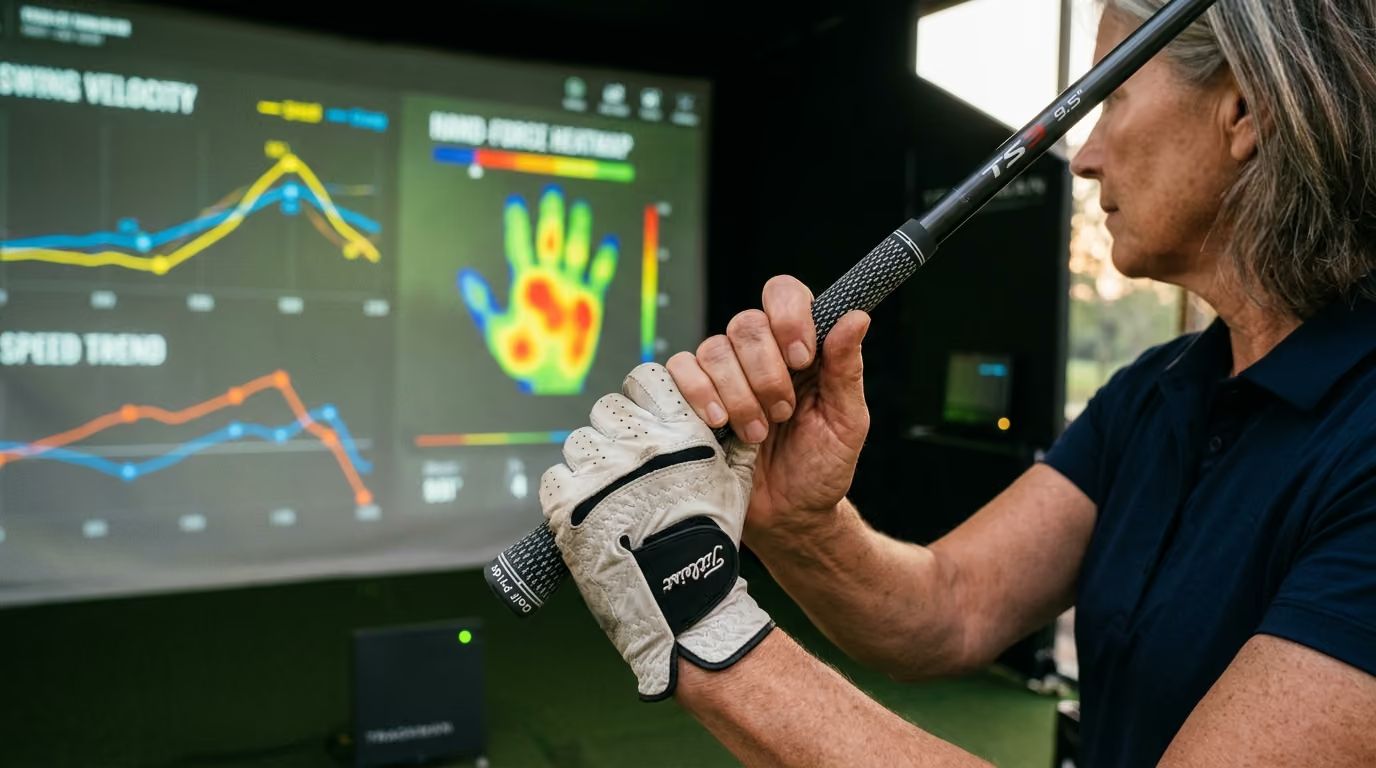
Four key kinematic stages and targeted hip mobility drills help golfers over forty generate powerful swing torque without lower back pain.




You are sitting at your computer searching online for terms like "how to stop lower back pain during golf transition" or "how to get more lag in golf swing without hurting your hips." You want a clear and direct answer. Many golfers over forty try to copy the fast swings of young professionals on television. They try to twist their bodies into extreme positions without the physical foundation to support those movements. This guide offers a complete physical blueprint to prepare your body for a high-torque transition safely.
We will explain how to build the required hip mobility and thoracic rotation. We will look at how to protect your spine. You will learn how to build a swing that produces high clubhead speed without causing pain.
The sun is beginning to set on the fourteenth hole. You are facing a long carry over a wide water hazard. You need a big drive to clear the grass bunker on the other side. You decide to swing a little harder than usual. You take the club back with a long and slow movement.
At the top of the backswing, you try to start the downswing with maximum speed. Your mind tells your lower body to fire toward the target. Your upper body wants to hold back to create a whip-like motion. You try to separate your hips from your chest.
As soon as you begin the change in direction, your body resists. You feel a sudden and sharp pinch in your lower back. Your hips stall immediately to protect your spine. Your hands flip at the ball to compensate for the lost pelvic turn.
The ball flying off the clubface is a weak slice that lands in the right rough. Your lower back feels tight and sore. You spend the final four holes of the round walking slowly and rubbing your lower hip. This scenario happens because your body lacks the physical tools to handle a high-torque transition.
To understand why your back pinched, you must look at how the body moves during a swing. Biomechanists study these movements to help players gain power without injury.
The golf swing relies on a precise chain of events. This chain of events is called the kinematic sequence. It describes how energy moves from the ground up to the clubhead.
First, your feet push against the ground. This push starts the rotation of your pelvis. Second, the pelvic rotation pulls your torso around. Third, your torso pulls your arms forward. Finally, your arms release the club through the ball.
Highly skilled players use this order on every single shot. They do not start the downswing by pulling with their hands. They start the downswing by turning their hips toward the target. This ground-up movement relies on a concept called the summation of forces.
Golf researchers use the term X-Factor to describe the angle between your hips and shoulders. At the top of your backswing, your shoulders should be rotated further than your hips. The difference between these two angles is your X-Factor.
According to biomechanist Dr. Phil Cheetham, there is a second and more critical measurement. This measurement is called the X-Factor Stretch. The X-Factor Stretch occurs during the very first move of the downswing.
As your backswing finishes, your pelvis begins rotating toward the target. Your upper body stays still or continues its turn away from the target. This split-second motion increases the stretch between your hips and shoulders. Dr. Cheetham found that this stretch can grow by fifteen degrees in top players.
The X-Factor Stretch works because of a muscle function called the stretch-shortening cycle. Your muscles act like heavy rubber bands. When you stretch a muscle quickly, it stores elastic potential energy.
If you contract that muscle immediately after the stretch, it releases that stored energy. This muscle action produces a much faster rotation than a regular contraction. In the golf swing, this cycle happens in your abdominal obliques and your deep core.
If you turn your hips while your shoulders stay back, you stretch these torso muscles. This stretch primes them to contract with extreme speed. You get a natural boost in clubhead speed.
To get this natural boost, you must have torso-pelvic dissociation. This term means you can move your upper body and lower body separately. If you turn your hips, your shoulders must be able to stay still. If you turn your shoulders, your hips must be able to stay still.
Many mature golfers lose this ability. Their hips and shoulders turn together as one solid block. When they try to force a transition, they strain their lower back.
To build a high-torque transition, you must understand the joint-by-joint theory. This theory was developed by physical therapist Gray Cook and strength coach Mike Boyle. It states that the human body is a stack of joints that alternate between needing stability and needing mobility.
Your thoracic spine is your middle and upper back. It consists of twelve vertebrae located between your neck and your lower back. This section of your spine is built for rotation.
Research from sports medicine organizations shows that competitive golfers have high thoracic mobility. They can rotate their upper back nearly forty degrees in each direction. If your upper back is stiff, your body cannot create a large shoulder turn.
You will struggle to keep your upper body back while your hips start the downswing. Your body will try to find rotation elsewhere.
Your lumbar spine is your lower back. It consists of five large vertebrae designed to bear weight and absorb shock. Unlike your upper back, your lower back is built for stability.
The joints in your lower back only allow about five to fifteen degrees of rotation. If your thoracic spine is stiff, your body forces your lower back to twist. Twisting your lower back under a heavy load causes disc damage and muscle strains.
To protect your spine, you must keep your lower back stable. You must let your upper back handle the twisting.
Your hips are ball-and-socket joints designed for high mobility. During the backswing, your trail hip must rotate internally. During the downswing transition, your lead hip must rotate internally.
If your lead hip lacks internal rotation, your pelvis cannot turn toward the target. Your pelvis will stop turning and push forward toward the golf ball. This common error is called early extension.
To avoid early extension, your hips must have clear rotational range. Improving hip mobility is a core part of any injury prevention strategies program.
You cannot perform complex gym exercises while playing a round of golf. You need simple actions to use on the course. Use these simple steps when you feel your transition getting rushed or tight.
When you stand over the ball, do not think about your hands or the club path. Focus entirely on turning your trail hip.
During your backswing, feel your trail butt cheek push backward toward the target. This movement makes sure you rotate your pelvis instead of sliding your hips.
At the top of the swing, hold that trail hip position for a split second. Let your lower body start the downward move before you swing your arms.
If your transition feels blocky, take two practice swings using the step-through drill. This drill restores your natural kinematic sequence.
Start with your feet together and the club resting in front of you. Take a backswing. As the club reaches the top, step your lead foot toward the target.
Let your foot strike the ground before you swing the club down. This step forces your pelvis to start the transition. It stops you from swinging with your arms first.
Never do static stretches where you hold a position for thirty seconds before you play. Research shows that static stretching reduces muscle power output. Use dynamic movements instead.
Stand with your feet apart and hold a golf club across your shoulders. Keep your hips completely still. Slowly rotate your upper back ten times to the left and ten times to the right.
Next, hold the club in front of you for balance. Keep your chest facing forward. Slowly turn your hips ten times to each side. These simple movements prime your joints for the high-torque transition.
To make a permanent swing change, you must train your body off the course. This program focuses on building hip mobility, upper back rotation, and core stability. Perform these movements three times per week. They are a core part of a healthy golf-specific strength training routine.
These exercises help improve the rotation of your upper back. They take the pressure off your lower spine.
Start on your hands and knees on a soft mat. Place your hands directly under your shoulders. Keep your knees under your hips.
Take your right hand and slide it under your left arm. Let your right shoulder sink toward the floor. Focus entirely on turning your upper ribcage.
Hold this position for two deep breaths. Slide your arm back out. Reach your right hand up toward the ceiling.
Follow your hand with your eyes to rotate your chest. Perform eight repetitions on each side.
Lie on your left side on a mat. Bend your knees to ninety degrees. Stack your knees directly on top of each other.
Reach your arms straight out in front of your chest. Place your hands together. Keep your knees glued together on the floor.
Slowly lift your right hand up. Reach it up and over to the right side of your body. Try to lay your right shoulder blade flat on the floor.
Keep your hips and knees facing left. Focus on the stretch across your middle back. Hold for three seconds, then return to the start.
Do ten repetitions on each side.
These movements help your hips rotate independently of your lower back.
Sit on the floor with your knees bent. Place your feet flat on the floor, wider than shoulder-width apart.
Lean back slightly and place your hands on the floor behind you. Lower both knees down to the right.
Your right leg should rest on the floor with your knee bent at ninety degrees. Your left leg should rest on the floor with your knee bent at ninety degrees.
Hold this stretch for five seconds. Lift your knees back up. Lower them down to the left side.
Focus on turning your thigh bones inside your hip sockets. Complete ten transitions in each direction.
Kneel on your left knee. Place your right foot flat on the floor in front of you. Both knees should form ninety-degree angles.
Squeeze your left glute muscle. This squeeze stabilizes your pelvis. Hold a golf club across your chest.
Slowly rotate your shoulders to the right. Keep your hips and your front knee facing straight ahead. Do not let your lower body wobble.
Return to the center. Repeat this movement ten times. Switch legs and rotate to the left ten times.
This exercise is excellent for building torso-pelvic dissociation.
These exercises protect your back. They build the power needed to drive your hips through the ball.
Lie on your back on a mat. Bend your knees and place your feet flat on the floor. Keep your feet hip-width apart.
Squeeze your abdominal muscles to flatten your lower back against the floor. Press your heels down. Lift your hips toward the ceiling.
Squeeze your glutes at the top of the movement. Do not arch your lower back. Your body should form a straight line from your knees to your shoulders.
Hold this position for two seconds. Lower your hips back down. Perform three sets of twelve repetitions.
Lie on your back with your arms reaching toward the ceiling. Raise your legs so your knees are bent at ninety degrees. Your knees should sit directly over your hips.
Press your lower back firmly into the floor. Do not let your back arch at any point during this exercise.
Slowly lower your right arm behind your head. At the same time, straighten your left leg forward. Hover your arm and heel just above the floor.
Return to the starting position. Lower your left arm and your right leg. Focus entirely on keeping your torso completely still.
Perform three sets of eight repetitions per side.
This advanced stretch improves rotational flexibility across your entire body.
Lie on your right side. Pull your left knee up toward your chest to a ninety-degree angle. Hold your left knee down with your right hand.
Bend your right knee backward. Reach back with your left hand and grab your right foot. If you cannot reach your foot, use a towel wrapped around your ankle.
Slowly turn your left shoulder back toward the floor. Keep holding your left knee down with your right hand.
Take deep breaths as you hold this position. With each exhale, let your shoulder sink closer to the floor. Hold this stretch for thirty seconds.
Switch sides and repeat.
Using these movements in your weekly schedule will improve your results from golf mobility protocols.
When your body lacks mobility, it compensates. These compensations lead to specific swing faults. Correcting these physical issues is key to fixing your swing.
Early extension is the most common swing fault among amateur golfers. It happens when your hips move toward the golf ball during the downswing. Your spine straightens up, and your hands flip at the ball.
This fault is rarely a technique problem. It is usually a physical limitation. If you lack lead hip internal rotation, your pelvis cannot turn out of the way.
Your body pushes your pelvis forward because it cannot rotate. This movement ruins your posture and causes inconsistent contact.
If your upper back is stiff, you will try to get a full swing by twisting your lower back. Your body is not designed to rotate this way.
Over time, this twisting causes microscopic tears in your lumbar spinal discs. It leads to muscle spasms and chronic lower back pain.
You must free up your thoracic spine to protect your lower back.
Many golfers try to build clubhead speed by pulling down hard with their arms. This movement starts the downswing from the top down. It destroys the kinematic sequence.
This problem often stems from weak glutes. If your glutes cannot anchor your pelvis, you cannot drive your lower body first. Your arms take over, resulting in a loss of power and accuracy.
Glute amnesia is a term used by physical therapists. It describes muscles that do not fire properly because of too much sitting.
When you sit at a desk all day, your glutes turn off. Your hip flexors become tight. When you get on the golf course, your glutes cannot stabilize your pelvis during the swing.
Your lower back and hamstrings must work twice as hard to compensate. This extra strain leads to fatigue on the back nine.
Your equipment plays a key role in how your body moves. Making small adjustments to your gear can reduce physical stress.
Many golfers use heavy spikes for maximum grip. If you have stiff knees or hips, heavy spikes can lock your feet too firmly into the ground.
When your feet cannot move, all the rotational force travels up to your knees and hips. This extra force can cause joint pain.
Consider using spikeless shoes or soft spikes. These options allow your lead foot to flare outward slightly during your downswing. This flaring reduces the twisting force on your lead knee and hip.
If your grips are too small, you will squeeze the club too tightly. This extra hand tension travels up your forearms to your shoulders.
Tense shoulders cannot rotate freely. This tension makes it harder to separate your upper body from your lower body.
Try using midsize or jumbo grips. These larger sizes help relax your hands and arms. They allow your upper body to stay loose during the transition.
Using a golf shaft that is too stiff forces you to swing harder to make the club work. This extra effort leads to a rushed and aggressive transition.
If you use a lighter, more flexible shaft, you can let the club do the work. You do not have to force the transition with your muscles. This change helps you maintain a smooth and efficient swing tempo.
Use this checklist to apply these concepts to your routine.
If you want more resources to improve your game, visit the Golfergy performance platform for expert articles on healthy aging and athletic performance.
Your lower back can only remain safe when your hips and your upper back perform their proper rotational duties during the swing transition.
Follow Golfergy for practical insights on performance, mobility, recovery and healthy ageing. Stay connected for new articles, research-led guidance and ideas to help you play better for longer.


Explore practical resources on performance, recovery, mobility and golf longevity.
Read the Blog