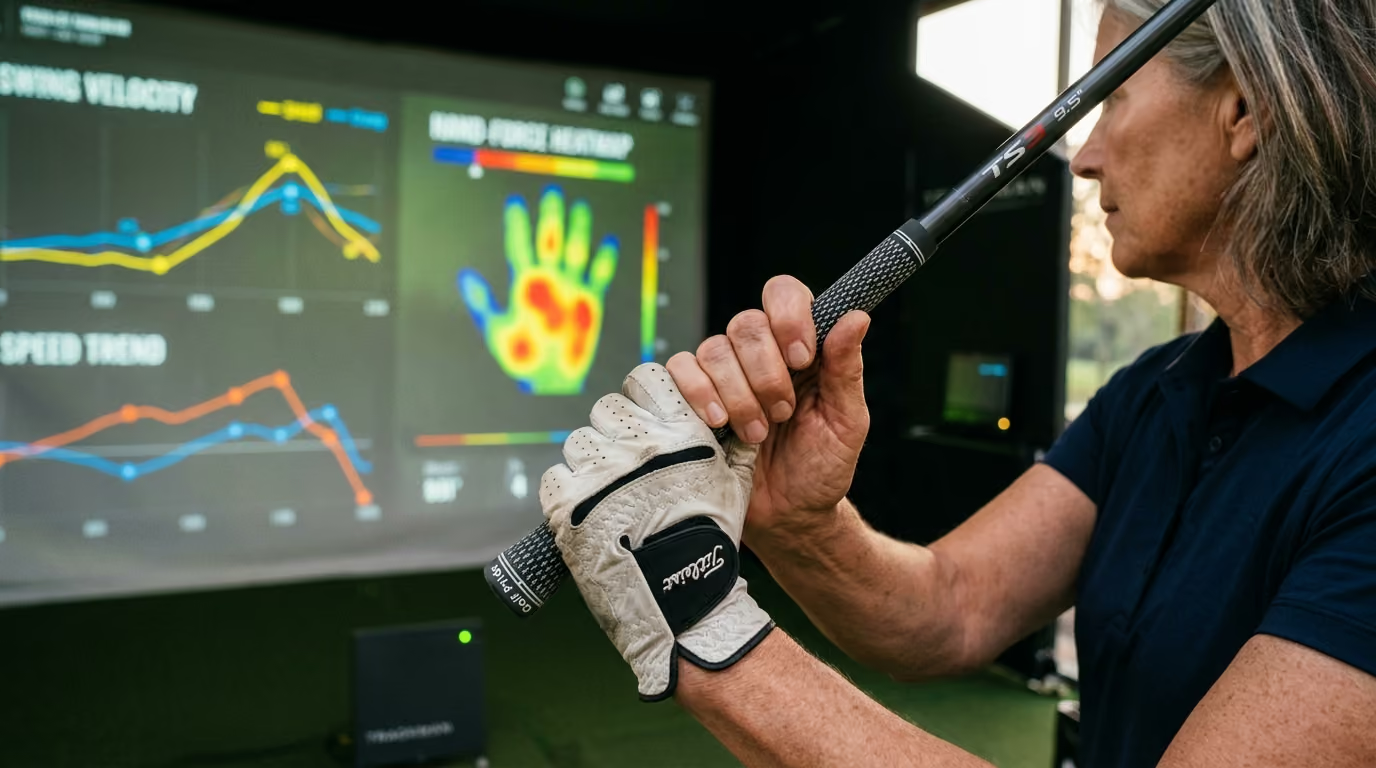

Evidence-based joint supplements protect aging golfers from cartilage wear, chronic knee strain, and rotational pain during the swing.




How to stop knee pain after a round of golf is a common search for mature players. Stiff joints can turn a pleasant afternoon on the course into a struggle. Many golfers accept this discomfort as a normal part of getting older.
You do not have to accept physical decline as a penalty for loving the game. This guide reviews the hard science behind the most popular joint supplements. You will learn what works, what fails, and how to protect your body for years to come.
Joint preservation is the key to playing this sport for a lifetime. We will look at evidence based solutions to keep you moving freely without pain.
The fourteenth hole often reveals the true state of your joints. You stand on a tee box that slopes slightly downward. You swing hard to clear a fairway bunker. As you finish your swing, you feel a sharp pinch in your front knee.
Your lead foot stayed glued to the grass. Your knee joint had to absorb all the rotational force. This on-course situation happens to thousands of golfers every weekend.
The golf swing is not a symmetrical movement. It creates different physical stresses on each side of your body. Your lead knee and trail knee experience completely different forces during the swing.
The lead knee faces rapid extension and high rotation during the downswing. Compressive loads on this front knee can reach 320 to 440 percent of your body weight. The tibia rotates quickly inside the joint capsule. This rapid twisting can wear down cartilage over time.
The trail knee experiences different mechanical stress. It faces a high lateral bending force during the backswing and transition. This lateral force is nearly four times higher than what the lead knee experiences. This load puts heavy pressure on the outer side of the joint and the stabilizing ligaments.
Your joints do not work in isolation. The human body operates as a connected chain of movement. If your hips are stiff, your body forces your lower back and knees to twist extra to compensate.
Focusing entirely on turning your trail hip during the backswing can help protect your lower back. Working on improving your rotational mobility is vital for your joints. If one joint stops moving, the next joint in the chain must work twice as hard.
Age changes how our joints react to these forces. Golfers under the age of 35 mostly suffer from muscle strains and joint instability. Golfers over the age of 35 face degenerative changes. The smooth cartilage that cushions your bones begins to thin.
This thinning cartilage leads to friction, swelling, and morning stiffness. To protect your body, you must support the joint from the inside out.
Collagen is the most abundant protein in your body. It acts as the glue that holds your tendons, ligaments, and cartilage together. As we age, our bodies produce less collagen every year.
You must understand the difference between the two main types of collagen supplements. Native Type II collagen is unprocessed. It works by training your immune system to stop attacking its own joint tissue. Hydrolyzed collagen peptides are different.
Hydrolyzed collagen is broken down into tiny amino acid chains. Your body absorbs these small peptides quickly. They act as raw construction materials to repair worn down connective tissue.
The scientific evidence supporting collagen is strong. A well known 24-week study looked at athletes with activity-related joint pain. The results showed that taking 10 grams of hydrolyzed collagen daily significantly reduced joint pain.
Participants reported a 1.11 point drop in pain while walking. They also had a 0.97 point reduction in pain while standing. These improvements were much greater than those seen in the placebo group.
For golfers, these numbers translate to easier walking on the back nine. Better comfort while standing over your putts can improve your focus.
The research shows that a dose-response relationship exists. To support your connective tissues, you need to take 5 to 15 grams of collagen peptides daily. This daily dose must be continued for at least 3 months to see real structural benefits.
Collagen also helps with recovery after a hard workout or a long day of carrying your bag. A study found that taking 20 grams of collagen peptides daily reduced muscle soreness by 32 percent at the 48-hour mark. This speed of recovery is crucial when you want to play consecutive rounds on a weekend trip.
Your tendons and ligaments are made mostly of collagen. When you swing a golf club, these tissues stretch and recoil to transfer power. Keeping these tissues strong prevents minor pulls from becoming chronic tears.
Adding high quality collagen to your diet helps maintain the structural integrity of your lead knee. This joint capsule takes a beating during the rotational finish of your swing.
Glucosamine and chondroitin are the most common joint supplements sold today. You can find them in grocery stores, golf pro shops, and pharmacies. There is still a lot of confusion about whether they actually work.
The confusion comes down to the specific chemical form of the supplement. Many cheap products use Glucosamine Hydrochloride. Clinical trials show that Glucosamine Hydrochloride is largely ineffective for reducing joint pain.
You should look for Crystalline Glucosamine Sulfate instead. This specific form has much better bioavailability. The body can absorb and use it far more efficiently.
Major reviews from the Cochrane Database show a clear difference between these forms. Crystalline Glucosamine Sulfate offers real improvements in joint function when taken for over 6 months. Glucosamine Hydrochloride does not show these benefits.
The overall data on these supplements can seem mixed because studies group all pain levels together. A major subgroup analysis looked specifically at patients with moderate to severe knee pain.
In this group, the combination of glucosamine and chondroitin had a 79.2 percent response rate. The placebo group only had a 54.3 percent response rate. This means players with more joint wear get the most benefit from these compounds.
Chondroitin sulfate works alongside glucosamine. It acts like a tiny sponge inside your cartilage. Chondroitin helps your cartilage retain water.
This water retention is critical for keeping the joint lubricated and bouncy. When you walk down steep hills on the course, this water cushion absorbs the impact. Without enough chondroitin, your cartilage can become dry and brittle.
Buying the correct form of these ingredients is the first step. You must also commit to a long trial. These compounds work slowly to rebuild joint fluid and protect cartilage.
Expect to take them consistently for several months before you judge their impact. Stopping early is the main reason golfers think these supplements do not work.
Swinging a golf club creates microscopic damage in your muscle fibers and joint tissues. This damage is normal, but it triggers an inflammatory response. If your body cannot quiet this inflammation, you will feel stiff and sore the next day.
Curcumin is the active compound found in turmeric. It is a natural anti-inflammatory agent. Research shows that curcumin works by blocking inflammatory pathways in the body.
Meta-analyses show that curcumin significantly lowers C-reactive protein and TNF-alpha levels. These are the main biological markers of systemic inflammation. Lowering these markers reduces joint swelling and morning stiffness.
Curcumin also helps you move more freely. Studies show it can increase your active range of motion after strenuous exercise. This improved movement is vital for maintaining your physical health as you age.
The main challenge with curcumin is absorption. Standard turmeric powder is poorly absorbed by the human digestive tract. You should look for curcumin supplements formulated with black pepper extract or clinical lipid carriers. These formulations can increase absorption by up to 2,000 percent.
Omega-3 fatty acids from fish oil are another powerful tool against joint pain. These healthy fats change the chemical makeup of your cell membranes. They replace pro-inflammatory fats with anti-inflammatory compounds.
To get the strongest reduction in joint inflammation, you need a high dose of Omega-3s. Clinical trials show you need at least 2 grams per day of combined EPA and DHA. This dose must be taken consistently for at least 6 weeks.
Using Omega-3s helps reduce the daily wear and tear on your cartilage. It acts like a natural lubricant for your entire cardiovascular and joint system.
Combining curcumin and Omega-3s targets joint pain from two different angles. Curcumin works quickly to block pain signals. Omega-3s work over time to rebuild healthier cell membranes. This combination helps you wake up without the physical dread of swinging a club.
Methylsulfonylmethane is commonly known as MSM. It is an organic sulfur compound found naturally in some plants. Sulfur is a critical structural element for your bones and joints.
Your body needs sulfur to create the chemical bonds that hold connective tissue together. Without enough sulfur, your collagen fibers cannot form a strong matrix.
MSM is highly effective at reducing muscle soreness after physical activity. This soreness is often called delayed onset muscle soreness. A well regarded study looked at healthy adults taking 3,000 milligrams of MSM daily for 30 days.
The participants who took MSM reported a 1.5 point reduction in muscle soreness on a 5-point scale. They recovered their physical strength much faster than the placebo group.
This recovery speed is incredibly useful for golfers who swing with high clubhead speeds. High speed swings put massive torque on your muscles and tendons.
Think about the trail hip during your backswing. This hip must rotate deeply while holding your weight. This movement creates a high amount of external torque on the joint.
Taking MSM helps your body process the oxidative stress built up in your hip muscles. It reduces the deep, dull ache that can develop in your glutes and lower back after 18 holes.
MSM also supports the production of glutathione. Glutathione is your body's primary internal antioxidant. Boosting this antioxidant helps protect your joint cells from the stress of long hours in the sun.
You can find MSM as a single supplement or combined with glucosamine. The research shows that a daily dose of 3,000 milligrams is safe and effective. It provides the raw sulfur your body needs to rebuild joint tissues and recover from fatigue.
Different golfers experience joint pain in different ways. A one-size-fits-all approach to supplements rarely works. You should tailor your supplement plan to your specific physical patterns.
Below are three common physical patterns seen on the golf course. Each pattern has a targeted supplement strategy based on clinical research.
This pattern is common in golfers who feel pain in their front leg during the follow-through. The pain is caused by the rapid rotation of the knee joint. You can read more about protecting your joints from swing stress to understand this movement.
This pattern affects older golfers who struggle with morning stiffness. Their joints click and pop, and they feel achy during the back nine of their round.
This pattern is seen in golfers who swing with high velocity. They generate power by loading their back hip, which leads to deep muscle soreness after playing.
You must be consistent with whichever protocol you choose. Your body cannot rebuild joint tissue overnight. Plan to stick to your chosen routine for a minimum of 90 days before evaluating your results.
Many golfers waste money on joint supplements that do not work. They often fall victim to clever marketing or poor product design. Understanding these common pitfalls will save you money and protect your health.
The first major pitfall is believing the performance myth. Many supplement advertisements claim their product will instantly boost your swing speed. They promise you will drive the ball 20 yards further after taking a pill.
Recent scientific reviews show this is simply not true. Joint supplements like collagen and Omega-3s have little to no immediate impact on sports performance. They do not increase your raw muscle strength or explosive power directly.
Instead, these tools work through symptom management and tissue preservation. They help you practice longer without pain. They speed up your recovery so you can play more often.
The actual performance boost comes from your ability to train and play consistently. The supplement itself does not add speed to your swing.
The second pitfall is buying the wrong form of the active ingredient. As we discussed, Glucosamine Hydrochloride is cheap but largely ineffective. Many popular brands use this form because it costs less to manufacture.
Always turn the bottle over and read the supplement facts panel. Look specifically for Crystalline Glucosamine Sulfate. If the label does not specify the form, avoid the product.
The third pitfall is expecting rapid results from natural compounds. Many golfers take a joint supplement for two weeks and stop because they do not feel different. They treat these supplements like fast-acting pain relievers.
Prescription anti-inflammatory drugs can mask pain in an hour. Joint supplements work by changing the structure of your tissues over time.
It takes months for collagen fibers to knit together. It takes weeks for Omega-3s to change the fatty acid profile of your joints. You must commit to a daily routine for 3 to 6 months to give these ingredients time to work.
Supplements work best when you stop actively irritating your joints on the course. You can make simple changes to your gear and technique to reduce joint stress. These physical adjustments work alongside your supplement routine.
If your lead knee hurts, you can use a simple technique adjustment. Focus entirely on flaring your lead foot outward by 20 to 30 degrees at address.
This small movement changes the angle of your knee joint. It allows your hips to clear more easily during the downswing. This adjustment reduces the twisting force on your lead knee by a significant margin.
Your footwear also plays a massive role in joint health. Many golfers wear shoes with heavy, rigid metal spikes. These spikes lock your feet into the turf, which prevents any natural rotation.
This lack of foot rotation forces your knees and hips to absorb all the twisting stress. Try switching to spikeless golf shoes or shoes with highly flexible soles. These designs allow your feet to slide slightly during the swing, which saves your knees from impact.
Look at the size of your golf grips as well. If your grips are too small, you must squeeze the club tightly to keep it from slipping.
This tight grip creates tension that travels up your forearms. This tension can irritate your elbows and shoulders over 18 holes.
Oversized or jumbo grips can help you relax your hands. A lighter grip pressure reduces the vibration that travels into your arm joints when you strike the ball. This is a simple equipment check that can prevent golfer's elbow.
Taking control of your physical health does not require a massive lifestyle change. You can start with a few simple steps this week to protect your joints.
First, look at the supplement bottles in your cabinet. Check the labels to see if you are taking the correct forms of glucosamine and curcumin.
Second, select one of the targeted protocols listed in this guide. Choose the pattern that best matches where you feel stiffness or discomfort.
Third, commit to a 90-day trial of your new routine. Set a daily reminder on your phone to keep your supplementation consistent.
Fourth, make one physical adjustment to your setup during your next practice session. Try flaring your lead foot to see if it reduces the pressure on your front knee.
Fifth, check out our physical performance guides to learn more about keeping your body strong. Combining smart supplementation with physical prep is the best way to extend your playing years.
Your joints have a limited capacity for wear and tear. Taking proactive steps today will help you walk the fairways comfortably for decades to come.
Consistent daily use of clinically proven joint supplements is the most reliable way to protect your physical mobility and extend your playing years.
Follow Golfergy for practical insights on performance, mobility, recovery and healthy ageing. Stay connected for new articles, research-led guidance and ideas to help you play better for longer.


Explore practical resources on performance, recovery, mobility and golf longevity.
Read the Blog