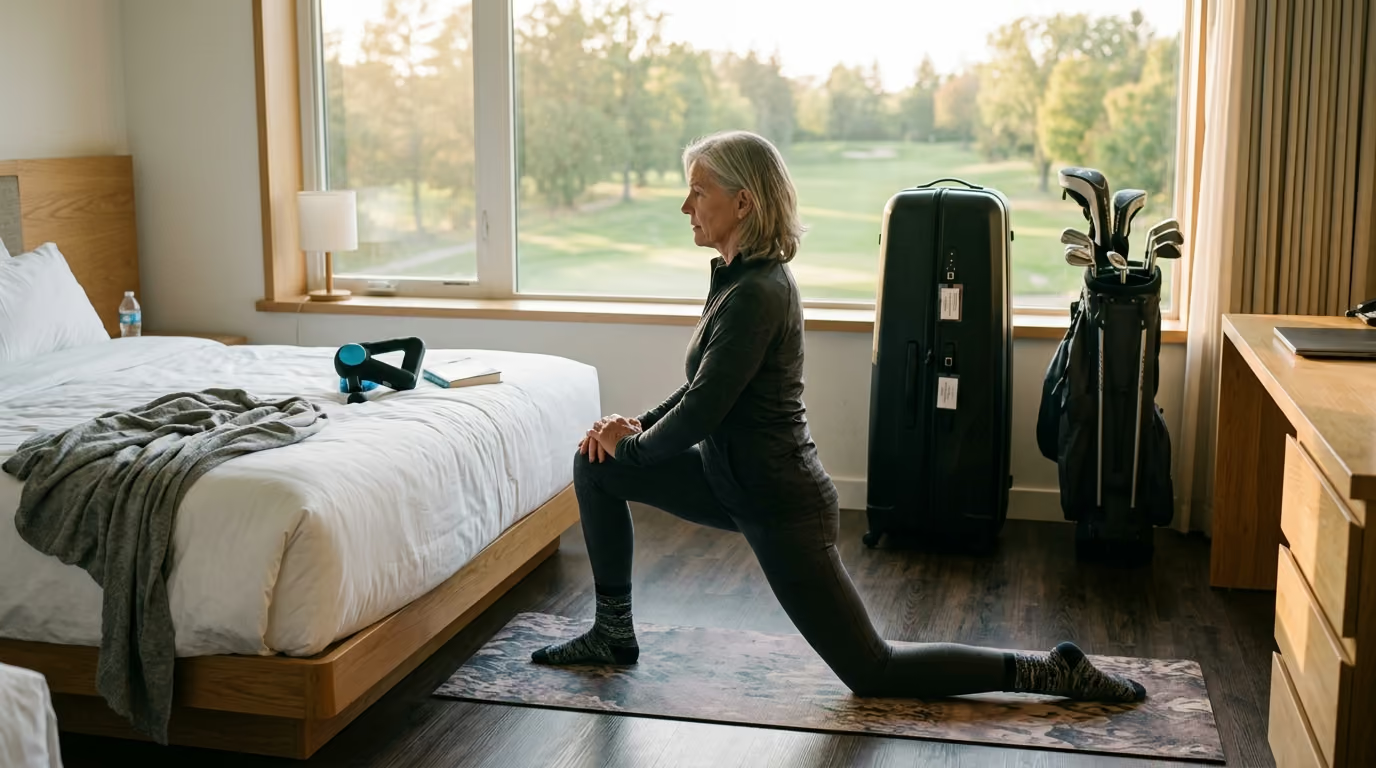

Thirty seconds of static stretching before a round can decrease muscular power and reduce your clubhead speed on the golf course.




Many golfers believe that holding a deep stretch before a round is the best way to prepare. They walk up to the first tee, bend forward, and hold a hamstring stretch for thirty seconds. Modern sports science shows this exact routine might actually ruin your swing speed.
For decades, athletes were told to hold static positions to get ready for movement. We now know that this practice decreases muscular power. It relaxes the nervous system when you actually need it to be sharp. For the mature golfer, choosing the wrong stretch at the wrong time leads to both slower swing speeds and a higher risk of injury.
This resource will show you the correct way to prepare your body for the physical demands of golf. We will look at how your joints work together during the swing. We will also outline a science-based warm-up and recovery routine. This guide is built specifically for players who want to maintain their physical health and protect their joints for years to come.
Improving your overall mobility is not about doing random stretches. It requires a targeted plan that respects how your body moves. By understanding the timing of different stretching techniques, you can protect your back and increase your clubhead speed. Let us look at how these movement patterns show up on the golf course.
It is 7:15 AM on a cool autumn morning. The grass on the practice green is wet with heavy morning dew. Your lower back feels stiff from the thirty-minute drive to the golf course. To wake up your muscles, you stand by your golf cart and pull your right knee tight to your chest.
You hold that position for forty-five seconds while talking with your playing partners. You feel a deep stretch in your glutes and hamstrings. You believe you have successfully prepared your body for the first shot of the day.
You step up to the first tee box, tee up your ball, and take a full practice swing. Your trail hip feels blocked during your backswing. Your lower back takes the brunt of the rotational force. When you swing down, your body feels slow and disconnected.
The drive ends up slicing forty yards into the deep right rough. Even worse, you feel a sharp pinch in your lower back. This common scenario happens because your muscles were relaxed by the static stretch rather than primed for explosive action.
This is a classic example of how well-meaning physical preparation can backfire. Your muscles need to act like coiled springs during the swing. Holding static stretches right before you hit makes those springs loose and slow. To fix this, you must understand how your joints cooperate.
To understand how to stretch, you must look at how your body is constructed. Sports scientists Gray Cook and Michael Boyle created a framework called the Joint-by-Joint approach. This model explains that the human body is an alternating stack of stable and mobile joints.
Your joints have primary jobs. Some joints are built to provide mobility, which means they move through a wide range of motion. Other joints are built to provide stability, which means they resist unwanted movement and transfer force.
Let us look at how this stack alternates from the ground up:
When this system works perfectly, your swing feels effortless. If a mobile joint loses its mobility, a stable joint is forced to move to make up for the loss. This is where most golf injuries occur.
For example, if your hips are tight, they cannot rotate fully during your backswing. To complete your turn, your body will force your lower back to twist. Your lower back is only designed to rotate about one to two degrees per vertebra. Forcing it to twist leads to muscle strains, disc injuries, and chronic pain.
You can find more smart strategies for injury prevention on our site. Protecting these stable joints is key to maintaining your physical health. Now let us look at what actually happens inside your muscles when you stretch them.
Static stretching involves reaching a muscle to its furthest point and holding that position. This method is highly effective for long-term flexibility, but it is dangerous right before athletic movement. To understand why, we must look at a sensory receptor called the Golgi Tendon Organ.
The Golgi Tendon Organ sits at the junction where your muscle fibers meet your tendons. Its primary job is to protect your muscles from tearing under extreme tension. When you hold a static stretch for more than thirty seconds, this sensor triggers a process called autogenic inhibition.
Autogenic inhibition is a neural reflex that forces your muscle fibers to relax. The nervous system shuts down the muscle’s active tension. This relaxation makes you feel loose, but it also temporarily weakens the muscle.
Research from the Journal of Strength and Conditioning Research has analyzed this phenomenon extensively. Studies show that static stretching before exercise reduces maximum muscle strength by 5.4 percent. It also lowers explosive power by 1.9 percent and decreases explosive performance by 2.0 percent.
For a golfer, this means your muscles cannot contract with maximum speed. Your ability to create force at the transition of your swing is severely compromised.
Furthermore, static stretching reduces the passive stiffness of your muscle-tendon units. Muscle stiffness is actually a good thing for explosive sports. It acts like a tight rubber band that snaps back when stretched. When you remove this stiffness, you lose the natural recoil at the top of your backswing.
This muscular weakness is not a brief issue. Studies show that the negative performance effects of pre-round static stretching can last for up to six holes. That means you are playing the first third of your round with reduced speed and coordination.
This neural shutdown makes it much harder to find the center of the clubface. Your timing gets thrown off because your muscles are not firing at their normal speed. To avoid this, you need to change how you prepare.
Dynamic stretching involves moving your joints through an active range of motion without holding the end position. This type of movement does not trigger autogenic inhibition. Instead, it prepares your neuromuscular system for the fast movements of the golf swing.
When you perform dynamic movements, your heart rate increases. Blood flows rapidly to your working muscles. This raises the temperature of your muscle tissues, which makes them more pliable and elastic.
Dynamic stretching also improves what scientists call nerve conduction velocity. The electrical signals traveling from your brain to your muscles move much faster. This fast communication is what allows you to transition smoothly from backswing to downswing.
Research published in the International Journal of Sports Medicine shows the clear benefits of this approach. Golfers who perform a dynamic warm-up show significant increases in clubhead speed. On average, they gain about 1.9 meters per second in swing speed. This translates to an increase of about 3.5 meters per second in ball speed.
In specific case studies, dynamic warm-ups increased carry distance by an average of 37.5 yards compared to no warm-up. When resistance bands were added to the dynamic routine, players gained up to 44.5 yards of carry distance.
Dynamic movements also utilize a concept called reciprocal inhibition. When you actively contract one muscle, your brain automatically signals the opposing muscle to relax.
For example, when you actively contract your glute muscle, your brain tells your hip flexor to release. This creates a natural, functional path of motion without weakening the tissue.
To perform these movements correctly, focus entirely on turning your trail hip. This single focus helps coordinate your lower body and prevents sway. Let us look at a simple routine you can use right on the first tee.
You do not need an elaborate gym setup to prepare your body. You can complete this highly effective, three-minute dynamic sequence right next to the tee box. It requires no floor space and uses your golf club for balance.
First, perform the Supported Torso Rotation to prepare your mid-back:
Second, complete the Dynamic Leg Swing to open your hips:
Third, use Pelvic Tilts to find your neutral spine:
These three simple movements prepare your body for the physical strain of hitting a driver. They warm up the exact joints identified in the Joint-by-Joint model.
This quick routine is a vital part of your long-term golf longevity strategy. It helps you avoid early-round injuries and keeps your swing fast from the very first shot. For deeper recovery, however, you need a different strategy.
While static stretching is poor for pre-round preparation, it is perfect for post-round recovery. Long-term flexibility requires changes in the physical length of your muscles and connective tissues. This structural change is called plastic deformation.
To achieve plastic deformation, you must hold a stretch when your muscles are already warm. The ideal time for this is within thirty minutes of finishing your round, or during a dedicated evening session.
You must hold these stretches for thirty to ninety seconds per side. This duration gives the fascia and connective tissues enough time to actually adapt and lengthen.
Here is a simple, highly effective evening recovery routine designed for mature golfers:
This position targets both internal and external rotation of your hips.
This stretch opens up the front of your hips, which get tight from sitting and riding in golf carts.
This movement restores rotation to your thoracic spine, taking the pressure off your lower back.
Doing this routine three times a week will slowly build your rotational capacity. It will make it much easier to make a full backswing without putting stress on your spine.
For more structural exercise advice, check out our golf performance blog. Regular recovery work is the secret to playing without pain as you age. Now let us look at some common mistakes to avoid.
Many golfers make simple errors when trying to improve their flexibility. These mistakes can cause muscle strains and slow down your recovery. Understanding what to avoid will keep your training safe.
This technique is called ballistic stretching. When you bounce at the end of a stretch, you trigger a safety mechanism called the stretch reflex.
The muscle spindle detects the rapid change in muscle length and instantly forces the muscle to contract. This reaction is the exact opposite of what you want. Bouncing can cause tiny tears in your muscle fibers and lead to chronic tightness.
Trying to stretch cold muscles is like trying to stretch a cold rubber band. Cold collagen fibers are stiff and brittle.
If you try to stretch them without warming up first, you risk straining the muscle-tendon junction. Always walk briskly for five minutes to get your blood moving before doing any static stretching.
Some golfers have naturally loose joints. If you are naturally double-jointed or very flexible, you do not need more stretching.
Adding more flexibility to loose joints creates joint instability, which increases your injury risk. If this describes you, swap your stretching routine for isometric holds to build stability.
Avoiding these common mistakes will save you from unnecessary pain. It allows your body to build real, usable range of motion. You can read more about safe training habits in our golf performance and longevity resources. Next, let us look at how your equipment affects your body.
Your golf equipment has a direct impact on your physical health and movement. If your gear is not suited to your body, it can force you into poor biomechanical positions.
First, look at your golf shoes. Stiff, heavily structured golf shoes can restrict your ankle mobility.
As we learned from the Joint-by-Joint model, restricted ankle mobility forces the knee to twist. Choose shoes that offer a balance of support and natural flexibility to protect your joints.
Second, check your grip size. If your grips are too thin, your hands will squeeze the club too tightly.
This excessive forearm tension travels up your arms into your shoulders. Tight shoulders make it very difficult to rotate your thoracic spine, which can lead to lower back pain.
Third, consider your shaft flex. Playing a shaft that is too stiff for your swing speed forces you to swing harder than you should.
This over-exertion puts massive stress on your joints and muscles. Switching to a lighter, more flexible shaft allows you to swing with control and reduces physical fatigue.
Paying attention to these details can make a big difference in how your body feels after eighteen holes. Small changes in your gear can significantly reduce the physical demands of the game. Let us summarize the most important points to take to your next round.
To play your best golf and protect your body, use dynamic movements on the first tee and save the deep stretches for the evening.
Follow Golfergy for practical insights on performance, mobility, recovery and healthy ageing. Stay connected for new articles, research-led guidance and ideas to help you play better for longer.


Explore practical resources on performance, recovery, mobility and golf longevity.
Read the Blog