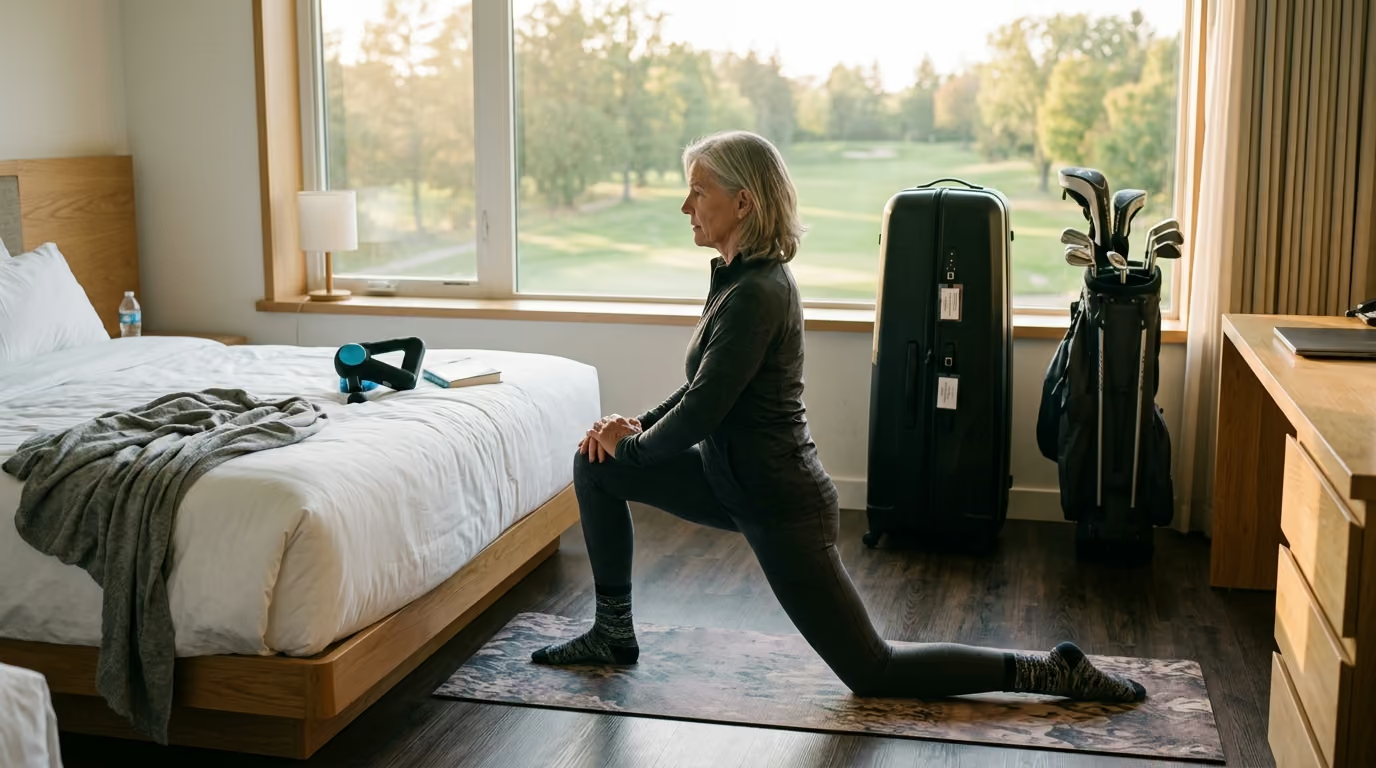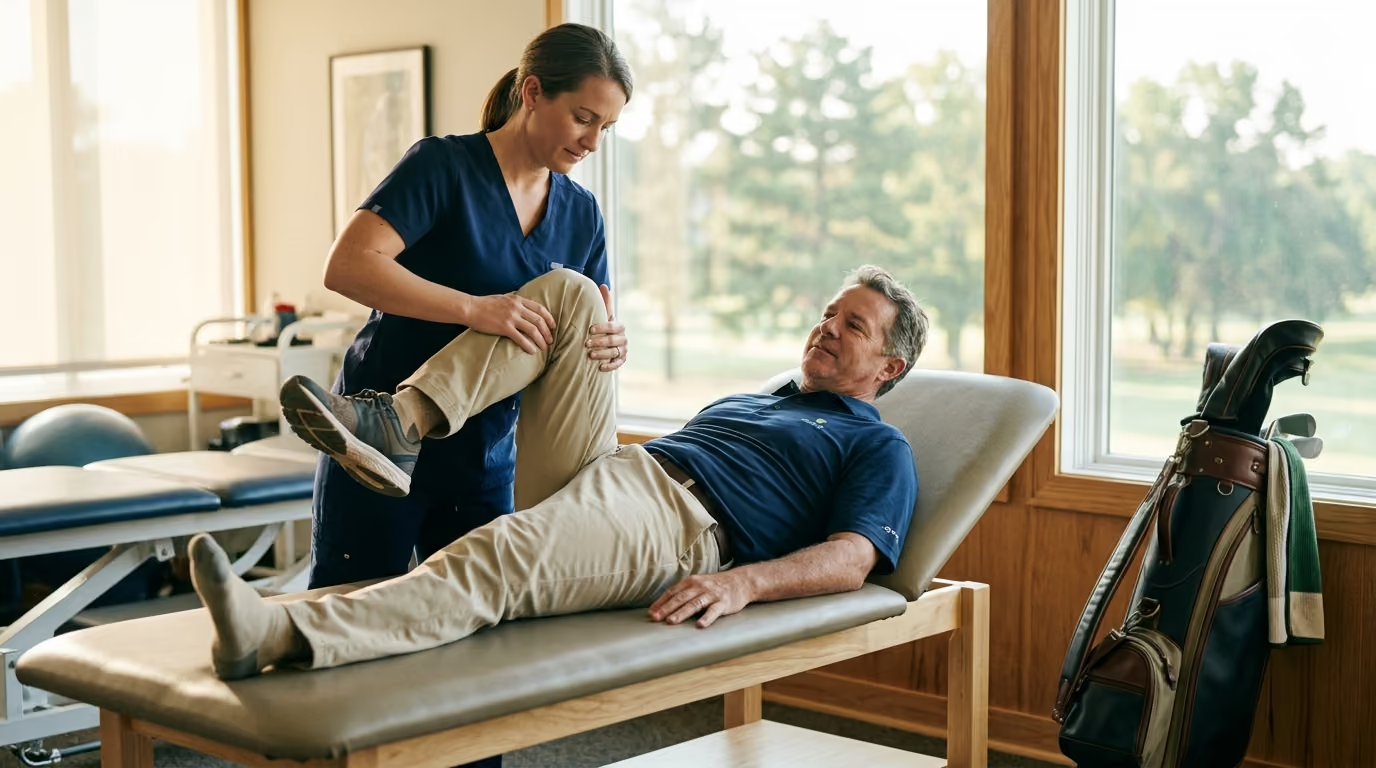
Fear of re-injury often causes golfers to subconsciously guard healed muscles and disrupt their natural swing mechanics on the course.




Many golfers believe that physical therapy is the most difficult part of recovering from an injury. They assume that once muscle tissue heals and doctors give the all-clear, the old swing will return naturally. This assumption is incorrect. The psychological barriers after an injury are often much harder to resolve than the physical damage itself.
The saddest thing I have seen in golf is watching lifelong playing partners slowly drop out of our weekend group. It usually starts with a nagging shoulder or knee issue they ignore until it requires surgery. That pattern is exactly why I became obsessed with golf longevity. We do not have to stop playing as we age, provided we do the right maintenance work between rounds.
To maintain physical longevity, we must understand how our minds react to past trauma. A healed muscle does not automatically mean a healed movement pattern. The brain remembers pain, and it will alter your movement to keep you safe. Understanding this mental guarding is the key to achieving healthy ageing on the course.
Experienced golfers often find that their physical rehabilitation goes well, but their scores continue to rise. They feel stiff, tentative, and disconnected from their swing. This happens because the brain is still protecting the site of the old injury. To overcome this, we must examine the intersection of neurology, biomechanics, and psychology.
Imagine standing on the tee box of a long, narrow par four. You have spent six months recovering from a herniated disc in your lower back. Your physical therapist has cleared you to play, and you have hit balls on the range without pain. Now, you hold your driver, look down the fairway, and prepare to swing.
As you start your takeaway, an unfamiliar feeling of hesitation creeps in. Your brain remembers the exact moment your back locked up a year ago. In response, your nervous system fires a warning signal. You do not feel acute pain, but you feel a sudden, involuntary tightness.
This tightness changes your entire transition from backswing to downswing. Instead of rotating your hips fully, you stop short and throw your hands at the ball. You steer the shot into the right rough, leaving yourself a difficult second shot. Your back feels stiff, not because you hurt it again, but because your brain tightened your muscles.
In our experience, this scenario happens to thousands of golfers every week. The golfer often blames their physical condition or a loss of flexibility. They do not realize that their brain is actively restricting their movement. This protective mechanism is a natural response, but it ruins your swing mechanics.
To regain your smooth turn, you must learn to recognize these warning signals. The body uses muscle tension as a shield against perceived danger. If you do not address this mental shield, you will continue to swing with a restricted, high-risk motion.
To understand why your swing changes after an injury, you must understand the Fear-Avoidance Model. This scientific framework shows how people develop chronic pain and movement issues. It begins when a golfer experiences a painful event on the course or in daily life.
[Painful Event] ──> [Catastrophizing Thoughts] ──> [Fear-Related Anxiety] ──> [Avoidance & Muscle Guarding] ──> [Disuse & Chronic Stiffness]
If you view pain as a sign of permanent damage, you begin catastrophizing. You might think your lower back will never handle a driver again. This thought creates fear-related anxiety, which leads to the avoidance of specific movements.
This avoidance behavior has a clinical name: kinesiophobia. Kinesiophobia is an irrational and disabling fear of physical movement. It results from feeling vulnerable to painful injury or re-injury. In golfers, this fear shows up during the transition from the backswing to the downswing.
Normal Swing: Smooth transition ──> Correct sequencing ──> Shared load across joint systems
Guarded Swing: Hesitant transition ──> Premature muscle firing ──> High shear forces on the lumbar spine
When you fear pain, you unconsciously hold back during this critical phase. Instead of allowing a natural kinetic chain, you contract your abdominal and back muscles prematurely. This mistimed muscle firing actually increases the shear forces on your spine.
By trying to protect your back, you make the swing more dangerous. Research published in the British Journal of Sports Medicine shows that fear-avoidance is highly common. In fact, studies suggest that kinesiophobia significantly impacts the return to sport in up to 66.7% of recovery cases.
This fear changes how your body handles physical stress. The lumbar spine, thoracic spine, and hip joints contribute 68.7% to 72.2% of the total work during a golf swing. We can think of these three areas as the power centers of your body.
If your brain does not trust one of these power centers, it shifts the work elsewhere. For example, if you protect a healed trail hip, your lower back must rotate further. This compensation puts immense pressure on your spinal discs.
[Spine, Thoracic, & Hip Joints] ── (Provide 68.7% to 72.2% of swing work)
│
┌───────────────┴───────────────┐
▼ ▼
[Normal Function] [Guarded Function (Fear)]
• Balanced rotation • Hip movement restricted
• Distributed forces • Excess rotational load forced on lumbar spine
Golfers also struggle to manage the crunch factor during recovery. The crunch factor is a combination of lateral trunk flexion and high axial rotational velocity. It occurs on the downswing and puts high compressive loads on the right side of the spine for right-handed golfers.
If you fear this movement, you might slide your hips instead of turning them. This slide prevents a clean strike and increases lateral stress on your lead knee. The physical tissue has healed, but your brain is still operating in a high-threat state.
When you feel tension rising on the course, you need an immediate way to lower your brain's threat level. You cannot stop your round to perform a 30-minute stretching routine. Instead, you can use simple, nervous-system-based drills to restore confidence.
The fastest way to calm your nervous system is through breath-driven rotation. When we feel threatened, we naturally hold our breath or take shallow chest breaths. This breathing pattern signals the fight-or-flight response, which increases muscle tension.
[Threat Perception / Fear of Re-injury]
│
▼
[Shallow Chest Breathing / Held Breath]
│
▼
[Sympathetic Nervous System Activation]
│
▼
[Increased Protective Muscle Stiffness]
To counter this, focus entirely on turning your trail hip while practicing slow, nasal breathing. Take a deep breath in through your nose as you make a slow backswing. As you transition into your downswing, let out a slow, controlled exhalation through your mouth.
Takeaway & Backswing ───> Inhale slowly through your nose
Transition & Downswing ──> Exhale slowly through your mouth
This breathing pattern stimulates the vagus nerve. The vagus nerve tells your brain that you are safe, which reduces protective muscle guarding. You can perform this breath-driven rotation while waiting on the tee box or walking to your ball.
Another immediate on-course option is the assessment and reassessment loop. This drill gives your brain objective proof that a movement is safe.
Step 1: Test Standing Thoracic Turn ──> Step 2: Do Eyes-Closed Balance Drill ──> Step 3: Re-test Thoracic Turn
Start by testing your standing thoracic turn. Stand with your feet together, cross your arms over your chest, and turn as far right and left as comfortable. Note your range of motion and any feelings of tightness.
Next, perform a simple neurological drill like eyes-closed balance. Stand on your lead leg, lift your trail foot slightly, and close your eyes for ten seconds. If you lose your balance, touch your foot down and try again.
Immediately re-test your standing thoracic turn after completing the balance drill. If your range of motion increases or the tightness decreases, your brain feels safer. Your nervous system has lowered its defense mechanism because you challenged your balance system.
This quick reassessment shows your brain that it does not need to guard your muscles. It is a simple tool to use before you hit your tee shot. By showing your body it is safe, you break the fear-avoidance loop before it ruins your swing.
To overcome kinesiophobia long-term, you must use a graded exposure plan. Graded exposure is a method where you slowly introduce feared movements in a safe environment. This process helps your brain rebuild its sensory map of your body.
After an injury, the brain often loses clear sensory feedback from the trunk and hips. This loss of clarity is called proprioceptive deficit. If the brain cannot map a joint, it treats that joint as a threat and creates stiffness to protect it.
To rebuild this map, you should use mirror swings. This exercise focuses on visual feedback to reassure your brain that movement is safe. You will need a full-length mirror and a quiet room at home.
Phase 1: Mirror Swings (No Club) ──> Phase 2: Half-Swings (Light Stick) ──> Phase 3: Short Irons (Real Balls)
Stand in front of the mirror in your normal golf stance without a club. Focus entirely on turning your trail hip backward while watching your reflection. Move slowly, taking five seconds to reach the end of your turn.
Hold this position for two seconds, then return to the start. Repeat this movement ten times, focusing on keeping your body relaxed. The mirror provides visual proof to your brain that your hip and back are moving without damage.
Hold a light alignment stick across your chest. Slowly turn to the top of your backswing, then pause. From here, focus entirely on turning your lead hip toward the target to initiate the downswing.
Watch your hips move in the mirror to confirm you are not sliding or shifting your weight incorrectly. Perform three sets of ten repetitions. By using a light stick, you avoid the heavy physical load of a real golf club.
Hold a short iron and stand sideways to the mirror. Swing slowly back to a parallel position, then swing through to a comfortable finish. Do not hit a ball yet, and do not swing at full speed.
Keep your eyes on your spine angle in the mirror. Observe how your body rotates smoothly through the hitting zone. If you feel any muscle guarding, slow down your speed until the movement feels smooth and easy.
Do this routine four times a week to improve your mobility and rebuild joint confidence. By moving slowly in front of a mirror, you teach your brain that rotation is safe. This physical and mental practice prepares your body for the physical demands of a real round of golf.
When golfers try to overcome the fear of re-injury, they often make several predictable errors. These errors can prolong recovery times and increase the risk of future injuries. Understanding these pitfalls will help you maintain your recovery progress.
Common Recovery Mistakes:
┌───────────────────────────────┬────────────────────────────────┐
│ The Technique Fallacy │ Over-Reliance on Rest │
│ • Changing swing path only │ • Complete inactivity │
│ • Ignoring underlying load │ • Deconditioning of tissue │
│ • Fails to fix joint movement│ • Lowers pain threshold │
└───────────────────────────────┴────────────────────────────────┘
The first common mistake is the technique fallacy. Many golfers believe that a poor swing path is the sole cause of their injury. They spend hours trying to change their swing path without addressing how their body actually moves.
While a bad swing path can increase physical stress, the real issue is often muscular imbalances and improper joint loading. If your hips are tight, changing your hand path will not protect your lower back. You must improve your physical capabilities before you can successfully alter your swing.
Focusing only on technique can lead to frustration and more fear. If you try to make a new swing with a restricted body, you will still experience pain or tension. You must prepare your body physically before trying to make major changes to your golf swing.
The second mistake is an over-reliance on rest. When a golfer feels back discomfort, their first instinct is often to stop moving entirely. They lie on the couch for weeks, hoping the issue will go away on its own.
In the Fear-Avoidance Model, excessive rest leads to disuse, muscle wasting, and a lower threshold for pain. Your muscles get weaker, your joints get stiffer, and your brain becomes more sensitive to movement. This state of deconditioning makes you more vulnerable to future injuries.
Active recovery is almost always better than complete rest. Unless you have a severe structural issue, you should keep moving within a pain-free range. Simple activities like walking or gentle stretching keep blood flowing to your muscles and joints.
The third mistake is ignoring sensory maps and kinetic feedback. Golfers often try to force their bodies into standard swing positions without checking if their joints can handle the load. They ignore the natural warning signs their body sends them.
If your lead ankle cannot bend properly, your lead knee must take more stress during the downswing. Specifically, research shows that injured golfers often swing with four degrees less lead ankle dorsiflexion. They also show six degrees less lead knee flexion at the top of the backswing.
Anatomy Point ───> Compensatory Deficit Under Threat
Lead Ankle ───> 4° less dorsiflexion at top of backswing
Lead Knee ───> 6° less flexion at top of backswing
These small physical limitations force your body to make compensations. If you do not address these joint restrictions, you will continue to put stress on other parts of your body. You must restore normal joint movement before you can swing with full confidence.
Your equipment can have a major impact on how safe your brain feels during a swing. If your club feels heavy, stiff, or difficult to control, your brain will respond by tightening your muscles. Choosing the right gear can help reduce this threat perception.
High-Threat Setup vs. Low-Threat Setup
┌───────────────────────────────┬────────────────────────────────┐
│ High-Threat Setup │ Low-Threat Setup │
├───────────────────────────────┼────────────────────────────────┤
│ • Heavy, stiff steel shafts │ • Light graphite shafts │
│ • Firm, corded grips │ • Soft, oversized grips │
│ • Long metal spikes │ • Spikeless shoes │
└───────────────────────────────┴────────────────────────────────┘
The first area to check is your club shafts. Many recreational golfers use shafts that are too heavy or too stiff for their swing speed. These stiff shafts require more physical effort, which can trigger a protective reaction in your muscles.
Switching to lighter graphite shafts can make a big difference, especially in your irons. Graphite shafts absorb more vibration than steel shafts, which reduces the impact on your joints. This reduced physical stress helps your brain feel more secure during the swing.
The second area to check is your golf grips. If your grips are worn, slick, or too small, you will naturally squeeze the club much harder. This excess grip pressure can lead to tension in your forearms, shoulders, and neck.
Using soft, oversized grips can help you relax your hands and arms. These larger grips reduce the amount of muscle effort needed to hold the club. This relaxed grip makes it easier to swing smoothly, helping you maintain good injury prevention habits.
The third area to check is your golf shoes. Heavy golf shoes with long, rigid spikes can lock your feet too firmly into the ground. While this setup provides good traction, it also increases the twisting forces on your knees and hips.
Choosing flexible, spikeless golf shoes allows your feet to rotate more naturally during the swing. This natural movement reduces the twisting stress on your joints, protecting your lower back and knees. Your body can rotate more freely, which lowers your brain's threat response.
Before returning to the golf course after an injury, you should assess both your physical and psychological readiness. Your physical healing may be complete, but you must make sure your mind is ready for the stress of a full round.
Psychological Assessment Tools
┌───────────────────────────────┬────────────────────────────────┐
│ Tool │ Purpose │
├───────────────────────────────┼────────────────────────────────┤
│ AFAQ (Athlete Fear Avoidance) │ Measures fear of re-injury │
│ ACL-RSI (Return to Sport) │ Tracks confidence in joints │
└───────────────────────────────┴────────────────────────────────┘
One helpful tool is the Athlete Fear Avoidance Questionnaire. This specific questionnaire is used by sports medicine professionals to measure fear-avoidance in athletes. Research shows that scores on this test correlate strongly with the time it takes to return to competition.
A high score on the Athlete Fear Avoidance Questionnaire indicates that you still have significant fear of re-injury. If your score is high, you may need to spend more time on graded exposure drills. Taking the time to build your mental confidence can help you avoid future setbacks.
You can also use the Return to Sport Index to track your progress. This index is commonly used to measure joint confidence during rehabilitation. Studies show that confidence scores typically increase from 55 to 71 between six and twelve months post-recovery.
[Rehab Start] ──> [6 Months: Score 55] ──> [12 Months: Score 71]
This steady increase shows that building joint confidence is a slow, gradual process. You should not expect to feel 100% confident on your very first round back. It takes time for your brain to accept that your body is safe and strong.
To build this confidence, try tracking your comfort levels during your practice sessions. Note any feelings of hesitation, muscle guarding, or tension. Tracking these mental signals can help you adjust your recovery program to match your physical progress.
As your confidence grows, your body will naturally move with more freedom. This balanced state is key to building physical strength and enjoying the game. By addressing both the mental and physical sides of recovery, you can protect your body and play golf for years to come.
Your brain will restrict your swing to protect a healed injury until you actively show it that rotation is safe.
Follow Golfergy for practical insights on performance, mobility, recovery and healthy ageing. Stay connected for new articles, research-led guidance and ideas to help you play better for longer.


Explore practical resources on performance, recovery, mobility and golf longevity.
Read the Blog