Static stretching before teeing off actually limits your power, but dynamic warm-up movements properly activate your muscles and protect your joints from injury.




If you have ever typed "how to stop golf swing stiffness on the first tee" into a search bar, you are not alone. Many golfers over forty experience a tight lower back and stiff shoulders during their opening holes. You might spend the first four or five holes just trying to find your rhythm. By the time your body finally warms up, you have already wasted several strokes.
There is a better way to prepare your body for the physical demands of the game. Passing on outdated stretching methods can protect your joints and immediately improve your ball striking. This guide offers a research-supported warming routine designed to prepare your muscles for an active, powerful swing from your very first shot.
Imagine arriving at the golf course on a cool morning. You spent forty minutes driving to the course in a seated position. Your hips are tight, your lower back is stiff, and your shoulders feel pinned to your ribcage. You walk straight from your car to the first tee box. You pull your driver from the bag, take two quick practice swings, and tee up your ball.
You swing with high effort, but your body resists the movement. Because your torso cannot rotate fully, your arms are forced to lift the club too steeply. You slide your hips instead of turning them. The club face strikes the ball at an awkward angle, sending your opening tee shot deep into the right rough.
This is the classic cold start penalty. Attempting high-velocity swings with cold muscles and stiff joints leads to inconsistent ball contact. It also reduces your accuracy due to poor coordination of your nervous system. Your brain cannot coordinate your muscles quickly when your tissue temperature is low.
For golfers over forty, this stiffness is more than just an inconvenience. Swinging hard with cold joints forces your lower back to absorb the force that your hips should be handling. This puts excessive stress on your spine and increases your risk of injury. Instead of forcing your body to adapt during the round, you need a method that prepares your joints before you tee off.
To understand how to prepare your body, you must understand how muscles generate power. Your golf swing is an explosive movement that requires coordination between your nervous system and your skeletal muscles. When you swing a club, your brain sends electrical signals to your muscle fibers, telling them to contract in a specific sequence. This sequence is called neuromuscular activation.
For decades, golfers were told to perform static stretching before a round. Static stretching involves holding a joint in a stationary position for thirty seconds or more. While this might feel good, research shows it actually hurts your swing performance. Holding a static stretch causes a reaction called neural inhibition. This reaction temporarily reduces the muscle's ability to generate maximum force.
When you perform static stretches, you tell your nervous system to go to sleep. Your muscles become too relaxed, like a loose rubber band. This makes it much harder for your body to generate the torque required for a powerful swing.
Dynamic stretching uses controlled, functional movements that mimic golf-specific actions. These movements keep your muscles active and ready for explosive movement. Dynamic movements increase your core body temperature and improve blood flow. They also lubricate your joints with synovial fluid, which allows your bones to glide smoothly.
Research from the Journal of Strength and Conditioning Research shows that a dynamic warm-up prepares your body for speed. It wakes up your nervous system so your prime movers, like your glutes and core, can contract quickly. This coordination allows you to transfer energy from the ground up through your body and into the club head.
The differences between dynamic and static preparation are not small. They have been measured in sports science labs around the world. The data shows that static stretching before a round carries a heavy performance penalty.
According to research published by Professor Jeffrey C. Gergley at Stephen F. Austin State University, static stretching alone can lead to a 4.19 percent decrease in clubhead speed. If you swing your driver at ninety miles per hour, this penalty costs you nearly four miles per hour of speed. Professor Gergley also found that static stretching causes a 5.62 percent drop in total distance.
The most alarming finding in the study was a 31.04 percent reduction in ball contact accuracy. When your muscles are overly relaxed from static holds, your brain struggles to control the club face. Your timing suffers, which leads to off-center hits and wider shot dispersion.
Dynamic warming protocols produce the opposite result. A study by Moran and colleagues in 2009 showed that dynamic stretching produces significantly greater clubhead speed. Golfers in the study gained approximately 1.9 meters per second of clubhead speed. This is equivalent to about 4.2 miles per hour of extra swing speed.
This speed increase translates directly to better ball speed and more carry distance. Dynamic protocols increase ball speed by roughly 3.5 meters per second over static alternatives. Research by Dr. Jack Wells and Dr. Ben Langdown from the Open University shows this adds four to eight yards of carry distance to your shots. This extra distance allows you to hit shorter irons into the greens, making the game much easier.
Sometimes you arrive at the golf course with only a few minutes before your tee time. If you do not have time for a full routine, you must focus on the movements that offer the highest return on investment. You should focus entirely on your upper back and your hips.
To perform a quick rescue movement, grab a single golf club and hold it across the front of your shoulders. Stand with your feet shoulder-width apart in your normal golf posture. Focus entirely on turning your trail hip toward an imaginary target behind you. Hold your pelvis steady for a split second as your upper body rotates, then return to the center. Repeat this movement ten times to loosen your torso.
Next, place the club head on the ground and rest both hands on the grip for balance. Step your right foot back into a shallow lunge position. Focus entirely on pushing your left hip backward to feel a gentle stretch in your glutes. Switch sides and repeat the movement five times on each leg.
These simple movements help restore basic rotational movement to your torso. They prepare your hips to rotate rather than slide during your swing. While this quick fix does not replace a full routine, it helps protect your lower back from injury when you are short on time. You can learn more about managing your body on the golf mobility page.
To get the best results, you should use a structured framework called the RAMP protocol. Developed by sports scientists, this professional-grade warm-up consists of three distinct phases. It is designed to prepare your body for maximum speed and consistency in just ten minutes.
The goal of this phase is to raise your heart rate and increase your deep muscle temperature. This makes your muscle tissue more pliable and less prone to tearing.
Begin by walking briskly from your car to the practice range. Do not stroll slowly. Walk at a pace that makes you breathe slightly harder. If you are already at the range, march in place for two minutes while pumping your arms. Focus entirely on lifting your knees toward your chest with each step.
This phase prepares your joints and activates the muscles you need to rotate your body. Complete five repetitions of each exercise described below.
First, perform hip openers to prepare your pelvis for rotation. Stand tall and place one hand on a golf cart or a club for balance. Lift your right knee up toward your chest, then rotate it outward to the side. Focus entirely on turning your trail hip through its full range of motion. Lower your foot back to the ground and repeat on the other side.
Second, perform thoracic rotations to free up your upper back. Place a club across your shoulders and assume your golf posture. Slowly turn your shoulders to the right while keeping your feet flat on the ground. Focus entirely on turning your ribcage while keeping your hips pointing forward. Hold this position for one second, then rotate your shoulders to the left.
Third, perform shoulder W-slides to prepare your upper back and shoulders. Stand tall with your arms bent at ninety degrees, keeping your elbows close to your ribs. Your arms should form a "W" shape. Slowly raise your hands upward toward the sky while keeping your elbows back. Focus entirely on squeezing your shoulder blades together as your arms move up and down.
Fourth, perform basic squats to activate your lower body. Stand with your feet shoulder-width apart. Lower your hips toward the ground as if you are sitting in a chair. Focus entirely on pushing through your heels to return to a standing position. This activates your glutes, which are the main power source in your golf swing.
This final phase primes your nervous system for speed. It prepares your fast-twitch muscle fibers to fire quickly.
First, perform standing jumps to activate your lower body power. Stand with your feet shoulder-width apart. Bend your knees slightly, then jump upward as high as you can. Focus entirely on landing softly on your midfoot to protect your joints. Perform five jumps with a brief pause between each jump.
Second, perform maximal speed swings with your driver. Tee up three balls or simply swing the club in the air. Swing the club as fast as you can while maintaining your balance. Focus entirely on accelerating the club head through the impact zone. Take twenty seconds of rest between each swing to let your nervous system recover.
Once your body is warm, proceed to your range ball progression. Hit twenty-five to thirty balls to build your swing feel. Start with ten short wedge shots to establish your tempo. Move to ten mid-iron shots, then hit five drivers. Finish your session with five gentle wedge shots to restore your control and touch before heading to the first tee. You can find more structured routines on our golf performance resources page.
Many golfers make mistakes during their pre-round preparation that limit their performance. Understanding these errors can help you avoid them on your next trip to the course.
The first mistake is the social warm-up. This occurs when a golfer stands by their golf cart and chats with friends while swinging a club with one hand. While social interaction is a great part of the game, it does not prepare your body physically. Gentle, distracted swings do not raise your core temperature or activate your muscles. Your nervous system remains asleep, leaving you unprepared for your first tee shot.
The second mistake is the direct to driver error. Many golfers walk onto the range, grab their driver, and immediately swing at full speed. This is highly risky for your joints. Your muscles are cold and stiff, making them vulnerable to strains. Starting with your longest, fastest club forces your body to make compensations. This can ruin your swing tempo for the rest of the day.
The third mistake is confusing static stretching with a proper warm-up. Some golfers perform long hamstring stretches or shoulder holds before they play. They believe that feeling loose from these holds will help them swing faster. As the research shows, this actually reduces your muscle strength. It makes it much harder for your body to create torque, leading to shorter drives and poor accuracy. You can read more about avoiding these mistakes on our injury prevention page.
Your equipment also plays a role in how your body moves during your warm-up and swing. The connection between your feet and the ground is the foundation of your golf swing.
Your golf shoes must provide enough traction to support your rotational movements. If your shoes slip, your hips cannot rotate properly. Your body will naturally slow down your swing to prevent you from losing your balance. If you play on wet mornings, make sure your spikes are in good condition. If you prefer spikeless shoes, choose a model with a deep tread pattern to prevent slipping.
The fit of your shoes is equally important. If your feet slide inside your shoes, your ankles must work harder to stabilize your body. This extra work can cause fatigue in your lower legs by the back nine. Consider using custom orthotic insoles if you suffer from flat feet or plantar fasciitis. These insoles help distribute your weight evenly, reducing strain on your knees and hips.
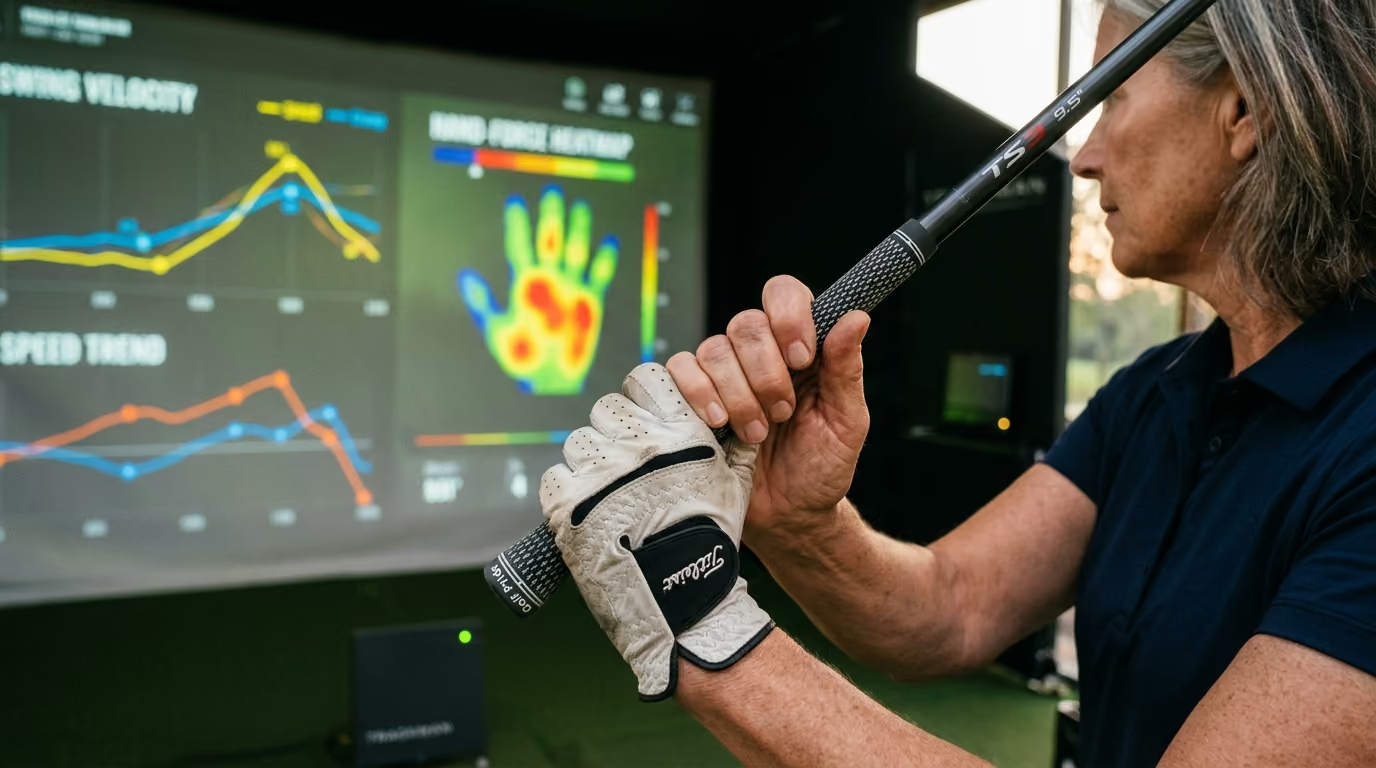
Your glove and grip choices also affect physical tension. If your grips are worn or too small, you will naturally squeeze the club tighter. This extra hand tension travels up your forearms and into your shoulders, preventing a smooth shoulder turn. Replace your grips once a year to maintain a secure feel with minimal hand pressure. If you suffer from arthritis in your hands, try using midsize or jumbo grips. These larger sizes allow you to hold the club securely without gripping too tightly.
Transitioning to a dynamic warm-up is one of the easiest ways to improve your performance and protect your body. You do not need to spend hours in a gym to see results. Consistently spending ten minutes before your round can yield significant benefits on the course.
Use this checklist to help you apply these concepts during your next round:
By adopting these habits, you will notice that your body feels more responsive on the very first hole. You will no longer need to spend several holes warming up on the course. Your swing will feel smoother, your ball contact will be more consistent, and you will protect your joints for years to come. For more tips on maintaining your physical health as you age, visit the healthy ageing section of our golf performance and longevity blog.
The most important lesson to remember is that active preparation builds swing speed, while passive stretching reduces your power.
Follow Golfergy for practical insights on performance, mobility, recovery and healthy ageing. Stay connected for new articles, research-led guidance and ideas to help you play better for longer.


Explore practical resources on performance, recovery, mobility and golf longevity.
Read the Blog