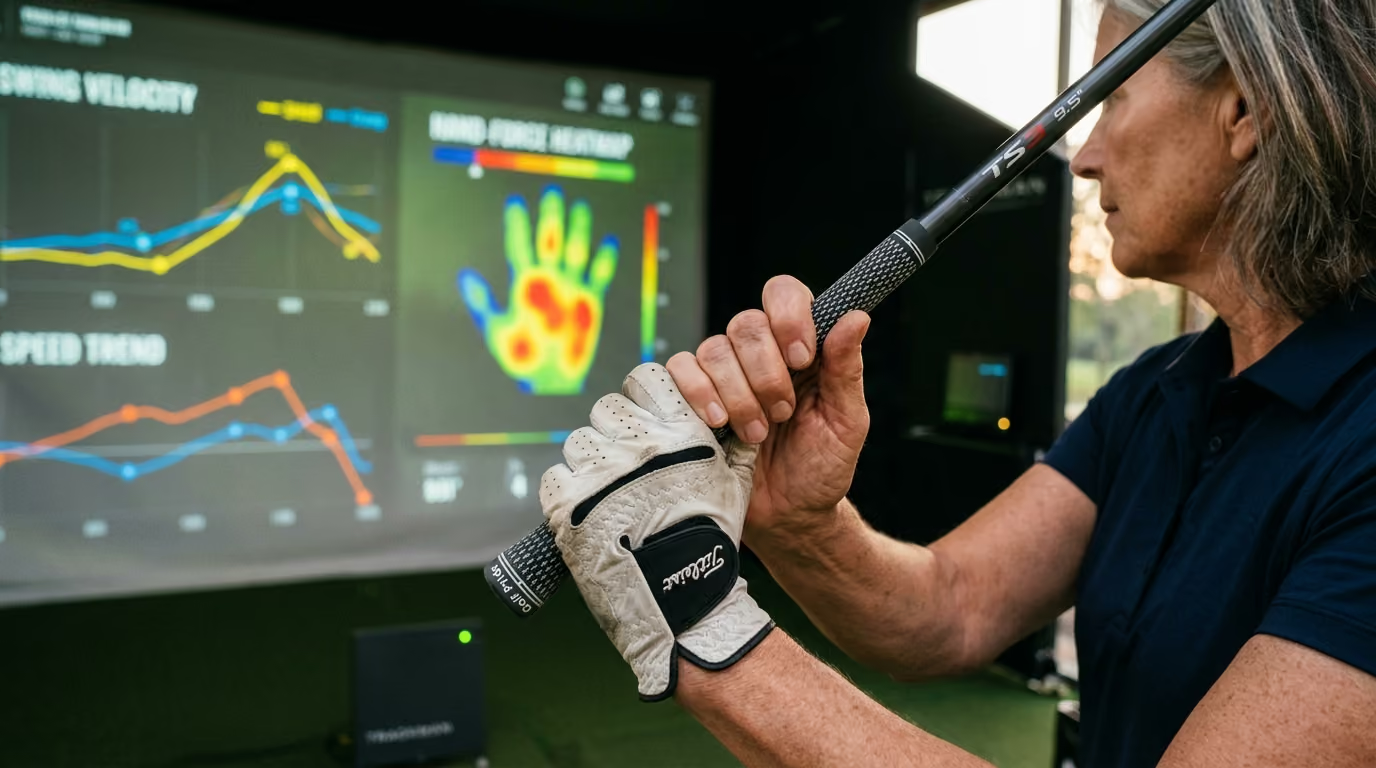
A pain-free golf swing and greater rotational speed start with proper spinal alignment at setup to protect your lower back from strain.




You stand on the fourteenth tee box with a driver in hand. The afternoon sun is starting to dip. You feel a dull, nagging tension creep across your lower back. When you address the ball, your normal shoulder turn feels restricted.
You swing anyway. The ball flares weak and right into the first cut of rough. As you walk toward your ball, you try to rotate your torso to loosen up. The stiffness stays locked in place.
Your playing partners notice you rubbing your back. This scene plays out on golf courses every single weekend. It is not just a sign of getting older. It is often the direct result of how you position your spine before you even take away the club.
Many mature golfers set up with subtle postural flaws. These flaws place massive stress on the joints. They also rob your swing of natural rotational speed. Correcting this alignment is the first step toward pain-free golf longevity.
The human spine has three natural curves. The neck curves slightly inward, the mid-back curves outward, and the lower back curves inward. When these curves line up correctly, they create a neutral spine. This position allows your body to rotate with the least amount of joint friction.
Titleist Performance Institute (TPI) research shows that over sixty percent of recreational golfers struggle with poor setup posture. Specifically, TPI data reveals that 33.1% to 35.6% of players set up in C-posture. Meanwhile, about 25.3% of golfers display an S-posture. Both of these patterns strain the body and limit movement.
These issues often stem from muscle imbalances described by sports science. The first pattern is Upper Crossed Syndrome. In this state, tight chest muscles pair with weak upper back muscles. This pulls the shoulders forward and rounds the spine.
The second pattern is Lower Crossed Syndrome. Here, tight hip flexors and lower back muscles combine with weak abdominal and glute muscles. This combination pulls the pelvis out of alignment.
Biomechanics relies on a process called reciprocal inhibition. When one muscle group is overactive, your brain automatically turns off the opposite muscle group. For example, when your lower back muscles are locked tight, your brain turns off your abdominal muscles. This process leaves your spine without its natural support system during the high-speed turn.
You can learn more about how physical limits affect your game by exploring our guides on golf mobility training.
S-posture occurs when you arch your lower back excessively at address. Many golfers do this intentionally. They believe sticking their tailbone out creates a more athletic setup position. They want to create a wide, stable base with their glutes.
This position actually locks the lumbar vertebrae. Your lower spine is not designed for heavy rotation. When you arch it too much, you jam the facet joints together. This prevents the hip joints from turning freely during the backswing.
S-posture is a leading cause of a dangerous swing flaw called Reverse Spine Angle. During this flaw, your spine tilts toward the target at the top of your backswing. This tilt places extreme shear forces on the L4 and L5 vertebrae. The risk of injury rises dramatically during the downswing transition.
Lower back pain is the most frequent injury for recreational players. Studies show it represents 18% to 54% of all reported golf ailments. Much of this discomfort begins with the S-posture setup. By arching the back, golfers deactivate the very core muscles needed to protect their spine.
Keeping your spine safe is a critical part of preventing golf injuries as you age.
In S-posture, your pelvis tilts forward, which is called anterior pelvic tilt. This tilt elongates and weakens your abdominal wall. Without abdominal support, your lower back muscles must work double-time. They become tight, hyperactive, and painful.
This muscular imbalance ruins your swing path. Since your hips cannot rotate, your body finds other ways to create turn. Usually, you will lift your torso out of the posture during the backswing. This lift is called early extension. Early extension causes thin shots, fat shots, and blocks.
C-posture is a rounded, slumped look over the ball. The shoulders curve forward, and the head hangs low. It looks like a slouch. For golfers over fifty, thoracic spine rotation is the number one physical limitation.
This slouch is very common in players who spend years working at a desk. Sitting for hours tightens the chest and weakens the upper back. When you address the golf ball, your body defaults to this slouched shape. The rounded mid-back cannot rotate efficiently.
A golfer with C-posture cannot turn their shoulders on a steep, correct plane. They must compensate to get the club back. Usually, they swing the club on a very flat path around their body. This path leads to a loss of clubhead speed and inconsistent ball contact.
It also forces a flat swing plane that lacks height. The body tries to lift the club using the arms instead of the torso. This movement puts stress on the neck and shoulder joints. Over time, this stress leads to chronic wear and tear.
In C-posture, your pectoralis major and minor muscles are extremely tight. These chest muscles pull your scapulae forward and outward. This position is called scapular protraction. The muscles of your middle back, like the rhomboids and middle trapezius, become stretched out and weak. They lose the ability to pull your shoulders back into a strong position.
This posture also limits your lung capacity. A rounded rib cage cannot expand fully. This means you take shallower breaths on the course. You might feel fatigued faster, especially during the back nine of your round.
You can find your neutral spine right on the tee box. Place your driver shaft along your spine. Make sure the shaft touches three points on your body. These points are the back of your head, your mid-back, and your tailbone.
Once you feel those three contact points, bend forward from your hips. Keep the shaft flat against your back. Do not let the shaft pull away from your head or your tailbone. If it pulls away, you are either rounding or arching too much.
This simple drill gives your brain instant feedback. It teaches you what a neutral spine feels like before a shot. You can do this before every tee shot to reset your posture. It takes only ten seconds but keeps your spine in a safe, powerful position.
Another quick option is to perform a small pelvic tilt before you swing. Stand in your setup position. Tilt your pelvis forward, then tilt it backward. Find the exact middle ground between those two extremes, and start your swing there.
This quick check helps break the habit of guessing your posture. Many players think they are standing straight when they are actually slouched. The driver shaft never lies. It acts as a physical mirror for your spinal alignment. With just a few repetitions, your body starts to memorize the correct position.
To fix a rounded mid-back, you must mobilize the thoracic spine. Lay on your back with a foam roller under your shoulder blades. Support your head with your hands. Keep your hips on the floor, and gently lean back over the roller.
Roll slowly from the middle of your back to the top of your shoulders. Do not roll your lower back. Spend two minutes on this daily to open up your chest. This movement helps break up the stiffness from sitting.
Next, perform the Cat-Cow stretch on your hands and knees. Slowly arch your back toward the ceiling like an angry cat. Let your head drop down toward the floor. Then, let your stomach sink toward the floor while looking slightly upward.
Move slowly between these positions for ten repetitions. This exercise helps your brain identify the limits of your spinal movement. It teaches you to control the tilt of your pelvis. You will quickly learn to recognize the neutral zone between the two extremes.
Finish the mobilization phase with side-lying rotations, often called Open Books. Lie on your side with your knees bent at ninety degrees. Extend both arms straight out in front of you. Keep your hips still, and slowly lift your top arm up and over to the opposite side.
Follow your hand with your eyes. Your chest should open toward the ceiling. Hold this stretch for three seconds, then return to the start. Do ten repetitions on each side to build better turn flexibility.
Thoracic mobility is the key to protecting your lower back. If your mid-back cannot turn, your lower back will try to turn instead. Your lower spine only has about fifteen degrees of rotational freedom. Forcing it to turn leads to muscle strains and disc problems. Daily mobilization makes sure your body turns where it is built to turn.
To build a stable swing, you must strengthen the muscles that hold your spine in place. Start with standing pelvic tilts. Assume your golf address position. Without moving your upper body, tilt your pelvis forward, then backward.
Focus entirely on turning your trail hip and pelvis. This movement isolates the lower spine and core. If you struggle to do this, your core and glutes are likely weak. Practice this for twenty repetitions to build better muscular control.
Next, move to the floor for the Bird Dog exercise. Begin on your hands and knees with a flat back. Extend your right arm straight forward and your left leg straight backward. Keep your hips level with the ground, and do not let your lower back arch.
Hold this position for three seconds. Return to the start, then switch to your left arm and right leg. Perform three sets of ten repetitions on each side. This exercise builds diagonal stability from your shoulder to your opposite hip.
The Dead Bug exercise is excellent for stopping your back from arching under load. Lie on your back with your arms pointing toward the ceiling. Bend your knees and hips to ninety degrees. Slowly lower your right arm behind your head while extending your left leg straight out.
Keep your lower back pressed firmly into the floor. Do not let your spine arch as your leg lowers. Return to the starting position and repeat with the opposite limbs. Perform three sets of ten repetitions to build deep core strength.
Regular strength work is key to healthy ageing for golfers who want to stay active.
Your deep core muscles act as a natural corset for your spine. Muscles like the transverse abdominis hold your pelvis in a neutral position. When these muscles are weak, your pelvis tilts forward under the weight of your torso. This tilt triggers S-posture immediately. Strengthening these muscles allows you to maintain your setup posture throughout the entire swing.
Take your physical training to the practice tee. Stand with your back about six inches away from a wall. Assume your golf posture. Cross your arms over your chest.
Rotate your shoulders as if making a backswing. Your trail hip should lightly touch the wall, but your head should stay still. Do not let your lower back arch or your hips sway wildly. This drill isolates your upper body rotation while keeping your lower body stable.
Next, use an alignment rod during your practice sessions. Slip the rod through your belt loops. Hold a club across your chest. Address the ball, and check the angle of the rod.
The rod should stay level or tilt slightly downward. If the rod tilts upward dramatically, you are likely in an S-posture. Practice making slow, half-swings while keeping the rod in a neutral plane. This gives you physical feedback during actual golf swings.
You can also practice with a feedback mirror if your range has one. Stand sideways to the mirror and check your spine angle. Look for a straight line from your ears to your hips. If you see a curve, adjust your hips and shoulders until the line is straight. This visual feedback helps connect what you see with what you feel.
Many golfers try to fix a rounded upper back by pulling their shoulders back aggressively. They squeeze their shoulder blades together as hard as possible. This action does not fix the underlying alignment issue. Instead, it creates extreme tension in the neck and upper back.
This tension prevents your arms from swinging freely. It also blocks your shoulders from turning fully. A good posture should feel relaxed, not rigid. Focus on lengthening your spine rather than squeezing your muscles.
Some players try to avoid slouching by locking their knees straight. They believe a taller stance helps them keep their back straight. This actually locks the pelvis. Locked knees make it impossible to tilt your hips correctly at address.
Your knees should have a soft, athletic bend. This bend allows your pelvis to sit in a neutral position. It also lets your weight distribute evenly across your feet. Soft knees provide the athletic foundation your swing requires.
Golfers are often told to keep their head down during the swing. This advice is often misunderstood. Trying to keep your head perfectly still forces your chin down against your chest. This chin position locks your cervical spine and rounds your shoulders.
Your chin should stay up, away from your chest. This creates room for your shoulder to turn under your chin during the backswing. Your head will move naturally as your spine rotates. Trying to freeze your head in place ruins your natural alignment.
To build a solid foundation, check out our tailored golf strength exercises.
Sometimes, bad posture is not a physical limit. It can be a simple equipment mismatch. If your clubs are too short, you will be forced to slouch over the ball. This roundness leads directly to C-posture.
If your clubs are too long, you will stand too upright. This upright position often forces you to arch your lower back to reach the ball. This arching leads directly to S-posture. You cannot find a neutral spine if your gear forces you out of position.
Pay attention to your driver and iron lengths. A professional club fitting can identify these issues. A fitter can adjust the length and lie angle of your clubs. This adjustment allows you to stand naturally and comfortably over the ball.
Shaft flex and grip size also play a role. If your shafts are too stiff, you might over-swing to create speed. This extra effort often ruins your posture during the downswing. Make sure your equipment matches your current physical abilities.
As we age, our spinal discs lose water content. This loss makes them thinner and less flexible. The muscles surrounding the spine also lose mass and strength. These changes make mature golfers more vulnerable to injury.
This age-related shift makes proper alignment even more critical. A young golfer can sometimes get away with poor posture because their body is highly resilient. An older golfer does not have that luxury. Every degree of poor alignment increases the wear on your joints.
Poor posture also limits your potential swing speed. When your joints are out of alignment, your body limits its speed to prevent injury. This is a natural protective mechanism. By restoring a neutral spine, you tell your brain it is safe to swing faster.
Regular mobility work can slow down or even reverse some of these aging changes. Consistent movement keeps the spinal discs hydrated. It also maintains the flexibility of the surrounding muscles. Investing time in your posture is the best way to extend your playing years.
A neutral spine changes how the club moves. When your spine is aligned, your shoulders rotate on a consistent, repeatable angle. This angle is called the swing plane. A stable swing plane leads to better ball-striking consistency.
In contrast, a curved spine causes the swing plane to shift constantly. In C-posture, your shoulders turn too flat. You must lift your arms to get the club up. This lift makes it hard to return the club face to square.
In S-posture, your swing plane is often too steep. You might plunge the club into the turf or swing over the top. This steep path causes slices and pulls. A neutral spine makes it easy to swing the club on the correct path.
The body functions best when everything is aligned. When your spine is in a neutral position, your hips and shoulders work together. This cooperation creates maximum power with minimum effort. You will hit the ball further without feeling like you are swinging harder.
Improving your posture requires mental focus. Many golfers are so focused on the target that they forget about their body. You must develop a strong sense of body awareness. This is also known as proprioception.
Before each swing, take a moment to feel your feet on the ground. Check the position of your pelvis. Ask yourself if your lower back feels arched or your shoulders feel rounded. This mental scan only takes a few seconds.
Over time, this scan becomes automatic. You will start to notice posture slips before they cause a bad shot or an injury. This awareness is a powerful tool for consistency. It helps you maintain your technique even when you get tired on the back nine.
You can practice this awareness off the course as well. When you are sitting at your desk or driving your car, check your posture. Sit tall, pull your shoulders back slightly, and keep your head aligned. These daily habits transfer directly to your golf swing.
Before your next round, remember that a neutral spine is the foundation of swing power, so check your alignment with a club shaft to play pain-free.
Revisit this guide whenever you feel a dull ache in your lower back after a round. Check these exercises if your drives start losing distance or your shoulder turn feels restricted. Regular posture maintenance will keep you swinging smoothly for years to come.
Follow Golfergy for practical insights on performance, mobility, recovery and healthy ageing. Stay connected for new articles, research-led guidance and ideas to help you play better for longer.


Explore practical resources on performance, recovery, mobility and golf longevity.
Read the Blog