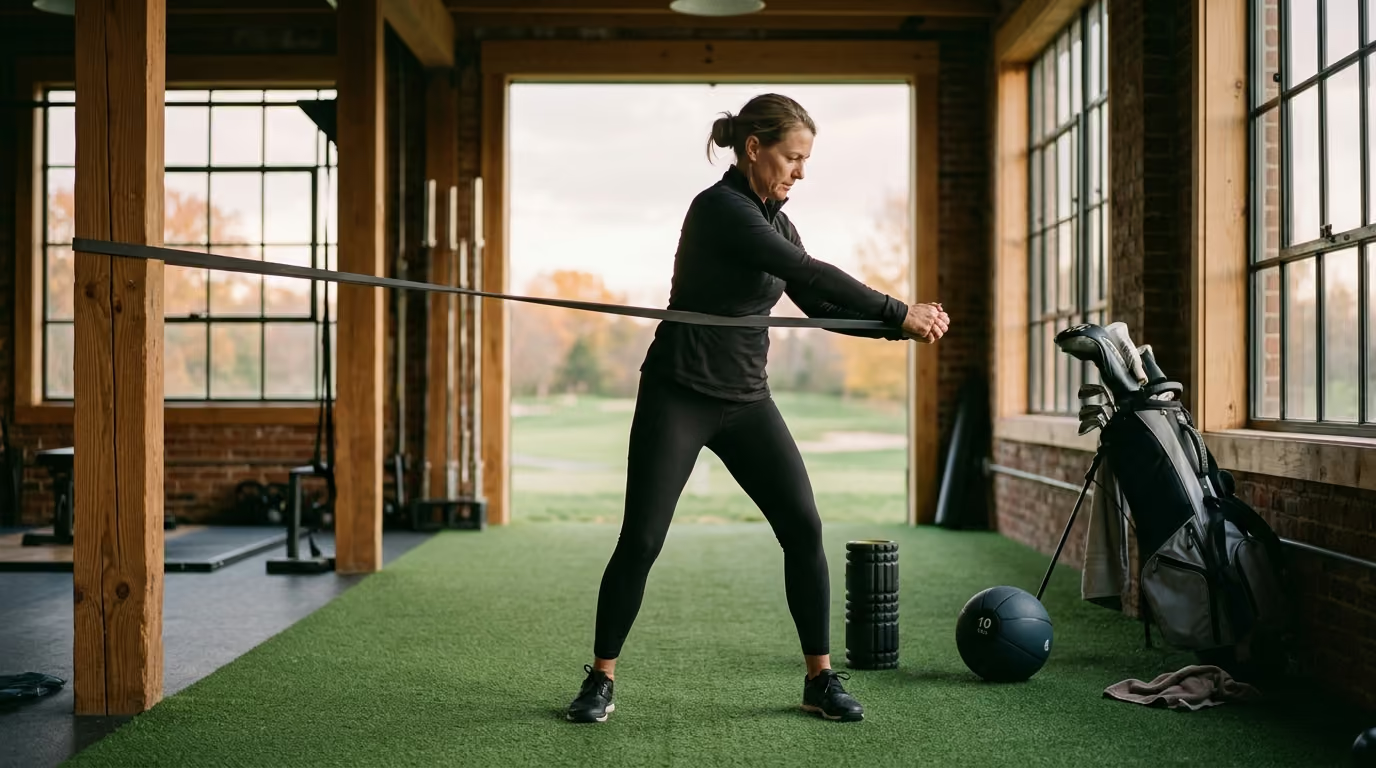

Pain-free golf swings and increased rotational power are achievable by following a structured winter conditioning plan focused on joint mobility and strength.




The morning of the first spring round is always the same. The sky is clear, the grass is starting to green, and the air has a crisp bite. You stand on the first tee box with your driver in hand. You have not swung a club in four months, but you feel ready.
You take a hard practice swing. A quiet tightness pulls in your lower back. You ignore it, tee up your ball, and swing with full force.
The ball slices into the right trees. More importantly, your lower back feels like a rusty gate hinge. By the seventh hole, you are struggling to bend over to tee up your ball.
Your hips refuse to turn, and your shoulder turn is cut in half. You spend the rest of the round trying to guide the ball with your arms.
This scenario happens to thousands of experienced golfers every spring. A long winter of sitting and inactivity ruins the body's joint mechanics. When you try to swing at high speeds in April, your body simply cannot handle the force.
The saddest thing I have seen in golf is watching lifelong playing partners slowly drop out of our weekend group. It usually starts with a nagging shoulder or knee issue they ignore until it requires surgery.
That pattern is exactly why I became obsessed with golf longevity. We do not have to stop playing as we age, provided we do the right maintenance work between rounds.
Winter is the best time to do this maintenance. Instead of losing your movement patterns during the cold months, you can build a physical reserve. This framework will help you step onto the first tee in the spring with a body that is loose, strong, and ready to swing fast.
When you stop playing golf for the winter, your body begins a process called detraining. This is not just about losing muscle strength. For golfers over the age of forty, the changes happen fast and affect the joints first.
According to sports science research, muscle mass can begin to decrease after just two weeks of complete inactivity. More importantly, the connective tissues around your joints begin to stiffen. Collagen fibers in your tendons and ligaments lose their elasticity when they are not loaded regularly.
In our experience, the hips and the thoracic spine suffer the most during a winter layoff. These are the two primary rotational centers of the golf swing.
When you sit at a desk or on a couch all winter, your hip flexors shorten. This keeps your pelvis tilted forward. This tilt makes it nearly impossible to turn your hips fully in your backswing.
Your thoracic spine, which is your upper back, also locks up from hours of slouching. If your upper back cannot rotate, your body will find that rotation somewhere else.
Usually, it forces your lower back to twist. Your lower back is designed for stability, not rotation. Forcing it to turn leads to muscle spasms, disc wear, and chronic pain.
By following a structured winter routine, you protect these areas. You maintain your joint space and keep your muscles active. This keeps your swing path consistent and your joints safe. Learn more about protecting your joints through injury prevention strategies during the colder months.
Building a physical reserve requires a structured plan. You cannot simply jump into heavy lifting or high-speed training in January. Your body needs to progress through specific phases to prevent injury and build lasting mobility.
We break the winter hiatus into four distinct blocks. Each block lasts four weeks and focuses on a specific physical attribute. This progression mirrors the physical needs of the aging golfer.
The goal of the first month is to restore movement to your tightest joints. We do not worry about strength or speed yet. Instead, we focus on breaking up the stiffness from the end of the season and early winter sitting.
You will focus heavily on your hips, upper back, and ankles. These three areas must move freely for a healthy swing.
Once your joints can move, you must build the strength to control that movement. Month two focuses on your core and your posterior chain. Your posterior chain includes your glutes, hamstrings, and lower back muscles.
These muscles act as the brakes and stabilizers in your golf swing. Strengthening them keeps you from losing your posture during the swing.
With mobility and stability established, you can begin building power. Golf is a rotational sport that requires quick bursts of energy.
During month three, you will train your body to transfer energy from the ground up through your core and into your arms. This phase is crucial for maintaining your clubhead speed as you age.
The final month prepares your body for the actual movements of the golf swing. You will combine your new mobility and strength into golf-specific movements.
This phase prepares your central nervous system for the high-velocity forces of the golf course. By the time the courses open, your body will feel like you never took a day off. Discover how to transition these movements into your spring play by checking out our articles on golf longevity and performance.
To start your off-season, you must unlock your joints. This phase requires daily consistency rather than intense effort.
You do not need weights or gym memberships for this phase. You only need a comfortable space on the floor and fifteen minutes of quiet time.
This movement is the ultimate test and cure for tight hips. It targets both internal and external hip rotation at the same time.
To perform this, sit on the floor with your knees bent at ninety degrees. Drop both knees to the right side. Your right thigh should point straight ahead, while your left thigh points out to the side.
Both knees should form ninety-degree angles on the floor. Keep your spine tall and vertical.
[Target: Hip Joint Capsule]
Step 1: Sit with knees bent, feet flat on the floor, wider than hip-width.
Step 2: Drop both knees to the right, creating 90-degree angles at both joints.
Step 3: Press your left hip tissue down toward the floor to feel the stretch.
Step 4: Slowly lift your knees and repeat the movement on the left side.
Hold this position for thirty seconds. You should feel a deep stretch in your hip joints.
Slowly transition your knees over to the left side without using your hands for support. If your hands must touch the floor to keep you upright, that is fine.
Perform five transitions to each side. Focus entirely on turning your trail hip inward during the movement.
This exercise directly addresses upper back stiffness. It helps you get a fuller shoulder turn without tilting your pelvis.
Lie on your left side on the floor. Bend your knees to ninety degrees and pull them up toward your chest. This position locks your lower back in place so it cannot twist.
Extend both arms straight out in front of you, touching your palms together. Slowly lift your right arm up and over your body, reaching toward the floor behind you.
Keep your knees pinned together on the floor. Follow your hand with your eyes to get a full neck rotation.
Hold the stretch for three deep breaths. Return to the starting position and repeat ten times on each side. If you want to dive deeper into these routines, look at our guides on improving your rotational mobility.
Ankle mobility is often ignored by golfers, but it is vital. If your ankles are stiff, your knees will collapse inward during your downswing. This causes a loss of balance and power.
Stand facing a wall with your toes about four inches away from the baseboard. Keep your heel flat on the floor.
Slowly bend your knee and try to touch the wall with it. Do not let your heel lift off the ground.
If you can touch the wall easily, slide your foot back one inch and try again. Find the distance where your knee barely touches the wall while your heel stays down.
Hold that position for three seconds. Repeat this ten times on each leg.
After four weeks of mobility work, your joints should move more freely. Now you must protect those open joints with strong, supporting muscles.
This phase focuses on building your core and your glutes. Your glutes are the power generators in the golf swing, and your core is the transmitter.
The bird-dog is excellent for building cross-body stability. This is the exact muscle coordination used when you transfer weight from your back foot to your front foot.
Start on your hands and knees on the floor. Keep your hands directly under your shoulders and your knees under your hips.
Slowly extend your right arm straight ahead. At the same time, kick your left leg straight back behind you.
[Target: Cross-Body Core Stability]
Setup: Hands under shoulders, knees under hips, neutral spine.
Action: Extend opposite arm and leg until they are parallel to the floor.
Cue: Push your heel back like you are trying to press a button on the wall.
Avoid: Do not let your lower back sag or arch during the movement.
Keep your hips level with the floor. Imagine a glass of water resting on your lower back that you cannot spill.
Hold the extension for three seconds, then return to the start. Perform ten repetitions on each side. Focus entirely on squeezing your glute at the top of the leg extension.
Strong glutes prevent your lower back from taking too much stress during the swing. This exercise trains your glutes to support your pelvis.
Lie on your back with your knees bent and your feet flat on the floor. Your feet should be hip-width apart.
Press your heels into the floor and lift your hips toward the ceiling. Your body should form a straight line from your shoulders to your knees.
Once your hips are raised, slowly lift your right foot off the floor. Pull your right knee toward your chest without letting your hips sag.
Hold this march position for two seconds. Place your foot back down and lift your left foot.
Perform ten marches on each side while keeping your hips high. This builds the endurance your hips need for a four-hour walk on the course. To find more detailed workouts, check out our golf strength programs.
The Pallof press is an anti-rotation exercise. It trains your core to resist twisting forces, which protects your lower back.
You will need a resistance band anchored to a door frame at chest height. Stand sideways to the anchor point and hold the band in both hands at your chest.
Step away from the wall until you feel tension in the band. Your body should want to twist toward the door frame.
Press your hands straight out in front of your chest. The band will try to pull your hands and torso toward the anchor point.
Resist this pull by squeezing your core and glutes. Hold your arms straight out for three seconds, then bring them back to your chest.
Perform twelve repetitions, then turn around and repeat facing the other direction. This builds the deep abdominal strength needed to hold your spine angle through impact.
Power is the ability to use your strength quickly. In golf, power comes from your ability to rotate your hips and chest around a stable spine.
During month three, we introduce dynamic movements. These exercises teach your muscles to contract quickly and safely.
This exercise mimics the specific muscle loading of your backswing and downswing. It helps your body build speed in a controlled path.
Anchor your resistance band at stomach height. Stand sideways to the anchor point in your golf posture.
Hold the band with both hands as if you were holding a golf club. Your hands should start near your trail hip.
[Target: Downswing Power and Hip Drive]
Setup: Stand in golf posture, holding the band near your trail hip.
Movement: Rotate your hips and torso away from the anchor point.
Cue: Forcefully turn your lead hip toward the target to lead the pull.
Repetitions: Perform 10 fast rotations, then control the return movement.
Rotate your hips and torso away from the anchor point. Focus entirely on turning your lead hip toward your target.
Let your trail heel lift slightly, just like in a real swing. Move with speed during the rotation, then return slowly to the start.
Perform three sets of ten repetitions on each side. Training both sides of your body prevents muscular imbalances that can lead to injury.
Golf is played on one leg at a time during parts of the swing. When you finish your swing, almost all your weight is on your lead leg.
This exercise builds balance and strength in that lead leg. It also targets your hamstrings and glutes.
Stand tall on your left leg with a slight bend in your knee. Keep your right leg straight and let it drift behind you.
Hinge forward at your hips, keeping your back completely flat. Lower your torso until it is nearly parallel to the floor.
Your right leg should extend straight behind you in line with your spine. Keep your hips square to the floor.
Squeeze your left glute to pull yourself back to the standing position. Perform eight repetitions on each leg for three sets. This movement builds the stability your lead leg needs to anchor your downswing.
This movement builds strength and mobility in your shoulders and upper back. It helps you maintain a wide swing arc.
Hold a light kettlebell or dumbbell by the horns upside down at your chest. Stand with your feet shoulder-width apart and your knees slightly bent.
Slowly circle the weight around your head. Keep the weight as close to your neck as possible.
Your head should stay completely still during the movement. Do not let your neck bend forward or backward.
Complete five circles clockwise, then five circles counter-clockwise. This builds the shoulder stability required to control the club at the top of your backswing.
As spring approaches, your workouts must match the speed and coordination of the actual golf swing. This phase blends your strength and mobility into athletic movements.
These exercises ensure your body is not shocked by the speed of your first full swings on the range. They are designed to bridge the gap between indoor workouts and outdoor play.
If you do not have a solid wall to throw against, you can perform these throws into an open field or a net. This exercise trains your body to transfer weight and release power.
Stand in your golf posture about three feet away from a brick or concrete wall. Hold a light medicine ball, around four to six pounds, in both hands.
Take a short backswing, loading your weight into your trail hip. Forcefully turn your hips and throw the ball against the wall.
Catch the ball on the rebound and repeat immediately. Move with high intent and speed.
Perform three sets of eight throws on each side. This movement teaches your core to transfer energy from your legs to your hands at high speed.
Using a speed-training system or a simple weighted club helps prime your nervous system. This is where you teach your brain that it is safe to swing fast again.
If you do not have a specific training system, use your driver with a headcover on. Stand in your normal stance and make ten swings at seventy percent effort.
Focus entirely on a smooth transition at the top of your swing. Gradually increase your speed over the next ten swings until you are at ninety percent effort.
[Target: Central Nervous System Speed Tuning]
Week 13: 15 swings at 70% effort, focusing on smooth rhythm.
Week 14: 15 swings at 80% effort, maintaining posture through impact.
Week 15: 15 swings at 90% effort, focusing on a balanced finish.
Week 16: 10 swings at 100% effort, mimicking real-course aggression.
Perform these swings twice a week during the final month. This routine wakes up your fast-twitch muscle fibers. These fibers are the first to atrophy during a long winter layoff.
This simple drill prepares your brain and feet for the balance demands of the course. It helps you hold your finish on uneven lies.
Stand in your golf posture with your arms crossed over your chest. Make a simulated backswing, turning your shoulders fully.
Now, transition into your downswing and swing through to a full finish. As you finish, lift your trail foot completely off the floor.
Balance entirely on your lead leg. Hold this finish position for five seconds without letting your foot touch the ground.
Repeat this ten times. If you struggle to balance, it means your hip stabilizers are still weak or your ankle is stiff. Keep practicing until you can hold the position with ease.
When spring finally arrives, your off-season work will give you a major advantage. However, you still need to prepare your body on the day of your first round.
Cold air makes muscles less pliable. This quick five-minute routine will prepare your body right next to your car or on the first tee box.
First, hold a mid-iron across your shoulders. Keep your knees slightly bent and your spine tall.
Slowly rotate your shoulders from side to side. Hold each turn for two seconds.
Perform ten rotations to get your thoracic spine moving. Focus entirely on keeping your lower body still while your upper body turns.
Next, place the club on the ground in front of you for balance. Swing your right leg forward and backward like a pendulum.
[Target: Dynamic Joint Warm-Up]
Exercise 1: Shoulder Turns with Club (10 reps) - Mobilizes upper back.
Exercise 2: Leg Swings (10 reps per leg) - Opens hip joints.
Exercise 3: Assisted Squats with Club (10 reps) - Activates glutes and thighs.
Exercise 4: Slow Motion Swings (5 reps) - Calibrates swing rhythm.
Perform ten swings on your right leg, then ten on your left leg. This opens up your hip sockets and warms up your glutes.
Finally, take five slow-motion swings with your driver. Start at fifty percent speed and gradually increase to your normal tempo. This alerts your brain that it is time to perform. You are now ready to hit your first drive with confidence and comfort.
Many golfers start their winter training with good intentions but make critical errors. These mistakes can lead to injuries before the season even begins.
Our team has observed three primary mistakes that mature golfers make during the winter. Avoiding these errors will keep your progress on track.
Social media is full of fitness routines from twenty-year-old professional golfers. These players have different joint structures, flexibility levels, and recovery times.
Trying to copy their extreme training can strain your joints. Focus instead on exercises that target your specific needs: joint space, stability, and control.
Your goal is not to look like a gymnast. Your goal is to move freely and without pain on the golf course.
It is easy to get excited in January and try to workout every single day. This approach usually leads to tendonitis or chronic fatigue by February.
Your muscles and tendons need time to adapt to new stresses. Start with two or three short sessions a week.
Consistency is far more important than intensity. A fifteen-minute daily mobility routine is much better than a grueling two-hour workout once a week.
Many golfers forget that walking a round of golf is a cardiovascular test. If you get tired on the back nine, your swing mechanics will break down.
Your hips will stop turning, and your posture will collapse. This fatigue leads to poor shots and increased injury risk.
Make sure to include low-impact cardio in your winter routine. Stationary cycling, brisk walking, or swimming are excellent choices. They build the stamina you need to play eighteen holes without losing your swing shape. Find more tips on staying active as you age in our guide on healthy aging on the golf course.
Your physical body is only one part of the golf equation. The equipment you play with also impacts how much stress your joints absorb.
Winter is the perfect time to review your gear. Making small changes can protect your body from repetitive impact injuries.
First, look at your shaft flex. As we age, our swing speeds naturally slow down.
If your shafts are too stiff, you will have to swing harder to get the ball airborne. This extra effort puts unnecessary strain on your lower back and shoulders.
Consider moving from a stiff shaft to a regular shaft, or from regular to a senior flex. This change allows the club to do more of the work.
Second, check your grip size. If your grips are too small, you have to squeeze the club tightly to keep it from twisting.
This tight grip can cause tension to travel up your forearms and into your elbows. This often leads to golfer's elbow.
[Equipment Check Checklist]
[ ] Shaft Flex: Is it time to soften your shafts to save your back?
[ ] Grip Size: Do larger grips reduce forearm and elbow tension?
[ ] Shoe Support: Do your shoes cushion your knees on hard terrain?
[ ] Total Weight: Can lighter clubs help maintain your speed?
Switching to midsize or jumbo grips allows you to hold the club with lighter pressure. This relaxes your arms and shoulders, leading to a smoother swing.
Finally, examine your golf shoes. Walking on hard ground in worn-out shoes transmits shock directly into your knees and lower back.
Look for shoes that offer good arch support and cushioning. If you prefer to walk, invest in high-quality insoles to absorb the impact of every step.
The biggest challenge of any off-season program is staying consistent. When the weather is cold and the golf course is closed, motivation can fade.
To prevent this, you must make your routine as easy as possible to start. Set up your workout space the night before.
Lay your exercise mat on the floor and place your resistance bands nearby. This reduces the mental effort required to start your session.
Additionally, track your progress. Keep a simple journal or use an app to record your workouts.
Seeing your consistency over several weeks builds momentum. You will start to look forward to the feeling of moving your joints every day.
Remember, you are not training for a fitness competition. You are training to keep playing the game you love with the people you care about. Keeping that goal in mind will help you stay consistent through the coldest winter months.
You should read this guide again at the start of every winter. Bookmark this page and return to it when your local course closes for the season.
Use the timeline to guide your transition from active play to structured recovery. By following this framework year after year, you will protect your joints, maintain your speed, and extend your playing years.
Your off-season work is an investment in your future on the course. Take care of your body during the winter, and your body will take care of your swing in the spring.
The secret to a long, pain-free golf career is building a physical reserve during the off-season rather than trying to find your swing on a cold spring morning.
Follow Golfergy for practical insights on performance, mobility, recovery and healthy ageing. Stay connected for new articles, research-led guidance and ideas to help you play better for longer.


Explore practical resources on performance, recovery, mobility and golf longevity.
Read the Blog


