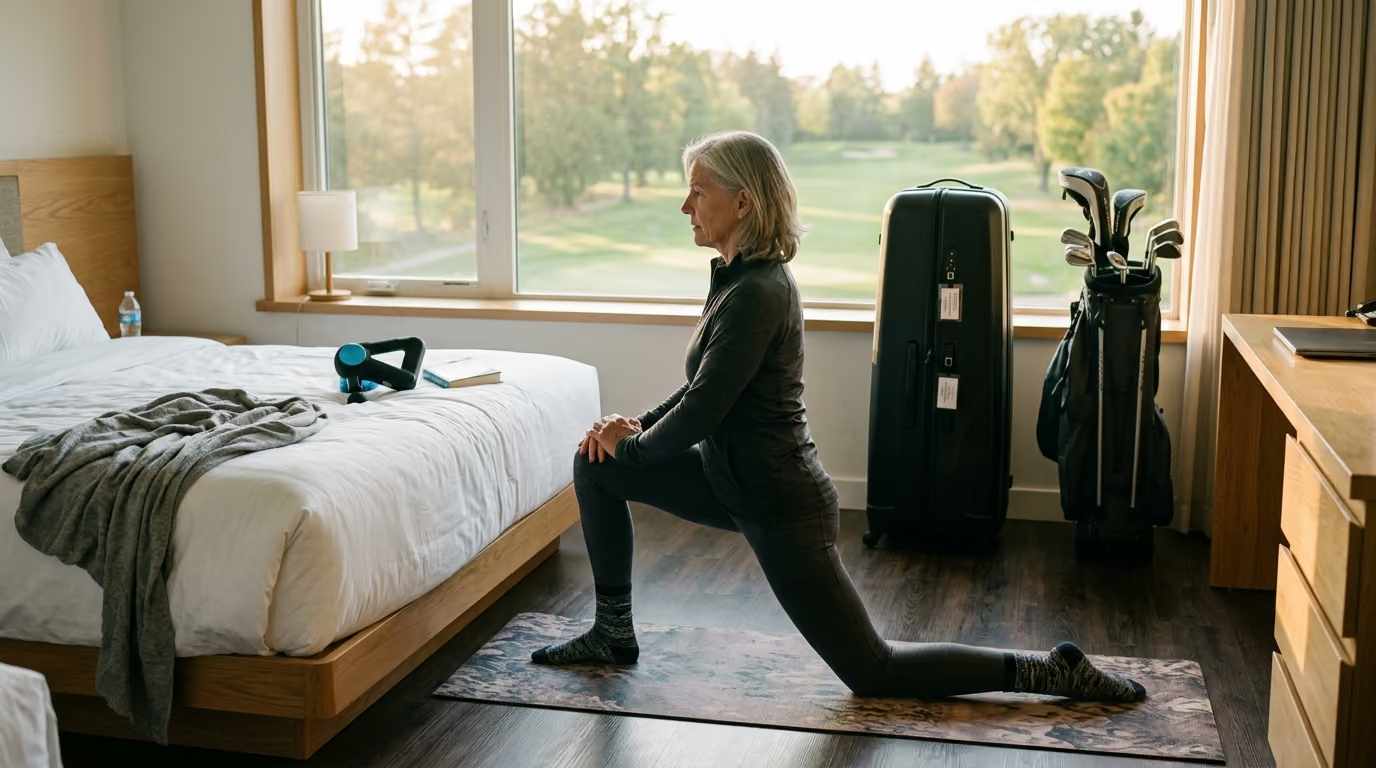
Forty-plus golfers can overcome age-related back stiffness and restore swing mobility by using targeted myofascial release to lubricate tight connective tissues.




You stand on the fourteenth tee with a clear view of the fairway. Your game has been solid today. Your tee shots have found the short grass, and your putts are dropping. Suddenly, as you settle into your stance, a familiar dull ache creeps across your lower back.
You back off the ball. You try to rotate your torso, but your hips feel like they are locked in wet cement. You try to force a full backswing anyway. Because your body cannot rotate, your arms take over.
The result is a weak slice that lands deep in the right rough. This moment is not just about a bad shot. It is the physical reality of a body that is tightening up as the round progresses.
For golfers over the age of forty, this sudden tightness is a common frustration. It is not always a sign of a muscle tear or a serious injury. Instead, it is often your connective tissue reacting to the repetitive forces of the golf swing.
As we age, our bodies require more intentional maintenance to stay fluid. Learning how to manage this tightness can keep you playing pain free. Utilizing proper golf recovery methods is the first step toward extending your playing years and keeping your swing consistent.
To fix this back-nine stiffness, we must look beneath the surface. Your muscles are wrapped in a web of connective tissue called fascia. Think of fascia like a tight, thin bodysuit that surrounds every muscle, bone, and nerve in your body.
When you are young, this bodysuit is highly elastic. It stretches and bounces back without any effort. It allows your muscles to slide past one another smoothly as you turn your shoulders and hips.
As we age, this tissue undergoes natural changes. It loses its water content and becomes less elastic. Researchers call this process densification.
Studies show that aging causes our connective tissues to change in very specific, regional ways. In older adults, the fascia in the lower limbs actually thins out by 12.3% to 25.8%. At the same time, the fascia in the lower back region increases in thickness by 40% to 76.7%.
This massive thickening in the lower back is a primary reason why veteran players feel chronic stiffness. Your lower back tissue becomes a thick, rigid band. Meanwhile, your thinning lower leg fascia loses its natural spring.
This double whammy makes it harder to push off the ground and rotate. Many golfers try to cure this stiffness with traditional static stretching. They hold a hamstring stretch for thirty seconds before they play.
However, research published in the Journal of Strength and Conditioning Research shows that static stretching can temporarily reduce muscle power. This reduction can lower your clubhead speed.
Self-myofascial release is different. It targets the fascia directly without reducing your muscle power. It helps restore the natural sliding motion of your tissues, which keeps your swing fast and fluid.
This restoration relies on a substance called hyaluronic acid. This acid acts as a natural lubricant between your fascia and your muscles. When you sit at a desk or repeat the same swing, this lubricant becomes thick and sticky.
Self-myofascial release applies targeted friction and warmth to these sticky areas. This pressure turns the sticky fluid back into a slippery liquid. Once the lubricant is liquid, your muscles can slide freely again. This process gives you an immediate boost in your physical range of motion.
Many golfers who use a foam roller make a simple mistake. They roll back and forth as fast as possible. This fast movement does not help your tissue.
It actually causes your muscles to contract to protect themselves from the pressure. To get a true release, you must use a specific system. This system is called the pin and smash technique.
First, you must find a trigger point. A trigger point is a small, tender spot in the muscle. It often feels like a tight knot under your skin.
Once you locate this spot, you apply steady pressure. This is the pin phase. You must hold this pressure for thirty to sixty seconds.
During this phase, do not move. Focus entirely on breathing slowly into your belly. This steady pressure sends a signal to your nervous system.
It triggers a reflex that tells the muscle to stop contracting. You will feel the knot start to soften under the roller. This softening is the sign that the tissue is releasing.
Second, you begin the smash phase. While keeping the pressure on the knot, you move the nearest joint. This movement pulls the muscle through the pinned tissue.
It shears the sticky layers of fascia apart. This shearing action is what restores the natural slide.
For example, if you are pinning a spot in your calf, you would slowly circle your ankle. The combination of pressure and movement breaks up the densified tissue. It is far more effective than just rolling back and forth.
It targets the exact spots that restrict your swing. This technique allows you to make precise improvements to your mobility.
You do not need to wait until you get home to release tension. You can use these concepts right on the course. You only need a simple golf ball or your club grip.
These quick movements can restore your flexibility between holes. They take less than a minute to perform.
If you feel your lower body tightening up, focus on your feet. Place a golf ball on the grass. Step on it with the arch of your shoe.
Apply moderate pressure. Focus entirely on rolling the ball slowly under your foot.
Move from the heel to the base of your toes. The tissue on the bottom of your foot is called the plantar fascia.
This tissue is connected to your calves and hamstrings. Releasing the bottom of your foot can loosen your entire posterior chain. It can immediately relieve tension in your lower back.
You can also release tension in your upper body using your golf club. Many players grip the club too tightly when they get stressed. This tension travels up the forearm and locks the elbows.
To fix this, take the rubber grip of your club. Press the round end of the grip into the palm of your opposite hand. Focus entirely on pressing the grip into the fleshy pad at the base of your thumb.
Hold this pressure for twenty seconds. While holding, slowly open and close your fingers.
This simple pin and smash move relaxes your hand and forearm. It allows you to maintain a light grip pressure. A lighter grip leads to a smoother release through impact.
To make lasting changes to your movement, you need a structured home routine. This routine targets the key areas that restrict mature players. You should perform these movements three times per week.
Each session takes about fifteen minutes. Consistent practice is the secret to maintaining your range of motion. Using daily golf mobility routines will help you build a solid foundation.
This proactive approach is excellent for preventing common golf injuries before they start. Use the following five exercises to target your tightest areas.
This movement targets your upper back. It helps you maintain a flat back at address and rotate your shoulders fully.
Do not let your lower back arch during this movement. The bending should only happen in your upper back. Repeat this on three different spots along your mid-back.
The lats are the large muscles on the sides of your back. Tight lats restrict your ability to get your hands high in the backswing.
Switch sides and repeat the process on your left armpit. This release will immediately make your backswing feel longer and freer.
The hip flexors get very tight from daily sitting. Tight hip flexors prevent you from extending your hips at impact.
Switch sides to target your left hip flexor. Releasing this area allows you to clear your hips fully during the downswing.
Your glute muscles power your swing. They also stabilize your pelvis. Tight glutes can block your hip rotation.
Switch sides to release your left glute. This release is crucial for preventing a sway or slide during your swing.
Tight calves limit your ankle mobility. This restriction makes it hard to maintain your balance on uneven lies.
Switch to your left calf. This exercise helps you push off the ground with more force during your downswing.
Many swing faults are not caused by bad technique. They are often direct results of physical limitations. When a muscle is too tight, your body must find a way to move around the restriction.
This compensation leads to common swing errors. Applying myofascial release to specific areas can correct these mechanical faults. It helps you move your body the way your instructor wants.
The first common fault is the C-Posture. This is a rounded posture at address. It makes it very difficult to rotate your shoulders on a proper plane.
This posture is often caused by tightness in your chest and lats. When these muscles are tight, they pull your shoulders forward. This pull rounds your upper back.
Using myofascial release on your chest and lats allows your shoulder blades to retract. This release helps you stand taller at address. It gives you the physical freedom to rotate around a stable spine. This is a vital component of golf performance training for mature players.
The second fault is Early Extension. This occurs when your hips move toward the golf ball during the downswing. Your spine straightens up, and you lose your posture.
This fault is often a spacing issue. If your hip flexors are tight, your hips cannot rotate backward.
Your body is forced to push your pelvis forward to make room for your hands. Releasing your hip flexors and glutes restores your hip depth.
It allows you to turn your hips instead of thrusting them forward. This correction helps you stay in your posture through impact, which leads to much cleaner ball contact.
The third fault is the Sway and Slide. A sway occurs when your hips move laterally away from the target during the backswing. A slide occurs when your hips slide too far toward the target during the downswing.
Both faults are often caused by tight lateral hip muscles. The tensor fasciae latae and the gluteus medius sit on the side of your hip. If these muscles are locked, your hip joint cannot pivot.
Instead of turning, your entire pelvis slides sideways. Releasing these lateral hip tissues allows your femur to rotate smoothly inside the hip socket. This improvement helps you pivot on a tight, powerful axis.
Self-myofascial release is highly beneficial when done correctly. However, performing these techniques incorrectly can hold back your progress. It can also lead to pain or injury.
Understanding these common mistakes will help you stay safe. It will make sure you get the most out of your recovery sessions.
This is the most common error. Many golfers treat a foam roller like a rolling pin. They roll back and forth quickly over their muscles.
This rapid movement does not give the fascia time to release. In fact, it triggers a protective stretch reflex.
Your muscles contract to protect themselves from the rapid impact. This contraction makes the tissue tighter.
Always move at a very slow pace. You should cover only one inch of tissue per second. When you find a tender spot, stop completely and hold.
Many golfers feel tightness in their lower back and immediately put a foam roller under it. This is a very dangerous mistake.
Your lower back consists of the lumbar spine. This area has no support from the rib cage.
When you place a firm roller under your lower back, your muscles contract violently to protect your spine. The roller can force your lumbar spine into hyperextension. This hyporextension puts intense pressure on your spinal discs.
It can irritate your facet joints. If your lower back is tight, do not roll it. Instead, roll your glutes, upper back, and hip flexors. Releasing these surrounding areas will naturally relieve the tension in your lower back.
Your eleventh and twelfth ribs are located at the bottom of your rib cage. These are called floating ribs because they do not attach to your breastbone. They are held in place only by muscles.
They are highly delicate. If you roll your lower lats or obliques too low, you can apply your full body weight to these floating ribs.
This pressure can cause severe pain. It can even fracture the ribs. Always keep your roller on the fleshy parts of your upper back and outer thighs. Avoid the very bottom of your rib cage.
Myofascial release is excellent for creating a temporary window of mobility. This window usually lasts for one to two hours after a session. However, this is only a temporary change.
If you do not teach your brain how to use this new range of motion, your body will tighten the muscle back up. You must follow your rolling with movement.
After you release your hips, perform some slow bodyweight squats. After you release your upper back, do some gentle torso turns.
This movement teaches your nervous system that the new range of motion is safe. This integration is what turns a temporary fix into a permanent improvement.
Some golfers believe that more pain equals more gain. They use extremely hard rollers or press down until they are gasping for air. This is counterproductive.
If you are grimacing or holding your breath, your sympathetic nervous system fires up. This is your fight-or-flight response.
It causes your body to tense up. This tension prevents your muscles from relaxing.
The pressure should feel like a deep, satisfying ache. It should never feel like a sharp, stabbing pain. If you cannot breathe slowly and deeply, the pressure is too high. You must back off or use a softer roller.
You do not need a lot of expensive gear to start. A few simple tools can cover your entire body. Choosing the right density and shape is the key to a safe practice.
A standard foam roller is your primary tool. These come in different densities.
If you are new to this practice, start with a low-density roller. These are usually white or blue and feel slightly soft to the touch.
As your tissues adapt, you can move to a high-density black foam roller. Avoid rollers with deep, hard plastic ridges.
These are often too aggressive for the delicate tissues of mature players. They can cause bruising and muscle guarding.
For targeted work, a small ball is ideal. A standard lacrosse ball is cheap and highly effective.
It is firm enough to reach deep tissues. However, if a lacrosse ball feels too painful, start with a tennis ball.
A tennis ball has more give, which makes it perfect for sensitive areas like the chest and calves. You can also use a tennis ball when rolling against a wall. This position allows you to control the pressure easily.
For players over the age of forty, safety is the top priority. There are several health conditions where myofascial release should be avoided or modified. Following healthy ageing guidelines for golfers means knowing when to pause.
First, if you take blood thinners or anticoagulants, use caution. Firm pressure can cause severe bruising or internal bleeding in your muscles. Use only soft rollers and very light pressure.
Second, if you have osteoporosis, avoid high focal pressure. Do not press hard balls near your spine, hips, or ribs.
A fracture can occur under heavy loads. Stick to soft foam rollers on large muscle groups. Avoid any deep, localized pressure on bones.
Third, if you have circulatory issues, do not use these techniques. This includes deep vein thrombosis, severe varicose veins, or unexplained leg swelling.
Applying pressure to these areas can be dangerous. It could dislodge a blood clot. Always consult your physician if you have vascular disease.
Finally, if you suffer from neuropathy or reduced sensation, be very careful. This is common in players with diabetes.
Because you cannot feel the normal pain signals, you might apply too much pressure. This can cause tissue damage without you realizing it.
Perform your releases gently. Limit your sessions to short durations. Always err on the side of caution.
Your body changes as the years go by. A recovery routine that worked in your twenties may not be enough today.
Myofascial release is a practical, science-backed way to manage these changes. It targets the physical root of stiffness. It helps you maintain your swing speed and protect your joints.
You do not need to spend hours on this. A few minutes of targeted release before your round can make a massive difference.
It can keep your back from tightening on the fourteenth tee. It can help you walk off the eighteenth green feeling fresh and ready for another round.
When to revisit this resource: Come back to this guide at the start of every golf season. Re-read the instructions if you feel a familiar ache returning to your lower back or hips. Review the safety considerations before you buy any new recovery tools or increase your training intensity.
Relieving deep tissue tension before you swing is the key to maintaining your power and protecting your spine.
Follow Golfergy for practical insights on performance, mobility, recovery and healthy ageing. Stay connected for new articles, research-led guidance and ideas to help you play better for longer.


Explore practical resources on performance, recovery, mobility and golf longevity.
Read the Blog