
Early extension in the golf swing stems from underlying physical limitations that force your pelvis toward the ball and cause inconsistent contact.




If you have ever searched for solutions to stop standing up during your golf swing, you are familiar with the frustration. It is the most common swing fault in the amateur game. You might have tried keeping your head down or forcing your hips back. Yet, the ball still flies off the hosel or curves weakly to the right.
To solve this issue permanently, you must realize that early extension is rarely a simple technical mistake. It is almost always a physical response to a movement limitation in your body. If your joints cannot rotate, your body will find another way to move. This manual will show you how to identify your specific physical limits and correct them.
You are standing on the fourteenth tee of a challenging par four. Your back feels slightly tight after walking the hilly back nine. You take a smooth practice swing and try to feel your spine hold its angle. At address, you feel balanced and ready to hit a solid draw down the fairway.
During the downswing, everything changes in a split second. Your hips thrust forward toward the golf ball. Your upper body stands up to compensate for this sudden shift. The space for your hands disappears instantly.
The clubhead strikes the ball directly on the hosel. You watch your ball shoot sideways into the thick trees on the right. Your hands feel a painful vibration from the off-center strike. Your lower back pinches as you try to hold a tall, unstable finish. This frustrating experience is the direct result of early extension on the course.
To understand early extension, you must understand pelvic movement. Biomechanically, early extension is the forward movement of the pelvis toward the golf ball during the downswing. The Titleist Performance Institute defines this fault as a reduction in pelvis-to-ball distance of more than 2.5 inches. It is also marked by a collapse of your spine angle by more than 12 degrees from address to impact.
Coaches often use an imaginary vertical line called the tush line to track this movement. This line runs from the back of your hips straight down to the ground at address. In a great swing, your glutes must stay in contact with this plane until the ball is gone.
When you early extend, your hips leave this line and push forward. Research shows that 67 percent of amateur golfers exhibit this swing characteristic. In contrast, less than 1 percent of professional tour players struggle with this issue.
There is a big difference between early extension and functional extension. Functional extension is a powerful upward move of the ankles, knees, and hips at impact. Elite players use this triple extension to create speed using ground forces. Early extension happens too early in the transition, which ruins your control and leverage.
Most golfers who struggle with this swing fault fall into one of three physical categories. Each category represents a specific physical limitation that forces your body to stand up. Identifying your archetype is the first step toward a lasting solution.
This archetype lacks sufficient lead hip internal rotation. During the downswing, your pelvis must rotate rapidly around your lead hip. If that joint is locked, your pelvis cannot clear out of the way.
To complete your swing, your body has only one option. It must push the pelvis forward and laterally to create room for the club. This movement destroys your spine angle and pushes your hands outward. You will often experience a blocked shot or a severe hook as a result.
This pattern is driven by limited ankle dorsiflexion, which is the ability to pull your toes toward your shins. Proper golf transition requires a slight squatting motion to load your legs. If your ankle joints are stiff, you cannot lower your center of gravity while keeping your feet flat.
Because your ankles cannot bend, your knees cannot flex forward correctly. Your body compensates by standing upright early in the downswing. This lifts your chest and forces your hands to reach for the ball. Your feet might also lift off the ground too soon, which ruins your balance.
This archetype lacks pelvic stability and glute strength. Your core muscles and glutes act as stabilizers that hold your posture under high rotational forces. If these muscles are weak, your pelvis will drift toward the ball during the transition.
Your lower body thrusts forward to create a false sense of stability. This is a survival mechanism for your nervous system. Your brain realizes you cannot support the swing force, so it makes you stand up to protect your spine. The result is a major loss of clubhead speed and inconsistent contact.
You do not need an expensive laboratory to find your physical limitations. You can run four simple physical tests in your living room to identify the cause of your early extension. These tests check your joint range of motion and muscle stability.
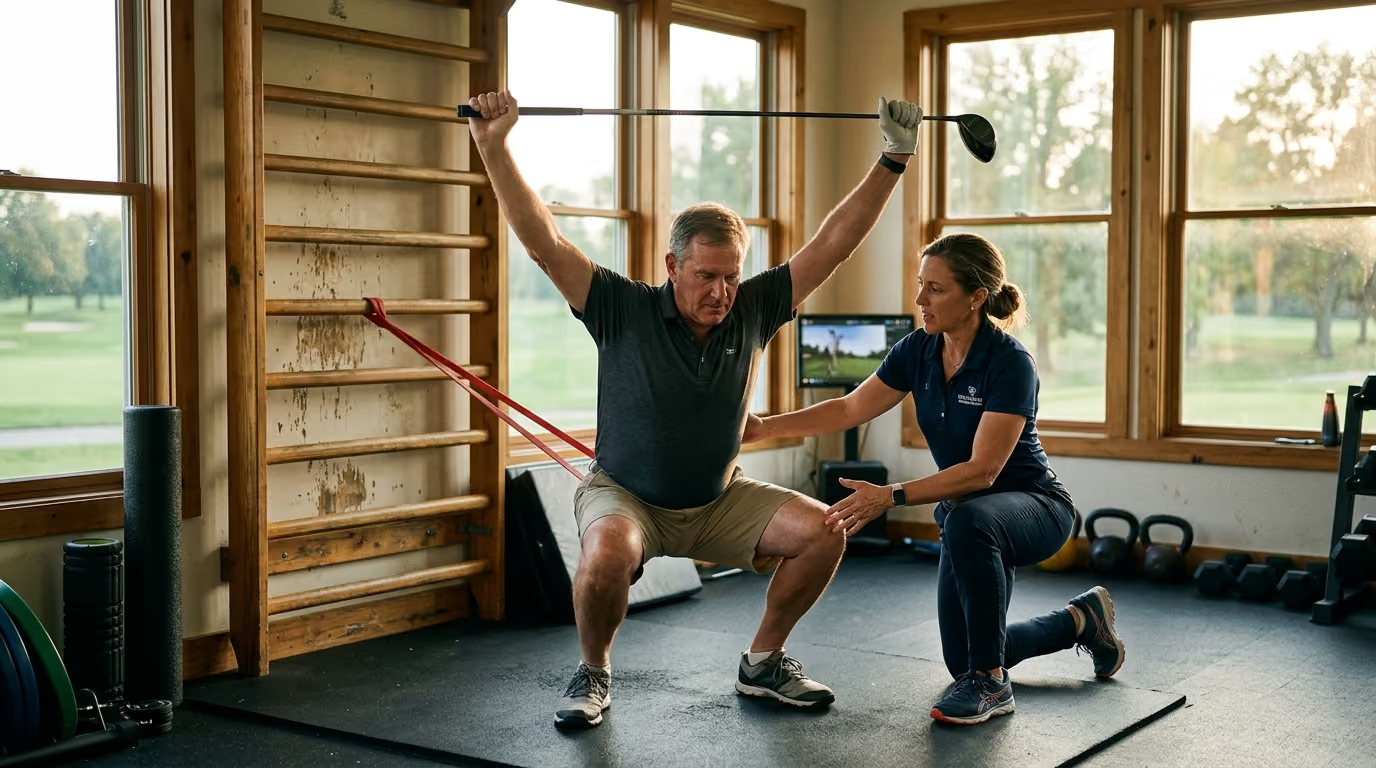
Stand with your feet shoulder-width apart and your toes pointing forward. Hold a golf club or a broomstick directly over your head with both hands. Keep your arms completely straight and slowly squat as deep as you can.
Observe your heels and your torso angle during this movement. If your heels lift off the floor, you likely have restricted ankle mobility. If your hands fall forward past your toes, your upper back or hips are tight. This test shows whether you have the basic mobility to maintain your posture.
Assume your normal golf posture with your arms crossed over your chest. Without moving your upper body, tilt your pelvis forward to arch your lower back. Then, tilt your pelvis backward to tuck your tailbone under.
This movement should be smooth and controlled. If your upper body shakes or your knees bend excessively, you lack pelvic control. This test highlights a weak connection between your abdominal muscles and your lower back.
Stand with your feet together and your knees completely straight. Bend forward at the waist and try to touch your toes with your fingertips.
Do not bounce or force the stretch during this test. Statistical research shows that golfers who cannot touch their toes are six times as likely to early extend. There is an 82 percent correlation between a failed toe-touch test and early extension in the swing. This failure points to tightness in your hamstrings, glutes, or lower back.
Lie flat on your back on a comfortable floor with your knees bent. Place your feet flat on the ground, about hip-width apart. Lift your left foot off the floor and extend that leg straight out.
Using only your right foot, push your hips up toward the ceiling until your body forms a straight line. Hold this position for ten seconds. Repeat this process on the other side.
If your hamstring cramps or your hips sag, your glutes are weak. Golfers unable to perform a single-leg bridge on their trail side are five times more likely to early extend. This test shows a 72 percent correlation with pelvic thrusting during the downswing. You can improve your glute engagement by focusing on strength training.
If you start early extending during a round, you cannot do a full workout on the tee box. You need simple, actionable keys to regain your posture immediately. These temporary fixes will help you get through the round with solid contact.
When you reach the top of your backswing, focus on your transition sequence. Feel your weight shift into your lead foot before you start your downswing. Physically feel yourself stomping your lead foot into the ground as your first move.
This stomping motion activates your lead glute and thigh. It pulls your lead hip down and back, which prevents it from thrusting forward. This move also creates a stable base that allows your arms to drop naturally.
At address, focus entirely on turning your trail hip. As you take the club back, imagine your trail hip pocket moving straight back behind you. This move creates a deep space in your pelvis during your backswing.
If you make a deep turn with your trail hip, you create room for your downswing. You will not feel the urge to stand up because your body already has space. Keep this focus simple and avoid thinking about other swing mechanics.
Imagine a sturdy string is attached to your lead front pocket. As you start down from the top, feel that string pull your pocket straight back toward your lead heel. This sensation helps clear your hips without moving them toward the ball.
This quick mental picture keeps your hips on the tush line. It encourages your pelvis to rotate rather than slide. Practice this feel once or twice during your pre-shot routine.
To eliminate early extension permanently, you must address your physical limitations. This structured routine targets hip mobility, core control, and pelvic stability. Perform these four exercises three times per week to build a sustainable swing.
This exercise is excellent for improving lead hip internal rotation. Sit on a comfortable yoga mat with your knees bent. Place your right leg in front of you, with your knee bent at a ninety-degree angle. Place your left leg to your side, also bent at a ninety-degree angle.
Keep your spine long and tall as you face your front shin. Gently hinge forward from your hips, keeping your chest open. Do not round your upper back as you lean forward.
Hold this position for thirty seconds while breathing deeply. Slowly return to the starting position. Rotate your body to face your side leg and repeat the stretch. This movement is a key part of any dedicated program for mobility improvement.
This drill builds rotational stability in your hips and pelvis. Stand next to a sturdy wall, squat rack, or kitchen counter. Place both hands on the surface for support and stand on your lead leg.
Hinge forward at your waist, keeping your trail leg extended straight behind you. Your torso should be parallel to the floor. This is your starting position.
Slowly rotate your hips open, pointing your chest and pelvis away from your standing leg. Pause for one second at the top of this movement. Next, slowly rotate your hips closed, pointing your belly button toward the floor. Focus entirely on turning your standing hip. Perform ten repetitions on each leg.
This exercise helps increase the rotational range of your hip joints. Sit on the edge of a sturdy chair with your feet flat on the floor. Keep your feet wider than shoulder-width apart.
Without moving your feet, slowly drop your right knee inward toward the floor. Keep your left leg still during this movement. You should feel a gentle stretch in your hip joint.
Return your right knee to the starting position. Now, drop your left knee inward toward the floor. Alternate sides for twelve repetitions per leg. This movement is highly effective for maintaining joint health during healthy ageing.
This exercise builds the deep core strength needed to hold your spine angle. Lie flat on your back with your arms pointing straight up at the ceiling. Bend your knees and hips to ninety degrees, keeping your feet in the air.
Press your lower back firmly into the floor so there is no gap. Slowly extend your right arm behind your head. At the same time, extend your left leg straight out, hover it just above the floor.
Keep your lower back pressed into the floor throughout this movement. Slowly return to the starting position. Repeat this motion with your left arm and right leg. Perform three sets of ten repetitions on each side.
Many golfers attempt to fix early extension with tips that actually make the problem worse. Avoiding these common errors will save you time and prevent unnecessary physical strain.
Many well-meaning partners will tell you to keep your head down when you hit a poor shot. This advice is often counterproductive for golfers with limited mobility. If your hips cannot rotate, forcing your head down stops your body from moving naturally.
This restriction actually increases the pressure on your lower back. Your pelvis will still thrust forward to clear the club. Forcing your head down can lead to neck strain and worse contact. It is better to focus on pelvic rotation than keeping your head down.
Some golfers believe that pushing their hips forward creates speed. They see professional players jump at impact and try to copy that move. This is a misunderstanding of how ground reaction forces work.
Professional players extend upward at the very end of the swing. Pushing your hips forward too early destroys your leverage and swing path. This move actually reduces your clubhead speed and leads to poor ball striking. Real power comes from rotation and late extension.
Golfers often try to fix early extension only during the downswing. However, the problem often starts during the backswing. If you do not turn your hips back, you cannot rotate them forward.
If your trail hip moves toward the ball during your takeaway, you lose your hip depth. You will be forced to early extend during your downswing to find balance. Focus on a deep backswing turn to set up a successful transition.
Your physical limitations are the main cause of early extension. However, your equipment can also influence how your body moves. Making small adjustments to your gear can help you maintain your posture.
If your club shafts are too heavy or too stiff, your body will struggle to swing them. You may have to use extra effort to move the club during the downswing. This extra effort often causes your hips to thrust forward.
A lighter, more flexible shaft can help you swing with less tension. This reduction in tension makes it easier to stay on your tush line. Consult a professional club fitter to find the right shaft specifications for your swing speed.
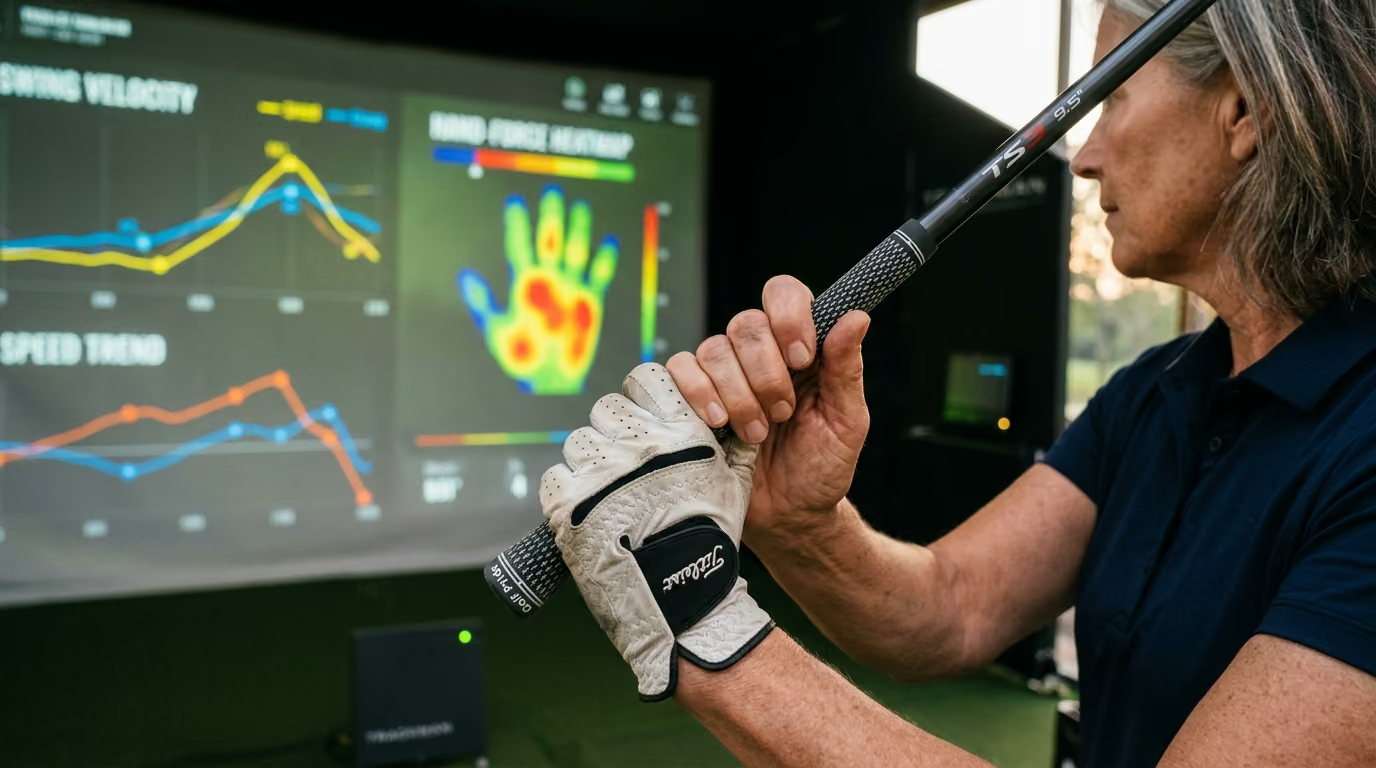
Grips that are too small can cause you to squeeze the club too tightly. Excessive hand tension can travel up your arms and stiffen your shoulders. This upper-body tension makes it difficult to rotate your hips smoothly.
Using a midsize or jumbo grip can help reduce your grip pressure. Lighter grip pressure allows your body to rotate more freely. This freedom of movement makes it easier to avoid early extension.
Your connection to the ground is crucial for a stable swing. If your shoes do not provide enough grip, your feet may slip during the downswing. This slip can cause your body to stand up to regain balance.
Choose golf shoes that offer excellent traction and support. A lower heel-to-toe drop can also help you stay balanced over your arches. Proper footwear is an important factor in injury prevention on the course.
You do not need to change your entire swing overnight. Instead, focus on a few simple steps this week to start your progress. Use this checklist to guide your practice and physical training.
You can read more detailed guides on golf fitness by visiting our resources section. Taking action today will help protect your joints and keep you playing the game you love.
To stop early extension, you must build the hip mobility and core stability required to stay on your tush line throughout the swing.
Follow Golfergy for practical insights on performance, mobility, recovery and healthy ageing. Stay connected for new articles, research-led guidance and ideas to help you play better for longer.


Explore practical resources on performance, recovery, mobility and golf longevity.
Read the Blog