
Golfers often pursue extreme spine flexibility to prevent injury, but lasting lower back health actually relies on core stiffness and mobile hips.




Lower back health for the golf swing is often misunderstood. Many players believe that protecting the spine requires deep twisting stretches or a highly flexible back. Some spend hours doing hundreds of sit-ups to build abdominal strength.
These approaches are incorrect and can lead to severe joint wear. True lower back health for golf is not about building bulky muscles or achieving extreme flexibility. Instead, it is the process of building deep muscular endurance while keeping your spinal joints stable. It is about matching mobility in your hips and shoulders with stiffness in your core.
The saddest thing I have seen in golf is watching lifelong playing partners slowly drop out of our weekend group. It usually starts with a nagging shoulder or knee issue they ignore until it requires surgery. That pattern is exactly why I became obsessed with golf longevity. We do not have to stop playing as we age, provided we do the right maintenance work between rounds.
By studying proper injury prevention methods and applying basic mechanics, you can protect your spine. This guide will cover the exact science of the golf swing and how it affects your lower back. We will look at swing faults that cause pain and how to correct them. You will find practical on-course strategies and a long-term routine to protect your joints. Our goal is to keep you playing pain-free for decades to come.
It is Saturday morning and you are standing on the fourteenth tee box. You have played well, but your lower back is beginning to feel tight. You bend down to push your tee into the turf. A sudden, sharp pinch catches you in the lower lumbar region.
You stand up quickly and rub your lower back. The discomfort does not fade. On the next swing, you notice your shoulder turn feels restricted. You cannot clear your hips. To compensate, you use your arms to lift the club.
This change ruins your tempo and causes a bad slice. The pain worsens as you walk to your ball. By the time you reach the eighteenth green, you are barely able to bend over to pick up your ball.
This scenario is very common for golfers over forty. The stiffness you feel is your body trying to protect itself. Your muscles are tightening to shield your spinal joints. This tightness is a warning sign.
Ignoring this warning often leads to severe disc or joint issues. When your back tightens, your swing path changes. This puts even more stress on your joints. Learning to manage this tension is vital for your long-term game. Using targeted active recovery protocols after your round can help release this muscle tension.
The lumbar spine consists of five large vertebrae. These bones are built to bear weight and resist rotation. In fact, the lumbar joints only allow about ten to fifteen degrees of total rotation. Their main job is to keep your trunk stable.
The thoracic spine and the hips sit above and below this area. The thoracic spine is designed for rotation. It should turn thirty-five to forty degrees. Your hips are built for high mobility and should rotate up to forty-five degrees.
If your hips or thoracic spine stiffen, your lower back must compensate. This is the "Pain Sandwich" framework. The stable lumbar spine is trapped between two immobile joints. It is forced to rotate beyond its natural limit, which leads to injury.
According to research, lower back pain is the most common complaint in golf. It affects fifteen percent to thirty-four percent of all players. The downswing creates intense forces on the lumbar region.
Studies show the spine experiences peak compressive loads of six to eight times body weight during the downswing. This load is concentrated at the L4 to L5 segment. This joint bears the brunt of the rotational and compressive forces.
During the swing, the spine faces three types of stress. The first is compression, which pushes the vertebrae together. The second is shear, which slides the vertebrae past one another. The third is lateral bending, which curves the spine sideways.
When you combine these forces at high speeds, the risk of injury rises. The spinal discs act as shock absorbers between the bones. High rotational speeds can tear the outer fibers of these discs.
Over time, these tears can lead to disc bulges or herniations. The small facet joints on the back of the spine can also wear down. This wear causes arthritis and chronic pain.
The X-Factor is the difference in rotation between your hips and shoulders at the top of the backswing. A high X-Factor can increase clubhead speed. However, it also increases shear stress on your lower vertebrae.
Another key concept is the "Crunch Factor". This is a calculation of the speed of your swing rotation combined with the angle of your side-bend. When you bend sideways and turn fast, your spine faces extreme stress. This combination often leads to disc herniations.
Finally, we must look at the "Reverse-C" finish. This occurs when a golfer finishes the swing with an arched lower back. This position compresses the small facet joints behind the vertebrae. Over time, this compression leads to arthritis and bone spurs.
Understanding these forces helps us see why swing mechanics matter. You cannot stop these forces completely. However, you can distribute them safely across your body by improving your mechanics and fitness.
Certain swing faults place excessive stress on the lower back. These faults are often caused by physical limitations in the hips or shoulders. By identifying these faults, you can protect your spine from injury.
Early extension is a classic swing fault. It happens when your pelvis moves closer to the ball during the downswing. This movement forces your spine into an upright, vertical position.
When you stand up early, you lose your core engagement. Your glutes stop working, and your lower back arches. This position transfers all the swing force to your lower lumbar discs.
To prevent this, focus entirely on turning your trail hip. This allows your pelvis to stay back during the turn. It keeps your core engaged and protects your spine.
Swaying occurs when your pelvis moves laterally away from the target during the backswing. Sliding is the lateral movement toward the target during the downswing. Both movements replace proper rotation with sideways shifting.
This lateral shifting creates massive shearing forces on your spine. Your lower back cannot twist efficiently from this position. Consequently, you must twist your spine aggressively to hit the ball.
This twisting leads to muscle strains and joint wear. To fix this, practice turning inside your trail hip. Avoid sliding your hips past your lead foot on the downswing.
This fault occurs when your upper body tilts toward the target at the top of the backswing. It places your spine in a hyperextended position before the downswing even begins. Your body is forced to make a violent downward crunch to reach the ball.
This movement creates a high Crunch Factor. It compresses the facet joints on one side of your spine. It also stretches the muscles on the opposite side, leading to painful strains.
Correcting this angle is crucial for spine health. Focus on maintaining a slight tilt away from the target at the top of your swing. This position keeps your spine in a safer, neutral alignment. By focusing on healthy ageing strategies, you can maintain the posture needed to avoid these faults.
The modern golf swing focuses on keeping the lead foot planted on the ground. This creates a large X-Factor and builds high clubhead speed. However, this style is very hard on the lower back. It requires immense core strength and flexibility.
The classic swing is different. In the classic swing, golfers allow their lead heel to lift during the backswing. Players like Jack Nicklaus and Bobby Jones used this technique. Lifting the heel allows the hips to turn fully.
This full hip turn reduces the twist on the lumbar spine. It distributes the rotational force across the entire body. The classic swing also features a more upright finish. This prevents the dangerous Reverse-C position.
For recreational players over forty, the classic swing is much safer. It reduces rotational strain on the lower back. It also allows you to play more holes without fatigue. Making this adjustment can extend your playing years.
If your back begins to ache during a round, do not push through it. Make immediate adjustments to protect your spine. These adjustments can save your back from severe injury.
First, shorten your backswing. Research shows that shortening your swing can reduce vertebral compression forces by about ten percent. It reduces the load from 7.6 to 7.0 times body weight.
You only sacrifice about ten meters of distance. This is a very smart trade-off. A shorter swing keeps your core engaged and prevents over-rotation.
Second, lift your lead heel on the backswing. This simple change frees up your hip joints. It allows your pelvis to rotate naturally.
This rotation prevents your lower back from twisting too far. It also helps you complete your turn without straining your shoulders. It is a highly effective way to relieve back tension immediately.
Third, flare your feet outward. Turn your lead foot and trail foot out by ten to twenty degrees. This position opens your hip joints.
It makes rotation much easier and reduces stress on your lumbar spine. It is especially helpful for golfers with stiff hips. This small change can make a massive difference in how your back feels.
Finally, focus entirely on turning your trail hip during your backswing. Do not try to keep your hips completely still. Let them turn with your shoulders. This change will immediately unload your lower back.
To protect your back, you must follow the law of proximal stability for distal mobility. This law states that your core must be stable to allow your limbs to move fast. If your core is weak, your swing will pull your spine out of alignment.
We will use exercises popularized by Dr. Stuart McGill. He is a leading expert on spine biomechanics. His "McGill Big Three" exercises are designed to build core endurance without stressing your back.
To perform the curl-up, lie on your back on the floor. Extend one leg straight and bend the other knee. Place your hands under your lower back to support its natural arch.
Slowly lift your head and shoulders just slightly off the floor. Do not bend your neck or arch your back. Focus entirely on one small movement at a time, such as lifting your shoulders.
Hold this position for ten seconds, then slowly lower down. Perform three sets of six repetitions. This exercise builds endurance in your abdominal wall without flexing your spine.
Lie on your side with your knees bent at ninety degrees. Support your upper body on your elbow. Keep your elbow directly under your shoulder.
Lift your hips off the floor until your body forms a straight line from your head to your knees. If this is easy, you can perform it with straight legs. Focus entirely on keeping your hips high.
Hold for ten seconds, then repeat. Perform three sets of four repetitions on each side. This exercise strengthens the lateral core muscles, which resist side-bending forces during the swing.
Start on your hands and knees on the floor. Keep your hands under your shoulders and your knees under your hips. Keep your spine in a neutral position.
Slowly extend your right arm straight forward and your left leg straight back. Do not let your lower back sag or twist. Focus entirely on keeping your pelvis level.
Hold for ten seconds, then return to the starting position. Repeat with the opposite arm and leg. Perform three sets of six repetitions. This movement builds back endurance while keeping the spine neutral.
Now, let's address joint mobility. Remember the Pain Sandwich framework. We must improve mobility in the hips and thoracic spine to unload the lower back.
Sit on the floor and bend your front leg to ninety degrees. Bend your back leg to ninety degrees behind you. Keep your torso upright.
Slowly lean your torso forward over your front thigh. Keep your spine straight as you lean. Focus entirely on turning your trail hip during this movement. Hold for thirty seconds, then switch sides. This stretch improves internal and external hip rotation.
This stretch target the thoracic spine. Lie on your side with your knees bent at ninety degrees. Extend both arms straight out in front of you. Your hands should be touching.
Slowly lift your top arm and rotate it open toward the floor behind you. Let your head and eyes follow your hand. Focus entirely on turning your ribcage toward the ceiling.
Hold for five seconds, then return. Perform ten repetitions on each side. This exercise improves rotation in your upper back, which reduces the need for your lower back to twist.
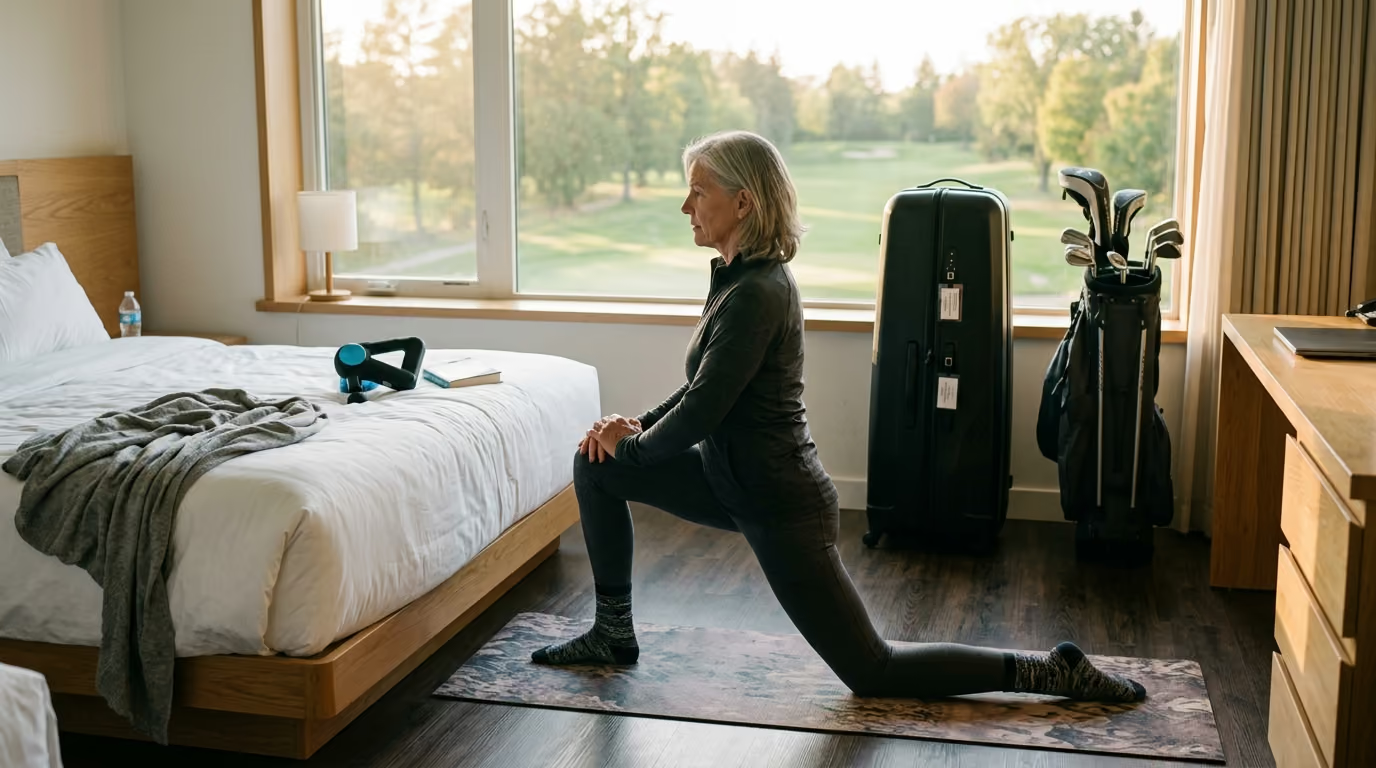
Kneel on one knee with your other foot flat on the floor in front of you. Keep your posture tall.
Gently squeeze your glute on the kneeling leg. Shift your weight forward slightly until you feel a stretch in the front of your hip. Focus entirely on squeezing your glute on that trailing leg.
Hold for thirty seconds and repeat on the other side. This stretch opens up the front of your hips. This helps prevent early extension during your downswing. Integrating these exercises into your weekly schedule is a key part of building functional strength.
Many golfers make their back pain worse by trying to fix it the wrong way. The first mistake is performing deep rotational stretches for the lower back.
When your back is sore, it often feels tight. You might lie on your back and twist your knees side to side. While this feels good for a moment, it actually increases spinal instability.
Your lower back is already moving too much because your hips are tight. Adding more rotation to your lumbar spine irritates the joints. Instead, you should stretch your hips and leave your lower back alone. You can learn more about improving your mobility safely to avoid these issues.
The second mistake is doing traditional sit-ups and crunches. Many golfers believe that sit-ups build a strong core. In reality, sit-ups place a high compressive load on your lumbar discs.
They force your spine into deep flexion under tension. This movement can cause disc bulges, especially if your back is already stressed from golf. Replace sit-ups with static core stability exercises like planks. These exercises protect your discs while building endurance.
The third mistake is ignoring hip stiffness. Golfers often treat the lower back as the source of the problem. They use heat, ice, or rubs on the sore area.
However, the lower back is often just the victim. The true culprit is almost always stiff hips or a stiff thoracic spine. If you do not improve your joint mobility, the back pain will always return. Always look at the joints above and below your lower back.
Your equipment has a major effect on how much stress your spine experiences. Choosing the right gear is an essential part of injury prevention methods for long-term play. Let's look at shoes first.
Many modern golf shoes are very stiff. While they offer stability, they can block the natural movement of your feet and ankles. If your feet cannot move, your knees and hips cannot rotate properly.
This forces your lower back to twist more to complete the swing. Try using spikeless or flexible golf shoes. These shoes allow your feet to interact with the ground. This freedom of movement unloads your hips and lower back.
Next, look at your grips. If your grips are too small, you will squeeze the club too tightly. This tension travels up your arms and into your shoulders and back.
Using oversized grips can reduce grip tension. This relaxation helps you make a smoother swing. It prevents your back muscles from locking up during the movement.
Consider your shaft flex and weight. Heavy, stiff steel shafts require a lot of physical effort to swing. If you are over forty, switching to lighter graphite shafts can help.
Lighter shafts allow you to generate clubhead speed with less effort. This reduction in effort decreases the compressive load on your spine. It lets you swing faster with less strain.
Finally, think about how you transport your clubs. Carrying a heavy bag on one shoulder is terrible for your spine. It creates an asymmetrical load that strains your lower back.
If you prefer to walk, use a pushcart or a double-strap bag. This keeps your spine aligned and reduces fatigue on the back nine. Protecting your back off the course is just as important as on the course. For more gear tips and guidelines, check our golf longevity, performance, and recovery resources.
To protect your lower back, build core stability to lock your spine in place, and improve mobility in your hips and thoracic spine to handle the swing's rotation.
Can I still play golf if I have a herniated disc in my lower back?
Yes, many golfers play with herniated discs, but you must modify your swing. Focus on lifting your lead heel and shortening your backswing to reduce spinal rotation. Focus on core endurance exercises like the McGill Big Three to keep your spine stable. Always consult with your doctor before returning to the course.
How often should I perform core stability exercises to see results?
For the best results, perform core stability exercises three to four times per week. Core endurance builds quickly with consistent, daily work. It is better to do ten minutes of targeted exercises every day than one long session once a week. Consistency is key for joint protection.
Will wearing a back brace during my round help prevent injury?
A back brace can provide temporary support, but it is not a long-term solution. Braces can make your core muscles lazy over time. This actually increases your risk of injury when you take the brace off. Use a brace only for temporary relief, and focus on building natural core stability instead.
Why does my back hurt more during the winter months?
Cold weather reduces blood flow to your muscles and joints, making them stiffer. Stiff hips and a stiff thoracic spine force your lower back to rotate more during your swing. Spend ten to fifteen minutes warming up indoors before you tee off in cold weather. Keeping your body warm is vital for spinal safety.
Follow Golfergy for practical insights on performance, mobility, recovery and healthy ageing. Stay connected for new articles, research-led guidance and ideas to help you play better for longer.


Explore practical resources on performance, recovery, mobility and golf longevity.
Read the Blog