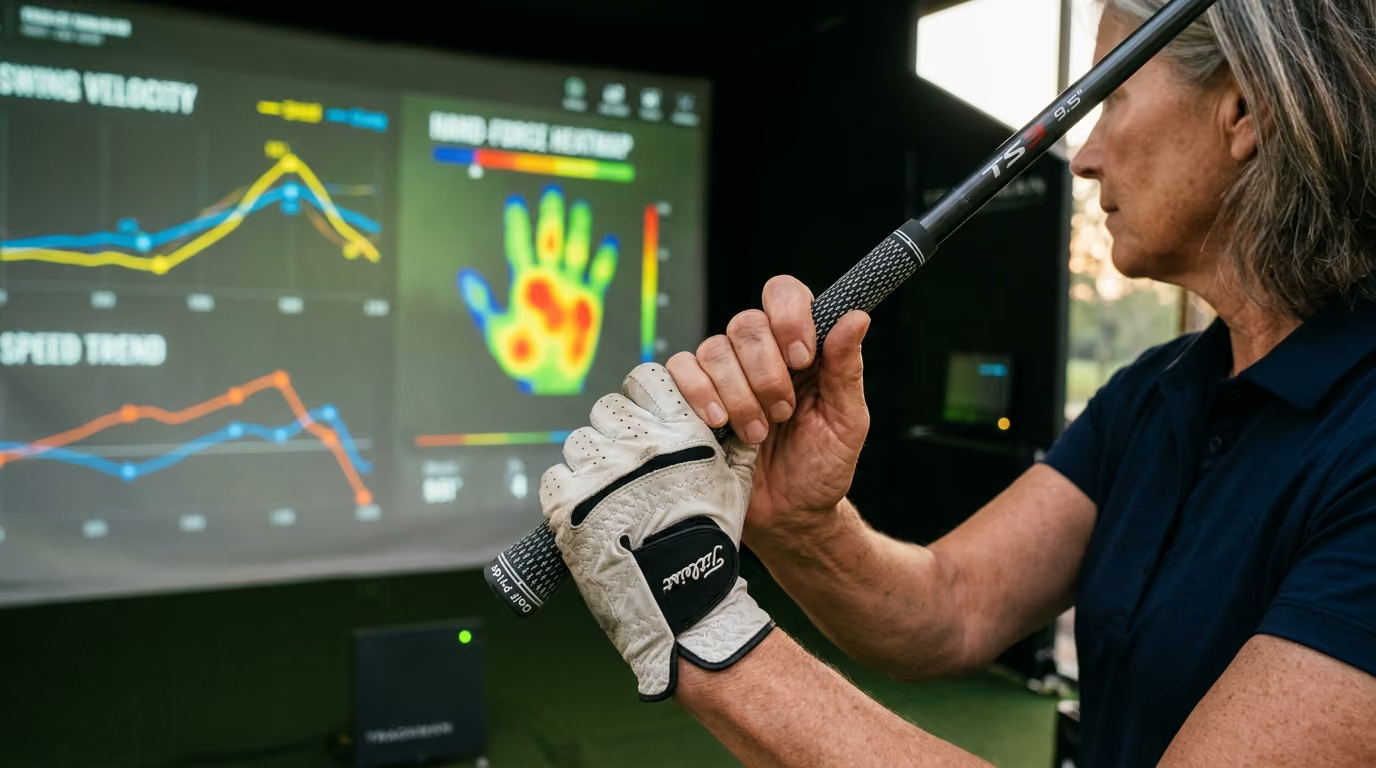

Hip mobility allows golfers to generate rotational swing power while shielding the vulnerable lumbar spine from excessive torque and chronic injury.




Low back pain after golf is one of the most common searches for mature players. When your lower back aches after eighteen holes, you likely blame your age or your swing speed. This guide provides a clear explanation of why your hips are the true culprit. It offers a permanent path to playing without pain.
Many golfers try to solve this issue by stretching their lower back. This approach often makes the problem worse. Your lower back is sore because it is doing the work your hips should be doing. To play better and protect your body, you must improve your hip rotation.
Imagine standing on the fourteenth tee box of a long course. You are tired, and your lower back feels tight and heavy. You take your driver out and swing with your usual effort. Instead of a smooth rotation, you feel a sharp pull in your lower back. Your hips stop turning toward the target.
Your hands must take over to save the swing. The ball slices off into the right trees. You walk off the tee box rubbing your lower back. This is the classic symptom of limited hip mobility during a round.
When your hips cannot turn, your body finds another way to create a swing. It forces your lower back to twist. This twisting creates immense friction in your spinal joints. Over eighteen holes, this friction leads to deep fatigue and pain.
Your swing loses power as the round progresses. You cannot clear your left side, so you start to slide your pelvis. Your shots become inconsistent, and your back becomes increasingly sore. This pattern is preventable with the right physical preparation.
To understand why your back hurts, you must look at how your joints work together. The human body operates on a joint-by-joint framework. Some joints are designed for stability, while others are designed for mobility. The lumbar spine, or lower back, is built for stability.
The lumbar spine only allows about 5 to 15 degrees of total rotation. The hip joint is a ball-and-socket joint designed for mobility. It is built to rotate in all directions. When you swing a golf club, your hips must handle the rotational demands of the movement.
Research shows a strong coupling relationship between the lumbar spine and hip rotational movements. There is a correlation of 0.81 between these two areas. This means that if your hips cannot rotate, your lower back is forced to turn. This is a primary driver of golf injuries. You can read more about keeping your body safe on our injury prevention page.
When your hip rotation is limited, the torque is transferred directly to your lower back. This leads to supra-maximal twisting of the spinal discs. The joints are forced beyond their safe physical limits. Over time, this repetitive twisting causes micro-tears in the discs and joint capsule strain.
A lack of hip rotation leads to predictable swing faults. The most common fault is early extension. The Titleist Performance Institute defines early extension as the pelvis moving toward the golf ball during the downswing. This happens because the lead hip cannot rotate backward.
When the lead hip is blocked, the pelvis has nowhere to go. It slides forward to find space. This forces your posture to stand up. You lose your spine angle, and your arms get trapped behind your body.
This is the famous Tiger Woods pattern of movement. When his hips were tight, he would load poorly into his trail hip. He would slide his pelvis forward at impact. This forced him to rely on his hands to square the club face. It also put incredible stress on his lower back.
Some researchers study the difference between the modern golf swing and the classic swing. The modern swing keeps the feet planted and limits hip turn to create a big stretch. This creates high speed, but it also creates high rotational velocities. If your hips are stiff, this swing style will quickly damage your spine. To protect your body, you need a swing that allows your hips to turn freely. You can read about golf movement patterns on our golf performance blog.
Many golfers focus entirely on the lead hip. However, the trail hip is just as critical. During the backswing, the trail hip must undergo internal rotation. This is how you load your body with power.
If your trail hip is tight, you cannot turn your pelvis. You will try to find a turn by swaying. Swaying is a lateral movement of the hips away from the target. This movement ruins your balance and your contact with the ball.
Swaying also makes it difficult to transfer your weight back to the lead side. Your body gets stuck on your trail foot. You end up hitting the ball with a scooping motion. This creates weak, high shots that curve to the right.
To load correctly, you must feel your trail femur turn inside the hip socket. This keeps your pelvis stable and centered. It allows your upper body to coil against a strong lower body. This is the foundation of a powerful, repeatable swing.
During the downswing, the lead hip becomes the primary pivot point. Your entire body must rotate around this single joint. This requires exceptional internal rotation in the lead leg. The lead hip must handle rotational speeds that are much faster than those in the backswing.
According to a study published in the Journal of Manipulative and Physiological Therapeutics, golfers with back pain have a severe deficit in lead hip internal rotation. The study showed that golfers with pain had an average of only 21.14 degrees of passive internal rotation. Golfers who played without pain had an average of 31.06 degrees.
This difference of nearly 10 degrees of rotation is the line between health and injury. If you have less than 30 degrees of lead hip rotation, you cannot clear your left side. Your body will compensate by sliding your pelvis past the target.
This slide prevents the club from releasing naturally. It forces you to tilt your spine backward at impact. This backward tilt pinch is a major cause of facet joint arthropathy in mature golfers. To save your back, you must improve your ability to pivot over your lead leg. Learn more about hip flexibility on our hip mobility page.
You do not need an expensive clinic to test your hip mobility. You can perform two simple tests in your living room. These tests will show if your hips are ready for the golf course.
The first test is the seated internal rotation test. Sit on a firm chair with your knees bent at 90 degrees. Keep your thighs together. Without moving your knees, swing your right foot outward as far as possible.
Measure the angle of your shin relative to the chair. If your foot moves outward less than 30 degrees, your internal rotation is restricted. Repeat this test with your left foot. Write down your results for both sides.
The second test is the seated external rotation test. Sit on the same chair. Cross your right ankle over your left knee. Let your right knee drop toward the floor.
Your shin should sit almost parallel to the ground. This requires about 45 degrees of external rotation. If your knee stays high or causes pain, your external rotation is tight. Repeat this on the other side to check for balance.
If you are playing today, you cannot wait weeks for exercise results. You need an immediate fix to protect your back on the course. The easiest adjustment is to change your stance.
At address, flare your toes outward. Turn your lead foot out by about 30 degrees. Turn your trail foot out by 15 degrees. This simple change pre-rotates your hips.
It reduces the amount of internal rotation your joints must produce during the swing. This takes the pressure off your lower back immediately. You will feel a freer turn on both sides of the ball.
During the swing, use a specific focus cue. Do not try to make a massive shoulder turn. Instead, focus entirely on turning your trail hip. Feel your trail hip pocket move backward toward the target.
On the downswing, change your focus. Focus entirely on turning your lead hip. Feel your lead hip pocket move backward, away from the golf ball. This simple movement cue prevents early extension and keeps your back safe.
To make lasting changes, you need a daily routine. This routine does not require heavy weights or hours of gym time. It focuses on gentle, active movements to restore joint space. You can learn more about building total-body strength on our strength development page.
This is the premier exercise for golf hip mobility. It targets both internal and external rotation at the same time.
This drill builds strength and control in your hip rotators while you stand on one leg.
The TFL is a small muscle on the side of your hip. When it gets tight, it blocks your hip from rotating internally.
Golfers often make several mistakes when trying to improve their hip flexibility. The first error is forcing the stretch. If you stretch past a point of sharp pain, your brain will protect the joint.
It will cause the surrounding muscles to contract and tighten. This defeats the purpose of the stretch. Keep your movements gentle and pain-free to get the best results.
The second error is stretching without building stability. Flexibility is useless if your muscles cannot control the movement. You must pair your stretching with strength exercises like hip airplanes.
This teaches your brain how to use the new joint space you have created. It prevents injury when you swing at high speeds.
The third error is stretching your lower back to relieve tightness. When your back feels sore, you naturally want to twist it. This twisting adds mobility to a joint that desperately needs stability.
Instead of twisting your spine, focus entirely on moving your hips. Leaving your lower back alone and moving your hips will relieve your back pain. You can read more about recovery on our physical recovery page.
Your equipment can have a major impact on your hip rotation. The most important piece of gear is your footwear. Spiked golf shoes provide excellent traction, but they lock your feet to the ground.
This prevents your feet from moving naturally during the swing. If your hips are stiff, this lack of foot movement increases the torque on your knees and lower back.
Try switching to spikeless golf shoes. Spikeless shoes allow for a small amount of foot slide at the finish of your swing. This slide acts as a safety valve for your joints.
It reduces the rotational stress on your lead hip and lower back. You can also experiment with your stance width. A very wide stance looks powerful, but it physically locks your hip joints.
Narrow your stance by two inches. A narrower stance makes it much easier to turn your pelvis through the ball.
Finally, check your club length. If your clubs are too short, you must bend over too much at address. This puts your hips in deep flexion, which limits their ability to rotate.
A professional club fitting can help you stand taller. A taller posture instantly gives your hips more room to turn.
Protecting your lower back requires turning your hips, not your spine, to generate power.
Use this simple checklist to start improving your hips this week.
Perform the seated internal and external rotation tests. Record your baseline numbers.
Spend two minutes massaging your TFL muscles with a golf club grip.
Perform three sets of the 90/90 stretch on each leg after your workday.
Do two sets of ten hip airplanes on each leg to build balance and control.
Go to the driving range. Flare both feet outward and practice swinging at eighty percent speed.
Use your flared stance on the course. Focus entirely on turning your lead hip on the downswing.
Give your muscles a day to rest. Check your lower back to see if it feels better than last week.
If you have questions about these movements, please visit our contact page. To learn more about our mission to help mature golfers, check out our about page.
Follow Golfergy for practical insights on performance, mobility, recovery and healthy ageing. Stay connected for new articles, research-led guidance and ideas to help you play better for longer.


Explore practical resources on performance, recovery, mobility and golf longevity.
Read the Blog