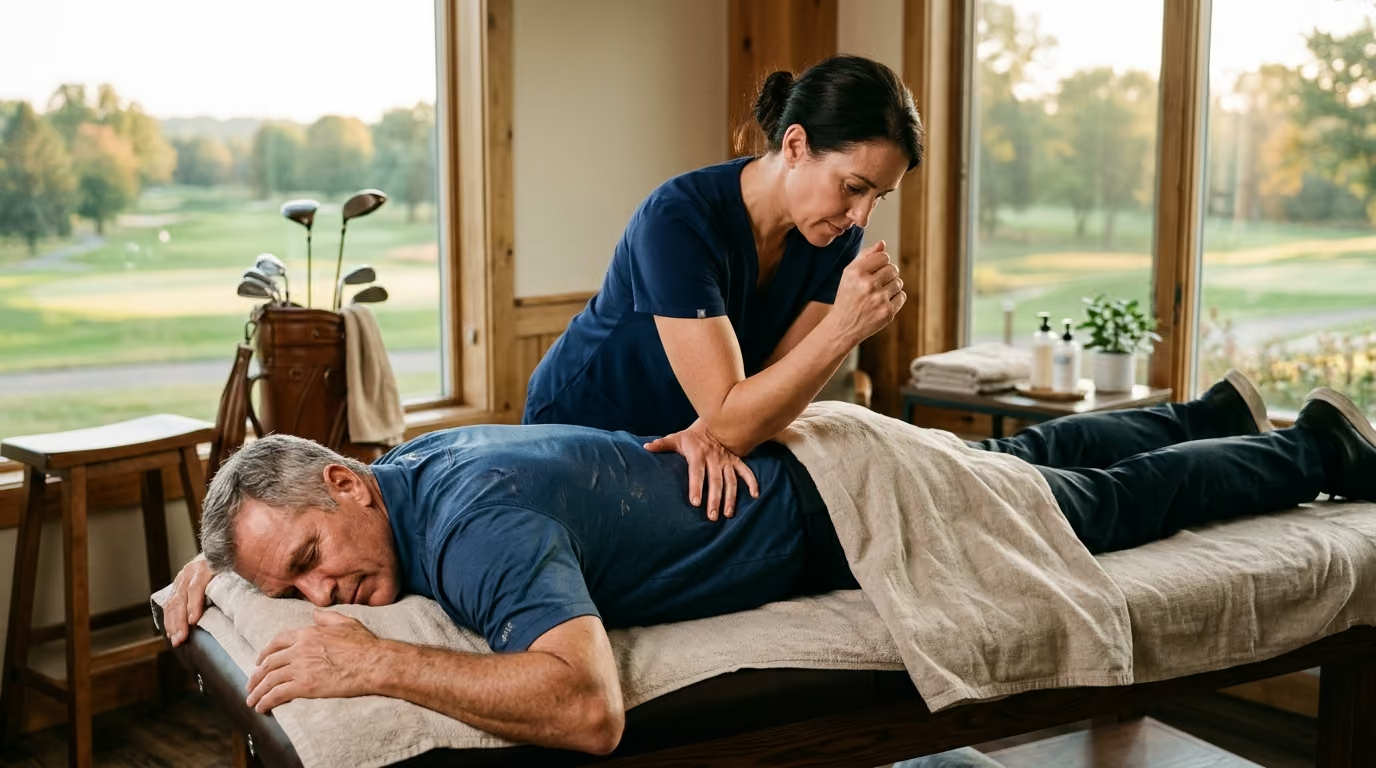

Targeted recovery techniques for rotational athletes help relieve persistent lower back tension and restore full mobility after demanding rounds on the golf course.




Let us look at a scenario that many mature players know too well. You are standing on the fifteenth tee on a beautiful Sunday afternoon. Your round has been solid, but you start to feel a dull, tight pull in your right lower back. When you try to make your backswing, your body resists the movement.
You try to swing harder to make up for the stiffness. Consequently, you hit a weak slice into the right rough. By the time you reach the final green, your entire lower back feels like a solid block of concrete. The drive home is uncomfortable, and getting out of the car requires real effort.
This experience is not just bad luck. It is the natural consequence of repeating a highly asymmetrical movement over and over. Golf forces your body to rotate in one direction at high speeds while your feet remain anchored to the ground.
Many players react to this stiffness by booking a standard full-body massage. They hope a therapist can simply rub the tightness away. In our experience, this approach rarely works for long because it ignores the unique physical demands of the golf swing.
To recover effectively, we must first understand the intense forces of the golf swing. The swing relies on a proximal-to-distal kinetic chain. This is a sequence of movements where energy is transferred from your feet all the way to the clubhead.
The first phase is ground interaction. Your feet push against the turf to create ground reaction force. Without this solid base, you cannot generate power.
The second phase is pelvic rotation. Your hips turn to transfer that ground force up into your torso. This movement requires incredible hip mobility.
The third phase is trunk separation. Your chest rotates further back than your hips during the backswing. This difference is called the X-factor, which pre-loads your muscles like a rubber band.
The fourth phase is lumbar stabilization. Your lower back must stay stable to transmit this massive energy safely. It must resist unwanted side-to-side bending while under rotation.
The fifth phase is scapular and shoulder motion. Your shoulder blades slide and rotate to position your arms. This allows for a wide, consistent swing arc.
The sixth phase is forearm and wrist control. Your hands and wrists release the clubface at impact. They absorb the sudden shock of striking the ball.
The final phase is follow-through braking. Your body must decelerate the club and absorb the leftover rotational energy. This requires strong eccentric muscle control to prevent injury.
During these seven phases, your spine is subjected to extreme physical forces. It does not just rotate. It is compressed, sheared, and twisted all at once.
Biomechanical research shows that your lower back experiences peak compressive loads greater than six times your body weight during the downswing. For a professional player, this can mean a force of approximately 7,584 Newtons. Amateur players face average compressive loads of about 6,100 Newtons.
While professionals handle these loads with efficient technique, amateurs often experience much higher shear forces. Shear force occurs when one vertebra slides forward or sideways over another. This lateral sliding force is highly stressful for your spinal discs and ligaments.
Additionally, the finish position often forces the spine into a combination of extension and lateral bending. This is sometimes called the crunch factor. A 2024 systematic review published in Sports Medicine confirmed that while there is no single biomechanical cause of back pain in golfers, the combination of these forces is a primary trigger for muscle spasms.
To use massage effectively, you must have realistic expectations. There are many myths about manual therapy that lead to wasted time and money.
Many golfers believe that deep-tissue massage physically breaks up scar tissue or adhesions. This is anatomically impossible. Human connective tissue is incredibly strong. It would require forces far beyond what a human hand can produce to physically tear or melt these tissues.
Instead, massage works by sending signals to your nervous system. The pressure of the therapist's hands coaxes your brain into releasing its protective muscle guarding. This neurological change is what makes you feel looser.
A comprehensive 2020 systematic review in Physical Therapy in Sport examined the effects of sports massage on recovery. The researchers analyzed data from multiple clinical trials. They found that massage does not improve muscle strength, endurance, or fatigue recovery.
The study did find that massage provides a small, statistically significant improvement in flexibility and muscle soreness. On average, players experienced a thirteen percent reduction in delayed-onset muscle soreness. Another study from 2023 showed that massage can reduce muscle swelling by up to thirty percent but does not speed up the recovery of muscle force.
Therefore, you should not look at massage as a way to build strength or repair damaged tissue. It is a tool for symptom management and sensory down-regulation. It helps you feel ready to move, but you must still do the hard work of physical training.
There is a big difference between feeling loose and being physically ready to perform. A massage can improve your perceived readiness by making your joints feel less stiff.
But this temporary relief does not mean your muscles have recovered their ability to produce maximum power. If your tissues are fatigued from a long weekend of golf, you must still manage your playing volume. Relying on massage to get you through an unsustainable workload will eventually lead to injury.
To learn more about managing your body's overall tolerance, you can look at our resources on injury prevention strategies.
Standard massages treat the left and right sides of your body as identical. But a golfer's body is highly asymmetrical. Your lead side (the side facing the target) and your trail side experience completely different types of physical stress.
For a right-handed golfer, the trail hip must rotate internally during the backswing. The lead hip must rotate internally during the downswing and follow-through. If either hip is restricted, your pelvis cannot turn properly.
When hip rotation is blocked, your lower back is forced to compensate by twisting. Your lumbar spine is only designed to rotate about one to two degrees per segment. Forcing it to rotate further can cause the deep muscles, like the quadratus lumborum, to go into a painful spasm.
Massage should target the gluteus medius, gluteus maximus, and the deep external rotators on the restricted side. Loosening these hip muscles restores proper pelvic movement, which takes the pressure off your lower back.
Your thoracic spine is built for rotation. If your middle back is stiff, you will struggle to complete your backswing.
Your therapist should focus on the latissimus dorsi, the thoracic erectors, and the pectorals. The latissimus dorsi is a massive muscle that connects your shoulder to your lower back. When it gets tight, it acts like a straightjacket, locking down your upper body rotation.
Releasing the latissimus dorsi can help you turn your shoulders more freely. This freedom reduces the need to over-extend your lower back at the top of the swing.
Your shoulders are highly vulnerable to overuse. Statistics show that shoulder injuries make up about 11.8 percent of all golf injuries.
The lead shoulder must reach across your chest during the swing, which stretches the posterior joint capsule. The trail shoulder must rotate externally, which can tighten the pectorals and the front of the shoulder.
Soft-tissue work should address these differences. The therapist should use light, slow strokes on the pectoralis minor and the subscapularis on the trail side. For the lead side, they should focus on the posterior deltoid and the rotator cuff.
Your forearms and wrists transmit all the energy from your body into the club. Professional golfers have a very high rate of hand and wrist injuries because of their high practice volume.
When I developed medial epicondylitis, commonly known as golfer's elbow, I thought I needed complete rest. Six weeks off the course did nothing to help. I finally learned that active recovery with a flexbar was the actual solution. It taught me that treating golf injuries requires loading the tissue properly, not just sitting on the couch and hoping for the best.
While active loading is vital for tendon health, light soft-tissue work can help manage the surrounding muscle tension. Your therapist can use gentle stripping strokes on the wrist flexors of your trail arm and the wrist extensors of your lead arm. This work helps reduce grip fatigue and makes it easier to maintain a relaxed grip pressure.
When you feel stiffness creeping in during a round, you cannot stop for a massage. You need an immediate way to relieve tension. Use this quick pelvic tilt exercise to release your lower back on the course.
Stand with your feet shoulder-width apart and rest your hands on your hips. Keep your knees slightly bent. Slowly tilt your pelvis forward, arching your lower back, then tilt it backward, tucking your tailbone under.
Perform this movement slowly and smoothly ten times. Focus entirely on moving your pelvis without moving your upper chest.
This simple drill acts as a neurological reset. It tells your brain that it is safe to relax the muscles in your lower back. It is a highly effective way to manage stiffness between holes.
Before you hop on a massage table, you must verify that deep-tissue work is safe for you. Vigorous massage is not always harmless. The National Center for Complementary and Integrative Health warns that rare, serious adverse events can occur.
To avoid complications like blood clots, nerve damage, or bone fractures, use this structured six-step framework.
Before any massage, check your body for warning signs. If you have sharp, radiating pain, numbness, or tingling in your arms or legs, do not get a massage. These are signs of nerve compression, which can be worsened by deep pressure.
Also, avoid massage if you have unexplained leg swelling, heat, or redness. These can be signs of deep-vein thrombosis, which is a medical emergency. If you take blood thinners, have osteoporosis, or are recovering from a recent surgery, you must get medical clearance first.
Before your therapist starts, perform a simple movement test. Stand up and turn your torso as far as you can to the left, then to the right. Take note of where you feel restricted or stiff.
This test gives you a clear baseline. It helps you and your therapist know if the treatment is actually helping your body move better.
Tell your therapist about your golf game. Explain your handedness, your typical ball flight, and when you feel stiffness.
For example, tell them if your back hurts during the backswing or the follow-through. This information helps them target the specific muscles that are limiting your swing.
Always communicate with your therapist during the session. The pressure should be deep enough to feel productive, but it should never be painful.
If you find yourself holding your breath or tensing your muscles, the pressure is too high. This tension actually defeats the purpose of the massage by triggering more muscle guarding.
After your massage, your muscles will be in a state of low tone. While this feels great, it can also make your joints temporarily unstable.
You must follow your massage with a few light, active movements. Perform ten slow, unweighted squats and five gentle torso turns. This tells your brain how to control your new, temporary range of motion.
The success of a massage is not decided on the table. It is decided over the next three days.
Keep track of how you feel. If your stiffness returns immediately during your next practice session, the massage did not address the root cause of your problem. You may need to look at your swing mechanics or physical strength.
To get the most out of manual therapy, you must coordinate your sessions with your golf schedule. The wrong massage at the wrong time can ruin your game.
A pre-round massage should focus on stimulation, not relaxation. Avoid deep, painful pressure within twenty-four hours of a round. This intense work can make your muscles feel weak and sluggish.
Instead, ask for light, rapid strokes to increase circulation and warm up your body. Always follow this with a dynamic warm-up on the driving range. Start by hitting short wedge shots and slowly work your way up to your driver.
The goal after a round of golf is to help your body down-regulate. Your muscles are fatigued, and your nervous system is highly active.
A post-round massage should be gentle and relaxing. Avoid deep-tissue stripping or painful trigger point therapy. Focus on slow, rhythmic strokes to help your body transition into a state of rest and recovery.
If you are experiencing delayed-onset muscle soreness, timing is everything. Research suggests that massage is most effective for reducing soreness when performed forty-eight to seventy-two hours after intense exercise.
A light-to-moderate massage during this window can reduce your discomfort by up to thirty percent. It helps you return to comfortable movement sooner, but remember that your muscle fibers still need time to physically recover.
For a mature golfer who plays regularly, a consistent maintenance schedule is highly valuable. A bi-weekly or monthly session can help you catch minor muscle tightness before it becomes a major restriction.
Keep your sessions consistent. Do not try a deep, aggressive massage right before a major tournament if you have never done it before. You do not want to find out that your body reacts poorly to deep pressure when your club championship is on the line.
You can read more about planning these sessions on the Golfergy blog.
Massage is an excellent way to relieve tight muscles, but it cannot create lasting physical change on its own. To play pain-free golf for years to come, you must build active mobility.
We recommend focusing on one small movement at a time. This approach makes it easy to build a sustainable daily habit. For rotational athletes, the most critical area to target is trail-hip internal rotation.
To perform this drill, sit on the floor with your knees bent at ninety degrees. Place your feet flat on the ground, wider than hip-width apart. Slowly let your trail knee sink inward toward the floor while keeping your pelvis anchored. Focus entirely on turning your trail hip.
Hold this position for five seconds, then return to the start. Repeat this movement ten times on each side.
This simple exercise helps build active, usable range of motion in your hips. Unlike the passive stretch of a massage, this active drill teaches your nervous system how to stabilize your joints. Adding this to your morning routine will help protect your lower back from the extreme forces of the swing.
To build a complete home routine, you can read our guide on golf mobility training.
Many golfers waste time and money on recovery methods that do not help them. Avoid these three common mistakes to keep your body healthy.
Many players think that if a light massage feels good, an extremely painful deep-tissue massage must be even better. This is a dangerous myth.
Vigorous, aggressive massage can cause muscle bruising, nerve irritation, and even increase your risk of blood clots. If you are sore for days after a massage, the pressure was too intense. The best recovery work is always within your comfort zone.
If your lower back is tight, do not let your therapist spend the entire hour rubbing your back. Your back is likely tight because your hips are locked or your upper back cannot rotate.
A good recovery plan looks at your entire body. It addresses the restrictions above and below the painful area to restore balance.
Passive therapies like massage can make you feel great, but they do not make your muscles stronger. A strong core and stable hips are your best defense against golf injuries.
A clinical study on golfers with lower back pain showed that those who performed trunk stabilization and lower-limb strength training had much better results than those who only stretched. Massage should be used to support your training, not to replace it.
To learn more about building a strong foundation, check out our articles on core strength exercises.
Your physical recovery is closely connected to the golf clubs and gear you use. If your equipment is not suited to your body, it will place extra physical strain on your joints.
If your grips are too small, you will naturally squeeze the club too tightly. This constant tension travels up your forearms, leading to elbow and wrist issues.
Switching to larger grips can help you maintain a relaxed grip pressure. This change reduces the workload on your forearm muscles, helping to prevent grip fatigue and tendonitis.
Heavy, stiff steel shafts transmit a massive amount of shock to your upper body when you strike the ball. This vibration can irritate your wrists, elbows, and shoulders.
Switching to lighter graphite shafts can make a massive difference. Graphite absorbs the vibration of impact, protecting your joints and saving your muscles from excessive fatigue.
Modern golf shoes with long, aggressive spikes lock your feet firmly to the ground. While this provides great stability, it also stops your feet from rotating slightly during your swing.
This lack of foot movement forces your knees and lower back to absorb all the rotational twist. If you struggle with joint pain, try switching to spikeless shoes. They allow for a small amount of foot rotation, which can relieve pressure on your lower body.
To help you apply these strategies, let us look at five common recovery patterns we see in mature recreational golfers.
Robert is a fifty-two-year-old golfer who recently doubled his weekly practice volume. He developed a dull, constant ache on the right side of his lower back. He had been trying to stretch his back, but it only seemed to make the pain worse.
During his assessment, we found that his right trail hip had lost significant internal rotation. His lower back was twisting excessively to make up for the locked hip.
We had his massage therapist focus on his right glutes, hip rotators, and latissimus dorsi. We also had Robert reduce his practice volume and start a daily hip mobility routine. Within three weeks, his back pain had completely vanished.
Arthur, a sixty-year-old player, noticed that his swing felt slow and restricted. He was struggling to turn through the ball, and his left lower back would pinch at the finish.
A movement test showed that his lead hip had very limited rotation. To finish his swing, he was forcing his lower back to twist and bend sideways.
His therapist used moderate pressure to loosen his left gluteus medius and tensor fasciae latae. Immediately after the session, Arthur performed gentle, active hip turns. This combination of manual release and active movement restored his pelvic rotation and relieved his back pain.
Thomas, a fifty-five-year-old player, felt "stuck" at the top of his backswing. To get the club back further, he was lifting his arms and bending his left elbow. This compensation was causing severe shoulder fatigue.
We found that his thoracic spine was extremely stiff, and his chest muscles were very tight. His therapist used slow, deep strokes on his thoracic erectors and pectorals.
After the massage, Thomas practiced gentle thoracic turns with a golf club across his shoulders. This work helped him find a fuller, more natural backswing without straining his shoulders.
David loves to practice on the driving range, but he noticed that his lead forearm felt weak and sore after hitting off hard mats. He was struggling to maintain a light grip pressure on the course.
Because he was experiencing forearm fatigue, his therapist performed very light soft-tissue work on his wrist flexors. We also advised him to stop practicing on hard artificial mats, which transmit high shock to the arms.
David switched to softer turf-style mats and put graphite shafts in his irons. These adjustments reduced the physical impact on his arms, allowing his forearms to recover much faster.
George got a deep-tissue massage every Friday evening before his weekend rounds. He felt incredibly loose on Saturday morning, but by Sunday afternoon, his back was stiff and sore again.
George was using massage as a temporary Band-Aid. The massage relaxed his muscles, but his core was too weak to stabilize his spine during thirty-six holes of golf.
We had him stop getting aggressive Friday massages. Instead, we put him on a basic core strength and hip stability routine. This active approach gave him the physical endurance he needed to play thirty-six holes without pain.
You can read more about building consistent habits on our main golf longevity page.
Your recovery is an active partnership between manual therapy to restore temporary movement and strength training to build long-term joint capacity.
Revisit this guide whenever you plan to increase your weekly swing volume, experience sudden on-course stiffness, or notice a loss of rotation in your hips and shoulders. Keeping your recovery strategy aligned with the unique physical demands of the rotational swing is the best way to extend your playing years.
Follow Golfergy for practical insights on performance, mobility, recovery and healthy ageing. Stay connected for new articles, research-led guidance and ideas to help you play better for longer.


Explore practical resources on performance, recovery, mobility and golf longevity.
Read the Blog


