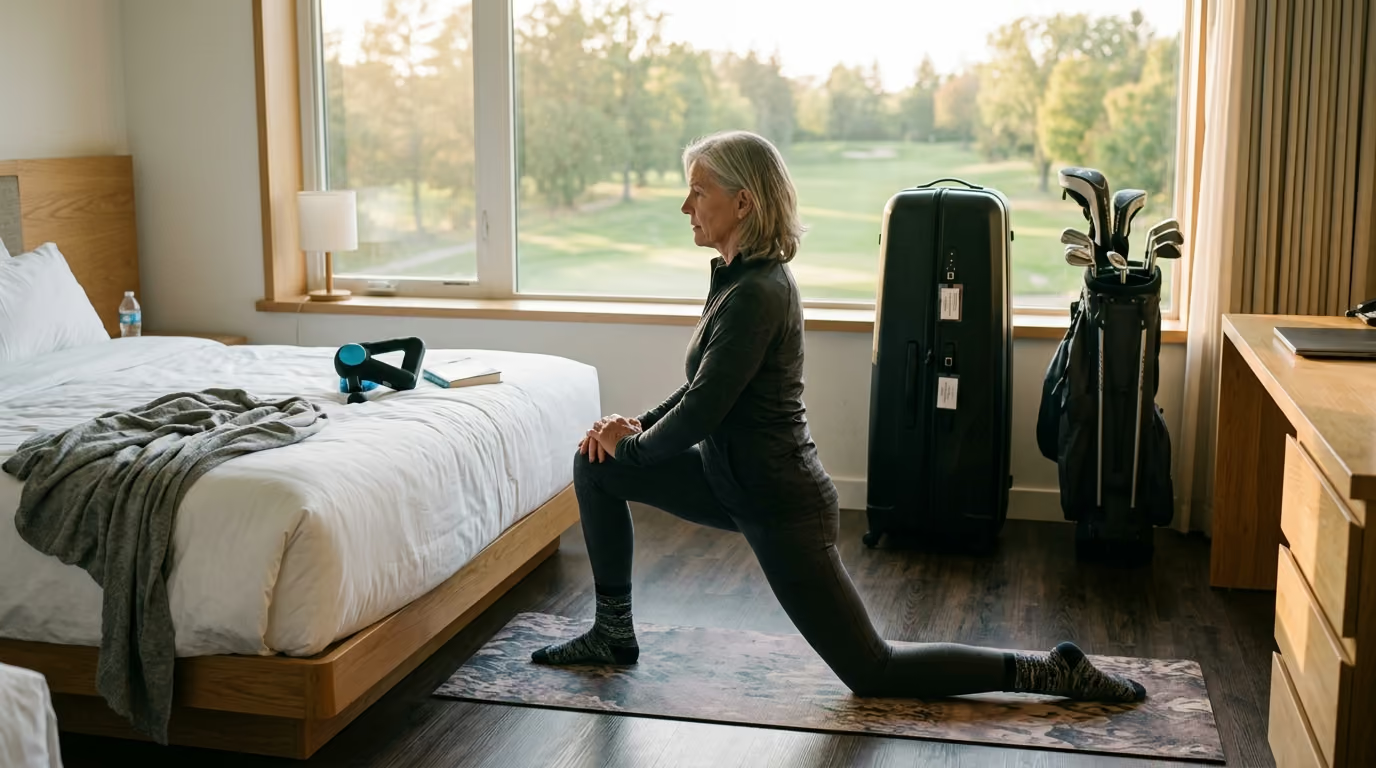

Visible abs do not protect a golfer from injury, but deep stabilizing muscles create the internal shield needed to prevent lower back pain.




Many experienced golfers believe that core strength is about building visible abdominal muscles. They spend hours performing crunches to protect their lower back from the rotational forces of the swing. Yet, these same golfers often experience nagging back pain. The truth is that superficial abdominal muscles do not protect your spine during a golf swing.
To build a body that can swing a club without pain, you must change your approach. You need to focus on the deep, stabilizing muscles that act as a natural weight belt. These muscles do not create big movements. Instead, they prevent tiny, harmful movements between your spinal joints. This guide explains how to build a deep spinal shield for your golf swing.
This is not a quick fix or a trendy workout routine. It is a research-supported approach designed for golfers who want to play pain-free for decades. By focusing on deep segmental stability, you can protect your spine from the intense forces of the golf swing. This is a vital part of maintaining your golf longevity as you age.
You are standing on the fourteenth tee box. The afternoon sun is starting to sink, and you have played a solid round so far. But as you bend down to tee up your ball, you feel a familiar tightness in your lower back. It is not a sharp pain yet, but a dull, heavy ache. You stand up slowly and try to stretch your torso by turning side to side.
When you set up over the ball, you feel hesitant. Your mind is no longer focused on target selection or club face control. Instead, you are wondering if your back will pinch during the downswing. You make a shorter backswing to avoid the discomfort. This restriction cuts your clubhead speed and causes you to push the ball into the right rough.
By the time you reach the eighteenth green, you are ready to head straight to the parking lot. You find yourself rubbing your lower spine with your thumb, trying to ease the tension. This scenario is incredibly common among recreational golfers. It is a clear sign that your deep stabilizing system has shut down. Your larger, superficial muscles are trying to do two jobs at once. They are trying to swing the club and keep your spine from moving too much.
When these large muscles fatigue, your spinal joints take the brunt of the force. The result is stiffness, pain, and a loss of rotational power. To stop this cycle, you must understand how your body naturally protects your spine during movement. This requires a shift in how you train and move on the course.
The golf swing is one of the most violent rotational movements in sports. During a full swing, your lower spine faces extreme physical forces. Research shows that the L4-L5 spinal segment experiences compressive loads reaching six to eight times an individual's body weight. For a 180-pound golfer, that means your spine must withstand up to 1,440 pounds of pressure on every single swing.
In addition to compression, your spine must handle lateral shear forces. Amateur golfers often experience peak anterior-posterior shear loads of roughly 600 to 900 Newtons. Your small spinal joints must resist at least half of this load. If your deep muscles are not active, these forces pinch the joints and stretch the ligaments. Over time, this leads to wear, tear, and chronic inflammation.
Your body has a built-in defense system known as the inner unit. This system is made up of four main parts. The roof is your diaphragm, and the floor is your pelvic floor. The sides and front are formed by the transverse abdominis. The back is protected by the multifidus muscle. Together, these muscles form a canister that supports your spine.
The transverse abdominis acts like a wide, biological corset. It wraps around your midsection from your ribs to your pelvis. When it contracts, it raises the pressure inside your abdomen. This pressure acts like an inflated balloon inside your torso, pushing outward to support your lower back.
The multifidus is a series of tiny muscles that connect your vertebrae. They control microscopic movements between individual spinal segments. When these two muscles work together, they create a natural weight belt that shields your spine from injury. If these muscles are weak, your spine is left unprotected.
In athletes with chronic non-specific low back pain, the multifidus often exhibits localized atrophy. This means the muscle actually shrinks and loses its strength. Research indicates that the muscle thickness can be reduced by up to ten percent in pain sufferers. In chronic cases, this muscle tissue is often replaced by fatty infiltration.
When fat replaces muscle tissue, the stabilizer loses its ability to contract quickly. It can no longer protect the spinal joints during high-speed movements. Furthermore, studies show that athletes with back pain exhibit a forty percent greater decrease in the endurance of this muscle. The muscle simply tires out much faster than it would in a healthy golfer.
This fatigue is why your back feels fine on the first few holes but aches on the back nine. As the multifidus tires, your body loses its ability to resist shear forces. Your nervous system then triggers the large outer muscles to tighten up in an attempt to protect the spine. This creates the feeling of a locked-up lower back.
To rebuild this muscle, you cannot just perform general strength exercises. You must target the deep stabilizers with specific, controlled movements. This is the only way to reverse atrophy and restore the protective shield.
Before you can build a stronger spinal shield, you must assess your current level of control. The Titleist Performance Institute utilizes specific screens to test this ability. You can easily perform these tests at home with no special equipment. They will show you if your deep stabilizers are functioning correctly.
Stand in your normal golf posture with your arms crossed over your chest. Without moving your upper body, try to tilt your pelvis forward and backward. Your goal is to arch your lower back, then tuck your tailbone under. Look at yourself in a mirror to see if the movement is smooth.
If you cannot tilt your pelvis without moving your chest, your core control is compromised. You may find that your movement is jerky or entirely absent. This indicates that your brain cannot coordinate the deep muscles of your pelvis and lower back. On the course, this lack of control leads to early extension during your downswing.
Lie on your back with your knees bent and your feet flat on the floor. Lift your hips into a bridge position, keeping your shoulders on the ground. Once you are stable, lift one foot off the floor and extend your leg. Hold this position for ten seconds.
Observe whether your hips sag or tilt to one side. You should not feel cramping in your hamstrings or tightness in your lower back. If your hips drop, your lateral core stabilizers are weak. This weakness allows your pelvis to sway and slide during your golf swing.
Stand on one foot with your hands on your hips. Lift your opposite knee until your thigh is parallel to the floor. Close your eyes and try to maintain your balance for at least ten seconds.
If you wobble instantly or touch your foot down, your reflexive stability is struggling. Your deep core should react automatically to keep you upright. When this system is slow, your body cannot stabilize itself during the high-speed transition of your swing. Improving this balance is a key step in injury prevention for long-term play.
You do not have to wait until your workout sessions to start protecting your back. You can use a simple technique right on the tee box. This technique is called abdominal bracing. It was popularised by spine biomechanist Dr. Stuart McGill. It is far more effective for golf than sucking in your stomach.
To perform an abdominal brace, imagine someone is about to tap you in the stomach. You do not suck your belly button inward toward your spine. Instead, you stiffen your entire midsection outward in all directions. You should feel the muscles in your front, sides, and lower back tighten simultaneously. This creates a solid, 360-degree shield around your spine.
When you prepare to swing, use this brace at a very low intensity. You only need about ten to twenty percent of your maximum effort. Over-bracing can make your swing stiff and slow. A light brace is enough to keep your pelvis and ribs connected.
As you address the ball, focus entirely on turning your trail hip. Maintain that light brace as you rotate back and through. This simple focus prevents your lower back from arching excessively at the top of your swing. It keeps your spine in a safe, neutral alignment throughout the entire motion.
To create lasting changes in your spinal health, you need a structured exercise routine. This routine should focus on teaching your deep muscles to work together. It progresses from simple isolation movements to dynamic, golf-specific patterns. Consistent practice will build the endurance your core needs for eighteen holes.
The first step is to wake up the transverse abdominis. Lie on your back with your knees bent and your feet flat. Place your fingertips on your abdomen, just inside your hip bones. Take a deep breath in, letting your belly expand.
As you exhale, gently draw your lower abdomen downward toward the floor. You should feel a slight tightening under your fingertips. Do not hold your breath or tilt your pelvis. The movement should be subtle, as if you are trying to zip up a tight pair of pants. Hold this contraction for five seconds, then release. Repeat this ten times.
This exercise is called the Abdominal Drawing-In Maneuver. It isolates the deep front of your spinal shield. Practicing this daily helps restore the connection between your brain and your stabilizers. It is an excellent starting point for any mobility or core routine.
Once you can activate the deep core, you must teach it to work while your limbs are moving. The Dead Bug exercise is perfect for this. Lie on your back with your arms pointing toward the ceiling. Raise your legs so your knees are bent at a ninety-degree angle.
Flatten your lower back against the floor. Imagine there is a small bug under your lower back, and you must squash it. Slowly lower your right arm behind your head while extending your left leg forward. Only lower them as far as you can without letting your back arch off the floor.
Return to the starting position and repeat on the opposite side. Focus entirely on keeping your lower back flat against the ground. Perform three sets of eight repetitions per side. This movement trains your core to resist extension, which is vital for preventing back pain.
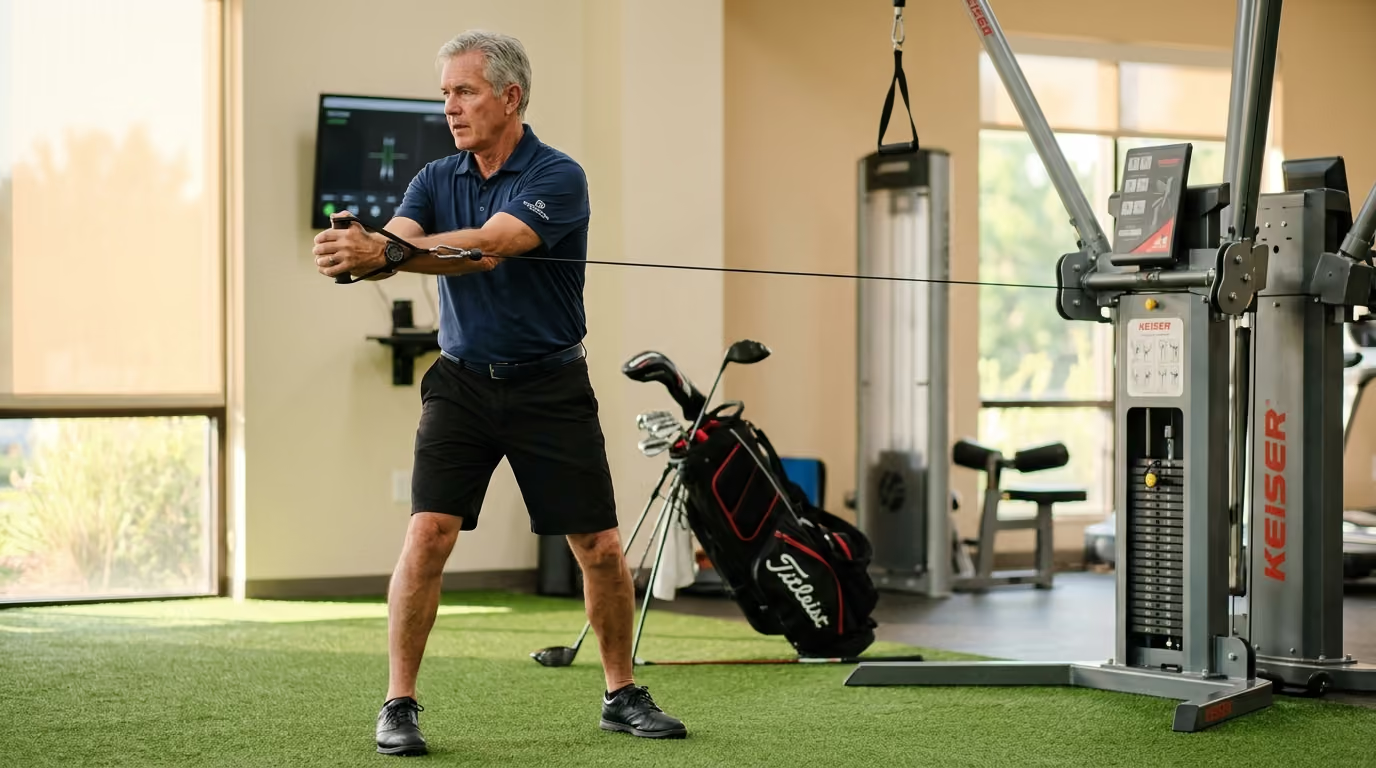
The final phase connects your core stability to the actual movements of a golf swing. The half-kneeling cable chop is highly effective for this stage. Kneel on your left knee with your right foot flat in front of you. Set up next to a cable machine or a resistance band anchored high to your side.
Grasp the handle with both hands. Keep your pelvis completely still and pointed straight ahead. Pull the handle diagonally down and across your body toward your right hip. Focus entirely on turning your upper torso while keeping your lower body locked in place.
Slowly return to the starting position under control. Perform three sets of ten repetitions on each side. This exercise teaches your body to transfer energy from your upper body to your lower body. It protects your lower back from twisting forces that cause injury. You can find more targeted exercises like this in our resources section.
Many golfers make critical mistakes when trying to strengthen their core. These errors can actually increase the risk of back injury. Understanding what to avoid is just as important as knowing what exercises to perform.
Many people are taught to draw their belly button toward their spine during exercise. This is called hollowing. While it can isolate certain muscles in a therapy setting, it is dangerous during a golf swing. Hollowing actually reduces the width of your abdominal wall.
This narrowing makes your spine less stable, not more. It leaves you vulnerable to the high rotational forces of the swing. Instead, you must practice the abdominal brace. Stiffen your midsection outward to create a wider, stronger base of support.
Standard crunches build the rectus abdominis, which is your superficial six-pack muscle. However, this muscle runs vertically down the front of your torso. It is designed to flex your spine forward, not to resist rotation. Over-training this muscle can pull your chest forward into a slouch.
This poor posture limits your thoracic rotation. To compensate, you will be forced to twist your lower back more during your swing. This extra twisting is a primary cause of joint wear. Shift your focus to exercises that challenge your ability to resist movement.
Some golfers try to brace their core as hard as possible throughout their entire day. They hold a tight brace while putting, chipping, or even walking down the fairway. This is a mistake that can lead to muscle fatigue and increased spinal compression.
Your deep core is designed to work reflexively at a low level of tension. It should adjust its stiffness based on the task. You do not need a heavy brace to read a putt. Save your active bracing for the full swing, and let your body relax between shots. This balance is vital for proper recovery during a long round.
Your equipment can play a surprising role in how your deep core functions. Minor adjustments to your gear can reduce the stress placed on your lower back. This allows your spinal shield to do its job more effectively.
Your feet are your only contact point with the ground. If your golf shoes lack stability, your body must compensate. Shoes with extremely flexible soles or worn-out spikes can cause your feet to slip during the swing.
This slipping forces your lower back and hips to work harder to keep you balanced. Look for shoes with a solid lateral structure and good traction. A slightly wider heel base can also improve your overall stability. This solid foundation reduces the workload on your deep stabilizers.
If your golf grips are too small, you will naturally squeeze the club tighter. This extra grip tension travels up your arms and into your shoulders. It can cause your upper body to become stiff and rigid.
When your upper back cannot rotate freely, your lower back must twist to complete your swing. This excessive twisting overloads the multifidus muscle. Consider trying slightly larger grips to encourage lighter hand pressure. This simple change allows for freer rotation in your shoulders and less strain on your spine.
Carrying a heavy golf bag for eighteen holes puts a constant compressive load on your spine. This load fatigues your deep stabilizers long before you reach the back nine. If you prefer to walk, use a push cart instead.
When using a push cart, make sure you push it with your arms relaxed and your posture tall. Avoid slouching over the cart or pulling it behind you with one arm. Pulling with one arm creates an asymmetrical twist in your spine that can cause muscle imbalances. Keeping your posture upright helps maintain your natural spinal alignment.
A strong spinal shield does more than just prevent injury. It also improves the efficiency of your golf swing. When your deep core is stable, it acts as a solid anchor. This anchor allows your hips and shoulders to rotate with greater speed and precision.
Energy can flow smoothly from the ground, through your torso, and into the clubhead. Without a stable core, this energy leaks out. Your swing becomes less efficient, and you lose yardage on your shots. Building your deep stabilizers is a fundamental part of strength training for older golfers.
By dedicating a few minutes each day to these simple exercises, you can transform your game. You will finish your rounds with energy to spare. Best of all, you can look forward to playing this great game for many years to come.
Protect your lower spine by maintaining a light, 360-degree abdominal brace before you begin your backswing.
Follow Golfergy for practical insights on performance, mobility, recovery and healthy ageing. Stay connected for new articles, research-led guidance and ideas to help you play better for longer.


Explore practical resources on performance, recovery, mobility and golf longevity.
Read the Blog