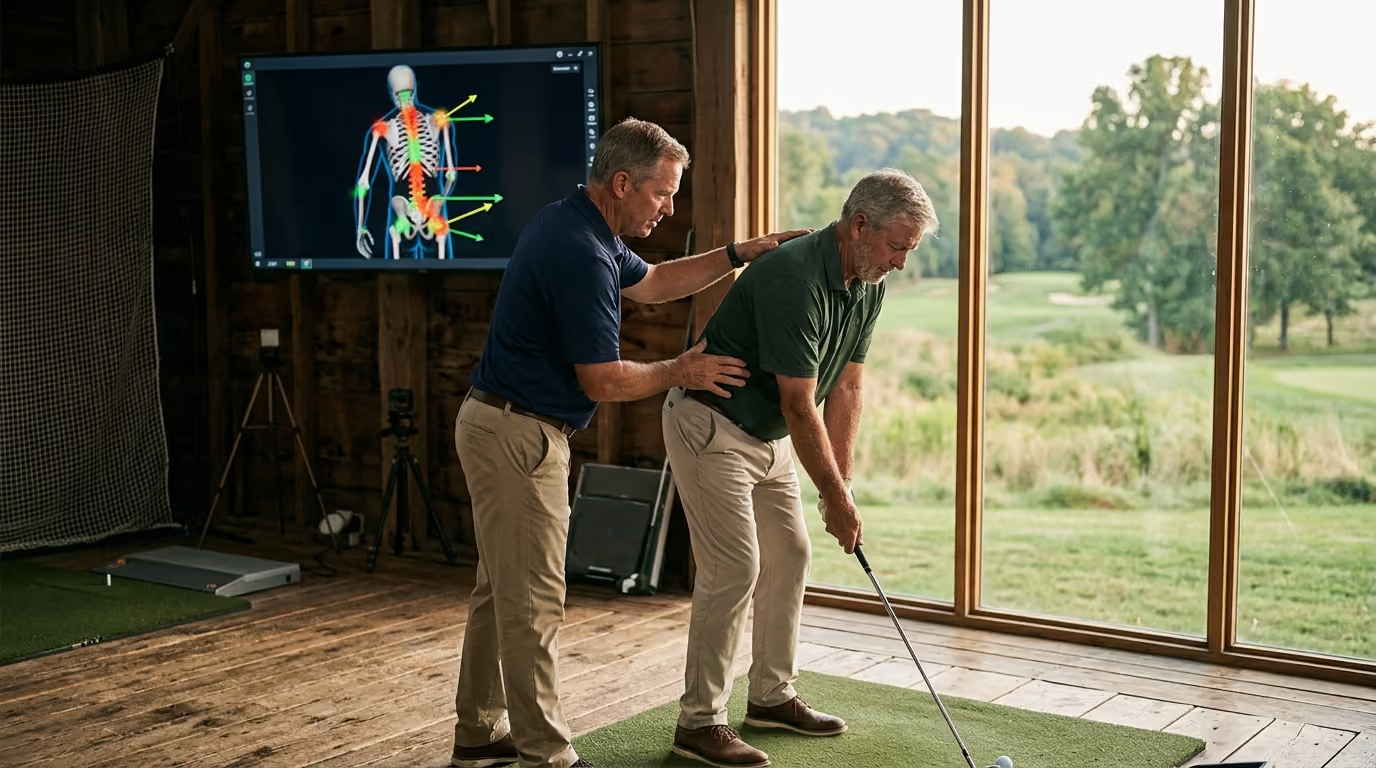

Lasting relief from golf-related back pain starts with establishing a neutral spine at address to eliminate destructive rotational forces during the swing.




Many experienced golfers spend hours searching for the cause of their nagging back pain. They type queries about golf swing lumbar strain into search engines late at night. They look for quick remedies for neck stiffness that sets in by the tenth hole. This guide provides the definitive answers you need to fix your posture and protect your spine.
The way you stand over the ball dictates how your body moves during the swing. Poor posture at address forces your muscles to work in unnatural ways. This creates excessive wear and tear on your spinal discs and joints. Over time, these minor strains turn into chronic injuries that keep you off the course.
Research from the Titleist Performance Institute shows that spinal injuries are the most common physical issue in golf. They account for up to 55 percent of all injuries in professional players. They make up between 15 and 35 percent of injuries in amateur golfers. Many of these issues are completely preventable.
Our team has watched countless players struggle with this exact problem. The saddest thing I have seen in golf is watching lifelong playing partners slowly drop out of our weekend group. It usually starts with a nagging shoulder or knee issue they ignore until it requires surgery. That pattern is exactly why I became obsessed with golf longevity. We do not have to stop playing as we age, provided we do the right maintenance work between rounds.
By learning the anatomy of a proper address, you can protect your joints. You can maintain your range of motion as you age. This guide details the most common posture mistakes and how to fix them. You will learn the science behind these issues and get practical steps for lasting relief.
The golf swing is one of the most complex movements in sports. It requires your body to rotate at high speeds while bent forward at the hips. This combination of rotation and forward bending places unique demands on your spine. Your muscles and joints must work together to distribute these forces safely.
When you bend forward, your spine must handle two types of forces. The first is compression, which pushes your spinal discs together. The second is shear force, which slides your vertebrae past each other. A neutral spine is highly resistant to both types of force.
If you lose your neutral spine angle at address, these forces become destructive. Your muscles must work twice as hard to stabilize your body. This extra effort leads to rapid fatigue on the back nine. It also leaves your spinal discs vulnerable to herniation.
According to clinical data published in PubMed, the lumbar spine is the most frequent site of golf-related discomfort. Approximately 37.3 percent of golfers who practice regularly report pain in this region. The cervical spine is the next most common area at 8.6 percent. Thoracic spine pain affects about 5 percent of active players.
To protect these areas, you must understand how your pelvis and upper back interact. Your hips act as the foundation for your entire torso. If the foundation is tilted incorrectly, the rest of your spine must bend to compensate. This creates a chain reaction of muscle tension from your calves to your skull.
To avoid this chain reaction, we must look at how the joints function. Your body operates on a joint-by-joint approach. Some joints need stability, while others need mobility. Your lumbar spine needs stability, but your thoracic spine needs mobility.
When you lose mobility in your upper back, your lower back is forced to move. The lumbar spine is not designed to rotate more than a few degrees. Forcing it to turn leads to muscle strains and joint damage. Proper address posture keeps each joint doing its designated job.
The lumbar spine consists of five large vertebrae in your lower back. These bones are built to carry your body weight and resist bending. They are not built for rotation. Each lumbar joint can only rotate about one to two degrees.
In total, your entire lower back should only turn about ten degrees. If you force your lower back to turn further, you damage the spinal discs. The protective outer rings of the discs can tear. This leads to painful disc bulges and nerve compression.
Your upper back is different. The thoracic spine has twelve vertebrae. Each of these joints is designed to rotate. Together, they should turn about thirty-five to forty degrees in a healthy swing.
If your upper back is stiff, your body will seek rotation elsewhere. It will force your lower back to twist beyond its safe limits. This is why upper back stiffness is a primary cause of lower back pain. You must keep your upper back mobile to protect your lower lumbar joints.
Your body moves in a continuous sequence from the ground up. This sequence is known as the kinetic chain. Your feet push against the ground to generate power. This force travels through your legs, pelvis, spine, and arms into the club.
If there is a break in this chain, energy is lost. A rounded or arched spine acts as a leak in this energy flow. You must swing harder with your arms to make up for the lost power. This extra effort increases your risk of injury to your shoulders and elbows.
The C-Posture is named for the shape your spine makes at address. Instead of a flat, strong back, your spine resembles a curved letter C. Your shoulders slump forward, and your chest collapses inward. Your chin juts out toward the ball to keep your eyes on it.
This setup posture is very common in golfers over forty. It is often the result of years spent sitting at a desk or driving. Your body adapts to these daily habits by locking into this rounded position.
Upper Crossed Syndrome is the clinical term for the muscle patterns that cause C-posture. It involves a specific set of tight and weak muscles. Your pectoralis major, pectoralis minor, and upper trapezius muscles become shortened and tight.
These muscles pull your shoulders forward and lift them toward your ears. Meanwhile, your rhomboids, middle trapezius, and deep neck flexors become weak and stretched. These weak muscles can no longer hold your shoulder blades in their proper position.
A rounded upper back ruins your ability to turn. The forward position of your shoulders locks your rib cage. This makes it impossible to rotate your thoracic spine fully.
To make a full swing, you must lift your arms up too high. This lift can pinch the tendons in your shoulder joint. This pinch is known as shoulder impingement, and it causes chronic pain. Correcting your posture is the only way to relieve this joint pressure.
In our experience, players who fix their C-posture see an immediate improvement in their swing speed. They can turn their shoulders more fully without feeling tight. They also report feeling much lighter and more energetic during their post-round activities. You can read more about these physical connections on our page about golf recovery practices.
The S-Posture gets its name from the sharp S-shape curve in your lower back. At address, you arch your lumbar spine excessively. Your tailbone sticks out far behind your body. It creates a distinct swayback shape in the lumbar region.
TPI research indicates that 25.3 percent of golfers set up with this dangerous arch. This flaw is usually caused by Lower Crossed Syndrome. This muscle imbalance involves tight hip flexors and tight lower back extensors. These tight areas are paired with weak glutes and weak abdominal muscles.
Your tight hip flexors pull your pelvis forward into an anterior tilt. Imagine your pelvis as a bucket of water. An anterior tilt tilts the bucket forward, spilling water out of the front. This tilt places your lumbar spine in a state of constant hyperextension.
In this hyperextended state, your spinal joints are compressed before the swing even starts. When you rotate from this position, you place extreme stress on your facet joints. This stress is a leading cause of lower back pain in rotational athletes. It also prevents your core muscles from engaging properly.
A weak core cannot protect your spine during the explosive downswing. This lack of protection can lead to severe muscle spasms and disc injuries. It also limits your power output. Your glutes are your primary source of power in the golf swing.
If your pelvis is tilted too far forward, your glutes cannot activate. This means you lose distance on your drives and tire out quickly. You must use your lower back muscles to generate power instead. This creates a cycle of fatigue and pain that worsens with every hole.
To break this cycle, you must learn to find a neutral pelvic position. This relieves the pressure on your lumbar spine instantly. It allows your glutes and core to work together to support your swing. You can explore more about building core support in our article on injury prevention strategies.
Many golfers develop poor posture because they follow well-meaning but flawed advice. One of the most common misconceptions is the idea of the athletic stance. Golfers who played sports like baseball or basketball are often told to get into a deep crouch. They are told to stick their butt out to remain active.
This advice works well for sports that require quick lateral movement. It does not work well for the rotational demands of golf. Sticking your butt out too far forces your pelvis into an anterior tilt. This creates an immediate S-posture and locks your lower back.
Almost every golfer has been told to keep their head down. This advice is meant to prevent players from lifting up too early. However, it often leads to a tucked chin and a rounded neck.
Tucking your chin tight against your chest flattens your cervical spine. This locks your neck muscles and prevents your shoulders from turning. Your shoulder will hit your chin, forcing you to lift your head anyway.
Some golfers believe that posture is just about how they look. They think a rounded back is a minor style choice. They do not realize that every degree of posture error increases joint wear and tear.
Your body cannot perform at its best when your joints are out of alignment. Even a small posture error can reduce your clubhead speed. It also increases your recovery time after a round. Correcting your posture is the most effective way to protect your body and play better.
You do not need fancy gadgets to check your alignment on the course. Your golf club is the perfect tool. Stand tall on the tee box and hold your club behind your back.
The shaft should run along your spine. Make sure it touches the back of your head, your mid-back, and your tailbone. Maintain these three points of contact as you bend forward into your golf stance.
To avoid C-posture, you must bend from your hips, not your waist. Start by standing completely tall with your feet shoulder-width apart. Place your hands on your thighs.
Push your hips backward as if you are trying to close a door with your rear. Let your hands slide down your thighs toward your knees. Your knees should bend slightly, but your back must remain completely flat.
If you tend to arch your back, practice the standing pelvic tilt. Stand in your address position and place your hands on your hips. Tilt your pelvis forward to arch your lower back.
Then, tuck your tailbone under to flatten your back. Find the comfortable middle ground between these two extremes. This middle position is your neutral pelvic alignment. It takes the pressure off your lumbar joints and prepares your body for a safe swing.
The Cat-Cow is an excellent exercise for improving spinal awareness. Get on your hands and knees on a comfortable mat. Keep your hands flat on the floor directly under your shoulders. Your knees should be placed directly under your hips.
Take a deep breath in through your nose. As you breathe out, slowly round your spine toward the ceiling. Let your head hang down and tuck your chin toward your chest. This is the cat position, which stretches the muscles along your spine.
Hold this rounded position for three seconds. Next, breathe in and slowly let your belly sink toward the floor. Lift your head and chest toward the wall in front of you. At the same time, lift your tailbone toward the ceiling.
This is the cow position, which gently extends your back. Perform this sequence ten times every morning. This movement helps you learn to control each section of your spine. It teaches your body how to find a neutral position throughout the day.
The Glute Bridge is vital for correcting Lower Crossed Syndrome. Lie flat on your back on an exercise mat. Bend your knees and place your feet flat on the floor about hip-width apart.
Keep your arms resting at your sides with your palms facing down. Squeeze your glute muscles as tightly as you can. Push through your heels to lift your hips toward the ceiling.
Your body should form a straight line from your knees to your shoulders. Do not arch your lower back at the top of the movement. Hold this bridge position for three seconds while breathing normally.
Slowly lower your hips back down to the floor. Perform three sets of ten repetitions of this exercise daily. This helps build the strength needed to prevent S-posture. You can find more core exercises in our guide to golf strength routines.
This exercise targets the weak mid-back muscles that cause C-posture. Stand tall with your feet shoulder-width apart and your knees relaxed. Hold a light resistance band in front of you at shoulder height.
Your hands should be shoulder-width apart with your palms facing down. Keep your elbows straight but not locked. Pull your hands apart to stretch the band across your chest.
As you pull, focus entirely on squeezing your shoulder blades together. Do not let your shoulders shrug up toward your ears. Hold the squeeze for two seconds, then slowly return to the start.
Perform three sets of fifteen repetitions of this movement. This helps pull your shoulders back into a healthy alignment. It reduces chest tightness and improves your thoracic mobility.
The Open Book stretch is excellent for improving upper back rotation. Lie on your left side on a comfortable mat. Bend your knees at ninety degrees and stack them on top of each other.
Extend both arms straight out in front of you at shoulder height. Stack your right hand on top of your left hand. Slowly raise your right arm toward the ceiling.
Continue to rotate your arm and upper body to the right. Try to touch your right shoulder blade to the floor behind you. Keep your hips and knees stacked and facing forward.
Take a deep breath as you hold this stretch for three seconds. Slowly bring your right arm back to the starting position. Repeat this movement ten times, then switch sides. This stretch improves your thoracic rotation, which is vital for a pain-free swing. Learn more about these routines in our section on golf mobility work.
Your golf clubs must fit your physical dimensions. If your clubs are too short, you must bend further forward to reach the ball. This forces your upper back to round into a C-posture.
It also makes it difficult to hinge from your hips properly. You may find yourself squatting more to get closer to the ground. This squatting position limits your ability to rotate your hips during the swing. It leads to a loss of power and increased back strain.
Clubs that are too long can also cause problems. They force you to stand too upright at address. This upright stance can make it difficult to clear your hips during the downswing. You may compensate by arching your back, leading to an S-posture.
The lie angle of your club head also affects your setup. If the lie angle is too upright, the toe of the club will point up. To flatten the club face, you may lower your hands at address. This lowering of the hands rounds your shoulders and slumps your chest.
If the lie angle is too flat, the toe will point down. You may raise your hands to compensate, which changes your spine angle. Both scenarios force your body out of its natural, athletic alignment. A professional club fitting can resolve these issues quickly.
The thickness of your grips can affect your upper body posture. If your grips are too small, you must squeeze the club too tightly. This excess tension travels up your forearms and into your shoulders.
This tension rounds your shoulders and tightens your neck muscles before your swing even starts. Larger grips can help reduce grip pressure and relax your upper body. This allows for a more relaxed, neutral address position.
Your golf shoes are the foundation of your athletic setup. Many modern golf shoes have a high heel drop. This design lifts your heels relative to your toes, shifting your weight forward.
To stay balanced, your pelvis may tilt forward, creating an S-posture. Look for golf shoes with a lower heel drop. This design keeps your feet flatter on the ground and supports a neutral pelvic alignment.
As we age, our bodies experience natural changes. Our muscles lose some elasticity, and our joint fluid decreases. This can make maintaining a neutral spine more difficult.
However, these changes do not mean you have to stop playing golf. A consistent, daily routine can keep your body resilient and healthy. Focus on small, manageable habits rather than drastic changes. This approach keeps your tissues hydrated and your joints moving freely.
Recovery is just as important as practice for mature golfers. Your muscles need time to repair after a round of golf. Active recovery helps speed up this process and reduces stiffness.
Active recovery includes light stretching, walking, and hydration. These activities keep blood flowing to your muscles, helping them heal. They also prevent the tightness that leads to poor posture. Read more about these practices in our guide to golf recovery strategies.
To make lasting changes, create a simple weekly plan. You do not need to spend hours in the gym to see results. A fifteen-minute routine three times a week is highly effective.
Focus on strength exercises on Mondays and Wednesdays. Dedicate Tuesdays and Thursdays to mobility stretches. Use your weekends for playing and practicing on the range. This balanced approach protects your body and improves your game.
Use this checklist this week to start improving your posture on and off the course:
Your address position dictates your swing path and protects your spine, so always find a neutral pelvis and a long back before you start your takeaway.
Follow Golfergy for practical insights on performance, mobility, recovery and healthy ageing. Stay connected for new articles, research-led guidance and ideas to help you play better for longer.


Explore practical resources on performance, recovery, mobility and golf longevity.
Read the Blog