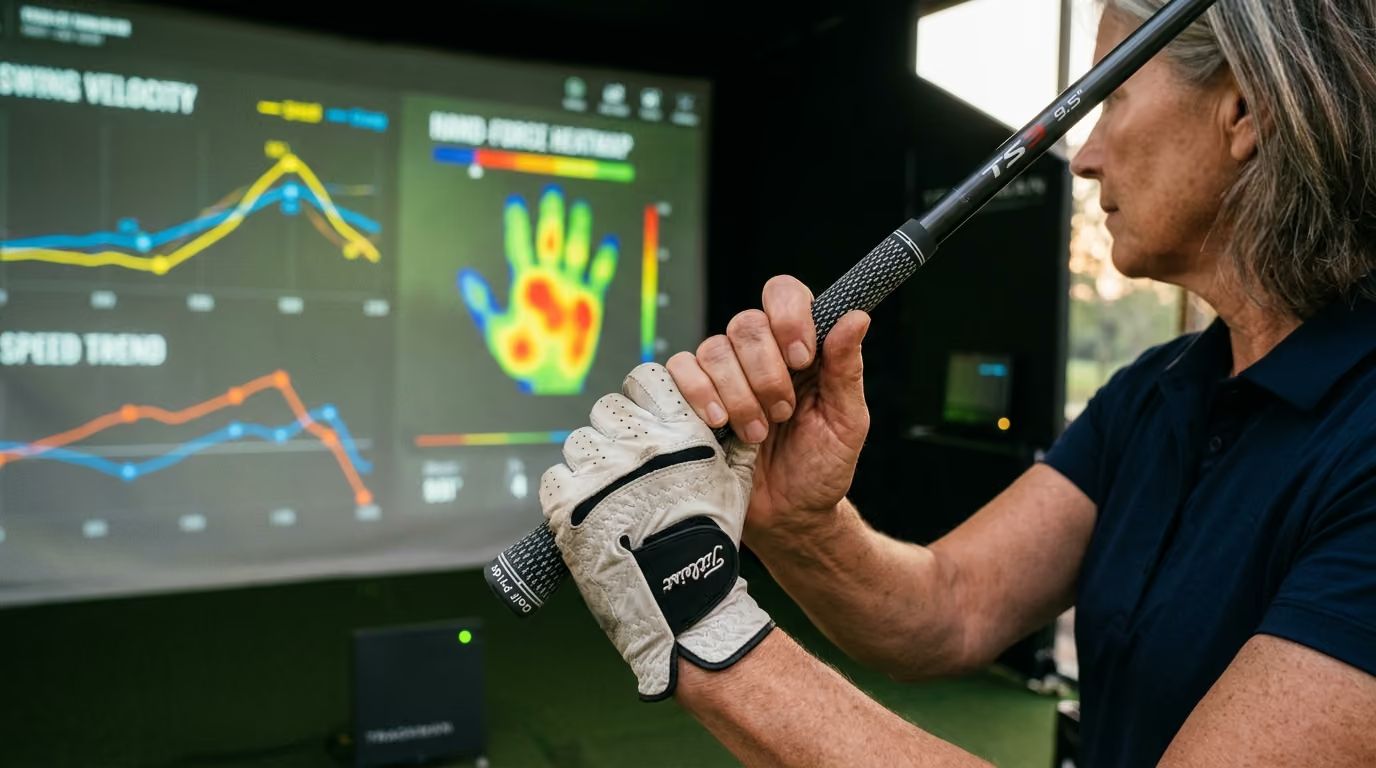
Tactical mobility routines help traveling golfers unlock tight hips and preserve their full swing speed after long flights or road trips.




Many golfers believe that preparing for a golf trip is just about packing their clubs and booking their tee times. They assume that physical preparation is something you only need to worry about when you are playing at your local club. This view is backward, and it often leads to ruined trips. The actual physical toll of travel begins the moment you sit in your car or board your flight.
Sitting in a cramped seat for hours actively robs you of your swing speed. Your joints stiffen, your muscles deactivate, and your nervous system goes into hibernation. You cannot expect to swing your club at top speeds immediately after a long journey. This guide provides a complete system to keep your body moving well when you travel, helping you maintain Golf Performance and Recovery over the long haul.
Imagine you just arrived at a premier golf destination after a five-hour flight and a two-hour drive. The weather is perfect, the grass is green, and your tee time is in forty-five minutes. You rush to the locker room, change your shoes, and walk straight to the first tee box. You grab your driver and take a few fast practice swings to loosen up.
Your lower back feels tight, and your hips feel like they are locked in wet cement. You swing hard at your opening tee shot, but your body refuses to turn. The clubface strikes the ball off-center, sending it slicing into the deep rough. You also feel a sharp, sudden pinch in your lower back.
By the sixth hole, you are tired, stiff, and struggling to make a full shoulder turn. Your driving distance is twenty yards shorter than usual, and your swings feel mechanical. You find yourself swinging harder to compensate, which only increases your pain and frustration. This physical decline is the classic travel-induced performance slump that ruins many golf trips.
This scenario happens to thousands of recreational players every single year. They blame their poor play on bad luck or a lack of practice. In reality, their bodies were physically restricted by the journey itself. Understanding how travel impacts your muscles and joints is the first step toward preventing this slump.
To protect your swing on the road, you must understand the difference between flexibility and mobility. Flexibility is simply the passive length of a muscle when it is stretched. Mobility is your active control over a joint through its usable range of motion. For golfers over forty, usable range is the most critical metric for swing speed.
Having flexible hamstrings will not help your swing if your brain cannot control your hips. Your brain is constantly monitoring your joints to prevent injury. If your brain senses a lack of control in a certain range, it shuts down your power. Consequently, your swing slows down, and your body compensates by using your lower back. This guide will show you how to maintain your joint mobility so you can play your best.
According to physical therapy research, sitting in a seat for hours locks up four critical zones. These zones are your hips, your shoulders, your thoracic spine, and your neck. When you sit, your hip flexors are held in a shortened position. This tightness prevents your hips from rotating and clearing during the downswing.
Likewise, your upper back curves forward, which locks your thoracic spine in a flexed position. A stiff thoracic spine prevents you from making a full backswing turn. Your shoulders then roll forward, which narrows your swing arc and reduces your potential speed. Finally, your neck stiffens from looking down at phones or resting on travel pillows, which disrupts your balance.
Your body functions as a kinetic chain, meaning each joint affects the next. When your hips and thoracic spine stiffen, your lower back must twist to complete your turn. Your lower back is designed for stability, not rotation. Forcing your lower back to rotate leads to micro-tears and chronic pain. Keeping your hips and upper back mobile safeguards your lower spine from these destructive forces.
This travel-induced stiffness is not just a feeling; it is a measurable athletic drop. A comprehensive review of ten sports science studies showed that thirty percent of athletes experienced clear physical drops after travel. For golfers, travel fatigue directly impacts your driving accuracy and your putting touch. Your nervous system is simply less responsive after hours of sitting in a pressurized cabin.
Do not run straight to the driving range or the bar when you arrive at your destination. Instead, spend forty-five minutes completing a simple system called the grounding protocol. This protocol is designed to wake up your nervous system and restore your baseline movement. It acts as a physical bridge between travel mode and playing mode.
Start your protocol with a simple twenty-minute walk around your hotel or resort. Walk at a moderate pace, letting your arms swing naturally at your sides. This light aerobic movement pumps fresh blood to your legs and flushes out metabolic waste from sitting. Focus entirely on taking slow, deep breaths through your nose to calm your nervous system.
After your walk, find a quiet carpeted area in your room or near the clubhouse. Spend fifteen minutes completing low-intensity movements to open up your tightest joints. Do not force your body into painful positions or deep stretches. Keep your movements gentle and fluid to restore your natural range of motion.
Drink sixteen ounces of clean water during this post-travel transition period. High-altitude flying and air-conditioned cars are highly dehydrating, which makes your muscles stiff. Avoid drinking alcohol or sugary sodas until you have fully hydrated your system. This simple protocol prepares your body for the physical demands of the golf course.
Before you start any physical routine on the road, you should assess your body. Doing random exercises without a plan is rarely effective. Instead, use two simple self-tests to identify your specific physical limits. These tests take only five minutes and require no special equipment.
Ankle mobility is critical for maintaining your posture during your swing. To test your ankles, find a wall in your hotel room. Kneeling on one knee, placing your front foot about four inches away from the wall. Keep your heel flat on the floor, then push your knee forward to try and touch the wall.
If your knee can touch the wall without your heel lifting, your ankle mobility is sufficient. If your heel lifts or your knee cannot reach, your ankles are tight. Tight ankles prevent you from shifting your weight correctly during the downswing. Focus on stretching your calves and rolling your feet to fix this issue.
Repeat this test on both legs to check for any imbalances. Many golfers find that one ankle is significantly tighter than the other. This imbalance can cause you to slide your hips instead of turning them. Addressing this imbalance is key to building a more consistent swing path.
Seated rotation testing shows how well your upper back rotates without help from your hips. Sit tall on a chair or the edge of your hotel bed. Place a golf club behind your shoulders, holding it in place with your elbows. Keep your knees squeezed together and your feet flat on the floor.
Slowly rotate your shoulders to the right as far as you can without moving your knees. Repeat the movement to the left and compare the two sides. You should be able to rotate your shoulders forty-five degrees in each direction. If your rotation is limited, your thoracic spine is stiff.
This restriction will force your lower back to twist during your swing, which causes pain. If you fail this test, prioritize the A-Frame stretch and the Brettzel in your routine. These exercises are specifically designed to restore your upper back mobility. Tracking your progress over time will help you play pain-free.
You do not need a fully equipped gym to keep your body ready for golf. This four-step hotel room routine targets the exact joints that tighten during travel. Perform this circuit every morning of your trip to unlock your swing.
The A-Frame stretch is an excellent way to unlock your upper back and your hips. Start by standing with your feet wider than shoulder-width apart. Bend at your hips and lower your torso until it is parallel to the floor. Place your right hand flat on the carpet directly beneath your chest.
Bend your left elbow and place your left hand on the back of your neck. To start the movement, focus entirely on turning your trail hip back. As you turn your hip, rotate your left shoulder toward the ceiling. Keep your eyes on your rotating elbow to guide your neck movement.
Hold this turned position for two full seconds while exhaling deeply. Slowly rotate back to the starting position and repeat the movement ten times. Switch hands and repeat the sequence to open your other side. This exercise restores the rotational capacity of your thoracic spine.
Your thoracic spine is designed to rotate seventy degrees in each direction. When you sit in a car or plane, this area becomes locked in a flexed position. This flexed position physically blocks your ability to rotate your shoulders. By restoring thoracic rotation, you can make a wider backswing without swaying off the ball. This directly leads to more consistent ball striking and increased clubhead speed.
Tight hips limit your swing rotation and force your lower back to overwork. The 90/90 stretch directly targets your hip rotators to restore your turn. Sit flat on the floor with your knees bent and your feet flat. Let both knees fall to the right side, forming two ninety-degree angles with your legs.
Your right thigh should point straight ahead, and your left thigh should point directly to the side. Sit up as tall as you can, keeping your spine straight and long. Focus entirely on pushing your front knee down into the carpet. Slowly hinge forward from your waist, keeping your chest proud.
Do not round your lower back as you lean forward over your right leg. Hold this stretch for thirty seconds while breathing deeply, then swap your leg positions to stretch your left hip. This movement directly improves your ability to rotate through your hips during the swing.
Your golf swing requires internal rotation in your trail hip during the backswing. It also requires internal rotation in your lead hip during the downswing. Sitting for long hours holds your hips in external rotation, which limits this crucial internal range. The 90/90 stretch addresses both internal and external rotation at the same time. Restoring this range allows you to clear your hips smoothly through impact.
The Brettzel is a comprehensive stretch that addresses both hip rotation and upper back mobility. Lie flat on your right side on the carpeted floor. Pull your left knee up toward your chest until it is bent at ninety degrees. Use your right hand to hold your left knee firmly against the floor.
Bend your right knee back behind you, reaching down to grab your right foot with your left hand. If you cannot reach your foot, you can loop a hand towel around your ankle. Once you have a grip, focus entirely on rolling your left shoulder back toward the floor. Keep your left knee pinned to the ground with your right hand.
Inhale deeply through your nose, then exhale as you let your chest sink closer to the carpet. Hold this deep stretch for one minute, then swap your setup to stretch the opposite side. This total-body movement releases tension along your lateral line and chest.
This stretch targets your entire myofascial sling system. These slings are diagonal lines of muscle and connective tissue that run across your body. They are responsible for transferring power from your feet to your hands during the swing. When these lines are tight, your power transfer is disrupted. The Brettzel opens these pathways, allowing for a more effortless and powerful swing.
Mobility is useless without the stability to control it. The Superman exercise strengthens your lower back and posterior chain muscles. Lie flat on your stomach with your legs straight and your arms stretched overhead. Keep your neck long by looking down at the floor throughout the movement.
Squeeze your glutes and lower back muscles to lift your chest, arms, and legs off the carpet. Lift only as high as is comfortable, making sure you do not pinch your lower back. Focus entirely on squeezing your shoulder blades together at the top of the lift.
Hold this contracted position for two seconds to activate your postural muscles. Slowly lower your body back to the floor with control. Complete three sets of ten repetitions to prepare your back for the physical forces of the swing.
Maintaining your spine angle is critical for solid ball contact. If your lower back and glutes are weak, your posture will collapse during the downswing. This collapse often leads to early extension, where your hips slide toward the ball. The Superman exercise trains your posterior muscles to hold your spine angle steady. This stability allows you to rotate with confidence and consistency.
Traveling often means you lack access to a proper weight room. You can pack a simple set of resistance bands in your suitcase to solve this. Resistance bands are light, cheap, and highly effective for maintaining your golf strength training on the road.
The Pallof Press trains your core muscles to resist unwanted rotation, which protects your lower back. Start by wrapping a medium resistance band around a secure object like a door handle. Stand sideways to the door and hold the handle of the band with both hands.
Step away from the door until you feel light tension pulling you toward the anchor point. Hold your hands close to your chest, keep your feet shoulder-width apart, and bend your knees slightly. To perform the exercise, slowly press your hands straight out in front of your chest.
Focus entirely on keeping your belly button pointing straight ahead. Do not let the band pull your torso toward the door as your arms extend. Hold the extended position for two seconds, then slowly return your hands to your chest. Complete three sets of ten repetitions on each side to activate your deep core stabilizers.
Many golfers think their core's main job is to twist the body. In reality, your core must resist unwanted twisting to protect your spine. This ability is especially critical during the high-speed deceleration phase of your swing. The Pallof Press builds this anti-rotational strength, creating a solid foundation for your torso. It protects your lower back from injury while allowing your shoulders to rotate fully.
Your glutes are the power source of your golf swing, but they often go to sleep during travel. Monster walks are the absolute best way to wake them up. Place a small loop band around your ankles and stand with your feet hip-width apart.
Lower your hips slightly into a shallow golf posture, keeping your back flat. Step laterally to the right with your right foot, then step your left foot in to follow. Focus entirely on keeping your feet pointing straight forward as you step.
Make sure your knees do not collapse inward against the resistance of the band. Take ten slow steps to the right, then reverse the direction to take ten steps back to the left. Repeat
Follow Golfergy for practical insights on performance, mobility, recovery and healthy ageing. Stay connected for new articles, research-led guidance and ideas to help you play better for longer.


Explore practical resources on performance, recovery, mobility and golf longevity.
Read the Blog