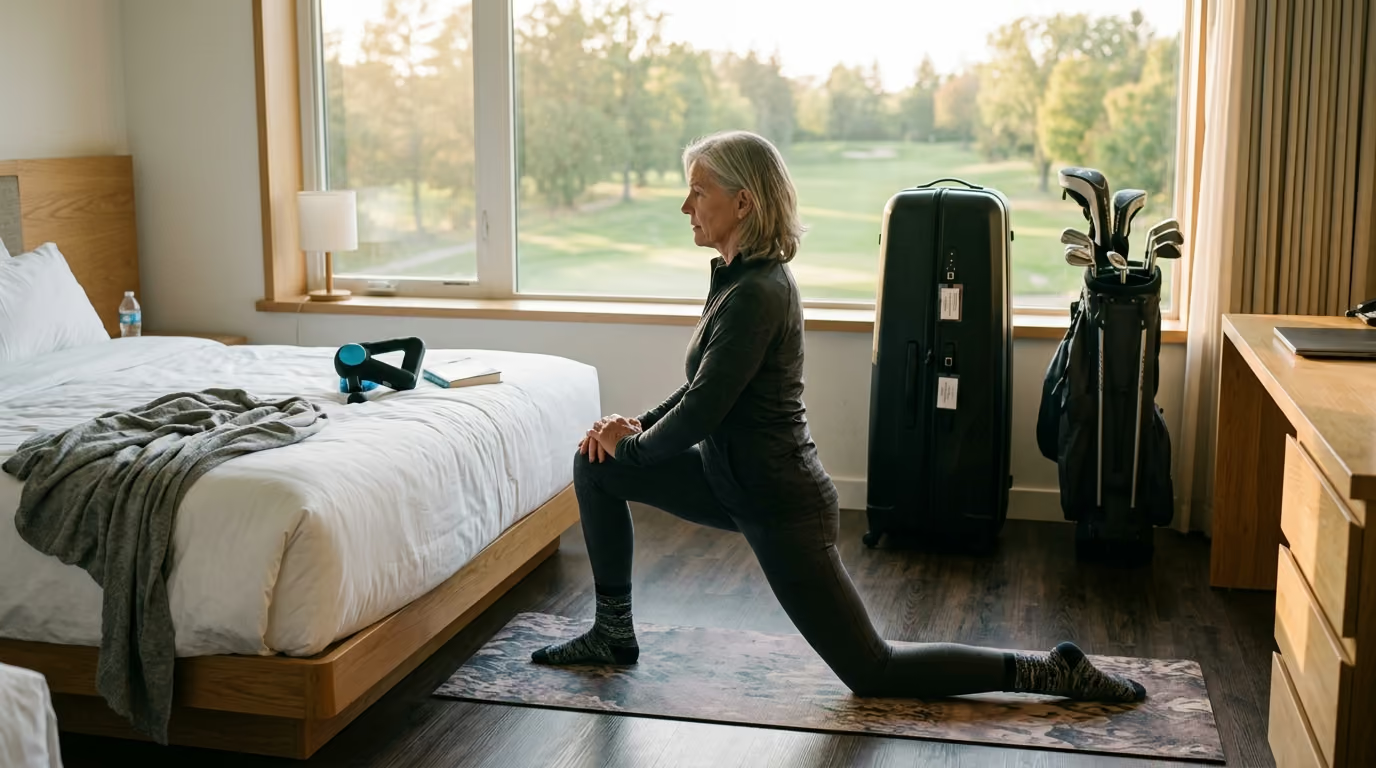
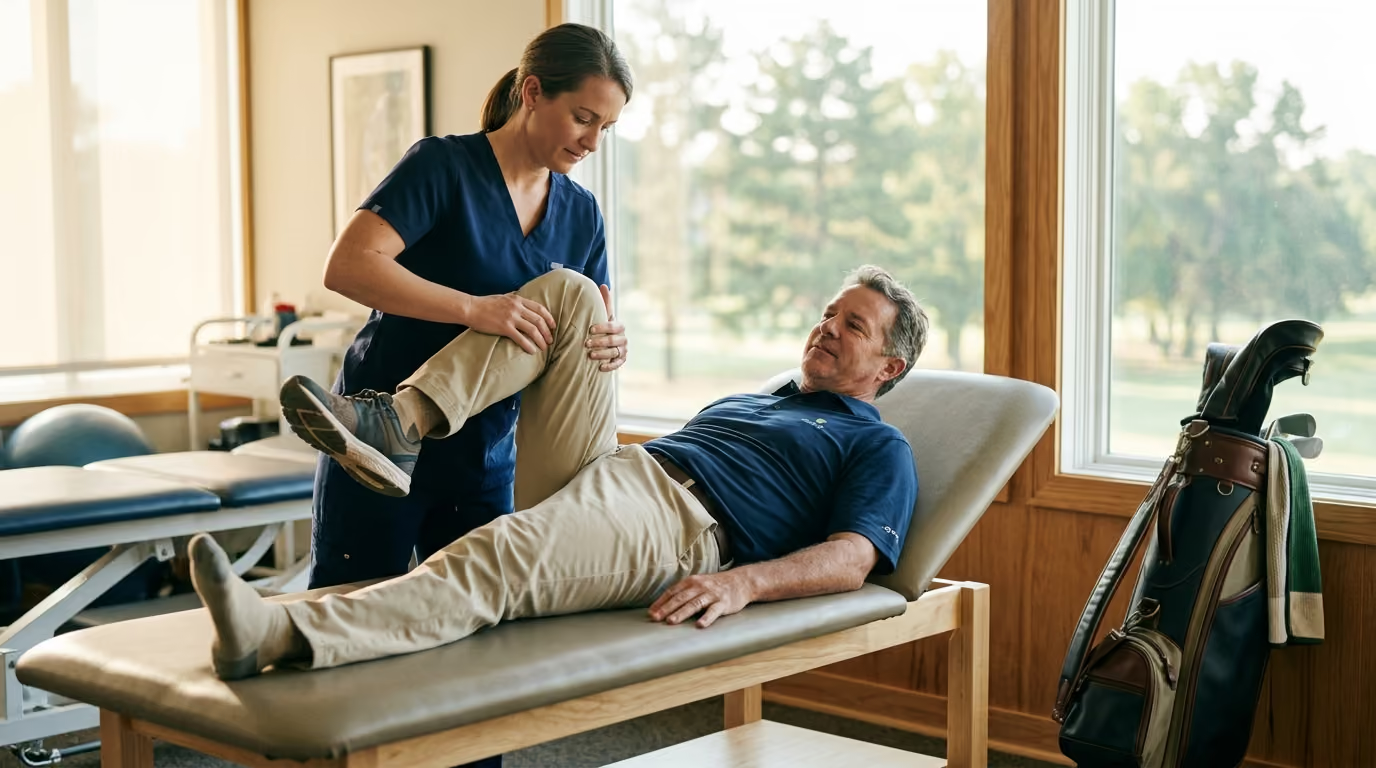
Soft tissue management helps golfers relieve tight muscles and improve mobility without sacrificing the explosive power needed for a smooth swing.




Many players arrive at the first tee and begin pulling their limbs into deep stretches. They pull their arms across their chest. They bend over to touch their toes. They hold these positions for thirty seconds or more. This seems like a smart way to prepare for a round of golf.
Yet physical training research shows that long static holds right before explosive activity can reduce muscular power. Your muscles become too loose. They lose the springy tension required to generate high clubhead speed. This is why we need a different approach to getting ready.
Soft tissue management, particularly self-myofascial release, is a superior choice. It prepares your body without draining your power. Instead of stretching the muscle beyond its resting length, you apply pressure to specific target areas. This technique targets the nervous system. It reduces tension while keeping your muscles ready to fire.
Over-forty golfers often struggle with stiff joints and chronic tightness. Trying to force a stiff muscle to stretch can trigger a protective reflex. The muscle actually tightens up further. Using SMR solves this problem by relaxing the muscle first.
This guide explains how to use simple tools to address key areas in your body. We will focus on the lats, the glutes, and the forearms. These three zones control your swing plane, your rotation, and your grip. Mastering this physical discipline will protect your joints. It will also help you play better for a longer period of time. It is a vital component of healthy ageing habits.
You are standing on the fourteenth tee box. You have played well for the first nine holes. Your swing felt smooth and your rhythm was excellent. Now, your body is starting to feel heavy.
You take a practice swing. Your shoulders do not want to turn fully. You feel a pull in your upper back and shoulder blades. When you swing at the ball, you slice it into the right rough.
This scenario is very common for mature golfers. As fatigue sets in, tight tissues begin to limit your movement. Your body naturally looks for the path of least resistance. It makes silent adjustments to complete the swing.
If your lats are tight, you cannot raise your arms fully without arching your lower back. This movement fault is known as a reverse spine angle. It places incredible stress on your lumbar spine. It is one of the top causes of back pain after a round.
If your glutes are tight, you cannot rotate your hips properly. You might find yourself sliding your hips toward the target instead of turning. Or you might stand up out of your posture during the downswing. This is called early extension. It causes inconsistent ball striking and thin shots.
Finally, your forearms control how you hold and release the club. After several holes, your grip tightens. This tight grip sends tension up your arm. It can lead to micro-tears in the tendons around your elbow.
Recognizing these patterns is the first step toward injury prevention methods. If you feel these physical changes on the course, your soft tissues are already signaling for help. We must address these issues before they become chronic injuries that keep you off the course.
Many people believe that foam rolling physically breaks down scar tissue. They picture the roller acting like a rolling pin on bread dough. This is a common misunderstanding. Human fascia is incredibly strong. It takes massive amounts of force to actually deform this tissue.
Instead, SMR works by communicating with your nervous system. When you apply pressure to a tight spot, you stimulate sensory receptors. These receptors are called Golgi tendon organs and Ruffini endings. They monitor muscle tension and pressure.
When these receptors feel steady pressure, they send a message to your brain. The brain realizes the muscle is under safe pressure. It sends a signal back to the muscle to relax. This feedback loop is called autogenic inhibition.
This neurological response helps explain why SMR is so effective before a round. It lowers the tone of overactive muscles. It does this without reducing their ability to contract when you swing.
To understand how this helps your swing, we must look at the joint-by-joint approach. This physical model was developed by physical therapists and golf researchers. It explains that the human body is a stack of joints.
Each joint has a specific primary function. Some joints require mobility. Others require stability.
The ankles need mobility. The knees need stability. The hips need mobility. The lumbar spine needs stability. The thoracic spine needs mobility. The scapula needs stability.
If a mobile joint becomes stiff, the nearest stable joint has to move to compensate. For example, if your hips are tight, your lower back must twist to complete your swing. Your lower back is not built to twist. It is built for stability.
By using SMR on your hips, you restore their natural mobility. This protects your lower back from twisting too much. It prevents pain and injury.
SMR creates a specific window of opportunity. Research shows that pressure therapy increases your range of motion for ten to thirty minutes. This change is temporary.
To make the change permanent, you must move through your new range of motion immediately. You should follow SMR with dynamic movements or golf swings. This teaches your brain how to control the new space you just created. It is the core of improving your mobility.
You do not have a foam roller on the fairway. You cannot lie on the grass to roll your hips. You still need ways to release tension during a round.
You can use your golf cart or a club to perform quick adjustments. These movements will help restore some mobility when you feel your body tightening up.
To address tight lats, use the roof frame of your golf cart. Stand facing the side of the cart. Grab the vertical support beam with your trail hand. Your palm should face inward.
Step your feet back until your body is slightly bent at the waist. Slowly push your hips away from the cart. Keep your arm straight. Feel the stretch run down the side of your torso.
Hold this position for three deep breaths. Exhale slowly. Focus entirely on expanding your rib cage with each breath. This relaxes the lat muscle.
To release tight glutes, use the passenger seat or the rear bumper of the cart. Stand on one leg. Place the ankle of your other leg across your thigh, just above the knee.
Hold onto the cart for balance. Slowly lower your hips back and down, as if sitting in a chair. Keep your chest up.
You should feel a deep stretch in your outer hip. Hold this for five seconds. Stand up, then repeat twice. This increases blood flow to your glutes.
For your forearms, use your golf club. Hold the club by the head with your lead hand. Extend your trail arm straight out in front of you. Your palm should face up.
Use the grip end of the club to press into the meaty part of your forearm. Press gently. Find a tender spot.
Once you find a spot, flex your wrist up and down. Do this five times. Move the club to a new spot and repeat. This simple pin-and-stretch method relieves forearm tension before your next shot.
The latissimus dorsi is the largest muscle in your upper body. It connects your arm to your spine and pelvis. When this muscle is tight, your golf swing suffers.
Tight lats prevent you from getting your hands high in the backswing. They also make it hard to turn your chest fully. This limitation often leads to a short backswing or an over-the-top motion.
To roll your lats, you will need a medium-density foam roller. Lie on your side on a comfortable mat. Place the roller under your armpit, running perpendicular to your body.
Extend your bottom arm straight out along the floor. Your palm should face the ceiling. Keep your knees bent to support your weight.
Slowly roll your body down. The roller should move from your armpit down the side of your rib cage. Stop when you reach the bottom of your shoulder blade.
Do not roll down onto your lower ribs. Move at a very slow pace of about one inch per second.
When you find a tender spot, stop moving the roller. Keep your body weight on that spot. Take three slow, deep breaths.
Now, add the active release technique. While keeping pressure on the spot, slowly sweep your extended arm upward. Move it toward your head, then sweep it back down toward your hip.
Perform this arm movement five times. This is called flossing. It forces the lat muscle to slide underneath the pressure point.
Repeat this process on the other side. Spend about two minutes on each side. Do this daily to see a noticeable improvement in your shoulder turn.
The glute muscles are the power plant of the golf swing. Your gluteus maximus provides the explosive power to turn your hips. Your gluteus medius stabilizes your pelvis when you shift your weight.
If these muscles are tight, your swing will lose power. You will also experience early extension. Your hips will push toward the ball during the downswing, causing poor contact.
To release these muscles, a lacrosse ball is the best tool. It is small and firm enough to penetrate the deep layers of tissue. You can perform this on the floor or against a wall.
If you are new to this, start by using a wall. The wall allows you to control how much weight you apply to the ball.
Stand next to a clear wall. Place the lacrosse ball on the fleshy part of your outer hip. This is where your gluteus medius sits, just below the pelvic bone.
Lean your body weight into the ball against the wall. Slowly search the area by moving your hips up, down, left, and right.
Once you find a sensitive spot, stop moving. Take a deep breath and let your hip sink into the ball.
To add active release, perform a standing clamshell. Keep the ball pinned against the wall. Slowly lift your knee on that side, then rotate your knee outward.
Return your knee to the starting position. Repeat this rotation five times. This movement stretches the glute under the pressure of the ball.
To target the gluteus maximus, lie on your back on the floor. Place the lacrosse ball under one side of your glutes.
Cross that ankle over your opposite knee. This opens up the hip joint and exposes the deeper muscle fibers.
Roll slowly until you find a tight spot. Hold the position for thirty seconds while breathing deeply.
Repeat this sequence on both hips. Spend two minutes on each side. This routine is excellent for restoring hip mobility and relieving lower back stress.
Your hands and forearms are your only connection to the golf club. They absorb a massive amount of vibration with every shot. This constant stress can lead to chronic elbow pain.
When I developed medial epicondylitis, commonly known as golfer's elbow, I thought I needed complete rest. Six weeks off the course did nothing to help. I finally learned that active recovery with a flexbar was the actual solution. It taught me that treating golf injuries requires loading the tissue properly, not just sitting on the couch and hoping for the best.
Using a lacrosse ball to manage forearm tissue is a key part of this loading process. It prepares the muscles to handle the force of the swing. It also helps remove the tight knots that cause pull on the elbow tendons.
To release your forearm flexors, sit at a table or desk. Place a lacrosse ball on the flat surface.
Rest your forearm on top of the ball. Your palm should face upward. Use your opposite hand to press down on your arm, increasing the pressure.
Roll your arm slowly over the ball. Move from just below your elbow crease down to your wrist. Avoid rolling directly over the bony points of your elbow.
When you find a tender spot, stop rolling. Hold the pressure constant.
Now, perform the pin-and-stretch movement. Slowly extend your hand backward, pointing your fingers toward the floor. Then, flex your wrist forward, making a loose fist.
Repeat this wrist movement ten times. You will feel the muscle sliding under the ball.
To target your forearm extensors, turn your arm over. Your palm should now face down.
Place the ball on the top part of your forearm, just below the elbow. Apply pressure with your other hand.
Find a tight spot and hold. Flex and extend your wrist ten times. This helps restore flexibility to the top of your arm.
Perform this routine on both arms after every practice session. It is a critical component of post-round recovery routines.
Many golfers approach fitness with an aggressive mindset. They believe that more pain equals more progress. This attitude can actually ruin your soft tissue routine.
The first common mistake is applying too much pressure. If you press too hard, your body perceives the pain as a threat. Your muscles will contract to protect themselves.
This reaction is called muscle guarding. It completely defeats the purpose of the release work. You want to aim for a moderate discomfort level of about six out of ten.
The second mistake is rolling directly over bones and joints. Never roll your foam roller over your lumbar spine. Your lower back does not have the protection of a rib cage. Rolling this area can cause spinal joints to lock up.
Also, avoid rolling over the bony bump on the side of your hip. This bump is the greater trochanter. Pressing a hard ball into this bone can irritate the bursa, causing bursitis. Keep your rolling on the soft, fleshy parts of the muscle.
The third mistake is moving too quickly. Many golfers roll back and forth on a foam roller at high speed. This rapid movement looks like rolling dough.
Fast rolling acts as a physical stimulant. It increases blood flow, but it does not release deep tension. To trigger a neurological release, you must move slow. A pace of one inch per second is ideal.
Finally, many players hold their breath when they feel a tight spot. This is a natural reaction to discomfort.
Holding your breath triggers your sympathetic nervous system. This is your fight-or-flight response, which keeps your muscles tense. You must practice deep, slow abdominal breathing.
Breathing out slowly signals your parasympathetic nervous system to relax. This allows the muscle to soften under the roller.
There are also specific medical conditions where you must avoid SMR. Do not roll over acute fractures, open wounds, or bruised areas.
If you suffer from severe osteoporosis, avoid deep pressure work. The same applies if you have deep vein thrombosis or advanced neuropathy. Always consult a physician if you have underlying medical conditions.
Your physical issues are often triggered or made worse by your golf equipment. Even the best SMR routine cannot overcome gear that does not fit your body.
Take a close look at your golf grips. If your grips are too small, your hands must work harder to hold the club. This causes you to squeeze the club too tightly.
This extra pressure travels up your forearms, causing muscle tightness and elbow strain. Upgrading to midsize or jumbo grips can help. They allow your hands to relax, reducing forearm fatigue.
Your golf shoes also play a major role in how your body moves. Many modern golf shoes are extremely stiff to provide stability.
If your shoes are too stiff, they can lock up your ankle joints. When your ankles cannot move, your hips must twist more to compensate.
This extra movement can overload your glutes and lower back. Look for shoes that offer a balance of support and natural flexibility.
How you carry your clubs is another major factor. Carrying a heavy bag on one shoulder puts massive strain on one side of your body.
This habit causes your latissimus dorsi on that side to tighten up. It can ruin your posture and your swing plane.
If you walk the course, use a push cart or a dual-strap bag. This distributes the weight evenly across both shoulders, protecting your back.
Choosing the right recovery tools is also key. A soft foam roller is best for sensitive areas like the upper back.
A firm lacrosse ball is perfect for the glutes and feet. Keep these tools in your locker or your travel bag. They are excellent investments in your personal performance resources.
Creating a sustainable routine is the secret to keeping your body young. You do not need to spend hours rolling every day.
Consistency is far more valuable than duration. Spending ten minutes every day on your soft tissues will produce better results than rolling for an hour once a week.
Try to pair your SMR work with an existing habit. You can roll your lats while watching the evening news. You can keep a lacrosse ball under your desk to roll your feet and forearms while working.
Make SMR a key part of your pre-round warm-up. Spend five minutes rolling your glutes and lats before you head to the driving range. This unlocks your joints, preparing you for a fuller turn.
Follow your rolling with some simple dynamic movements. Perform some gentle bodyweight squats or arm reaches. This teaches your brain how to use the newly released range of motion.
After your round, spend another five minutes on recovery. Roll out your forearms and glutes to flush out metabolic waste. This simple habit will significantly reduce muscle soreness the next day.
As we age, our tissues naturally lose water and elasticity. SMR acts like a self-massage, drawing fresh blood and hydration into the muscles.
This process keeps your fascia healthy and pliable. It allows you to maintain your swing speed as the years pass.
Taking care of your body is a continuous process. By investing a few minutes each day, you protect your joints and preserve your swing. This is the key to enjoying this great game for decades to come.
Managing your soft tissues is one of the most effective ways to preserve your golf swing. By targetting the lats, glutes, and forearms, you prevent injuries and improve your power on the course.
To protect your swing and play pain-free, treat your soft tissues as a high-precision system that needs daily maintenance rather than occasional emergency repair.
Follow Golfergy for practical insights on performance, mobility, recovery and healthy ageing. Stay connected for new articles, research-led guidance and ideas to help you play better for longer.


Explore practical resources on performance, recovery, mobility and golf longevity.
Read the Blog