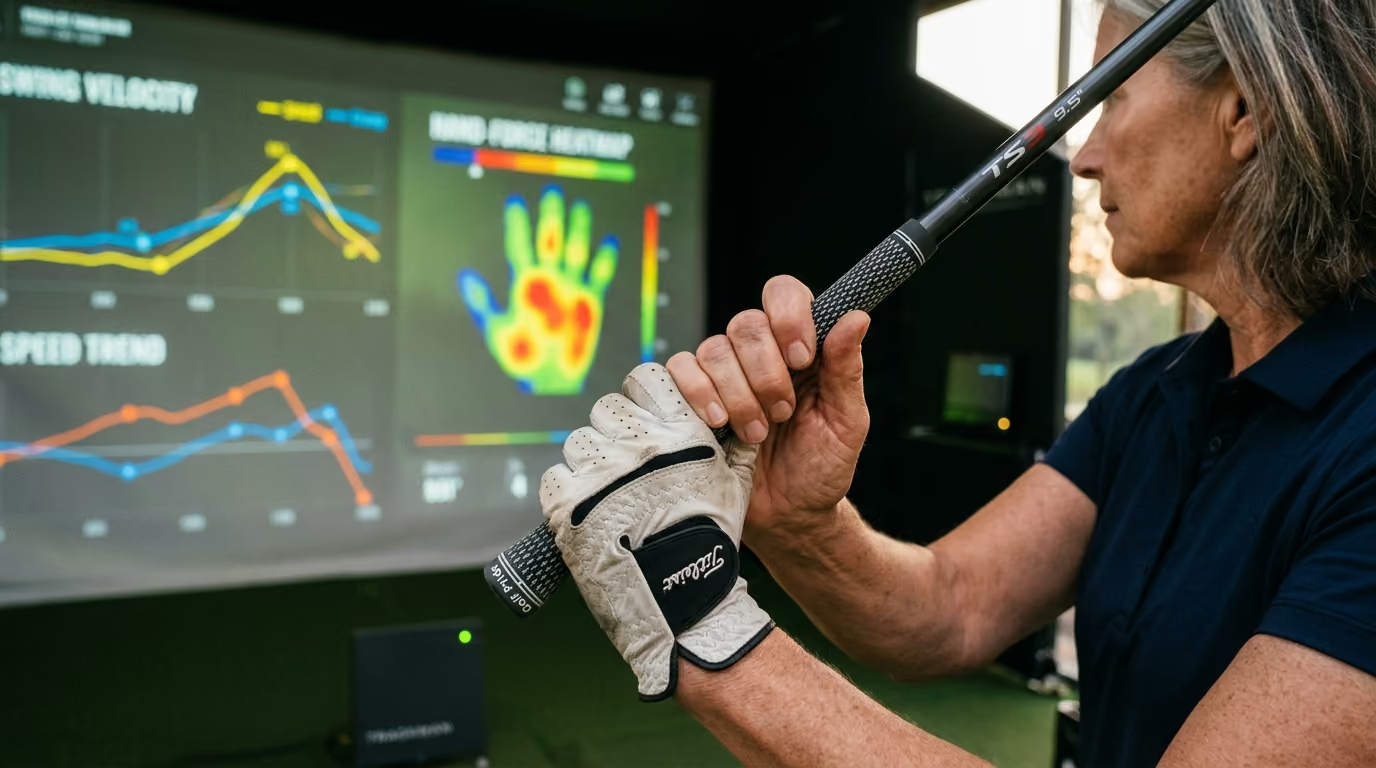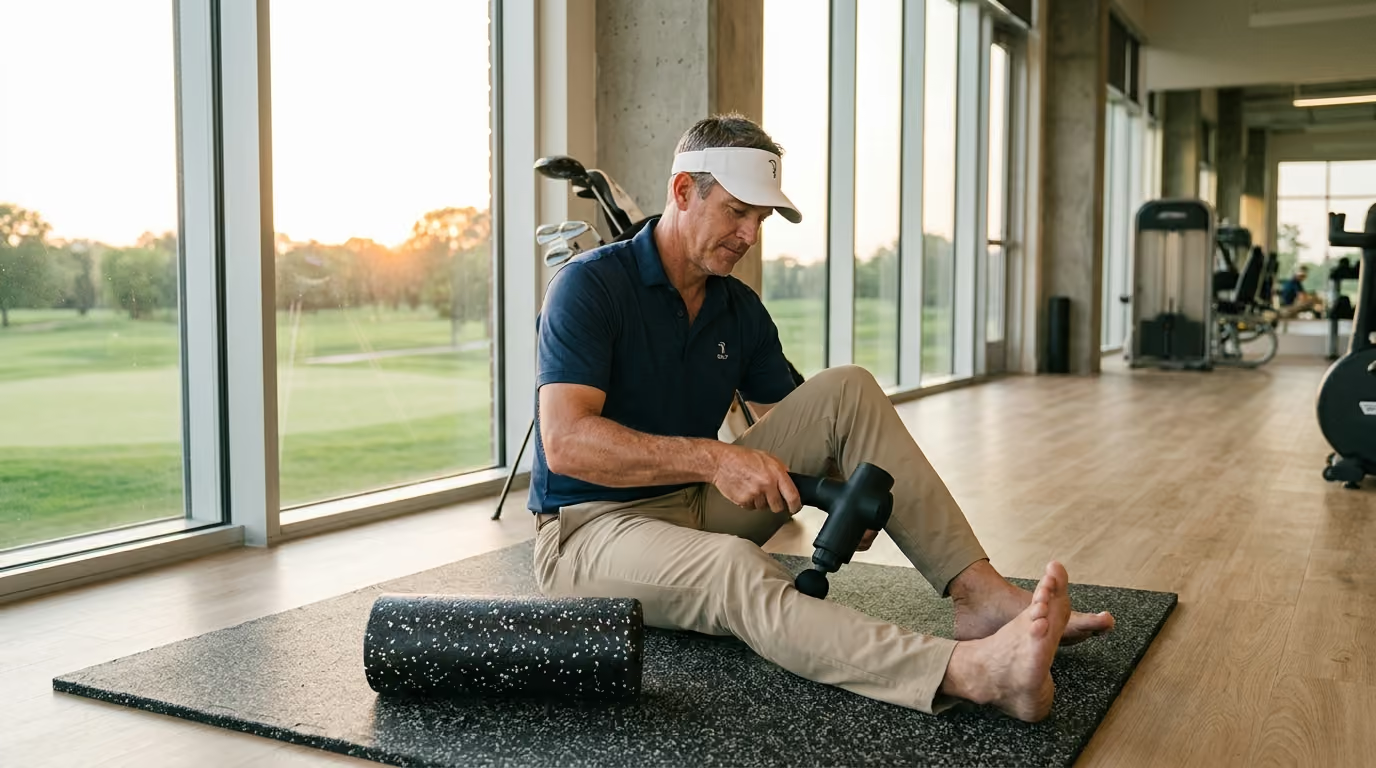

A smoother golf swing and faster muscle recovery come from using foam rollers and massage guns to restore full hip rotation and flexibility.




Soft tissue maintenance is the deliberate practice of using physical tools to keep your muscles, tendons, and fascia flexible and functional. It is not a replacement for medical care, nor is it a way to force your joints beyond their healthy limits. True tissue maintenance is an active process of restoring the natural elasticity of your body so you can move without restriction.
Many recreational players believe that stretching is the only way to stay limpy on the course. However, stretching alone often fails to target the deeper layers of connective tissue that become stiff from repetitive motion. This guide will examine the actual science of self-myofascial release, compare different tools, and give you a simple routine to use before and after your rounds. By understanding how to care for your muscles, you can protect your joints and keep your swing smooth for years to come.
The sun is beginning to set, and you are standing on the fourteenth tee of a challenging, tree-lined course. You felt great during the first nine holes, but now you notice a dull ache in your lower back. Your lead hip feels like it is locked in place. When you take your backswing, you cannot get a full turn without your lead knee buckling inward.
As you swing down, your lead hip resists the rotation needed to clear your body. Because the hip is stiff, your torso stalls before impact. Your hands try to compensate by flipping the clubhead at the ball. The result is a weak shot that lands short and right of your target, leaving you with a difficult recovery shot.
This scenario is common for golfers over the age of forty. During a round of golf, your muscles perform the same high-speed rotation dozens of times. As fatigue sets in, the nervous system tells your muscles to tighten to protect your joints from injury. This natural defense mechanism reduces your range of motion and alters your swing path.
When your lead hip loses its ability to turn inward, the force of your swing must go somewhere else. Usually, this force travels straight into your lower back or your lead knee. This leads to the familiar stiffness you feel in the parking lot after eighteen holes. Recognizing these physical limits during a round is the first step toward managing your mobility.
To understand how to fix these physical blocks, you must look at the science of self-myofascial release. Your muscles are wrapped in a thin, strong web of connective tissue called fascia. In a healthy body, this fascia is wet, slippery, and flexible. It allows your muscles to slide past one another smoothly as you turn your torso.
When you perform repetitive movements, or sit at a desk for long hours, your fascia can become dry and sticky. This stiffness is known as densification. Self-myofascial release uses tools like foam rollers and massage balls to apply pressure to these tight areas. According to research published in the Journal of Bodywork and Movement Therapies, this mechanical pressure changes the physical state of your fascia.
[Normal Fascia: Fluid & Slippery] -> (Repetitive Swing / Sitting) -> [Stiff Fascia: Dry & Sticky]
|
[Restored Movement: Pliable & Elastic] <- (Foam Rolling / SMR Applied) <----+
Fascia has a physical property called thixotropy. This means the tissue becomes more fluid and less sticky when warmth and pressure are applied. Think of it like cold honey in a jar. If you try to stir cold honey, it resists. If you warm it up and stir it, it becomes thin and flows easily.
Applying a foam roller to your muscles warms the tissue and coaxes the fascia into a more liquid state. This restores the correct viscoelastic parameters of your muscles. These parameters include resting muscle tone, stiffness, and elasticity. Keeping these tissues fluid is a key part of active injury prevention for mature players.
Your muscles operate on small electrical signals sent from your brain. When a muscle is overused, it can remain in a state of high electrical activity even when you are resting. This is common in a muscle called the longissimus dorsi, which runs along your spine.
During the golf swing, the mid-back portion of this muscle can become overactive. Research from the journal Sensors shows that self-myofascial release helps reduce this overactive bioelectrical signal. By applying pressure to the mid-back, you tell the nervous system to turn down the volume of these electrical signals. This allows the muscle to relax and return to its normal resting state.
Your fascia contains collagen fibers that produce tiny electrical charges when compressed. This is known as the piezoelectric effect. When you roll over a muscle, the mechanical pressure helps reorganize these charges within the fascial matrix.
This reorganization helps normalize tissue tension. It also improves local blood flow, which brings fresh oxygen and nutrients to the recovering muscle. Over time, this process helps prevent the buildup of chronic scar tissue that limits your swing.
For a golfer, the lead hip is the gateway to a powerful downswing. To finish your swing, your lead hip must rotate internally. If this rotation is limited, your body will compensate by tilting your pelvis or lifting your spine.
[Restricted Lead Hip Internal Rotation]
|
+---> [Pelvis Tilts Early] ---> [Spine Angle Changes / Loss of Posture]
|
+---> [Lower Back Absorbs Force] ---> [Post-Round Lumbar Soreness]
A study in the International Journal of Environmental Research and Public Health looked at how to improve this specific movement. Researchers found that combining foam rolling with dynamic stretching is highly effective. This combination increases both the internal rotation range of motion and the strength of the hip muscles. Using these two methods together prepares your body for the physical demands of the swing far better than stretching alone.
When you are on the course, you do not have access to foam rollers or massage guns. However, you can still use a quick physical cue to help release tension in your hips. This simple drill uses your own body weight to stimulate the nervous system and open up your hips.
Stand next to your golf bag with your feet placed shoulder-width apart. Hold a long club across your shoulders, keeping your posture tall. Focus entirely on turning your trail hip backward, keeping your lead foot flat on the ground.
Hold this turned position for five seconds while taking a deep breath. Now, slowly turn your torso the opposite way, focusing entirely on turning your lead hip backward. Repeat this movement five times in each direction before you hit your next shot.
This simple exercise does not replace a deep soft tissue session at home. However, it helps wake up the joints and normalizes the bioelectrical activity in your hips. It gives you a brief window of improved mobility so you can make a better swing on the remaining holes.
To create lasting changes in your tissue quality, you need a consistent daily routine. This routine uses a combination of foam rolling and dynamic stretching. It is designed to target the key areas that restrict the golf swing: the lead hip, the mid-back, and the lower legs. You can find more helpful routines on the Golfergy resources page.
+-------------------------------------------------------------------------+
| THE GOLFER'S DAILY MOBILITY ROUTINE |
| |
| Phase 1: Roll Lead Hip (60 sec) ---> Phase 2: Dynamic Hip (10 reps) |
| Target: Glutes & Rotators Target: Internal Rotation |
| |
| Phase 3: Roll Mid-Back (60 sec) ---> Phase 4: Roll Calves (60 sec) |
| Target: Longissimus Dorsi Target: Ankle Mobility |
+-------------------------------------------------------------------------+
This two-step sequence targets the external rotators and adductors of your lead hip. It is designed to quickly improve your internal rotation before you practice or play.
This sequence utilizes the science of muscle plasticity. The rolling warms the tissue and reduces resting tension. The dynamic stretch then teaches your nervous system how to use this new range of motion.
This exercise targets the thoracic portion of the longissimus dorsi muscle. It helps restore the independent rotation of your upper body, which is critical for a full backswing.
Regular thoracic rolling helps restore the natural curve of your upper back. This makes it easier to maintain your posture throughout your swing. It also reduces the rotational stress on your lower back, helping you stay pain-free.
Stiff ankles prevent you from shifting your weight properly during the transition of your swing. This release targets the calf muscles to improve your ankle mobility.
By keeping these tissues pliable, you help your body absorb the ground forces generated during the swing. This leads to a more stable base and more consistent ball striking. This routine is a highly effective way to use your time for long-term recovery.
Self-myofascial release is simple, but many golfers do it incorrectly. These mistakes can reduce the effectiveness of the session or even lead to injury.
Mistake 1: Rolling Too Fast ---> Triggers Protective Muscle Spasms
Mistake 2: Rolling Lower Back ---> Pinches Facet Joints & Stresses Lumbar Spine
Mistake 3: The Power Myth ---> Avoiding SMR Before Play (Thinking It Kills Power)
Many golfers use a foam roller like a rolling pin on bread. They roll back and forth as fast as they can. This rapid movement does not allow the tissue to change.
In fact, rapid rolling can trigger a protective reflex in your muscles. The nervous system senses the rapid pressure and tells the muscle to contract to protect itself. To get the benefits of thixotropy, you must roll slowly. Aim to move at a speed of about one inch per second.
When your lower back feels stiff, your first instinct may be to place the roller directly under it. This is a mistake. The lower back (lumbar spine) is designed for stability, and it does not have the protection of the rib cage.
Rolling the lower back can pinch the small facet joints of your spine. It can also cause the surrounding muscles to spasm in defense. If your lower back is stiff, focus your rolling on the hips and the mid-back instead. Opening these areas will naturally relieve the pressure on your lower spine.
Some players believe that soft tissue work relaxes muscles too much, causing a loss of swing speed. They avoid rolling before a round because they worry it will decrease their power.
Research shows this concern is unfounded. Meta-analyses in the Journal of Strength and Conditioning Research show that self-myofascial release does not hurt muscle performance. It improves your range of motion without reducing your explosive power. Rolling before a round is a safe and effective way to prepare your body for play.
Percussion guns are popular, but they are often used incorrectly. Some golfers use them at high speeds directly on muscles that are highly inflamed from a hard workout.
Studies show that percussion therapy has limited evidence for reducing soreness when used immediately after hard exercise. Using a heavy massage gun on damaged muscle fibers can actually increase local swelling. For recovery from soreness, a gentle foam roller is often a better choice than an aggressive percussion device.
With so many mobility tools on the market, it can be difficult to know which ones are worth your money. Choosing the right tool depends on your physical needs and your experience level.
Smooth Foam Roller ---> Best for beginners, general recovery, & broad muscle groups
Grid / Textured Roller -> Best for localized knots (can trigger defensive tightening)
Massage Ball ---> Best for targeted hip work (glutes, piriformis, & feet)
Percussion Gun ---> Best for warming up tissue & improving blood flow pre-round
A standard, smooth foam roller is the best starting point for most golfers. These rollers distribute pressure evenly across a wide area of muscle. This makes them ideal for sensitive areas like the upper back and calves.
Look for a roller made from high-density molded foam. These rollers maintain their shape over time, unlike cheaper open-cell foam options. A smooth roller is gentle enough to use daily without irritating your tissues.
Textured rollers feature ridges and bumps designed to mimic a massage therapist's hands. These rollers apply more intense pressure to specific spots.
While useful for targeting stubborn knots, they can be too painful for some players. If a tool causes you to hold your breath or tense up, it is too firm. For general soft tissue health, a smooth roller is usually sufficient.
For deep, targeted work, a small massage ball is highly effective. You can use a lacrosse ball, a tennis ball, or a specialized mobility ball.
These tools are perfect for reaching the deep external rotators of your hips. Because they are small, they can target areas that a wide foam roller cannot reach. Place the ball against a wall and lean into it to control the amount of pressure applied to your hips.
Handheld percussion guns use rapid pulses to stimulate your muscles. These devices are excellent for increasing blood flow and reducing the perception of muscle tightness.
They are especially useful during a pre-round warm-up, as they can quickly stimulate the nervous system. However, they do not stretch the fascia in the same way a foam roller does. For best results, use a percussion gun to warm up your muscles, and use a foam roller for deep recovery work.
Prepare your lead hip with a combination of slow foam rolling and dynamic stretches before you tee off to keep your swing turn smooth and protect your lower back.
Research shows that both tools are useful, but they serve different purposes. A foam roller is more effective at restoring the physical properties of your muscles, such as stiffness and elasticity. A percussion gun is excellent for increasing blood flow and reducing the sensation of muscle fatigue. For post-round recovery, start with a foam roller to address tissue length, and use a percussion gun on a low setting to relax tight spots.
If you are experiencing acute pain, you should avoid rolling your lower back directly. Instead, focus on the areas that control the movement of your pelvis, such as your glutes, hamstrings, and hip flexors. Tightness in these muscles often pulls your pelvis out of alignment, putting stress on your lower back. If your pain is severe or does not improve, consult a medical professional before continuing your routine. You can find more information about managing back discomfort on the Golfergy injury prevention page.
You do not need to spend hours rolling to see benefits. Research suggests that sixty seconds per muscle group is enough to improve your range of motion. Spend about thirty seconds rolling the entire muscle slowly, then spend another thirty seconds holding pressure on any particularly tight spots. A complete routine targeting your hips, back, and calves should take no more than ten minutes.
No, rolling should not be highly painful. There is a common belief that "more pain means more gain," but this is a myth. If the pressure is too intense, your body will view it as a threat and your muscles will contract to protect themselves. This defeats the purpose of the exercise. The pressure should feel like a deep, comfortable stretch. If you find yourself holding your breath or tensing up, reduce the pressure by using a softer roller or shifting some of your body weight off the tool.
Ankle mobility is critical for maintaining your posture during the golf swing. If your ankles are stiff, your heels may lift off the ground early during your downswing, leading to a loss of balance. This lack of mobility can also cause your knees to collapse inward, putting extra stress on your joints. Rolling your calves regularly helps keep these tissues flexible, allowing you to maintain a strong, stable base throughout your swing. For more tips on building a stable foundation, visit the Golfergy strength page.
Follow Golfergy for practical insights on performance, mobility, recovery and healthy ageing. Stay connected for new articles, research-led guidance and ideas to help you play better for longer.


Explore practical resources on performance, recovery, mobility and golf longevity.
Read the Blog