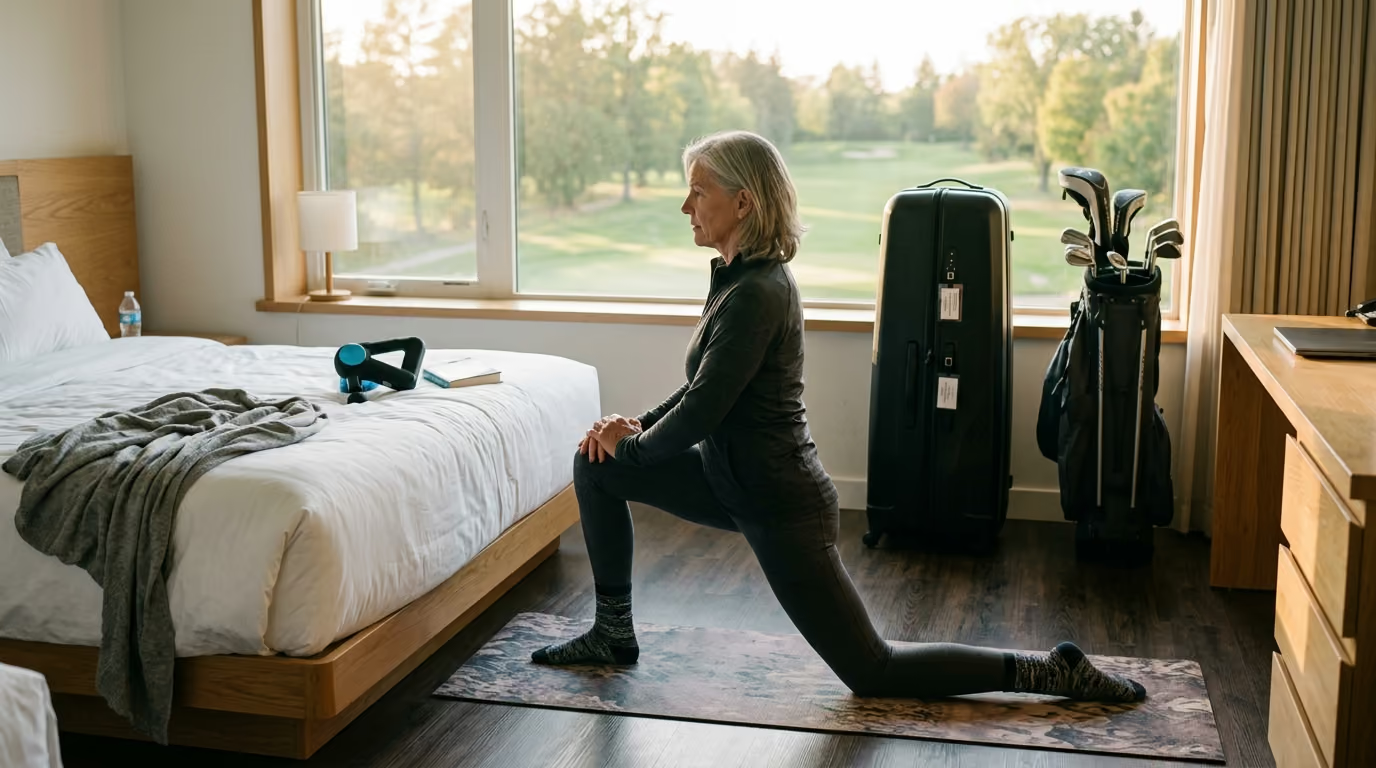
Lifelong shoulder health and pain-free golf swings come from strengthening the rotator cuff muscles that stabilize the joint through every round.




Many mature golfers accept shoulder pain as a normal part of aging. They search online for solutions to ease the dull ache after eighteen holes. They hope for a quick stretch to solve their problems.
The saddest thing I have seen in golf is watching lifelong playing partners slowly drop out of our weekend group. It usually starts with a nagging shoulder or knee issue they ignore until it requires surgery. That pattern is exactly why I became obsessed with golf longevity. We do not have to stop playing as we age, provided we do the right maintenance work between rounds.
Maintaining joint health is key to playing well past sixty. We must focus on the correct physical habits. This guide will help you understand your shoulders and keep them moving well.
We will focus on real biology and simple physical rules. You can protect your body and maintain your swing power. Our team wants to show you how to preserve your shoulders for life.
Let us look at a common situation on the course. You are standing on the tee box of the fourteenth hole. It is a long par four with a stiff breeze blowing.
You feel a dull ache in the front of your lead shoulder. Your backswing feels shorter than it did on the first tee. You try to force a big turn to reach the fairway.
Instead of a smooth rotation, you lift your arms. The lead shoulder pinches. Your trail elbow flies out wide.
The ball slices into the right rough. This physical fatigue leads to poor shots and joint strain. Your shoulder joint pays the price for this compensation.
This on-course fatigue is a classic sign of weak stabilizing muscles. Your large muscles are tired. Your small rotator cuff muscles are working too hard.
When these small muscles fail, your swing changes. You lift your arms instead of turning your torso. This movement puts your joints in a vulnerable position.
Over time, this habit causes micro-tears in your tendons. You might not feel them immediately. But they build up round after round.
Soon, the dull ache becomes a sharp pain. You start taking pain relievers before you play. You slowly lose the ability to swing with confidence.
To fix this issue, we must understand the shoulder. The shoulder is a shallow ball and socket joint. It relies on muscles rather than deep bone structure for stability.
The primary stabilizer is the rotator cuff. It is a group of four small muscles. Experts call this the SITS functional unit, according to clinical data from StatPearls.
These four muscles are the Supraspinatus, Infraspinatus, Teres Minor, and Subscapularis. They form a protective collar around the joint. Each muscle has a specific job during your swing.
The Supraspinatus helps initiate lifting your arm. The Infraspinatus and Teres Minor handle external rotation. The Subscapularis handles internal rotation.
[Supraspinatus] --> Initiates arm lifting
[Infraspinatus] --> Handles external rotation (backswing stabilization)
[Teres Minor] --> Handles external rotation (backswing stabilization)
[Subscapularis] --> Handles internal rotation (peaks during acceleration)
These four muscles work together. They pull the head of your upper arm bone into the shoulder socket. Medical experts call this process concavity compression.
This compression stabilizes the joint. It keeps the ball centered in the socket during high-speed swings. Without this balance, the joint rubs and wears down.
The golf swing puts specific demands on each shoulder. During the backswing, your trail shoulder rotates outward. Your lead shoulder must move across your chest.
In the downswing, the Subscapularis is highly active. Studies show it peaks during the acceleration phase. It pulls your arm forward with great force.
Your lead shoulder acts as a stabilizer. Your trail shoulder moves through a wide range of motion. Both sides must be strong to prevent injury.
You can focus on injury prevention by training these muscles. Balanced strength keeps the ball centered in the socket. This balance protects your joint from wear.
To build lasting joint health, we use a clear framework. This framework consists of four steps. They are mobility, stability, strength, and power.
Mobility is your physical range of motion. You need good rotation in your upper back and shoulder joints. Without this range, your body will compensate.
Improving your shoulder mobility will make the backswing easier. You will not have to force your joints into bad positions. Your swing will feel more natural.
Stability is your ability to control that movement. This involves the muscles around your shoulder blades. These muscles anchor your joints.
If your shoulder blade is unstable, your rotator cuff must work harder. This extra work leads to fatigue and pain. We must build stable bases for our arms.
Strength is loading these movements through a full range. This bridges the gap between simple motion and explosive force. Strong muscles protect your tendons.
Building basic strength in these muscle groups is simple. You do not need heavy weights. Light resistance is safer and more effective.
Power is the ability to produce force quickly. This is what gives you clubhead distance. We only train power after building mobility, stability, and strength.
Skipping any of these steps is dangerous. If you train power without stability, you risk injury. If you train strength without mobility, your swing will feel stiff.
A critical concept for the over-40 golfer is silent joint wear. Research shows that joint changes happen as we age. These changes do not always cause immediate pain.
According to research published by the National Institutes of Health, many older adults have rotator cuff tears without knowing it. By age sixty, roughly thirty percent of people have a tear. By age seventy, this number rises to over thirty-one percent.
These individuals often feel no symptoms during daily activities. They carry out their routines without any issues. However, the golf swing is a violent, high-speed movement.
An asymptomatic tear can quickly become a painful injury under swing stress. A single bad swing can tear a weakened tendon completely. This is why proactive care is so critical.
We cannot assume our shoulders are healthy just because they do not hurt. We must actively protect them. We must build tissue resilience through regular exercise.
This is especially true if you have had a past shoulder injury. For example, a shoulder dislocation in older adults carries a high risk. Research shows a fifty percent chance of a rotator cuff tear after a dislocation for those over forty.
By age seventy, that risk rises to one hundred percent. Your joints need extra support after any trauma. Proper physical training provides this support.
Do not wait for pain to start your routine. Treat your shoulders like your golf clubs. They need regular maintenance to perform well.
If your shoulder starts to ache during a round, do not panic. You can make quick adjustments to protect the joint. These changes will help you finish the round safely.
First, focus entirely on turning your trail hip. This simple change reduces the strain on your lead shoulder. It allows you to complete your backswing without pulling your arm too far.
Many players try to turn their shoulders without moving their hips. This creates a massive stretch in the shoulder joint. This stretch can pinch the rotator cuff tendons.
By turning your trail hip, your whole body rotates. This distributes the load across your entire torso. Your shoulder does not have to do all the work.
Second, shorten your swing. Swing your club to a three-quarter position. Do not try to force a full parallel position at the top.
A shorter swing reduces the extreme angles on your joints. It helps you maintain control. You might lose a few yards, but you will protect your shoulder.
Third, use a light grip. Tight fingers tense the forearm and shoulder muscles. A loose grip allows the joint to move more freely.
Try to hold the club with a pressure of four out of ten. This light pressure keeps your arms relaxed. It reduces the stress on your rotator cuff.
Finally, allow proper recovery between shots. Do not carry your heavy bag on one shoulder. Use a push cart or a golf cart to save your energy.
We need a consistent plan to build healthy tissue. This routine does not take hours. You can do it twice a week at home.
We will start with scapular stability. These exercises help anchor your shoulder blades. This prevents the joint from sliding out of place during your swing.
[Wall Slides] --> Targets scapular stability & upper back extension
[Band Pull-Aparts] --> Targets posterior shoulder strength & posture
[PNF Diagonals] --> Mimics swing path with rotational resistance
[Turkish Get-Up] --> Builds total-body coordination & multi-angle stability
Stand with your back flat against a wall. Keep your heels, butt, upper back, and head touching the wall. Keep your elbows and wrists touching the wall surface.
Slowly slide your arms upward. Go as high as you can without letting your back arch. Lower them slowly and repeat ten times.
Perform this movement slowly. Focus on the muscles between your shoulder blades. Do three sets of ten repetitions.
Hold a light resistance band in front of your chest. Keep your arms straight but do not lock your elbows. Your hands should be shoulder-width apart.
Pull your hands apart to stretch the band. Squeeze your shoulder blades together as you pull. Your arms should move out to your sides.
Return to the starting position slowly. Do not let the band snap back. Perform three sets of fifteen repetitions.
This exercise strengthens the muscles of your upper back. These muscles support your posture during the swing. They keep your shoulders in a safe position.
Next, we build rotational strength. We use diagonal patterns that mimic the golf swing. These are called proprioceptive neuromuscular facilitation patterns.
Hold a light resistance band anchored at chest height. Hold the band with both hands. Pull it diagonally down across your body.
Focus on turning your torso during this move. Control the return to the starting position. Perform three sets of ten repetitions on each side.
This movement trains your body to transfer power from your legs to your arms. It reduces the need to use your shoulder muscles for power. Your swing will feel more integrated.
Finally, we use the Turkish Get-Up. This exercise is highly recommended by the Titleist Performance Institute. It builds total body coordination.
Lie on your back with a very light weight in one hand. Press the weight straight up toward the ceiling. Keep your eye on the weight at all times.
Slowly rise to a seated position, then to a kneeling position, and finally stand up. Keep your arm locked straight. Reverse the steps to lie down again.
This movement forces your shoulder to stabilize in every direction. It strengthens the entire joint structure. Start with a light weight or no weight at all.
Perform three repetitions on each side. Take your time with each step. This is not a fast exercise.
If you are recovering from an injury, you must progress slowly. Do not jump straight back to your driver. Follow a structured plan.
Our team has seen many golfers ruin their recovery by rushing. They feel good for a day and try to hit full shots. This usually leads to a setback.
Start with half-swing pitch shots. Use a short iron like a wedge. Focus on clean contact without force.
Do this for two sessions of twenty balls. If you feel no pain, you can move to the next step. If you feel any ache, stop and rest.
Step 1: Half-swing pitch shots (Wedges, 20 balls)
Step 2: Three-quarter swings (7-iron, 50-60% effort)
Step 3: Full swings (Short/Middle irons, controlled speed)
Step 4: Driver swings (Full release, build up speed slowly)
The second step is three-quarter swings. Use a middle iron at fifty percent effort. Focus on smooth movement.
Do this for two sessions of thirty balls. Give your body a day of rest between sessions. This allows your tissues to adapt.
The third step is full swings with your short irons. Keep your effort level around seventy percent. Do not try to swing hard.
Only move to full driver swings when you are completely pain-free. This progression protects your healing tendons. It prevents re-injury.
This careful return to play is crucial for healthy ageing on the course. It allows your body to rebuild strength safely. Your patience will reward you with years of pain-free play.
Many golfers make mistakes when trying to fix shoulder issues. The first mistake is thinking all pain is a tear.
According to the American Academy of Orthopaedic Surgeons, pain can have many causes. It might be simple shoulder arthritis. Arthritis causes stiffness and a grinding sensation.
A tear often presents as sudden weakness. You might struggle to lift your arm at all. Knowing the difference helps you seek the right care.
Another mistake is over-stretching the joint. Mature golfers often stretch their arms across their chests with great force. This can pinch the rotator cuff tendons.
We must focus on shoulder blade stability rather than just stretching. A loose joint without control is highly prone to injury.
The third mistake is ignoring the C-posture. This is the rounded-shoulder position. It is common among desk workers.
[C-Posture: Rounded upper back] --> Limits shoulder space --> Causes impingement
[Neutral Posture: Flat upper back] --> Maximizes joint space --> Safe rotation
A rounded upper back limits shoulder movement. If you try to swing from this posture, you will pinch your joint. You must address your posture to protect your shoulders.
You can improve your posture by sitting tall at your desk. Take frequent breaks to stretch your chest. This simple habit will help your swing.
The fourth mistake is the flying elbow. This happens when your trail elbow drifts high and wide during the backswing. This position puts extreme stress on your infraspinatus.
Keep your trail elbow pointed toward the ground. This keeps your shoulder in a stronger position. It reduces the risk of strain.
Your equipment affects how much stress your shoulders take. Let us look at your clubs.
Heavy, stiff shafts require more muscle force to swing. If you have shoulder pain, try lighter shafts. Graphite shafts absorb more vibration than steel.
This vibration absorption protects your joints. It reduces the impact that travels up your arms. Your shoulders will feel fresher after eighteen holes.
Grip size is also important. Small grips cause you to squeeze too tightly. This tension travels up your arm to your shoulder.
Try using a midsize or jumbo grip. This reduces grip pressure and relaxes your upper body. It is a simple change that yields big benefits.
Also, check your shoe traction. Good traction allows your lower body to rotate. If your feet slip, your upper body must work harder.
This extra work strains your shoulders. Make sure your spikes are in good condition. A stable base protects your entire body.
To enjoy this game for decades, you must care for your body. Your shoulders are the links between your torso and the club. Protect them with consistent care.
Here is your checklist for the week:
A stable shoulder blade is the foundation of a healthy swing.
Follow Golfergy for practical insights on performance, mobility, recovery and healthy ageing. Stay connected for new articles, research-led guidance and ideas to help you play better for longer.


Explore practical resources on performance, recovery, mobility and golf longevity.
Read the Blog