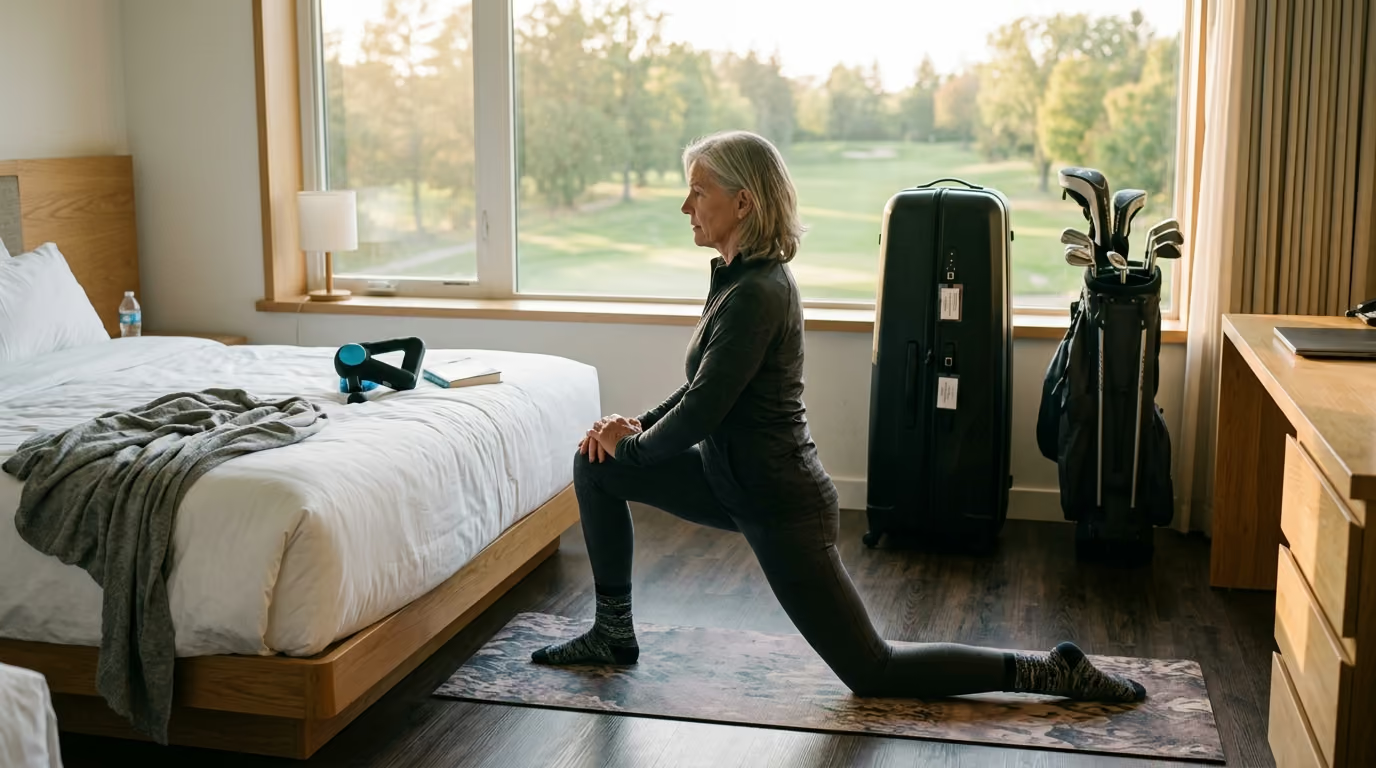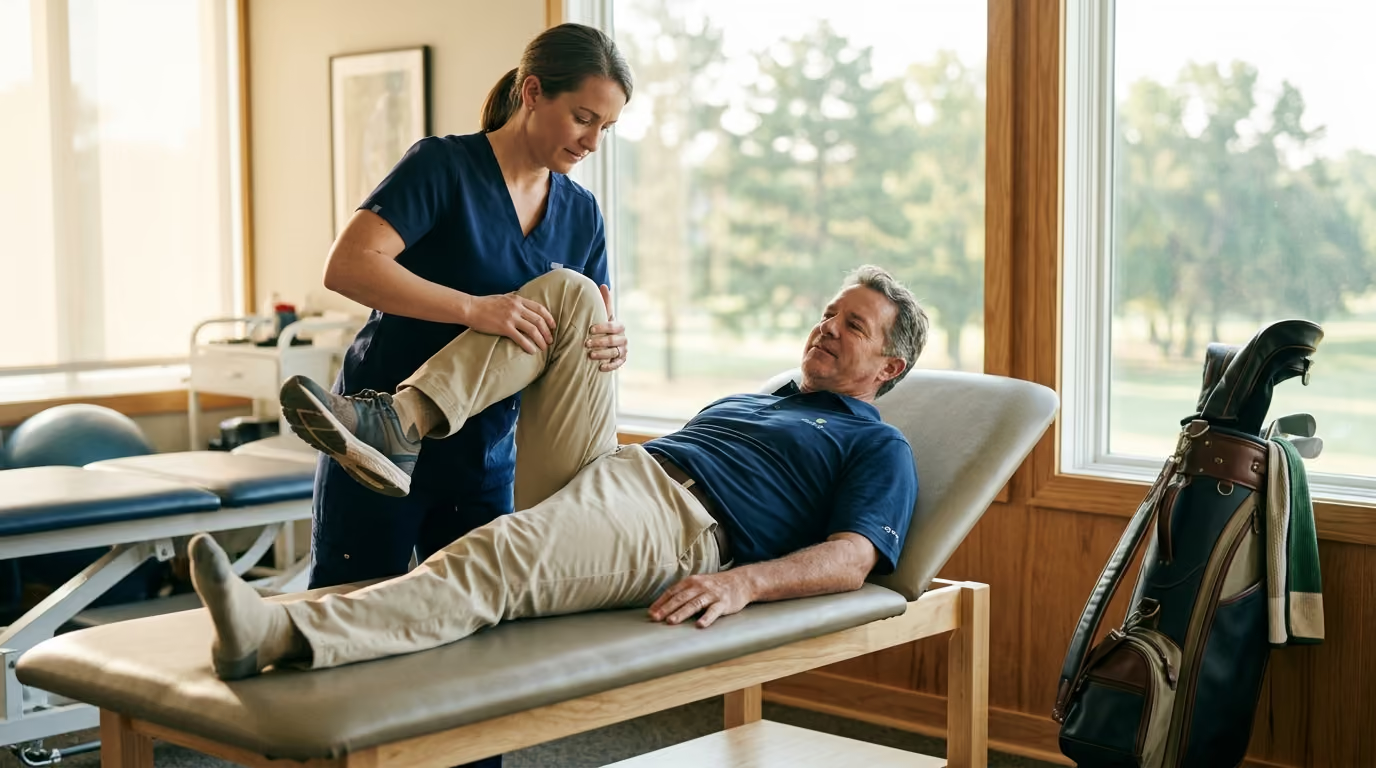
Sciatica causes debilitating leg and lower back nerve pain for golfers, but practical management strategies and swing adjustments can help you play without discomfort.




You stand on the twelfth tee box of a beautiful course. You bend over to push your tee into the turf. Suddenly, a hot, sharp sensation shoots through your right buttock and down your leg. It feels like an electrical wire has been tapped inside your thigh.
Your leg goes slightly numb, and your lower back locks tight. This is the reality of sciatica on the golf course. It is a common problem that can ruin a promising round of golf.
For golfers over forty, this pain is more than a minor annoyance. It is a signal that your body is struggling with the unique physical demands of the swing.
Fortunately, you do not have to accept this pain as a permanent part of your playing years. By understanding the root causes of sciatic discomfort, you can take control of your physical health. You can protect your spine and restore your ability to play without fear. This resource will guide you through the physical causes, on-course relief techniques, and long-term habits to keep you playing pain-free.
The typical sciatica flare-up rarely starts with a massive, explosive movement. Instead, it begins as a subtle stiffness during your warm-up. You might feel a slight tightness in your lower back while taking practice swings. By the fifth hole, this stiffness transforms into a deep, dull ache in your trail hip or buttock.
The turning point often occurs on a difficult shot. Perhaps you find your ball on a sloping lie in the deep rough. You must stand with your feet uneven, forcing your body to rotate at an awkward angle.
You take a hard swing to slash the ball back onto the fairway. During the follow-through, your trailing hip is forced to stretch beyond its comfortable limit.
As you walk toward the green, you notice the pain is no longer confined to your hip. It begins to travel. It creeps down the back of your thigh, passing your knee and reaching your calf. Every step feels slightly unstable, as if your leg might give out.
By the time you reach the ninth green, bending over to mark your ball feels nearly impossible. You find yourself leaning heavily on your putter just to take the pressure off your spine. Your focus shifts completely from your golf game to your physical survival. This is the moment where many golfers make the mistake of pushing through the pain, which only worsens the irritation.
To manage this pain, you must understand what is happening inside your body. The sciatic nerve is the largest nerve in the human body. It begins in your lower spinal column and runs deep through your hips, buttocks, and down each leg. Anything that squeezes or irritates this nerve along its path can trigger sciatic symptoms.
There are two primary conditions that cause this issue for golfers. The first is true sciatica, which originates in the lower spine. This occurs when a herniated disc, a bulging disc, or bone spurs compress the nerve roots as they exit the spinal column. Research from the Cleveland Clinic indicates that spinal compression is often the result of repetitive bending and twisting.
The second condition is piriformis syndrome, which is sometimes called pseudo-sciatica. In this case, the spine is completely healthy. Instead, a small muscle deep in your buttock called the piriformis becomes tight, inflamed, or spasmed. Because the sciatic nerve runs directly underneath or even through this muscle, the tight muscle pinches the nerve. This creates the exact same radiating leg pain as a spinal issue.
In the game of golf, your body is subject to the Body-Swing Connection. This framework, popularized by the Titleist Performance Institute, explains how physical limitations lead to swing faults and injury. A key concept here is the victim versus culprit relationship. Your lower back is almost always the victim of poor mobility in other parts of your body.
Your lumbar spine is built for stability, not rotation. It is designed to move forward and backward, but it only possesses about twelve degrees of rotational freedom. In contrast, your thoracic spine and your hips are built for massive rotation. If your hips or your upper back are tight, your body still needs to find rotation somewhere to complete the swing.
It forces your lower back to twist far beyond its safe limits. This excessive twisting under high speed creates immense shear force on your spinal discs. Over time, these discs wear down, bulge, or herniate, leading to nerve compression.
Furthermore, golf is a highly asymmetrical, uni-lateral sport. You swing the club in one direction hundreds of times per week. This repetitive motion creates massive physical imbalances. For a right-handed golfer, the lead hip must absorb incredible rotational force during the downswing.
If this lead hip loses its ability to turn inward, your body will compensate. To get around the ball, you will stand up during the downswing. This common swing fault is called early extension. Early extension forces your lower back to arch aggressively under load, which instantly pinches the sciatic nerve.
Understanding these mechanics changes how you view your pain. The pain in your leg or back is simply the alarm. The true cause of the alarm is often a locked hip or a stiff upper back.
If you experience a sciatic flare-up while playing, you should not try to stretch your back aggressively. Pulling your knees to your chest or twisting your spine will often make the nerve more angry. Instead, you need to use gentle movements that reduce neural tension and calm the surrounding muscles.
Nerve flossing is a highly effective way to relieve sciatic pain without stretching an already inflamed nerve. Think of your nerve as a long string inside a tight sleeve. If you pull both ends of the string, you create tension and friction. If you release one end while pulling the other, the string glides smoothly through the sleeve.
To perform this on the course, find a flat bench or sit on the seat of your golf cart. Sit up tall with your shoulders back and down. Straighten your painful leg out in front of you. As you lift your leg, point your toes away from your body and tuck your chin down toward your chest.
Next, slowly bend your knee back down. As your foot lowers, lift your chin and look up toward the sky. Move smoothly between these two positions without rushing. Perform ten to fifteen repetitions on the affected leg.
This movement slides the sciatic nerve gently through your lower back and hip. It reduces inflammation and improves blood flow to the nerve tissue. You should feel an immediate reduction in the intensity of the shooting pain.
If your pain is caused by a tight glute muscle pinching the nerve, you can release it using your golf cart. Stand facing the side bumper or the footrest of the cart. Place the foot of your painful leg up on the elevated surface. Turn your knee outward so your leg rests in a comfortable, open position.
Keep your hands on your hips and lift your chest high. Focus entirely on tilting your pelvis forward, as if you are trying to stick your tailbone out. Gently lean your torso forward from your hips while keeping your spine perfectly straight. Do not round your shoulders or bend your lower back.
You will feel a deep, comfortable stretch in the middle of your buttock. Hold this position for twenty to thirty seconds while breathing deeply. Repeat this stretch three times to allow the piriformis muscle to relax.
To offload your lower back, you must encourage your upper back to rotate. Stand with your feet slightly wider than shoulder-width apart. Place a golf club across your upper back, resting it gently on your shoulders. Keep your knees slightly bent and your abdominal muscles engaged.
Slowly turn your shoulders to the left as far as you comfortably can. As you turn, focus entirely on turning your trail hip inward. Keep your head relatively quiet and your lower back stable. Hold the turn for two seconds, then slowly rotate to the opposite side.
Perform ten slow repetitions in each direction. This movement helps restore mobility to your thoracic spine. By waking up your upper back, you prevent your lower back from twisting on your next swing.
How you move between shots is just as important as how you stretch. Many golfers slouch while walking or lean to one side while waiting for their partners. This poor posture places continuous, uneven pressure on your spinal discs.
When walking the fairway, focus entirely on keeping your chest tall. Imagine a string pulling the crown of your head toward the sky. Allow your arms to swing naturally at your sides. If you are waiting on the tee box, stand with your weight distributed equally on both feet to avoid irritating the nerve.
If you are looking for proactive strategies to protect your body before pain starts, check out our guide on active strategies for injury prevention.
On-course quick fixes are excellent for survival, but they do not solve the root cause of sciatica. To build a body that can withstand the forces of the golf swing, you need a daily routine. This routine should focus on restoring hip and spine mobility while building abdominal stability.
The 90/90 stretch is one of the most effective exercises for improving hip internal and external rotation. Sit on a comfortable mat on the floor. Place your lead leg in front of you, bent at a ninety-degree angle. Your thigh should point straight ahead, and your shin should be perpendicular to your torso.
Place your trail leg out to your side, also bent at a ninety-degree angle. Your trail thigh should point directly to the side, and your shin should point behind you. Sit up as straight as possible. If your hips are very tight, you can place your hands on the floor behind you for support.
To target your lead hip, slowly hinge forward from your pelvis. Keep your spine long and straight as you lower your chest toward your front calf. Focus entirely on turning your lead hip outward. Hold this position for thirty seconds while taking deep, slow breaths.
To target your trail hip, sit back up tall. Gently rotate your torso toward your back leg. Press your back hip down toward the floor, feeling the stretch deep inside the joint. Hold this position for another thirty seconds. Repeat this entire sequence twice on each side daily.
To protect your lower back from excessive twisting, you must keep your upper back mobile. Lie on your left side on the floor. Bend both knees up toward your chest at a ninety-degree angle. This knee position locks your lower back in place, preventing it from rotating.
Extend both arms straight out in front of you, resting your palms together. Slowly lift your right arm up toward the ceiling. Continue to rotate your arm and upper chest to the right, attempting to touch the back of your right shoulder to the floor. Keep your knees squeezed together and firmly on the ground.
Follow your moving hand with your eyes throughout the entire movement. You will feel a deep opening stretch across your chest and upper back. Hold this position for three seconds, then slowly return to the starting position. Perform ten repetitions on each side.
Your lower back needs stability to act as a solid anchor for your swing. The bird-dog exercise builds this stability without putting compressive force on your spinal discs. Get down on your hands and knees on a soft surface. Place your hands directly under your shoulders and your knees under your hips.
Engage your core muscles by pulling your belly button gently toward your spine. Without moving your torso, slowly extend your right arm straight forward. At the same time, extend your left leg straight back behind you. Focus entirely on reaching through your fingers and heel, keeping your limb parallel to the floor.
Do not allow your lower back to sag or your hips to tilt. Hold this extended position for three seconds. Slowly return your hand and knee to the floor with control. Repeat the movement using your left arm and right leg. Perform three sets of ten repetitions on each side.
Many golfers trigger sciatica by practicing poorly. They stand on the driving range for an hour, hitting ball after ball without stopping. This repetitive swinging creates extreme fatigue in your core muscles. Once your core fatigues, your lower back loses its primary defense mechanism.
To prevent this, modify your practice habits. Limit your practice sessions to thirty minutes. Take a two-minute break after every ten swings to stand up tall and walk around. Use this time to perform a few gentle hip rotations.
Never practice on hard artificial mats if you suffer from lower back issues. These mats do not absorb shock. The impact of your club striking the hard surface sends a massive vibration up the shaft. This shock wave travels directly into your wrists, elbows, shoulders, and spine. Always seek out grass practice facilities to protect your joints.
To learn more about how proper recovery habits can extend your playing years, read our articles on muscle recovery after golf.
When golfers experience sciatic pain, their natural instinct is often to fight back with aggressive physical habits. Unfortunately, many common self-treatment methods actually make the nerve compression worse. Recognizing these mistakes is critical for avoiding long-term damage.
The most common mistake is attempting to stretch away nerve pain. When a nerve is compressed, it becomes highly inflamed and sensitive. If you perform a traditional hamstring stretch by bending over and reaching for your toes, you place the nerve under extreme tension.
This tension acts like a hacksaw on an already raw nerve. It increases inflammation and can cause the muscles around the nerve to spasm even tighter. If a movement causes a sharp, electrical pain down your leg, you must stop doing it. Focus on gentle mobilization, such as nerve flossing, rather than aggressive static stretching.
Another common pitfall is focusing all your recovery efforts on your lower back. Golfers will apply ice, heat, and massage creams directly to their lumbar spine. While this might ease the pain temporarily, it does nothing to solve the underlying problem.
If your hips cannot rotate, your lower back will be forced to rotate on every swing. You can massage your lower back daily, but the pain will return as soon as you take a club back. To find lasting relief, you must shift your focus. Treat your lower back with rest and stability, and focus your mobility work entirely on your hips and thoracic spine.
Many golfers take heavy doses of anti-inflammatory medications before a round to mask their symptoms. While this allows you to complete eighteen holes, it is a highly dangerous practice. Pain is your body's primary warning system.
If you numb this system, you lose the ability to feel when your swing is damaging your spine. You may rotate too far, compress a disc further, and cause serious long-term nerve damage. Use medication to manage daily discomfort under a doctor's care, but do not use it to force your body through a round of golf.
Your physical body is only one part of the equation. The gear you use on the course can either protect your spine or contribute to its daily wear and tear. Simple changes to your equipment can make a significant difference in how your back feels after a round.
Carrying a golf bag is one of the worst activities for an inflamed lower back. A loaded bag weighs between twenty and thirty pounds. Every time you walk, this weight compresses your spine. Furthermore, you must lift and lower this bag over eighty times during a typical round.
This repetitive lifting requires bending and twisting under load, which is the exact mechanism that herniates spinal discs. Research shows that using a push cart reduces your body's oxygen consumption by over ten percent. This means you experience significantly less systemic fatigue during your round.
More importantly, a push cart removes the compressive load from your spine. It allows you to walk with a natural, upright posture. If you suffer from chronic back pain, switching to a push cart or using a riding cart is a simple way to protect your back.
Your connection to the ground starts with your shoes. Many traditional golf shoes are designed to be extremely rigid to maximize stability. However, if your shoes do not allow your feet to flex and rotate, that motion must be absorbed higher up the kinetic chain.
Stiff shoes prevent your ankles from moving, which locks up your knees and hips. This force travels directly into your lower back. Look for golf shoes that offer a balance of support and flexibility. Spikeless shoes often allow for more natural foot rotation during the swing, which reduces torque on your hips and spine.
The physical weight and stiffness of your clubs have a direct impact on your muscles. If your shafts are too heavy or too stiff, you must use more muscular effort to swing them. This extra effort increases the tension in your core and lower back.
As we age, our swing speed naturally decreases. Switching to a lighter graphite shaft with a more flexible profile can be incredibly beneficial. These shafts absorb more vibration on impact and require less physical effort to swing. This allows you to maintain swing speed without straining your lower back.
When your hands are tense, that tension travels up your arms, into your shoulders, and down into your back. If you have arthritis or general hand stiffness, you will naturally grip the club too tightly.
Switching to midsize or jumbo grips can help relax your hands. Larger grips do not require as much finger pressure to control the club. This simple adjustment keeps your upper body relaxed, which allows for a smoother, more natural shoulder turn.
To build the physical capacity to swing these clubs with ease, try our exercises for building core strength.
Recovering from a sciatica flare-up requires patience. You cannot go from bed rest directly to the first tee without risking another injury. You must follow a structured, step-by-step plan to prepare your body for the forces of the golf swing.
Your first priority is to eliminate the active nerve pain. During this phase, you should not swing a club at all. Focus entirely on gentle walking and your daily mobility routine. Walking is a natural, low-impact movement that pumps fluid into your spinal discs and improves blood flow to your nerves.
Aim for a fifteen-minute walk twice per day on flat surfaces. Avoid walking on steep hills, as uphill walking can strain your hamstrings and irritate the sciatic nerve. If you can walk for thirty minutes without any leg pain or numbness, you are ready to progress to the next step.
Start your return to golf with your short game. Spend twenty minutes putting and chipping green-side. These movements require very little rotation and place minimal stress on your spine.
Focus entirely on your posture during these short swings. Keep your spine straight and bend from your hips, not your waist. If you can chip and putt for three separate sessions without any discomfort, you can begin to make partial swings.
Move to the grass driving range and grab your pitching wedge. Begin by making very slow, half-swings. Focus entirely on turning your trail hip during the backswing and your lead hip during the downswing.
Do not try to hit the ball hard. Focus on smooth, rhythmic movements. Limit your first session to fifteen swings. If you feel any stiffness or pain the following day, rest until it clears. If your body responds well, slowly increase the number of swings and the length of your clubs over the next two weeks.
Your first round back should be limited to nine holes. Use a golf cart to minimize fatigue. Do not try to hit your maximum distance on any shot. Play conservatively and focus on smooth, easy swings.
If you complete nine holes without pain, rest for two full days before playing again. This rest period is critical. Often, the inflammation from a round of golf does not peak until twenty-four to forty-eight hours later. If your body remains pain-free during this rest period, you can gradually work your way back to playing eighteen holes.
For more resources on managing your physical health as you age, visit our main page on golf performance and longevity.
You should return to this guide whenever you feel a familiar tightness starting in your glutes after a round. Do not wait for the sharp, radiating pain to return before taking action. Use the daily mobility routine described here to keep your hips moving freely throughout the playing season.
Your lower back is the victim of tight hips, so protect your spine by restoring hip rotation and choosing dynamic nerve flossing over aggressive stretching.
Follow Golfergy for practical insights on performance, mobility, recovery and healthy ageing. Stay connected for new articles, research-led guidance and ideas to help you play better for longer.


Explore practical resources on performance, recovery, mobility and golf longevity.
Read the Blog