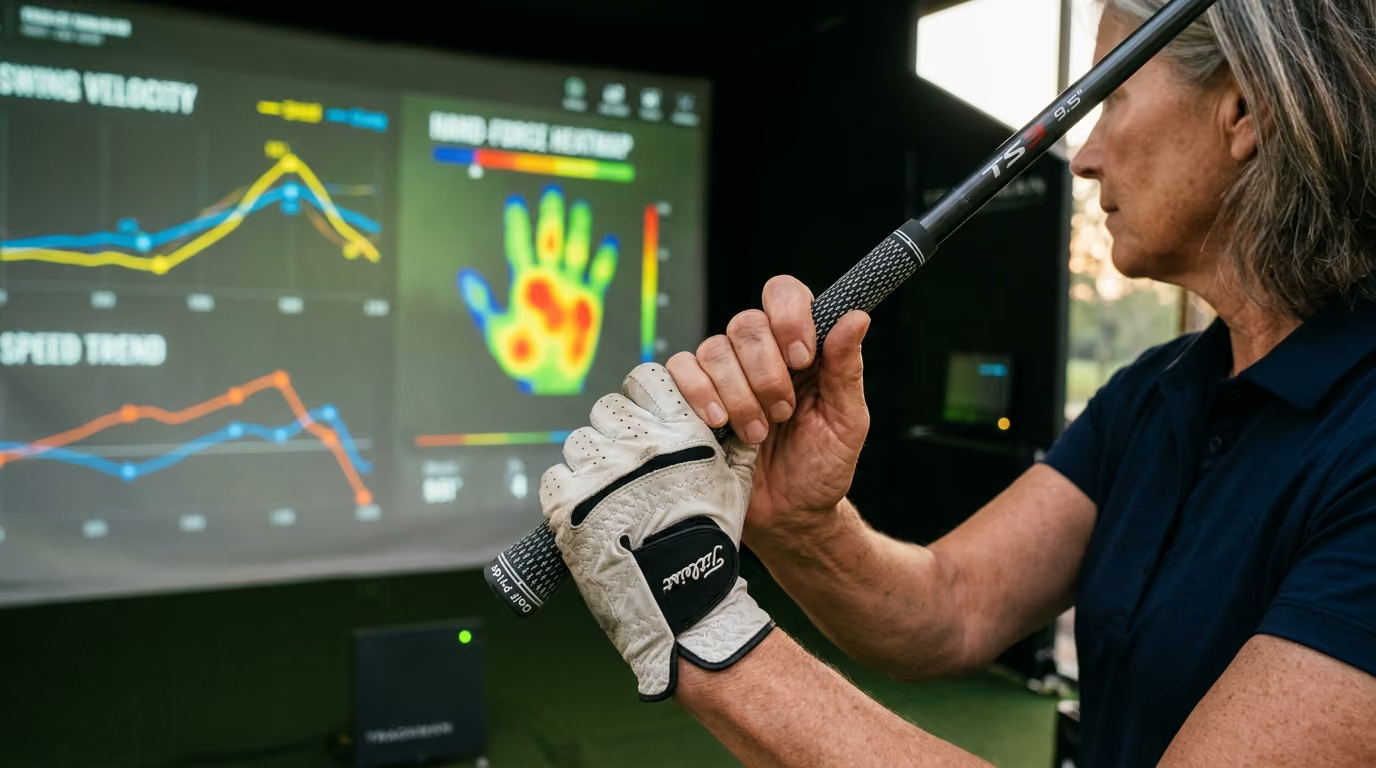

Fourteen holes into a round of golf, shoulder fatigue often ruins swing mechanics because weak scapular muscles fail to stabilize the arms.




You are standing on the fourteenth tee box of a beautiful course. The sun is starting to lower in the sky. Your driver has been highly dependable all morning. You feel confident as you step up to address the golf ball.
Suddenly, your swing feels slightly loose. You swing anyway, but the contact is poor. The ball slices weakly into the right rough. You shrug it off as a temporary loss of focus.
On the fifteenth hole, you face a short iron shot into the green. You swing, but you hit a few inches behind the ball. The heavy contact sends turf flying, and your ball lands far short of the putting surface. Your shoulders feel heavy, and your posture is starting to slouch.
You might think your swing timing is off. You might try to adjust your wrist release or your knee bend. In reality, your shoulder blades have stopped doing their job. They are no longer supporting your arms, which ruins your swing path.
This frustrating situation is highly common for golfers over forty. By the fourteenth hole, the muscles that hold your shoulder blades steady are tired. When these muscles lose their strength, your entire golf swing begins to crumble. Understanding how to manage these muscles is a vital part of healthy ageing for active players.
To fix your ball striking, you must understand your anatomy. The shoulder blade is known as the scapula. It is a flat, triangular bone that sits on the back of your rib cage. Unlike your hip joint, your shoulder blade has no deep socket to hold it in place.
Instead, your scapula floats on a bed of muscles. This unique design allows your arms to move in many directions. You can reach high, swing low, and rotate your body. However, this freedom makes the joint naturally unstable.
Your shoulder blade serves as the anchor point for your arm. It provides the base of support for your rotator cuff. If your anchor moves during your swing, your club path will change. You cannot hit the ball consistently if your anchor is sliding around your back.
The coordinated movement of your arm and shoulder blade is called scapulohumeral rhythm. For every two degrees you move your upper arm, your shoulder blade must move one degree. This precise movement keeps your shoulder joint aligned. If this rhythm is lost, your swing loses its power.
This concept is a key part of the joint-by-joint approach. This approach was described by researchers Paine and Voight in 2013. They explained that your body alternates between stable joints and mobile joints. Your thoracic spine needs to be mobile, but your scapula must be stable.
If your scapula is unstable, your mobile shoulder joint becomes weak. This instability prevents you from transferring power from your legs to the club. Your arms must work twice as hard to make up for the loss of support. This extra work can cause pain and lead to injuries over time.
This stable base is critical for improving your shoulder mobility safely.
One muscle plays a major role in keeping your shoulder blade steady. This muscle is called the serratus anterior. It runs from your upper ribs and wraps around your side to attach to the inner edge of your scapula. It looks like a hand gripping your rib cage.
The primary job of the serratus anterior is protraction. Protraction means pulling your shoulder blade forward and around your ribs. This muscle also rotates the scapula upward. This upward rotation allows you to raise your arm above your head safely.
During your swing, the serratus anterior pins your shoulder blade flat against your back. It prevents the inner edge of the bone from lifting up. When this muscle works correctly, you can reach the full extension needed for a wide swing arc. A wide swing arc gives you more time to build clubhead speed.
If your serratus anterior is weak, your shoulder blade will lift off your ribs. This lifting is called winging. Winging makes your shoulder joint highly unstable. Your lead arm will collapse inward, which reduces the width of your swing.
This muscle is critical for maintaining your swing width. Without a strong serratus anterior, you cannot keep your arms extended. Your swing arc will become small and narrow. This narrowing makes it very difficult to return the club to the ball consistently.
On the opposite side of your shoulder blade sit the rhomboids. These muscles are located deep beneath your large trapezius muscle. They run from your spine to the inner border of your scapula. Their primary job is retraction.
Retraction means pulling your shoulder blades back toward your spine. This movement is the opposite of protraction. In the golf swing, the rhomboids act as your body's braking system. They control the high-speed movements of your arms.
During a golf swing, your arms move at very high speeds. After you hit the ball, your body must slow the club down safely. Your rhomboids must work hard to control this deceleration. This work is done through eccentric muscle contraction.
An eccentric contraction happens when a muscle lengthens under a load. Your rhomboids must hold tight as your arms pull forward. If your rhomboids are weak, they cannot act as effective brakes. Your shoulder blades will fly forward uncontrollably, which can cause severe strain on your upper back.
Many golfers only focus on the muscles they can see in the mirror. They train their chest and shoulders, but they ignore their upper back. This imbalance is a common cause of shoulder pain. Building strong rhomboids is a vital part of injury prevention for serious players.
Your shoulder blades rely on a system of balance. The serratus anterior and the rhomboids form a team. Sports scientists call this team a force couple. These muscles must work together to control the scapula.
As one muscle contracts to move the shoulder blade, the other provides tension to stabilize it. If this balance is correct, your scapula stays flat against your ribs. It glides smoothly as you swing. This smooth motion allows for a consistent swing path.
If one muscle in the team is weak, the system breaks down. For example, a weak serratus anterior cannot pull against the rhomboids. The shoulder blade will tilt and twist. This twisting changes the angle of your shoulder joint.
This muscular imbalance leads to inconsistent ball striking. You might hit one shot fat and the next shot thin. Your body cannot find a consistent bottom point for your swing. To fix this, you must train both muscles to work in harmony.
Scientific research using electromyography has studied these muscles in detail. Dr. Frank Jobe performed landmark studies on professional golfers. His research showed exactly how the upper back muscles fire during each phase of the swing.
During the takeaway and backswing, your trailing arm rhomboids are highly active. They retract and elevate your trailing shoulder blade. This movement allows your chest to turn fully. It creates a deep, powerful backswing.
Meanwhile, your lead arm serratus anterior works constantly. It holds your lead shoulder blade steady against your turning torso. This steady hold prevents your lead arm from collapsing across your chest. It maintains the width of your swing at the top.
As you transition into the downswing, your trailing arm serratus anterior reaches peak activity. It fires hard to push your trailing shoulder blade forward. This protraction helps you square the clubface at impact. It allows you to strike the ball with maximum force.
At the same time, your lead arm rhomboids contract. They pull your lead shoulder blade back toward your spine. This retraction creates a solid pivot point. Your lead arm can swing fast around this stable anchor, which helps you release the club cleanly.
Finally, during deceleration and follow-through, both of your serratus anterior muscles remain active. They help control the deceleration of your shoulders. They maintain your posture as you finish your swing. Your rhomboids act as the primary brakes to prevent shoulder injuries.
Your lead arm serratus anterior is highly vulnerable to fatigue. Unlike other muscles that fire in short bursts, this muscle is active throughout the entire swing. It never gets a moment of rest. This constant load makes it tire easily.
For golfers over forty, this fatigue is a common problem. As you play more holes, the lead serratus anterior gets weaker. By the back nine, the muscle can no longer pin your shoulder blade. The blade begins to lift off your rib cage.
This winging ruins your control of the club. Your lead shoulder joint becomes loose. You will struggle to maintain your swing path. Your shots will start to spray left and right.
This issue is often made worse by poor posture. Many people spend hours sitting at a desk or driving a car. This position leads to a rounded upper back. Physical therapists call this C-posture.
C-posture puts your serratus anterior in a stretched, weak state. Over time, the muscle becomes inhibited. It forgot how to fire correctly. When you get on the golf course, your body cannot activate this key stabilizer.
When your rhomboids and serratus anterior are weak, your body looks for help. It recruits the upper trapezius muscle to move your shoulder blades. The upper trapezius runs from your neck to your outer shoulder. It is a very strong muscle.
However, the upper trapezius is not designed to stabilize your swing. Its main job is to shrug your shoulders upward. If you rely on this muscle, you will shrug at the top of your backswing. This shrugging pulls your shoulders toward your ears.
This movement shortens your neck and raises your chest. It ruins your posture at the top of your swing. As a result, your downswing path becomes very steep. You will swing over the top, which causes a slice or a pull.
To fix this, you must learn to quiet your upper trapezius. You must teach your brain to use your lower stabilizers. This change requires focus and practice. It is a vital step toward a consistent golf swing.
The first common flaw is the chicken wing. This happens when your lead elbow bends and points outward after impact. Many golfers think this is an elbow problem. They try to force their elbow to stay tucked.
In reality, this is a shoulder blade problem. If your lead rhomboids do not pull your scapula back, your arm has no room to move. Your lead arm is blocked by your rib cage. Your elbow must bend outward to let the club pass.
The second flaw is casting or early release. This happens when you release your wrists too soon on the downswing. This early release ruins your clubhead speed. It also leads to weak, high shots.
If your trailing serratus anterior is weak, your shoulder blade collapses during transition. You lose the wide arc of your swing. Your brain senses this loss of reach. To hit the ball, your brain tells your wrists to flip early.
By strengthening your upper back, you can fix both of these flaws. You will create the physical space your arms need to swing freely. This space allows for a natural, powerful release of the club.
Many golfers over forty spend a lot of time sitting down. They sit at desks, in cars, or on couches. This sitting posture has a direct impact on your golf game. It creates physical changes in your body that weaken your swing.
When you sit and type, your arms are in front of you. Your shoulders are rounded forward. This position keeps your chest muscles in a tight, shortened state. At the same time, your upper back muscles are stretched out and weak.
This long posture state makes your serratus anterior stop working. Your brain stops sending strong signals to this muscle. When you get on the golf course, you cannot expect this muscle to work perfectly. It has been asleep all week.
This muscular sleep is what physical therapists call muscle inhibition. To wake up your serratus anterior, you must do daily movement. You cannot rely on a quick warm-up on the driving range. You must build daily habits that keep these muscles active.
Your shoulder blade does not work in isolation. It relies on the position of your upper back. This part of your spine is called the thoracic spine. It must be able to twist and extend for a healthy swing.
If your thoracic spine is stiff, your shoulder blades cannot glide correctly. They will get stuck as you try to turn. This stiffness forces your shoulder joints to do too much work. This extra work can cause pain in your rotator cuff.
To improve your scapular stability, you must also work on your thoracic spine. You need to keep this area of your back loose and mobile. A mobile thoracic spine gives your shoulder blades a flat surface to slide on. This flat surface is vital for a smooth swing path.
You can improve this mobility with simple daily stretches. One great stretch is the Book Opener. Lie on your side with your knees bent. Slowly rotate your top arm open to touch the floor behind you.
You can easily test your shoulder blade stability at home. This test requires no special equipment. You only need a flat wall and a mirror. It takes less than two minutes to perform.
Stand with your back flat against the wall. Your heels, buttocks, upper back, and head should touch the wall. Raise your arms to shoulder height and bend your elbows at ninety degrees. The back of your hands should touch the wall.
Slowly slide your hands up the wall as high as you can. Keep your elbows and hands in contact with the wall. If your shoulder blades are unstable, your back will arch. Your hands or elbows will lift off the wall.
If you cannot complete this test, your scapular stability needs work. Do not worry if you struggle with this movement. It is a very common issue for mature golfers. Using the routine in this guide will help you improve your score.
We often think about scapular stability for long drives. However, it is just as important for your short game. Your pitching, chipping, and putting rely on this stable base. Without it, you cannot control your distances.
During a chip shot, your arms must work as a single unit. Your chest rotates, and your arms follow. If your shoulder blades are loose, your arms will move independently. This movement ruins your contact and your distance control.
When putting, you want a repeatable, smooth stroke. This stroke is driven by your shoulders and upper back. If your scapula is unstable, your hands will try to take over. This hand movement makes it hard to start the ball on your intended line.
By stabilizing your shoulder blades, you steady your entire short game. Your chips will become more consistent. Your putts will roll truer. You will save many strokes around the green.
You should not start your round without a quick warm-up. This warm-up should focus on your upper back. It prepares your serratus anterior and rhomboids for the swing. It takes only five minutes to do.
Start with some shoulder shrugs and rolls. Stand tall and roll your shoulders forward ten times. Then, roll them backward ten times. This movement gets blood flowing to the area.
Next, do the Standing Wall Push-Up. Find a flat wall or a sturdy post near the first tee. Place your hands on the wall at shoulder height. Perform ten slow push-ups, focusing on pushing the wall away at the top.
Finally, perform some arm circles. Hold your arms out to your sides. Make small, slow circles in a forward direction for thirty seconds. Repeat this movement in a backward direction for thirty seconds.
This quick routine wakes up your stabilizers. It prepares your upper back for the first tee. You will feel more stable and hit better shots right away. This simple habit is key for golf longevity and health.
You cannot do complex exercises while playing a round of golf. However, you can use simple mental cues. These cues help keep your shoulder blades in the correct position. They protect your swing path without causing tension.
When you stand over the ball, focus on one small movement. Focus entirely on turning your trail hip during the backswing. This simple turn helps your entire torso rotate. It reduces the stress on your shoulders.
You can also use a physical feel during your practice swings. Before you hit, feel your lead shoulder blade slide down your back. Imagine it is sliding into your back pocket. Do not let it shrug up toward your ear.
Keep your neck long and relaxed. This simple check activates your lower shoulder stabilizers. It helps you maintain a wide swing path without extra effort. Use this feel on every tee box to stay consistent.
To fix the root cause of your swing flaws, you must build strength. A simple home routine can produce great results. These exercises focus on your serratus anterior and your rhomboids. They are excellent for building upper back strength over time.
Start on your hands and knees on a soft mat. Place your hands directly under your shoulders. Keep your knees under your hips. Your spine should be in a neutral position.
Keep your arms completely straight during this exercise. Slowly let your chest sink toward the floor. Your shoulder blades will pinch together on your back. Do not bend your elbows to lower your chest.
Next, push your hands hard into the floor. Raise your chest as high as possible. Your upper back will round slightly at the top. You should feel your shoulder blades sliding apart.
Perform three sets of ten repetitions. Move slowly and feel the muscles working. This drill trains your serratus anterior to control your shoulder blades.
Start in a push-up position on your knees or toes. Keep your body in a straight line from your head to your heels. Squeeze your glutes and pull your belly button in. Your shoulder blades should be flat against your back.
Slowly lift your right hand off the floor. Tap your left shoulder with your right hand. Put your right hand back down and stabilize your body. Now, lift your left hand and tap your right shoulder.
Do not let your hips twist as you change hands. The arm on the ground must push hard into the floor. This force activates your serratus anterior to support your weight.
Perform three sets of ten taps per side. If this is too hard, start with your hands on an elevated surface. A sturdy bench or kitchen counter works well.
Find a sturdy pull-up bar. Grip the bar with your palms facing away from you. Let your body hang completely straight. Your shoulders should touch your ears in this passive position.
Keep your arms straight during the entire movement. Now, pull your shoulder blades down and together. Your body will rise a few inches. Your shoulders should move away from your ears.
Hold this active position for three seconds. Slowly lower your body back to the passive hang. Do not swing or use momentum to lift yourself.
Perform three sets of five repetitions. This drill is highly effective for strengthening your rhomboids. It trains them to act as strong brakes for your swing.
Many golfers make mistakes when trying to improve their shoulder stability. The most common mistake is lifting weights that are too heavy. When you use too much weight, your smaller stabilizers cannot do the work.
Your body will compensate by using your upper trapezius. This shrugging motion defeats the purpose of the exercise. Always use lighter weights and focus on perfect form. You want to feel the muscles between your shoulder blades working.
Another mistake is ignoring the eccentric phase of your exercises. Golfers often pull a weight quickly and then let it drop. They ignore the lowering part of the movement.
You must control the weight as you return to the start. This slow lowering builds the eccentric strength your rhomboids need. It teaches them to act as effective brakes during your swing finish.
A third mistake is moving your elbows instead of your shoulder blades. During rowing exercises, focus on your back first. Pull your shoulder blades together before you bend your elbows. This sequence helps train the correct muscles.
Your golf equipment can also affect your shoulder stability. If your club grips are too small, you will squeeze them too tightly. This tight grip creates tension in your hands and forearms.
This tension travels up your arms to your shoulders. It prevents your shoulder blades from moving freely. Using slightly larger grips can help relax your hands. This relaxation allows your scapular muscles to function correctly.
The weight of your club shafts is another important factor. Shafts that are too heavy can cause your muscles to fatigue early. This fatigue is especially noticeable on the back nine.
If you struggle with fatigue, look at lighter graphite shafts. Lighter shafts reduce the load on your upper back. This reduction helps you maintain your posture throughout the entire round.
Your golf shoes also play a critical role in shoulder health. Proper traction allows you to push off the ground effectively. This ground force travels up your legs, through your core, and into your shoulders.
If your feet slip, your shoulders must work harder to create club speed. This extra work leads to early fatigue. Make sure your shoes have good traction to support your upper body.
Revisit this resource whenever you notice your ball striking become erratic on the back nine. It is also helpful to reread these steps if you experience shoulder stiffness or neck tension after a round.
Consistent ball striking relies on a stable shoulder blade to anchor your swing and control your clubhead.
Follow Golfergy for practical insights on performance, mobility, recovery and healthy ageing. Stay connected for new articles, research-led guidance and ideas to help you play better for longer.


Explore practical resources on performance, recovery, mobility and golf longevity.
Read the Blog