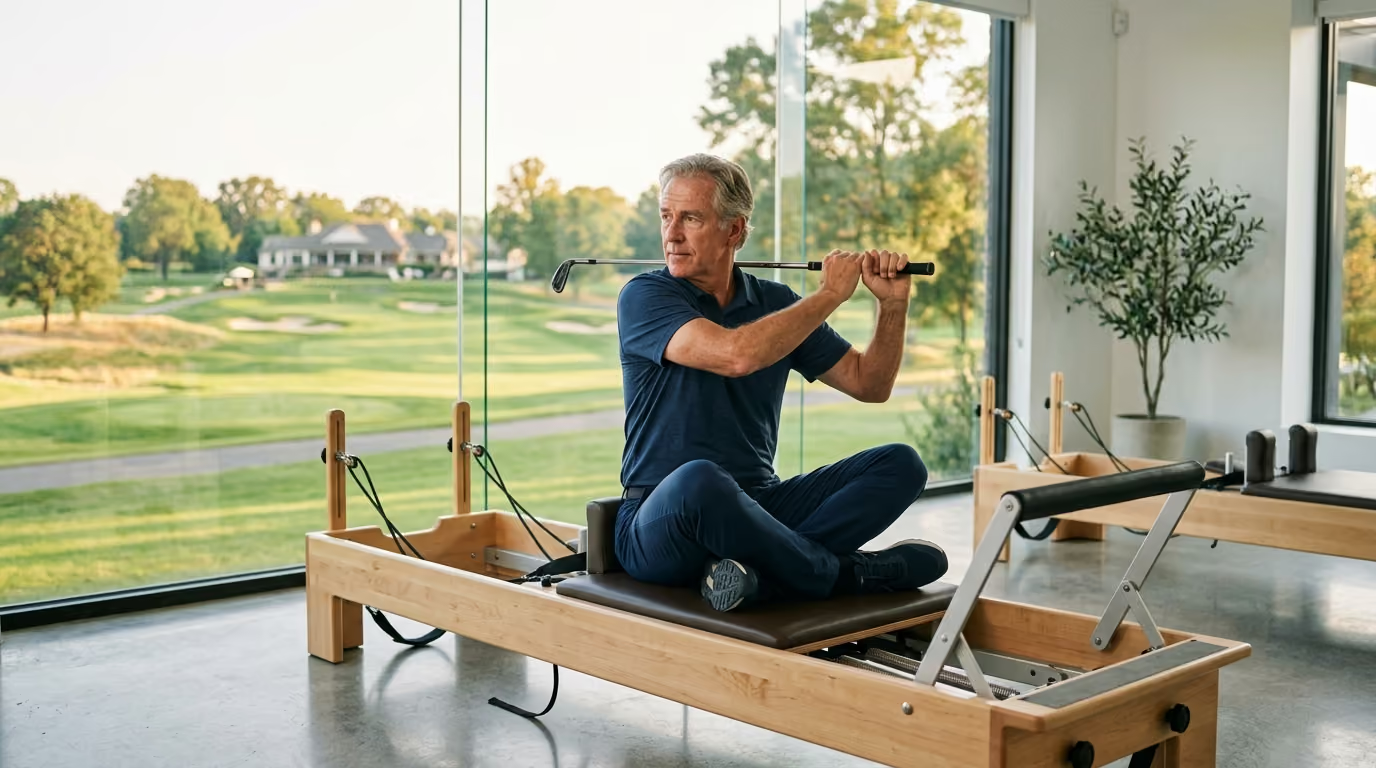

Pilates is often dismissed as simple stretching, but it builds the active core strength and rotational control golfers need to prevent back pain.




The afternoon sun is starting to sink. You stand on the fourteenth tee box. You feel a familiar tightness spreading across your lower back. Your hips feel heavy, and your shoulders feel stiff.
You take a couple of practice swings. Your backswing feels short and restricted. Your body stops turning halfway back. You try to force the turn anyway by lifting your arms high.
This compensation throws your swing off plane. You swing down with your upper body. The club face cuts across the ball. You watch your ball slice into the deep right rough.
This physical breakdown is common for mature golfers. As we age, our joints naturally lose their elasticity. Fatigue sets in on the back nine. We lose the ability to rotate our hips and shoulders independently.
We compensate by using brute force with our arms. This leads to poor shots and sore muscles. It can also lead to serious back injuries. Physical conditioning builds the foundation for long-term golf performance without pain.
Pilates is often misunderstood as a passive stretching program. It is actually a system of strength and control. It is designed to build a stable base from the center of the body outward. For a golfer, this central focus is exactly what the swing requires.
The first major concept of Pilates is centering. Instructors often call this your powerhouse. The powerhouse consists of your deep abdominal muscles, your pelvic floor, and the muscles around your spine. These muscles work together like a wide corset. They stabilize your lower back and pelvis during rotation.
The second principle is concentration. You must focus on how your muscles move. You cannot mindlessly complete the repetitions. In Pilates, you pay close attention to the alignment of your joints. This mental focus helps your brain coordinate complex movements on the golf course.
The third principle is control. Every exercise is performed slowly. You do not use momentum to lift your limbs. Controlling the movement prevents your joints from moving into dangerous positions. This control helps you maintain a stable spine angle when you swing.
The fourth principle is precision. Every small movement has a purpose. You focus on the position of your feet, your hips, and your shoulders. This attention to detail builds better physical awareness. You learn to make micro-adjustments to your swing posture.
Finally, we focus on deep, structured breathing. Many golfers hold their breath during the backswing. This tightens the chest and limits rotation. Pilates breathing expands your rib cage sideways. This stretch loosens the small muscles between your ribs.
Many golfers believe they need to become flexible. They think they need to stretch their muscles as far as possible. This is a common misunderstanding. There is a critical difference between passive flexibility and active mobility.
Passive flexibility is how far a joint can be pushed by an outside force. For example, if you lie on your back and someone lifts your leg, that is passive flexibility. It does not require your muscles to do any work. It only measures the length of your tissues.
Active mobility is how far you can move a joint using your own muscle power. This is the range of motion you can control. Mature golfers need active mobility to keep their joints moving freely during a high-speed swing.
Having passive flexibility without muscle control is dangerous. If you can turn your body very far but cannot control that turn, your joints become unstable. This instability often causes shoulder and lower back injuries. Your muscles must be strong enough to slow your body down at the end of the swing.
Pilates focuses on building functional flexibility. This means strengthening your muscles through their entire range of motion. It teaches your nervous system that it is safe to move into deep angles. This active control protects your joints from wear and tear.
It also improves your ability to separate your upper and lower body. Biomechanists call this movement dissociation. It is the key to creating torque in the golf swing. If you cannot separate your hips and shoulders, you cannot generate speed.
When you feel your back tightening up on the course, you need an immediate way to restore your rotation. You can perform this simple movement right next to your golf cart. It requires no special equipment.
First, stand with your feet shoulder-width apart. Keep your knees slightly bent and relaxed. Place your driver across your shoulders behind your neck. Hold the ends of the shaft with your hands.
Second, focus entirely on turning your trail hip backward. If you are right-handed, this is your right hip. Slowly rotate your chest to the right. Do not let your knees sway to the side.
Third, hold this position for three deep breaths. Feel the stretch in your middle back and rib cage. Keep your pelvis as stable as possible.
Fourth, slowly rotate your chest to the left side. Again, hold the position for three deep breaths. This movement wakes up your nervous system. It gently reminds your body how to separate your upper and lower torso before your next shot.
The back nine of a golf course is where many rounds fall apart. Your swing might feel great for the first six holes. By the thirteenth hole, your shots begin to push or slice. This loss of distance and accuracy is directly linked to core fatigue.
Your primary spinal stabilizers are small muscles. They are designed for endurance, not explosive power. These muscles include the transverse abdominis and the multifidus. When these deep muscles tire, they stop supporting your spine.
Consequently, your body tries to protect itself. It tightens the larger, outer muscles of your back and hips. This causes the stiffness you feel in your lower back. It also forces you to lift your chest during the downswing.
This swing fault is known as early extension. It happens because your tired core cannot hold your hips back. You lose your posture, and your hands must work harder to find the ball. This leads to thin shots and inconsistent contact.
By training your deep core muscles with Pilates, you build the endurance needed for eighteen holes. These muscles stay active longer. They support your spine and keep your posture stable until your final putt. By stabilizing your spine, you build a natural shield for injury prevention on the course.
This section outlines a simple home routine. It targets the exact physical demands of the golf swing. Perform these exercises three times a week for the best results.
This exercise is critical for lower back health. It helps you find and maintain a neutral pelvis during your swing.
To begin, lie on your back on a comfortable mat. Bend your knees and place your feet flat on the floor. Keep your feet hip-width apart. Relax your shoulders and place your arms flat by your sides.
Inhale deeply through your nose. As you exhale, pull your belly button toward your spine. Tilt your pelvis backward to flatten your lower back against the floor. Focus entirely on turning your trail hip or tilting your pelvis using your lower abdominal muscles.
Hold this flat position for two seconds. Inhale and slowly tilt your pelvis forward. This will create a small arch in your lower back. Repeat this gentle rocking movement ten times.
This exercise releases tension in your lower lumbar spine. It also teaches you how to control your pelvic position. This control is vital for maintaining your spine angle during the transition of your swing.
This movement targets your glutes and hamstrings. Strong glutes are the engine of a powerful golf swing.
Start in the same position on your back. Your knees should be bent, and your feet should be flat on the floor. Keep your feet close to your seat.
Inhale to prepare. As you exhale, press your feet firmly into the floor. Squeeze your glutes and lift your hips toward the ceiling. Lift your hips until your body forms a straight line from your shoulders to your knees.
Do not arch your lower back at the top. Keep your ribs pulled down and connected to your stomach. Focus entirely on pressing your heels into the ground to lift your pelvis.
Hold this position for three deep breaths. Inhale and slowly lower your spine back to the floor. Lower down one joint at a time, starting from your upper back. Repeat this movement eight times.
This exercise is excellent for improving thoracic rotation. It teaches your body to turn your chest while keeping your hips stable.
Sit tall on your mat with your legs straight. Spread your legs slightly wider than your shoulders. Flex your feet so your toes point toward the ceiling. If your hamstrings are tight, sit on a folded towel or bend your knees slightly.
Reach your arms straight out to your sides. They should be level with your shoulders. Inhale and lift your head toward the ceiling to lengthen your spine.
Exhale and turn your chest to the right. Reach your left hand forward and try to slide it past your right pinky toe. Keep both seat bones pressed firmly into the floor. Focus entirely on keeping your left hip heavy as you turn.
Inhale and return to the starting position. Repeat the movement to the left side. Complete five repetitions on each side. This exercise builds the active mobility needed for a full backswing.
This side-bending stretch targets the obliques and the quadratus lumborum. These lateral muscles are often tight in golfers.
Sit on your mat with your knees bent in a Z-shape. Your left shin should be in front of you. Your right shin should be tucked behind you. If this hurts your knees, sit cross-legged instead.
Place your left hand flat on the floor for support. Reach your right arm straight up toward the ceiling. Inhale to grow tall.
Exhale and bend your torso to the left. Reach your right arm over your head. Keep your right hip anchored to the floor. Focus entirely on breathing into the right side of your rib cage.
Inhale and return to the center. Lower your right hand and lift your left arm to repeat the stretch on the other side. Do five slow repetitions on each side. This improves your lateral mobility for a fluid follow-through.
This exercise builds strength in your obliques. These diagonal core muscles control your rotation and downswing speed.
Lie on your back with your knees bent. Your feet should be flat on the floor. Interlace your fingers and place your hands behind your head. Keep your elbows wide.
Inhale to prepare. As you exhale, pull your belly button down. Lift your head, neck, and shoulders off the mat. Keep your pelvis perfectly still on the floor.
Inhale and rotate your chest to the right. Do not pull on your neck with your hands. Focus entirely on moving your left rib cage toward your right hip.
Exhale and return to the center. Inhale and rotate your chest to the left. Exhale to return to the center and lower your shoulders to the mat. Repeat this sequence eight times on each side. Developing core strength helps stabilize your pelvis during the downswing.
Many golfers make simple errors when they start a Pilates routine. These mistakes can reduce the effectiveness of the exercises. They can also lead to muscle strains.
The first mistake is believing you must be naturally flexible to begin. Many golfers think Pilates is only for bendy people. This is not true. Pilates is a tool to build mobility over time.
If you cannot sit with straight legs, bend your knees. If you cannot reach your toes, reach for your shins. Your body will adapt slowly. Respect your limits and do not force your joints into painful positions.
The second mistake is using brute force. Golfers are used to using muscular effort to swing a heavy club. They often bring this tension into their Pilates practice. They grip their teeth and tense their neck muscles.
Pilates requires relaxed strength. You should only use the muscles needed for that specific movement. Keep your face, neck, and shoulders relaxed. If your neck hurts during abdominal exercises, support your head more with your hands.
The third mistake is rushing through the movements. Fast movements use momentum instead of muscle control. They do not build deep core strength.
Always move slowly. Count to three during the lifting phase. Count to three during the lowering phase. This slow tempo forces your muscles to work harder. It also prevents joint injuries.
Your physical movement on the course is closely linked to your equipment. If your gear does not fit your body, you will struggle to move correctly. Let's look at three critical items.
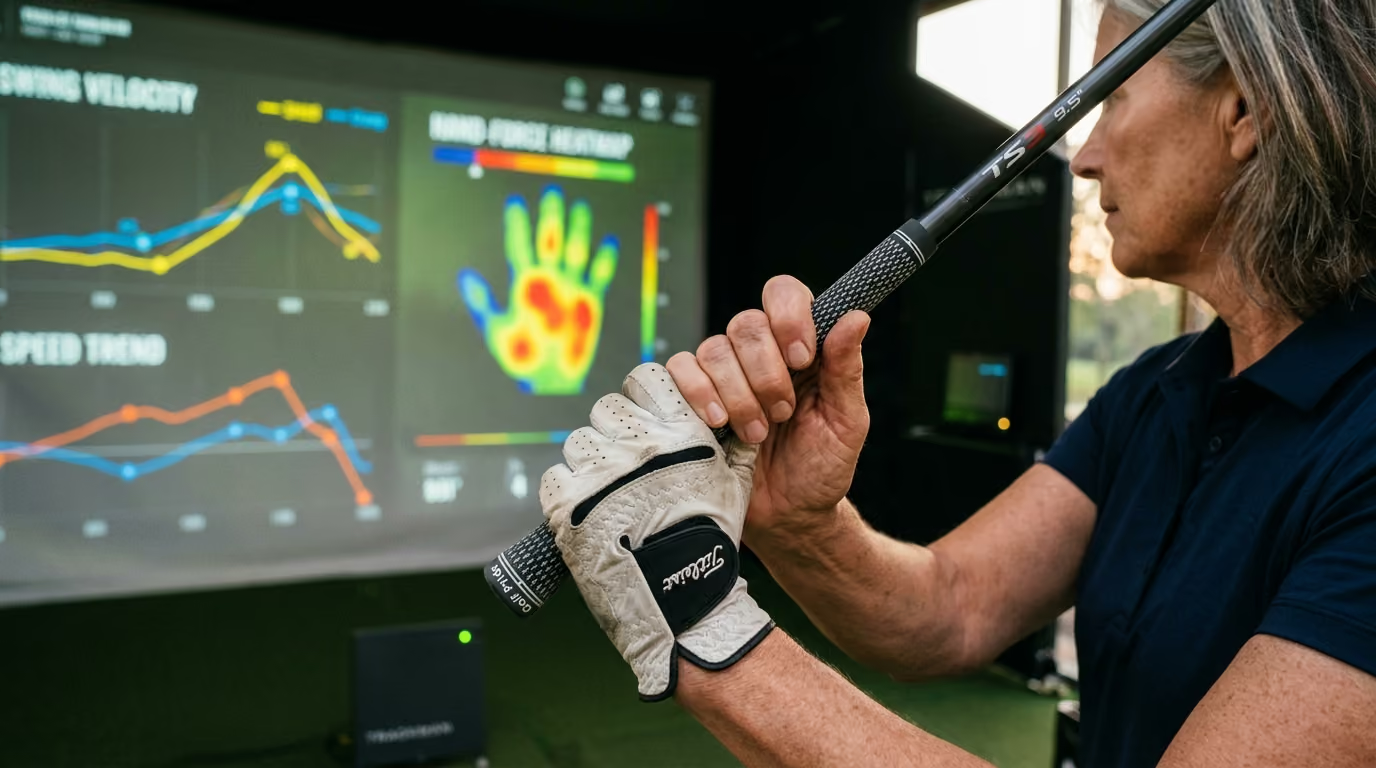
First, consider your golf grips. If your grips are too small, your hands will squeeze too hard. This tension travels up your forearms. It continues into your biceps and shoulders.
This tight upper body limits your shoulder rotation. It makes your swing stiff and mechanical. Midsize or jumbo grips can help relax your hands. This allows your shoulders to turn more freely.
Second, check your golf shoes. Your feet are your connection to the earth. Your shoes must provide a stable platform.
If your shoes are worn out, your feet will slip during your swing. Your body will sense this instability. Your brain will tighten your hips and lower back to protect you. This limits your swing speed and rotation.
Choose shoes with good arch support and traction. This stable base allows your hips to turn safely. It lets you transfer your weight without fear of slipping.
Third, look at your shaft weight. If your club shafts are too heavy, you must use brute force to swing them. This extra effort ruins your posture.
Lighter, flexible shafts let you swing with less tension. They allow you to focus on a smooth, controlled rhythm. This helps you maintain your spine angle and stay balanced.
Scientific research supports the use of Pilates for golf. Many studies show measurable improvements in performance and injury prevention. Let's look at the data.
A landmark study was published in the Journal of Bodywork and Movement Therapies by Dorado et al. (2012). The researchers studied a group of amateur golfers. These players completed a twelve-week Pilates-based conditioning program.
The results showed a significant increase in trunk rotation. More importantly, the golfers increased their clubhead speed. This means they could hit the ball further with less physical effort.
Another study by Hwang et al. (2019) in the Journal of Exercise Rehabilitation looked at core muscle activation. They found that Pilates improves the strength of the transverse abdominis. This deep muscle is critical for spinal stability.
Better core activation reduces the shear forces on your lower back. This is how Pilates protects you from injury. It keeps your spine safe during high-speed twisting.
Further research in the Journal of Strength and Conditioning Research by Sekendiz et al. (2020) studied joint mobility. The study linked Pilates to increased range of motion in the hips and shoulders. These are the two primary joints used in the golf swing.
The timeline for these physical changes is reasonable. Most studies show significant improvements in eight to twelve weeks. To get these results, you must practice two to three times per week.
Consistency is more critical than intensity. A short, twenty-minute session three times a week is highly effective. It allows your tissues to adapt and grow stronger without overloading them.
A proper cool-down routine improves your overall recovery after a demanding eighteen holes. This consistency pays off. You will feel stronger on the back nine, and you will wake up with less stiffness the next morning.
Real power and longevity on the golf course come from a strong, controlled core that allows your upper and lower body to move independently.
Revisit this guide when your lower back feels stiff after eighteen holes. Read it again when you notice your backswing getting shorter during the winter months. It is also helpful to review these exercises before you begin a new season. Keep your body moving with control, and your golf swing will reward you for years to come.
Follow Golfergy for practical insights on performance, mobility, recovery and healthy ageing. Stay connected for new articles, research-led guidance and ideas to help you play better for longer.


Explore practical resources on performance, recovery, mobility and golf longevity.
Read the Blog