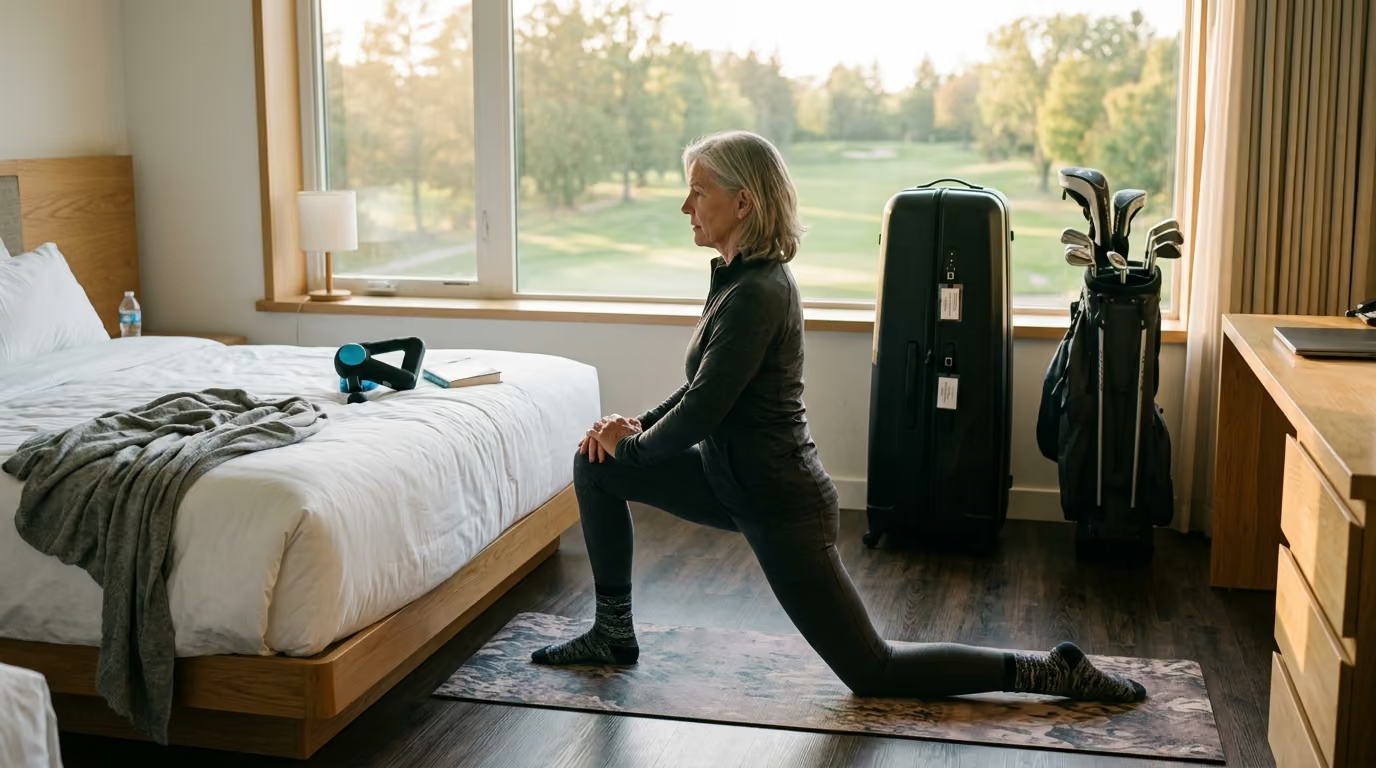

Post-round discomfort feels like normal fatigue to most golfers, but sharp localized pain often signals serious tissue damage requiring immediate rest.




You are standing on the fourteenth tee box during a chilly autumn round. The wind has picked up, and your body is starting to feel the fatigue of a long walk. You pull a mid-iron, address your ball in the semi-rough, and make a aggressive swing. The club catches the ground slightly behind the ball, sending a harsh vibration up the shaft.
Immediately, you feel a dull twinge in your lower back. You walk to the green, wondering if you should finish the round. Is this just the normal tightness that comes with playing eighteen holes? Or did you just cause structural damage to your spine?
Understanding the difference between simple fatigue and a true injury is one of the most important skills a golfer can develop. The saddest thing I have seen in golf is watching lifelong playing partners slowly drop out of our weekend group. It usually starts with a nagging shoulder or knee issue they ignore until it requires surgery. That pattern is exactly why I became obsessed with golf longevity. We do not have to stop playing as we age, provided we do the right maintenance work between rounds.
To keep your body moving well, you need a clear system to judge what your muscles are telling you. Applying the right injury prevention programs can mean the difference between a minor pause and a season-ending injury. This guide will give you the tools to analyze your physical feedback and make smart decisions.
Your body communicates through physical sensations, but it uses different channels for different issues. To manage your physical health, you must understand the difference between muscle adaptation and structural tissue damage.
When you perform unfamiliar movements, your muscles experience microscopic microscopic tears. This condition is known as Delayed Onset Muscle Soreness, or DOMS. It is a natural process that occurs as your body adapts and builds stronger muscle tissue.
DOMS typically begins to develop between twelve and twenty-four hours after your round. The discomfort usually peaks between twenty-four and forty-eight hours. It presents as a dull, broad ache across both sides of the targeted muscle group.
This type of soreness is actually a sign of positive physical development. If you feel a general tightness in your upper back after practicing your swing, your muscles are getting stronger. The discomfort will improve when you start moving, walking, or performing light stretches. It should completely resolve within three to four days without any medical intervention.
An acute injury is entirely different from normal muscle adaptation. It involves actual damage to structural tissues such as ligaments, tendons, joint capsules, or cartilage. These structures do not have the same blood supply as muscles, meaning they take much longer to heal.
Acute injury pain is often felt immediately during a swing or impact. It is typically described as sharp, stabbing, or shooting. Unlike the broad ache of DOMS, injury pain is highly localized to a specific joint or a single side of the body.
Moving the affected joint will usually make the pain worse. Resting does not bring quick relief, and the area may begin to swell or turn red. If you feel a sharp pinch in your lead wrist when hitting out of thick grass, you are likely dealing with tissue damage.
Many golfers view their sport as a low-risk activity. However, data compiled by the British Journal of Sports Medicine shows a different story. Professional golfers have a lifetime injury rate of 73.5%, while amateurs face a 56.6% risk.
For recreational players, the annual risk of injury ranges between 15.8% and 40.9%. These injuries are rarely caused by a single traumatic event. Instead, they are usually the result of repetitive strain on vulnerable areas of the body.
Among amateur golfers, the lower back is the most common site of injury, representing 15.2% to 36.4% of cases. The elbow and forearm follow closely, accounting for 7% to 33% of complaints. Wrist and hand injuries represent 10% to 32%, while the shoulder accounts for 4% to 19% of problems. These figures show why understanding your pain is critical for long-term play.
You do not need an advanced medical degree to perform a basic physical check. You can use a structured assessment to determine if your post-round discomfort requires rest or medical attention.
The first step in your self-assessment is tracking how your body feels twenty-four hours after activity. This timeframe is a critical diagnostic window for golfers.
If you feel stiff after your round, monitor the progression of that tightness. If the discomfort begins to fade within twenty-four hours, your tissues are adapting well. Your joints and muscles are successfully managing the workload of your swing.
If the pain remains intense or worsens after twenty-four hours, your tissues are struggling to recover. This persistent discomfort indicates that the workload exceeded your capacity. You should avoid hitting balls until the discomfort begins to drop.
How you feel when you get out of bed the day after a round is highly revealing. It is common to feel a little stiff when you first stand up. However, the duration of that stiffness is the key detail.
Normal, recovery-related stiffness should resolve within fifteen to thirty minutes of waking. As you move around and drink water, your joints should self-lubricate. Your natural range of motion will return without much effort.
Stiffness that lasts longer than thirty minutes is a warning sign. If you struggle to bend over or turn your head an hour after waking, you have joint inflammation. This level of stiffness suggests you have strained the structural elements of your musculoskeletal system.
Sometimes, a sudden pain occurs during a round. If you experience a sharp sensation during a swing, you need to run a quick three-step check.
First, stop and stand still for sixty seconds. Let your adrenaline settle so you can feel the true state of your body.
Second, gently touch the area to locate the exact point of discomfort. If the pain is limited to a single spot on a bone or tendon, that is a warning sign.
Third, test your range of motion without using a club. Gently turn your torso or rotate your wrist. If you cannot complete these movements without pain, do not continue your round.
Before you return to the course after experiencing pain, you must test your body. Using functional movement screens helps confirm your joints can handle the physical forces of a swing. You can perform these simple tests at home.
The pelvic tilt screen tests your ability to separate your upper body from your lower body. This separation is vital for protecting your lower back during the swing.
Stand in your normal 5-iron posture and cross your arms over your chest. Focus entirely on turning your trail hip forward and backward. Try to arch your lower back, then tuck your pelvis under your spine.
Your upper body should remain completely quiet during this movement. If you feel pain in your lower back while tilting, your spine is not stable. You should not attempt to hit full shots until this test is pain-free.
The toe touch screen measures the flexibility of your hamstrings and the mobility of your lower spine. It helps check if you can maintain a proper posture throughout your swing.
Stand with your feet together and your toes pointing forward. Keep your knees straight but not locked. Slowly bend forward at your hips and reach down to touch your toes.
You should be able to touch your toes without bending your knees or feeling sharp pain. If you feel a sharp pull in your back or buttocks, your posterior chain is restricted. This restriction often leads to early extension during your downswing.
Golf requires significant stability on one leg as you shift your weight. The single-leg balance screen tests your hip stability and ankle strength.
Stand near a wall for safety, but do not touch it. Lift your lead foot off the ground, keeping your weight on your trail leg. Hold this position with your eyes open for ten seconds, then try it with your eyes closed.
Repeat the test on the opposite leg. If you wobble excessively or feel pain in your hip joint, your stabilizers are weak. Improving this stability is a core part of improving your rotational mobility for a safer swing.
Before you swing a club, you must confirm your body can hold key golf positions under tension. The static hold test checks your joints at four critical points in the swing.
Assume your setup position and hold it for ten seconds. Next, rotate to the top of your backswing and hold that position. Transition to your impact position, then finish in your full follow-through posture.
[Setup Position] ---> [Top of Backswing] ---> [Impact Position] ---> [Follow-Through]
Hold 10s Hold 10s Hold 10s Hold 10s
Focus entirely on holding each position without any shaking or discomfort. If you can hold all four positions pain-free, your joints can handle static loads. You are now ready to progress to dynamic movements.
If you are recovering from an injury, you should not jump straight back into playing eighteen holes. You need a structured, gradual return to avoid re-injury. The following steps are based on established clinical rehabilitation protocols.
The foundation of your return is the ability to complete daily activities without discomfort. You must be able to perform household tasks without pain.
Walking, bending, lifting light objects, and driving your car must be completely pain-free. You must also pass your basic physical screens, including the toe touch and single-leg balance.
If you still feel a dull ache during normal daily life, your tissues are not fully healed. Do not pick up a golf club yet. Give your body more time to rest and rebuild.
Once daily life is comfortable, you can begin practicing short, controlled movements. Start with your putting and chipping setup.
Spend ten minutes practicing your putting stroke on a carpet or green. Focus entirely on keeping your spine stable and your head still. Next, practice short chips using a high-lofted wedge.
Keep your swings short and smooth, focusing on clean contact. If you can complete this session without pain, monitor your body the next morning. If you feel no residual soreness, you can move to the next step.
Now you can introduce moderate rotational forces to your body. Take a short iron, such as a 9-iron or pitching wedge, to the driving range.
Begin with slow, half-effort swings. Focus entirely on keeping your balance and making clean contact with the ball. Do not try to hit the ball hard or create maximum speed.
Limit your first session to twenty shots, taking a thirty-second break between each swing. If you experience any pain, stop immediately. If you remain comfortable, wait twenty-four hours before progressing.
If your short iron session went well, you can gradually increase your swing speed and club length. Start with your mid-irons, then progress to your hybrids and fairway woods.
Begin your session with five easy swings using your pitching wedge. Once your muscles are warm, hit ten moderate shots with a 7-iron. Finally, take five smooth swings with your driver.
Avoid hitting out of heavy rough or off hard synthetic mats during this phase. Synthetic mats transfer a high level of shock to your wrists and elbows. Stick to natural grass tee boxes and fairways as you rebuild your strength.
Many golfers make mistakes when assessing their own physical condition. Recognizing these common errors will help you avoid making a minor strain worse.
One of the most dangerous myths in golf is that pain is fine if it disappears during your warm-up. You might feel a sharp ache in your shoulder on the first tee, but find it fades by the fourth hole.
This reduction in pain is not a sign of healing. Instead, it is the result of increased blood flow, tissue temperature, and natural adrenaline. The movement temporarily desensitizes your nervous system to the pain.
The real test occurs during the cool-down phase after your round. If the pain returns once your body temperature drops, you are dealing with an overuse injury. Continuing to play through this pattern will cause long-term tissue damage.
Golfers often confuse muscle strains with nerve irritation, especially in the forearm and elbow. A classic example is the difference between Golfer's Elbow and Ulnar Nerve Entrapment.
Golfer's Elbow, or medial epicondylitis, causes localized pain at the inner bump of your elbow. The pain usually gets worse when you squeeze a grip or bend your wrist downward. It is a tendon issue that responds well to rest and gentle stretching.
Ulnar Nerve Entrapment feels very different but occurs in the same area. It causes "pins and needles," numbness in your ring and pinky fingers, and weakness in your hand. Up to 60% of players with Golfer's Elbow also experience some ulnar nerve involvement.
Golfer's Elbow (Tendon) ---> Localized inner elbow pain, worse with gripping.
Ulnar Nerve (Nerve) ---> Numbness, tingling in ring/pinky fingers, hand weakness.
If you feel tingling or numbness, do not stretch your arm aggressively. Nerve tissue is highly sensitive to stretching when irritated. You should seek guidance from a medical expert to address nerve-related issues.
Sometimes, the location of your pain is not where the actual injury is located. This issue is known as referral pain, and it is common in the back and shoulders.
For example, a herniated disc in your neck can cause sharp pain in your shoulder blade. You might spend weeks stretching your shoulder without finding relief because the source is in your neck. Similarly, a lower back issue can cause a deep ache in your hip or buttock.
If your pain travels down your arm or leg, you are likely experiencing referral pain. This radiating sensation indicates that a nerve is compressed or irritated. Do not try to massage or stretch the area of the pain; instead, consult a specialist to find the root cause.
Your golf equipment has a direct impact on the physical stress placed on your body. Modifying your gear is an excellent way to support your physical longevity.
The stiffness of your golf shafts determines how much vibration travels into your hands, wrists, and elbows. If your shafts are too stiff, your joints must absorb the excess energy of every impact.
Switching from steel to graphite shafts can significantly reduce this joint shock. Graphite absorbs vibrations much better than steel, which helps protect your joints. Mature golfers often find that moving to a regular or senior flex shaft reduces post-round elbow pain.
You should also ensure your clubs are the correct length. If your clubs are too short, you will have to bend too far forward at your waist. This posture increases the shear stress on your lower back during your swing.
Your grip size affects how hard you must squeeze the club to maintain control. If your grips are too small, your fingers will wrap too far around the handle. This thin grip forces your forearm muscles to work incredibly hard to prevent the club from slipping.
Installing midsize or oversized grips can help reduce this tension. A thicker grip allows your hands and forearms to remain relaxed throughout your swing. This simple change can quickly ease the strain of Golfer's Elbow.
Thin Grips ---> Excessive finger wrap ---> High forearm tension ---> Elbow strain
Thick Grips ---> Relaxed finger wrap ---> Low forearm tension ---> Elbow relief
You should also check the material of your grips. Soft, tacky grips require less squeezing power than hard, worn-out grips. Replace your grips once a year to keep your hands and arms relaxed.
The shoes you wear play a major role in how your lower body rotates during your swing. Traditional shoes with long, heavy spikes lock your feet securely into the turf.
While this traction provides stability, it also prevents your feet from rotating slightly during your follow-through. This lack of foot movement transfers the rotational forces directly to your knees and lower back.
Using spikeless shoes or shoes with shorter, flexible traction can help protect your joints. These shoes allow your lead foot to spin slightly as you clear your hips. This small release reduces the rotational strain on your knees and lower spine.
Establishing healthy post-round recovery habits will also help your body adapt to these rotational stresses.
You should return to this resource whenever you feel a new physical sensation during or after a round. It is also wise to review these screens at the start of every season to measure your physical readiness. Keep this framework handy if you are changing your equipment or modifying your swing mechanics.
By keeping this guide nearby, you can protect your joints and extend your playing years.
Before your next round, remember that muscle soreness is a sign of your body building strength, but joint pain is a clear warning to stop and protect your swing.
Follow Golfergy for practical insights on performance, mobility, recovery and healthy ageing. Stay connected for new articles, research-led guidance and ideas to help you play better for longer.


Explore practical resources on performance, recovery, mobility and golf longevity.
Read the Blog