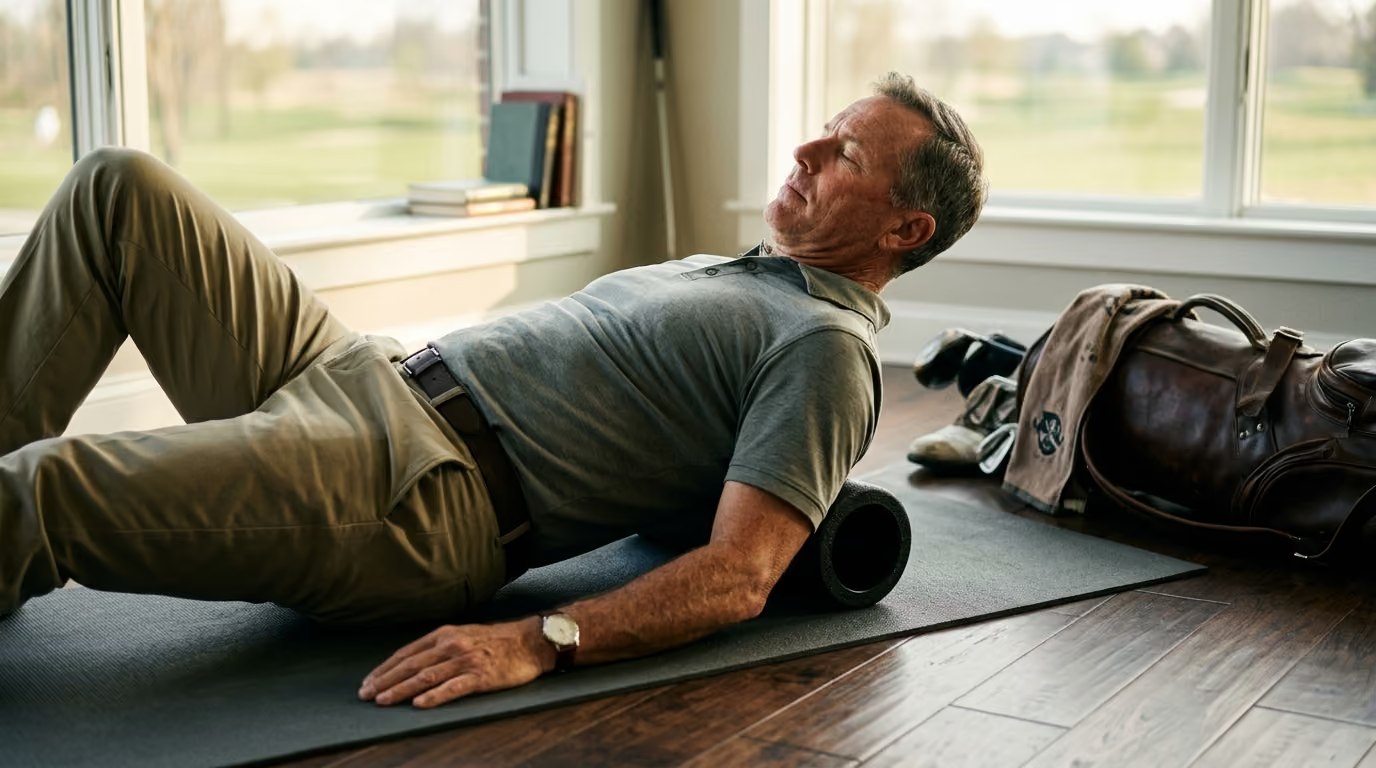

Myofascial release restores full rotational mobility and relieves lower back tightness so golfers can maintain smooth swing mechanics through eighteen holes.




You have played nine solid holes of golf. You walk off the ninth green feeling good and ready for the back nine. But as you stand on the tenth tee, your lower back feels tight. Your practice swing feels restricted.
You try to turn your shoulders but your body resists. You feel like you have lost several inches of your turn. You swing anyway. The ball slices right into the rough because your hips could not clear in time.
This is a common issue for golfers over forty. The body stiffens up after walking the hills or sitting in a golf cart. You did not lose your swing technique in the last two hours. Your soft tissues simply tightened up and locked your joints in place.
Understanding how to manage this tightness can save your round. It can also save your joints from wear and tear. Let us look at why this happens and how you can fix it.
To keep your body moving well, you must understand fascia. Fascia is a continuous web of connective tissue. It wraps around your muscles, your bones, and your organs.
Think of fascia like a tight plastic wrap. When it is healthy, it is wet and slippery. Your muscles slide past each other without any friction. You can turn your shoulders fully and create a smooth swing.
As we age, this tissue can become dry and thick. We call this densification. When fascia becomes dense, it acts like glue. It sticks your muscles together.
This creates swing leaks. A swing leak is where you lose power because your joints cannot move through their full range. Your muscles must work twice as hard to move the club. This leads to early fatigue on the back nine.
To fix this, we look at the body through a special lens. Physical therapists call this the joint-by-joint framework. This concept states that the body is a stack of joints. Each joint has a specific job to do.
Some joints need to be highly mobile. Other joints need to be stable. They alternate all the way up your body.
Your ankles must be mobile to transfer your weight. Your knees must be stable to support that force. Your hips must be highly mobile to turn during the swing.
Your lower back must be stable to protect your spinal cord. Your upper back must be mobile to turn your shoulders. Finally, your shoulder blades must be stable.
When a mobile joint gets tight, your body does not stop swinging. It simply forces the stable joint above or below to do the extra work. If your hips are tight, your lower back must twist to complete the swing. Your lower back is not built to twist.
This extra twisting leads to lower back pain. By releasing the fascia in your hips, you protect your lower back. This is a core rule of long term injury prevention for mature players.
This tissue management is vital for the golf swing kinetic chain. The swing relies on the X-Factor. The X-Factor is the difference between your shoulder turn and your hip turn.
To get a big X-Factor, you need flexible lat muscles. You need a loose upper back. You also need mobile hips.
Using self-myofascial release can help you get this movement back. It uses pressure to break up the sticky spots in your tissue. This makes your muscles pliable.
You can think of it as a tune-up for your internal infrastructure. It prepares your body for the physical demands of the game.
When you feel tight on the course, you need a quick fix. You cannot carry a large foam roller in your golf bag. But you always have a small, hard ball with you.
You can use a standard golf ball to release your feet. This is a simple trick that works because of fascial lines. The bottom of your foot is home to the plantar fascia.
This tissue connects to your calves. Your calves connect to your hamstrings. Your hamstrings connect to your glutes and your lower back.
A tight foot can cause a tight lower back. Slipping your shoe off for a moment can help you release this entire chain.
First, place a golf ball on a flat spot on the cart path or the grass. If you can, take your shoe off to get direct contact. If you cannot, you can do this through a thin-soled shoe.
Second, step onto the ball with the arch of your foot. Apply moderate pressure. Do not press so hard that you gasp for air.
Third, roll the ball slowly from your heel to the ball of your foot. Move at a speed of one inch per second. When you find a tender spot, stop moving.
Fourth, focus entirely on curling your toes over the ball. Hold this pressure for thirty seconds while breathing deeply. Repeat this process on both feet.
You will feel an instant change in your hamstrings. Your hips will feel looser as you walk to your next shot. This simple action can restore your hip turn on the back nine.
To make lasting changes to your tissue, you need a daily routine. A quick roll before a round is good for a warm-up. But real tissue change takes time and daily effort.
Research shows that consistent soft tissue work for four weeks creates lasting joint flexibility. This is the key to maintaining your joint mobility as you age.
We will focus on three key areas. These areas are the upper back, the glutes, and the side muscles of your torso. You will need a foam roller and a lacrosse ball.
Place your foam roller on the floor. Lie down on your back. Position the roller under your shoulder blades.
Cross your arms over your chest. This movement pulls your shoulder blades apart. It exposes the muscles underneath them.
Lift your hips slightly off the floor. Keep your knees bent and your feet flat. Use your legs to roll your body up and down.
Only roll from the middle of your back to the top of your shoulders. Do not roll onto your neck. Do not roll onto your lower back.
Move slowly. When you find a tight spot, stop. Lower your hips to the floor.
Gently arch your upper back backward over the roller. Keep your ribs tucked down. Focus entirely on bending your upper spine.
Do this three times on that spot. Then move to another spot. Spend two minutes on this area.
Sit on the floor with your knees bent. Place a lacrosse ball under your right hip. Specifically, place it on the side of your hip, just below your pelvic bone.
Tilt your body to the right. Put your right hand on the floor behind you for support. Cross your right ankle over your left knee.
This open position exposes the deep hip rotators. These muscles get tight from sitting and walking. They can cause your hips to sway during your swing.
Slowly roll your hip over the ball. Search for areas that feel tender. When you find one, stop moving.
Take a deep breath in through your nose. Exhale slowly through your mouth. Let your hip sink into the ball.
Hold this for thirty seconds. Then uncross your leg and roll to another spot. Spend ninety seconds on each hip.
The lat muscles run from your armpit to your lower back. If they are tight, they stop you from raising your arms fully. This cuts your backswing short.
Lie on your side on the floor. Place the foam roller under your armpit. Extend your bottom arm straight out above your head.
Keep your palm facing up. This rotates your shoulder into a safe position. Roll slowly down your side.
Stop when the roller is a few inches below your armpit. This is a common knot location.
Apply pressure and hold. Now, slowly rotate your chest toward the ceiling. Then rotate your chest back toward the floor.
This creates a cross-fiber massage. It pulls the muscle tissue in a different direction. Spend one minute on each side of your body.
There are many tools on the market today. You do not need to buy all of them. You only need a few simple tools to keep your muscles healthy.
The most common tool is the foam roller. It is best for global tissue work. It covers large areas of your body quickly.
When buying a foam roller, look for high-density foam. Soft rollers will bend and lose their shape. Dense rollers hold their shape and apply better pressure.
You can also get a grid roller. These have ridges that mimic a massage therapist's hands. They are excellent for the upper back and thighs.
For smaller areas, you need a lacrosse ball. A lacrosse ball is firm and does not compress. It can reach deep into the glutes and shoulders.
You can also make a peanut tool. Take two lacrosse balls. Wrap them together tightly with athletic tape.
This creates a groove in the middle. The groove protects your spine while the balls press on the muscles on either side. It is the perfect tool for your upper back.
Another popular tool is the massage gun. These guns use rapid tapping to relax your muscles. They are great for a quick warm-up.
The vibration increases blood flow. It also tricks your nervous system into relaxing. It is a useful addition to your pre-round routine.
Many golfers use these tools incorrectly. They make mistakes that can actually cause more tightness. Here are three common errors you should avoid.
The biggest mistake is rolling your lower back with a foam roller. Your lower back consists of five lumbar vertebrae. These bones do not have the protection of the rib cage.
When you place a roller under your lower back, your muscles contract. They do this to protect your spine. This contraction makes your back tighter than before.
It can also squeeze your spinal discs. This can cause pain or injury. Always stop your foam rolling at the bottom of your rib cage.
To relax your lower back, roll your glutes and your upper back instead. Loosening these areas will take the pressure off your lower spine.
The second mistake is the belief that more pain equals more gain. Some golfers press down as hard as they can. They grimace and hold their breath.
This is counterproductive. Your body views extreme pain as a threat. It activates your sympathetic nervous system.
This is your fight or flight response. It causes your muscles to tense up. You cannot release a muscle that is actively fighting you.
Only use moderate pressure. You should be able to breathe easily through your nose. If you have to hold your breath, the pressure is too high.
Back off until you can relax. This will allow your brain to signal the muscle to let go.
The third mistake is rolling back and forth too quickly. Many golfers look like they are rolling out pizza dough. They slide up and down the roller rapidly.
This does not change your tissue. It only warms up the skin. To change fascia, you must apply slow, steady pressure.
Move at a pace of one inch per second. When you find a spot, stay there. You must hold pressure for at least thirty seconds for the tissue to release.
Combine this hold with active movement. For example, if you are rolling your calf, flex your foot up and down. This creates shear force.
It helps separate the sticky layers of fascia. It is much more effective than fast rolling.
Your equipment has a direct impact on your muscles. It can cause chronic tightness if it is not a good fit for your body. Let us examine how your gear affects your soft tissues.
Golfers walk several miles during a standard round. Your feet absorb all the force of your steps. They also hold you stable during your swing.
If your golf shoes are too narrow, they squeeze your feet. This locks up the small bones in your feet. It prevents your arch from moving naturally.
This leads to tight calf muscles. It can also cause heel pain. Look for shoes with a wide toe box.
This allows your toes to spread out. It helps your feet absorb shock. It also gives you a more stable base for your swing.
Make sure the sole has some flexibility. A stiff sole forces your lower leg muscles to work too hard. This leads to early fatigue.
Your hands are your only connection to the club. If your grips are too small, you must squeeze the club tightly. This constant squeezing tightens your forearms.
The tension travels up your arm. It can make your elbows and shoulders stiff. This limits your backswing control.
Consider using larger grips. Midsize or jumbo grips can reduce your grip pressure. This allows your forearms to stay relaxed.
You can swing with less effort. It also reduces the strain on your elbow joints. This is a simple change that can protect your arms.
Carrying your golf bag can create muscle imbalances. If you use a single strap, you carry all the weight on one shoulder. This forces your neck and back muscles to contract on one side.
Over time, this makes one shoulder lower than the other. It ruins your posture and your swing path. If you like to walk, use a push cart.
A push cart keeps your spine neutral. It saves your energy for your shots. If you must carry your bag, use a high quality double strap.
Adjust the straps so the bag sits evenly on your back. This distributes the weight across both shoulders. It keeps your posture aligned.
Many studies support the use of soft tissue work. Research shows that foam rolling has a large positive effect on joint range of motion. It increases flexibility without reducing muscle power.
This is a major benefit. Traditional static stretching can sometimes reduce your muscle strength temporarily. SMR does not have this negative effect.
It makes it the perfect tool for your warm-up. You can get loose without losing your swing speed.
SMR also helps with recovery. After a long round, your muscles can feel sore. This is called delayed onset muscle soreness.
Using a foam roller after your round can reduce this soreness. It helps flush out metabolic waste. It also brings fresh blood to your muscles.
This speeds up your muscular recovery. You can play consecutive rounds without feeling run down. It is a vital tool for multi-day tournaments.
Long term studies also show benefits. A consistent program improves scores on movement screens. These screens measure your overall movement quality.
Golfers who use SMR regularly show better shoulder and leg mobility. They also report less lower back pain. Their swings become more consistent.
This shows that soft tissue work is not just a temporary fix. It is a way to build a more resilient body. It helps you maintain your physical strength as you age.
You should review this guide regularly to keep your routine on track. Revisit these instructions when you start to feel a loss of shoulder turn. Read it again if your lower back begins to ache after eighteen holes.
It is also good to review these steps as you transition into winter training. Use it to prepare your body for a spring golf trip.
To help you get started with your long term fitness planning, you can look at the Golfergy performance resources page. You can also read more about healthy physical habits on the Golfergy performance and recovery homepage.
If you have questions about how to apply these techniques to your specific swing, you can reach out on our Golfergy contact page. Keeping your soft tissues healthy is a continuous process that pays off with every round you play.
Before you step onto the tee for your next round, remember that mobile hips and a loose upper back are the true keys to a powerful, pain-free golf swing.
Follow Golfergy for practical insights on performance, mobility, recovery and healthy ageing. Stay connected for new articles, research-led guidance and ideas to help you play better for longer.


Explore practical resources on performance, recovery, mobility and golf longevity.
Read the Blog